
What to Expect From This Guide to Starting a Crawl Space Encapsulation Business
This guide walks you through the key decisions and practical steps involved in starting a crawl space encapsulation business, from evaluating personal fit through licensing, equipment, and opening preparation.
The highlights below point to selected areas of value, not everything the guide includes.
Inside the guide, you will find:
- Startup steps: Follow a numbered progression from evaluating personal fit through licensing, equipment, pricing, and opening-day preparation.
- Business fit: Consider the physical demands, income uncertainty, and lifestyle tradeoffs of running a field-based, project-based trade.
- Market demand: Learn how local housing age, climate, and competition affect whether this business makes sense in your area.
- Financial planning: Work through pricing methods, operating capital needs, and profit logic before committing to major spending.
- Legal requirements: Review licensing, certification, insurance, and permitting matters that vary by state and by scope of work.
- Risks and warnings: See red flags to weigh before starting, along with checks to confirm before taking on your first job.
- Common questions: Find a concise answer to a practical question about equipment purchasing decisions.
The sections that follow walk through what it actually takes to move from that first evaluation to a working crawl space encapsulation business.
Starting a Crawl Space Encapsulation Business
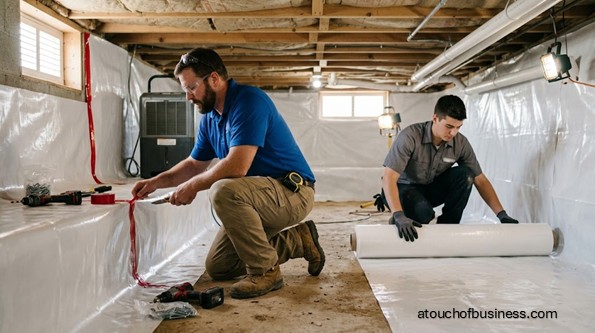
Crawl space encapsulation contractors seal off the space beneath a home from moisture, humid air, and pests.
You install a vapor barrier across the floor and walls.
From there, you often add drainage, a sump pump, or a dehumidifier to control humidity.
This is a field-based, project-based trade—there’s no storefront.
You travel to each home to inspect the crawl space and quote the job.
Then you complete the install, sometimes over more than one visit.
Demand tends to run highest where homes sit on crawl space foundations rather than slabs.
It also runs higher where humidity or a high water table make moisture a recurring problem.
Before you follow the standard steps for starting a business, it helps to think through whether this specific trade fits your life.
Crawling and kneeling in tight spaces for hours, sometimes in heat or damp cold, is physically demanding work.
Be honest about whether you can sustain that personally, especially in your first year or two.
This is also a quote-to-close business. You’ll spend time on in-home evaluations and written estimates before a signed job ever hits your schedule.
Can your household absorb uneven income while you build a customer base? Do you have support at home if the first few months run lean?
Think through your risk tolerance too. Structural and moisture-related work carries liability exposure, and a slow month doesn’t pause your vehicle payment or insurance bill.
Local demand matters as much as personal fit.
Are there enough older or crawl-space-foundation homes nearby?
How many competitors—local or national—already serve that demand?
You’ll also need a plan for reaching your first customers and explaining why they should hire you instead of a competitor.
Step 5 below walks through realistic channels for this trade.
Red Flags Before You Start
Some markets simply don’t support this trade—homes built on slabs or a dry regional climate mean less structural demand for encapsulation.
Check your local housing stock and climate before committing significant capital to equipment or a vehicle.
National dealer networks and franchise brands already operate in this space in many regions.
Their marketing budgets can be hard for an independent start to match.
Compare your target market’s competition level honestly, or consider whether a dealer network or franchise path might offset that disadvantage for you.
The licensing path in this trade is more fragmented than typical home improvement work.
You may be dealing with a general contractor license, lead-paint certification, and possibly radon or pest-control licensing—all separately.
Underestimating this compliance runway is a common reason new operators delay their first paid job longer than planned.
The work itself is physically demanding, and once you have employees, confined-space safety practices commonly call for a second person on-site during entries.
If you can’t sustain the labor personally, you may need to staff up sooner than your revenue would otherwise support.
Many home inspectors are restricted by state law or professional ethics rules from profiting off repairs on homes they inspected.
Referral-fee arrangements with inspectors or agents are limited in some states, too.
If your customer-attraction plan leans heavily on paid inspector or agent referrals, verify that first.
Confirm the arrangement is legal in your state before you build your marketing around it.
Installing a vapor barrier without first addressing a bulk-water or drainage problem is a documented cause of system failure and callback liability in this trade.
Sequencing matters here: fix drainage first, then encapsulate.
On the industry level, this trade sits at the intersection of several separately regulated fields.
General contracting, radon mitigation, and structural pest control all play a role.
That fragmentation is a structural fact of the industry, not a sign you’re doing something wrong.
It does mean ongoing compliance attention is part of running this business.
Step 1: Talk to Owners Who Won’t Compete With You
Before you spend on equipment or licensing, talk to people already doing similar work—just not in your service area.
Useful conversations include septic and excavation contractors, HVAC contractors, radon mitigation specialists, and home-performance contractors.
They understand confined-space work and permitting friction without competing for your customers.
Prepare specific questions before these conversations.
Ask what surprised them when they started, how they price jobs, and what compliance issues caught them off guard.
Every owner’s path is different, but firsthand experience is still one of the most useful things you can gather before committing.
Advice from real business owners can save you from repeating avoidable mistakes.
Step 2: Decide How You Want to Enter the Trade
You have real options here beyond starting completely from nothing.
- Start independently, building your own brand, pricing, and supplier relationships from the ground up.
- Buy an existing crawl space or basement-systems business with an established customer base.
- Join a franchise system or a multi-location dealer network that provides training, branding, and sometimes territory exclusivity.
Each path trades cost, support, and control differently.
Weigh them against your budget, timeline, and how much structure you want from day one. Starting from scratch or buying a business covers this decision in more depth.
If you’re leaning toward a franchise or dealer network, request the franchise disclosure document or dealer agreement.
Compare training, territory terms, and ongoing fees before you sign anything.
If you’re planning to go fully independent, expect to build your own supplier accounts, pricing method, and brand recognition without outside support.
That takes longer but keeps more control in your hands.
Step 3: Choose Your Service Scope and Business Model
Decide how narrow or broad your service list will be before you build out pricing or buy equipment.
You can specialize narrowly in encapsulation—vapor barrier, sealing, and basic dehumidification.
Or you can bundle in adjacent services like waterproofing, insulation, minor structural repair, radon-vent installation, or pest exclusion.
Also decide who handles specialty work such as electrical circuits, HVAC tie-ins, radon systems, or wood-destroying-organism treatment.
Your own licensed staff can take it on, or you can subcontract it to a licensed partner.
If you’re planning to stay narrow and specialize only in encapsulation, your licensing path stays simpler.
You’ll still need referral relationships for anything outside your scope.
If you’re planning to bundle in waterproofing, insulation, or radon work, expect a longer pre-opening compliance runway.
Each added service can carry its own licensing requirement.
Step 4: Check Local Demand and Competition
Not every market supports this trade equally, so verify demand before committing.
Research the age and foundation type of homes in your target area.
Crawl-space foundations, older housing stock, and humid or high-water-table conditions all point toward stronger demand.
Separately, map existing competitors—independent local contractors, dealer-network operators, and franchise locations already serving the area.
A market with strong demand but heavy competition isn’t automatically a bad fit, but it does affect how quickly you can build a customer base.
Step 5: Map Out How You’ll Attract Your First Customers
Think through who your first realistic customers are and how they’ll find you.
- Homeowners who notice musty odors, high humidity, or visible moisture and search for help directly.
- Home inspectors who flag crawl space issues during a sale—though many are legally restricted from profiting off referred repair work.
- Real estate agents preparing a home for listing or negotiating repairs after an inspection.
- HVAC and mold-remediation companies that don’t have an in-house encapsulation crew.
If you plan to build referral relationships with inspectors or agents, check your state’s rules on referral fees first.
Some states restrict or prohibit paying inspectors or agents for repair referrals.
Focus on explaining, in plain terms, what problem you solve—moisture, mold risk, energy loss, or pest activity.
Then explain why that matters to the specific customer in front of you.
Step 6: Choose a Business Structure and Register Your Company
Given the liability exposure in structural and moisture-related work, compare your business structure options carefully.
An LLC is common in this trade because it separates personal assets from business liability.
Talk to a professional if your situation isn’t clear-cut. Choosing a business structure walks through the tradeoffs.
Once you’ve chosen a structure, register your business with your state.
File a DBA if you’re operating under a different name, and apply for a federal tax ID.
Most suppliers, banks, and insurers will ask for that federal tax ID even if you’re a solo operator.
Get it done before your first job.
Step 7: Handle Contractor Licensing and Specialty Certifications
Licensing for this trade varies by U.S. jurisdiction more than you might expect.
Some states require a general or specialty contractor license for any paid moisture-control work.
Others only require it above a certain project value, and some only license the electrical or mechanical portions separately.
Check with your state’s contractor licensing board directly—don’t assume your state handles this the same way a neighboring state does.
Two federal and specialty certifications commonly apply to this trade specifically:
- Any paid work disturbing painted surfaces in a pre-1978 home requires EPA lead-safe firm certification, including a certified renovator on staff.
- Radon-vent installation and structural pest-control work—such as identifying or treating wood-destroying organisms—often require separate state licensing beyond a general contractor license.
If you’re planning to work mostly in older housing stock, budget time upfront for EPA lead-safe certification.
It’s a federal requirement that applies no matter which state you’re in.
If you’re planning to work mostly in newer construction, that specific certification may rarely come into play.
Still, confirm the actual age mix of homes in your service area before assuming either way.
Step 8: Register for Taxes and Set Up Business Banking
Determine whether your state taxes materials, labor, or both for this type of work.
Register with your state’s revenue department accordingly.
Open a dedicated business bank account before you take a deposit from your first customer.
If you plan to accept card payments or offer financing, set up a merchant account at the same time.
That way, payment processing isn’t a bottleneck later.
Step 9: Get Insured and Build a Safety Program
Confirm what insurance your state ties directly to contractor licensing—commonly general liability coverage and sometimes a surety bond.
Beyond what’s legally required, evaluate commercial auto coverage, tool and equipment coverage, and pollution or mold-specific liability coverage.
Some insurers offer this given the nature of the work. Business insurance explains the difference between required and optional coverage.
Workers’ compensation becomes required in most states once you hire your first employee—confirm your state’s threshold before that hire happens.
Crawl spaces can meet the federal definition of a confined space.
Once you have employees, you’re responsible for evaluating each site and following entry and safety procedures under federal construction rules.
If you’re planning to work solo at the start, this obligation doesn’t fully apply yet.
Still, build basic hazard-awareness habits, since they’ll matter the moment you bring on help.
If you’re planning to bring on help soon, build your confined-space entry and rescue procedure before that person’s first day, not after.
Step 10: Set Up Your Workspace and Vehicle
Even though this is field-based work, you still need a base of operations.
Confirm whether your local zoning allows a home-based office, and whether storing bulk materials or a company vehicle at your home runs into home-occupation limits.
Vapor barrier rolls, dehumidifiers, and sump pump inventory are bulky.
Decide between home storage, a small rented unit, or ordering materials closer to each job.
If you’re starting with a personal pickup truck, plan for a trailer or roof rack to haul rolled material.
Standard truck beds fill up fast with full-size rolls.
If you’re starting with a dedicated cargo van, you’ll have more secure, weatherproof storage on the road.
It usually costs more upfront than a used pickup, though.
Step 11: Build Supplier Accounts and Buy Your Equipment
Set up contractor-pricing accounts with vapor barrier manufacturers, dehumidifier and sump pump suppliers, and insulation suppliers.
Do this before you need materials for a scheduled job.
Compare distributor pricing against general retail, since contractor accounts often bring better material costs at volume.
Your core equipment list includes:
- Reinforced vapor barrier, seam tape, and fasteners for sealing the floor and walls.
- A dehumidifier sized to the space, plus a sump pump and drainage materials where groundwater is present.
- Insulation materials if your scope includes conditioning the crawl space.
- A sealed access door and vent covers if you’re converting a vented space to a conditioned one.
- Personal protective equipment, including respirators, knee protection, and a gas or oxygen monitor for confined-space testing when conditions call for it.
Decide new versus used for major items like your vehicle and dehumidifiers.
Base that call on your available funds and how much you can verify about a used unit’s condition.
Step 12: Plan Your Operating Capital and Funding
Running out of operating capital is one of the most common reasons new service businesses close, so plan beyond your initial equipment list.
Because this trade runs on a sales cycle—estimate visit, decision time, then a signed job—plan enough operating capital accordingly.
That means covering your vehicle, insurance, and supplier costs through slower stretches.
Don’t rely on next month’s deposits to cover this month’s bills. That’s a fragile position for any project-based business.
Compare funding sources before you commit to major equipment or a vehicle purchase.
Personal savings, a small-business loan, and equipment financing are the most common options for this trade.
Step 13: Set Your Pricing Method
Build your pricing approach before your first estimate visit, not during it.
Most operators price by square footage of crawl space, adjusted for crawl height and access difficulty.
The specification chosen—vapor barrier thickness, drainage, and dehumidifier size—all move the price too.
Startup costs may include:
- Vehicle, tools, and initial material inventory.
- Licensing, certification, and permit fees.
- Insurance premiums and any required bonding.
- Estimating and invoicing software.
The most accurate estimate comes from listing everything you need and pricing it out locally, not from a generic number pulled from another market.
Pricing your products and services covers common pricing methods in more depth.
Step 14: Set Up Your Business Identity and Paperwork
Customers need to find you and trust you before they’ll sign a contract for work under their home.
Register a business name, secure a matching domain and business email, and set up basic signage for your vehicle.
Do this before you start marketing.
Build your standard paperwork ahead of time too: a written estimate and contract template, a scope-of-work document, and warranty terms.
If you’ll be working in homes built before 1978, stock the EPA lead-safe pamphlet you’re required to hand the homeowner before work begins.
Step 15: Confirm Permits, Staffing and Pre-Opening Steps
Not every job needs a permit, but some do—confirm the pattern before you start quoting.
Jobs that add a dehumidifier circuit, a radon fan, or an HVAC tie-in commonly trigger an electrical or mechanical permit.
That’s true even in areas where a plain vapor-barrier install doesn’t need one.
Check with your local building department so permit-pulling becomes a normal part of your workflow, not a surprise mid-job.
Decide on staffing before your first paid job, not after.
Solo work has real limits in this trade, so don’t leave the decision until you’re already booked solid.
Run through this final check before you advertise or accept your first paid lead:
- Licensing, certifications, and insurance are active and confirmed in writing.
- Your vehicle is loaded with a standard tool and material kit.
- Your estimate, contract, and warranty templates are ready to send.
- You’ve completed at least one test or supervised installation if you’re new to the trade.
Business Plan
Pull the previous steps together into a working plan you can actually follow, not just a document you write once and set aside.
Your plan should cover service scope, target customer types, and staffing approach.
It should also cover equipment and supplier decisions, plus how you’ll fund the months before steady income arrives.
Profit potential deserves real attention here. This trade tends to run on a moderate number of higher-value jobs rather than high-volume, low-ticket sales.
That means a relatively small number of completed jobs each month can cover your fixed costs.
Still, each job carries a real sales cycle between the estimate visit and a signed contract.
Material costs swing with your choices too. Vapor barrier thickness, drainage complexity, and dehumidifier specification all affect your margin on a given job.
Work out how many completed jobs per month you need, using your own local costs and pricing.
That number should cover your vehicle, insurance, and any staff costs.
Then compare that number honestly against what your local market can realistically support, based on the demand research from Step 4.
Estimating profitability and revenue can help you work through this calculation with your own numbers.
Also plan for seasonal and referral-driven swings in demand—real estate listing seasons and weather events both tend to shift when customers call.
Opening-Day Red Flags
Before your first paid job, double-check a few things that are easy to overlook in the rush to start booking work.
Confirm every license, certification, and insurance policy is active—not just applied for.
Operating with paperwork still pending is a common compliance mistake for new operators.
Verify your permit-pulling process with your local building department for any job involving electrical or mechanical work, so you’re not caught mid-install without one.
Check that your confined-space safety procedure is actually in place if you have any employees, not just planned for later.
Make sure your drainage assessment is a required step before every vapor-barrier install, not an optional add-on.
Skipping it is what creates the callback risk covered in the red flags above.
Finally, confirm your supplier accounts are active and your material inventory matches what your first scheduled jobs actually require.
Interviews with Crawl Space Encapsulation Business Professionals
These interviews bring together crawl space company owners, franchise operators, service-business leaders, and industry professionals discussing business ownership, customer problems, encapsulation, moisture control, and service delivery.
Readers can use their experiences to better understand the technical work, customer expectations, business systems, and ownership decisions involved before entering this field.
Crawlspace Medic on Franchising in Home Improvement and Home Repair
Jon Dando, co-founder and president of Crawlspace Medic, joins a discussion about franchising, the crawl space and basement repair niche, and the role crawl spaces play within the home repair industry.
The conversation is useful for someone considering this business because it provides a view of the industry from a company that developed a franchise model around crawl space and basement services.
Serving Others: An Interview with Jeff Anderson
Jeff Anderson discusses becoming an owner and operating partner of a Crawlspace Medic franchise in Chattanooga, starting the location, adjusting to business ownership, working with employees, and learning from business partners and other owners.
His experience is useful for readers weighing the transition into ownership because he discusses why he chose a franchise, the pressures he encountered, and the value he found in mentors, networking, and support from other business owners.
Tailgate: Larry Janesky, Entrepreneur
Larry Janesky explains how he moved from carpentry into waterproofing and crawl space repair, developed products, built dealer networks, trained contractors, and created systems for sales, marketing, customer service, and business management.
The interview is useful for someone entering the industry because it shows how technical services, training, business processes, employee quality, and customer service can work together as a company grows.
Crawl Space Encapsulation: A Chat With Jay Eastland
Jay Eastland, owner of Engineered Solutions of Georgia, discusses crawl space encapsulation, moisture problems, dehumidification, professional liner installation, vent sealing, and questions homeowners should consider when evaluating contractors.
The interview is useful for understanding the type of technical knowledge and customer education an encapsulation company may need to provide when inspecting problems and recommending solutions.
Chuck Worley: Outwork Everybody, Part 1
Chuck Worley, owner and founder of Worley’s Home Services, discusses his experience building a home service company that includes crawl space encapsulation along with HVAC, plumbing, electrical, and insulation services.
Topics include sales, leadership, business setbacks, marketing, branding, systems, and growth.
The interview is useful for someone considering a crawl space service business because it provides practical perspective on building a home service company, developing leadership, recovering from setbacks, and creating systems for growth.
Christina Edwards Interviews American Crawlspace Solutions
American Crawlspace Solutions owner Jeremy Ross participates in a series of video discussions covering standing water, foundation vents, humidity, crawl space encapsulation, vapor barriers, groundwater problems, damp crawl spaces, and the company’s needs-based approach to recommending services.
The interviews are useful for seeing how an experienced crawl space company explains common homeowner problems, connects those problems to possible services, and communicates when different solutions may be appropriate.
Southeast Foundation & Crawl Space Repair on Channel 6
Chris Hunter, owner of Southeast Foundation & Crawl Space Repair, discusses crawl space encapsulation and how the service relates to problems such as buckled floors, mold, and musty odors in a home.
The interview is useful for someone considering this business because it demonstrates how an owner explains the problems customers may encounter and connects encapsulation services to those concerns.
Related Articles
- How To Start a Home Inspection Business
- How To Start a General Contracting Business
- How To Start a Custom Home Construction Business
Sources:
- OSHA: Confined Spaces Construction FAQ, Residential Confined Spaces Fact Sheet, Confined Spaces Construction Overview
- US EPA: RRP Program for Contractors, RRP Firm Certification, Lead Renovation Repair Painting, Brief Guide Mold Moisture, Mold Remediation Guide Chapter 1
- International Code Council: IRC Section R408 Crawl Spaces
- NRPP: Types of Radon Certification
- National Radon Program Services: Radon Certification Programs
- NRSB: National Radon Safety Board
- Basement Health Association: Waterproofing Certification Program, Basement Health Association Certifications
- NC Dept. of Agriculture: Structural Pest Control Licensing
- California SPCB: Structural Pest Control Board
- South Carolina Realtors: Inspectors Repairs Conflict Interest
- Howard Environmental: Crawl Space Mold Sump Pump
- Crawl Space Door Systems: Crawl Space Vapor Barrier