
What to Expect From This Guide to Starting a Basement Waterproofing Business
This guide walks you through the key decisions and practical steps involved in starting a basement waterproofing business, from evaluating whether the work fits you through setup, licensing, and opening preparation. The bullets below highlight select areas of value.
Inside the guide, you will find:
- Startup steps: Follow the practical progression from evaluating whether this business fits you through setup, licensing, and opening preparation.
- Business fit: Weigh the physical demands, unpredictable income, and lifestyle tradeoffs before committing to this trade.
- Financial planning: Work through pricing methods, funding options, and the logic behind covering fixed monthly costs.
- Equipment needs: Review the tools, vehicle, and supplies required for interior and exterior waterproofing work.
- Local requirements: Understand licensing, insurance, zoning, utility-locate rules, and lead-safe certification considerations that vary by location.
- Risks and warnings: See common traps and red flags tied to specific decisions, from estimating to staffing to safety.
- Startup FAQs: Find answers to practical questions about staffing, equipment timing, licensing, and demand patterns.
The sections ahead start with whether this business fits you, then move into the setup work involved in opening one.
Basement waterproofing contractors stop water from entering below-grade spaces.
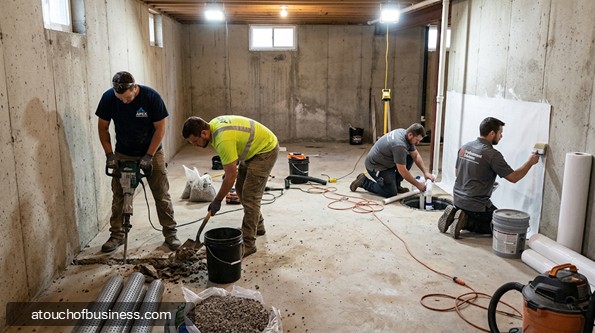
The work includes drainage systems, sump pumps, crack injections, and exterior excavation.
Most calls come in after water has already caused a problem, not before.
You’ll spend a lot of time working directly inside homes, often in tight, below-grade spaces.
If you’re new to launching a business, it helps to review the general startup steps alongside this guide.
Is Basement Waterproofing the Right Business for You?
This work is physical. You’ll spend hours on your knees, cutting concrete and hauling materials.
Ask yourself honestly whether you have the stamina this trade demands, especially in your first year.
Income is uneven here. Storms and snowmelt drive sudden spikes in calls.
Those spikes are followed by stretches with little work at all.
Talk with your household about that unevenness before you commit.
It affects monthly cash flow, not just your income over a full year.
Common trap: Assuming this business runs like a typical trade with steady, calendar-based demand.
Weather drives the calls here, not the season on paper.
Plan your finances around unpredictable timing.
Before you invest in tools or a vehicle, talk with waterproofing or foundation repair owners you won’t compete against.
Prepare specific questions about crew size, warranty callbacks, and how they handle slow stretches.
Firsthand insight from someone who runs this business is different from anything you’ll read online.
Some owners buy an existing company or join a dealer network instead of starting from nothing.
A dealer or franchise path can offer training and product access.
It also means less control and ongoing fees, so weigh that trade-off against your budget and timeline.
Your first customers are usually homeowners with a visible water problem.
Others come from referrals, when someone else spots the issue before the homeowner does.
Real business owners in this trade often say referral relationships matter more than any single marketing effort.
Real estate agents, home inspectors, general contractors, and mold remediation professionals regularly refer clients who need this work.
Building a few of those relationships before you open gives you a head start once the phone starts ringing.
Look into your local soil type, water table, and how often local basements have water problems.
Also check how many independent, regional, and investor-backed companies already compete for the same customers.
Red Flags Before You Start
Large investment firms are actively buying up foundation repair and waterproofing businesses across the country.
That consolidation can affect pricing power and supplier access for small independent operators in some markets.
It’s worth understanding before you commit to a service area.
This isn’t a reason to avoid the business. It’s context for realistic planning.
Waterproofing systems commonly carry warranties lasting 10 to 25 years.
That means your liability and service obligations can stretch far beyond the day you finish a job.
Plan your insurance and reserves with that timeline in mind.
Exterior excavation work demands more capital and more safety training than interior-only work.
If your budget or experience doesn’t support excavation yet, an interior-focused launch is a realistic way to start.
Demand is reactive, not steady. Storms and snowmelt can flood your schedule one week and leave it empty the next.
If you can’t set aside enough operating capital to cover a slow stretch, delay opening until you can.
Common trap: Relying entirely on rented excavation equipment without pricing that rental cost into every job.
That gap quietly erodes your margin on exactly the jobs meant to be your highest earners.
Step 1: Decide on Interior, Exterior, or Both
Interior work covers crack injection, interior drain tile, sump pumps, and dehumidification.
It requires less equipment and lower startup capital than exterior work does.
It also doesn’t require digging up anyone’s yard.
Exterior work adds excavation, exterior drain tile, and foundation membranes.
That requires heavier equipment and a higher level of capital.
Interior drain tile is the more common retrofit for existing homes, which makes it a practical starting point.
Common trap: Buying excavation equipment before confirming there’s enough local demand to justify it.
Start interior-focused, track how often customers ask about exterior fixes, and expand once demand is proven.
Step 2: Choose a Business Structure and Handle Registration
Compare a sole proprietorship against an LLC or other structure.
Weigh this especially given the long warranty exposure common in this trade.
Your business structure affects how much personal liability protection you have if a job goes wrong years later.
Register your business name and entity with your state.
Apply for a federal tax ID and register for any needed state and local tax accounts.
Some states tax contracting materials, labor, or both differently.
Confirm this with your state’s revenue department before you set your prices.
Step 3: Get Licensed and Bonded
Some states have a dedicated waterproofing contractor license.
Most fold the work into a general or specialty contractor category instead.
Check your state’s contractor licensing board to confirm which category applies.
Licensing approval can take time, so build that timeline into your launch schedule.
Some states also require a surety bond tied to your license.
The amount is sometimes scaled to your contract values.
Verify the bond type and amount required where you’ll operate, since this varies by state.
Step 4: Set Up Business Insurance Before You Take a Job
General liability with completed-operations coverage is central to this trade.
That’s because waterproofing warranties commonly last far longer than most contracting work.
Business insurance that only covers claims during the policy period can leave you exposed.
That’s especially true if you later switch carriers or let coverage lapse.
Add workers’ compensation before you hire anyone, since most states require it.
Commercial auto coverage protects your work vehicle on the road and at the job site.
Umbrella coverage adds an extra cushion, given the long warranty tail on this work.
Common trap: Assuming general liability covers redoing your own faulty work.
It typically covers damage your installation causes to a customer’s property, not the cost of fixing your own mistake.
Step 5: Open Business Banking and Payment Processing
Open a dedicated business bank account from day one.
Keep it fully separate from your personal finances.
Set up a payment processor or merchant account that can handle deposits and final payments.
Test the payment process before your first real job, not during it.
Step 6: Plan Your Funding and Operating Capital
Consider personal savings, a small business loan, equipment financing, or a line of credit.
A business loan can cover licensing, insurance, a vehicle, and tools if you don’t have enough saved.
Set aside enough operating capital to cover a slow, storm-free stretch.
Running out of operating money before the next demand spike is a common reason startups in this trade close.
Step 7: Choose Your Workspace and Confirm Zoning
Decide between running the business from home or renting a small shop or yard.
If you’re home-based, check local zoning or home-occupation rules before you commit.
Some residential areas limit parking a work trailer at a home address.
They may also limit storing bulk materials, like gravel and drain pipe, on the property.
Common trap: Assuming home-based storage is automatically allowed, then finding out otherwise after buying a trailer.
Check with your local zoning office before you commit to equipment that needs somewhere to live.
If local zoning doesn’t allow storage at home, a small rented shop or yard becomes the more realistic option.
Step 8: Build Your Vehicle, Tool, and Equipment Kit
At minimum, you’ll need a work vehicle, hand tools, and basic drainage and sump pump supplies.
List what your chosen service model needs, then price it out locally.
Compare buying new, buying used, or using equipment you already own.
- Diagnostic tools: moisture meter, inspection light, concrete saw
- Crack repair: injection ports, injection pump, hydraulic cement
- Drainage: drain pipe, gravel, filter fabric, drainage membrane
- Sump systems: primary pump, battery backup, basin, discharge piping
- Safety gear: respirator, safety glasses, gloves, ventilation fan
If you plan to offer exterior work, equipment rental is a common way to launch without owning it all.
Renting per job keeps upfront costs lower while you confirm how much exterior demand actually exists.
Step 9: Set Up Supplier and Vendor Accounts
Open accounts with waterproofing product distributors for drain tile, membranes, and sump pumps.
Do the same for dehumidifiers and injection materials.
Confirm lead times and any minimum order requirements before you schedule your first jobs.
A supplier who can’t deliver on time will delay your schedule, not just theirs.
Step 10: Handle Excavation Safety, Utility Locates, and Lead-Safe Rules
If you offer exterior work, deep trenches require a protective system under federal excavation safety standards.
Decide who on your team will serve as the trained, competent person responsible for daily trench inspections.
Call your state or regional utility-locate center before every excavation job.
This lets buried utilities be marked before anyone starts digging.
Build that required notice period into your scheduling for every exterior job.
If your service area includes homes built before 1978, federal rules require lead-safe certification.
This applies to any paid work that disturbs painted surfaces in those homes.
It applies even to a one-person business, so confirm your certification before taking these jobs.
Common trap: Scheduling an excavation job without waiting for utility markings to come back first.
Skipping that step risks a utility strike, an injury, and a costly, avoidable delay.
Step 11: Set Your Pricing Structure
Common approaches include per-linear-foot pricing for perimeter drainage work and per-square-foot pricing for coatings.
Flat pricing usually works better for single items, like one sump pump.
Decide which method fits your service mix, then price your jobs using your own local costs.
Don’t copy a price list from another market. Local soil, access, and competition all change the math.
Common trap: Quoting a flat number before measuring the job.
Depth or soil conditions can change the cost fast.
A rushed walkthrough estimate can turn a job into a loss.
Step 12: Create a Compliant Contract and Warranty Policy
Many states require a signed written contract before you accept any deposit.
Common state rules include a cap on deposit amounts and a right-to-cancel notice.
Many also require a mechanics lien warning printed in the contract itself.
Check your state’s home improvement contractor rules and build a template that meets them.
Decide your warranty length and terms before you sign your first contract.
Plan how you’ll staff and fund warranty calls years from now, not just this year.
Step 13: Decide Your Staffing Needs
Decide whether you’ll start solo, with a helper, or with a small crew.
Excavation and drain-tile removal generally need more than one person for safety and pace.
If you hire, plan basic safety training before anyone sets foot in a trench.
You’ll know it’s time to add a second person once job volume regularly requires extra hands for safe excavation.
The same is true once back-to-back storm-driven calls become more than you can handle alone.
Common trap: Sending yourself or a solo crew into exterior excavation work to save on labor.
Trench collapses happen fast, and one person can’t safely manage both the dig and an emergency.
Step 14: Line Up Your First Customers and Referrals
Reach out to real estate agents, home inspectors, and general contractors in your area.
Mold remediation professionals are worth adding to that list too.
These are the people most likely to spot a wet basement and send the homeowner your way.
Set up your business name, vehicle signage, and contact information so people can find you.
Have your payment processing and contract template ready before that first call comes in.
Business Plan
Your business plan should turn every step above into one working document.
List your service model, licensing and insurance status, equipment plan, pricing method, and funding source together.
Include a simple cash flow view that accounts for this business’s uneven, weather-driven demand.
Profit potential here depends on how many jobs of each type you need to cover your fixed monthly costs.
Calculate how many interior jobs, exterior jobs, or a mix of both you’d need in a typical month to break even.
Factor in gross margin pressure from materials, equipment, and labor.
That pressure shows up most on exterior jobs that depend on rented equipment.
Plan for slow, storm-free stretches when few or no jobs come in.
That’s a normal part of this business, not a warning sign on its own.
Use your own local costs and prices to run these numbers, not a figure from another market.
Opening-Day Red Flags
Before you take your first paid job, confirm every piece of your field system is actually ready, not just planned.
- License and any required bond are active, not just applied for
- General liability, completed-operations, and workers’ compensation certificates are in hand
- Written contract template matches your state’s disclosure and deposit rules
- Supplier lead times are confirmed, not assumed
- Utility-locate process is set up and tested before your first exterior job
- Lead-safe certification is complete if you’ll work in older homes
- Warranty terms are written down, not just decided in your head
Opening before these are locked in creates the kind of early rework and disputes that are hardest to recover from.
A rushed launch on an unpermitted or improperly insured job can cost far more than the delay would have.
Basement Waterproofing Business Interviews: Advice from Contractors
These interviews feature basement waterproofing business owners and professionals discussing how they operate, solve customer problems, manage projects, build teams, and grow their companies.
Use their experiences to better understand the technical work, customer expectations, operating practices, hiring decisions, marketing, and quality standards involved before starting a basement waterproofing business.
Behind the Scenes with BAM Basements: Interview with Owner Mark Williams
Mark Williams discusses why he entered the basement waterproofing industry, how he started BAM Basements, and the importance he places on customer service, scheduling, project management, pricing, employees, and workmanship.
This interview is useful for seeing how an experienced contractor approaches business positioning, customer relationships, employee treatment, and day-to-day standards while competing in the waterproofing industry.
Dan Kelly – Basement Gurus
Dan Kelly, owner of Basement Gurus, discusses launching a basement waterproofing brand with limited startup costs, hiring employees who fit the company’s goals, and generating leads.
This interview gives someone entering the business practical insight into controlling startup expenses, building a team, and attracting customers during the growth of a waterproofing company.
Basement Water Problems and Solutions with Steve Grohn
Steve Grohn, owner of Standard Water, discusses basement drainage, diagnosing the cause of water problems, drain tile systems, concrete removal, dust control, waterproofing practices, radon mitigation, and foundation repair.
This conversation is useful for understanding the importance of diagnosing problems before recommending work, controlling job-site dust, explaining solutions accurately, and avoiding unnecessary services.
Foundation Waterproofing and Repair with Gavin MacRae
Gavin MacRae of GJ MacRae Foundation Repair discusses residential basement waterproofing, hand excavation, weeping tile systems, sump boxes, structural foundation repairs, wall replacements, underpinning, and changing construction tools.
This interview helps prospective contractors understand the range of work a waterproofing and foundation repair company may encounter, along with the technical processes and challenging field conditions involved.
Smart Start Waterproofing: Strong Foundations, Real Protection, Lasting Value
David, owner of Smart Start Foundation Waterproofing, discusses surface preparation, grinding, HEPA systems, waterproofing applications, drainage boards, certification, warranties, shortcuts, and lessons from a decade in the trade.
This interview is useful for understanding how preparation, installation standards, equipment, certification, and warranty considerations can affect the quality and reputation of a waterproofing business.
What Most Basement Waterproofing Contractors Get Wrong with Sean Worthington
Sean Worthington, president of the Basement Health Association and owner of Worthington Foundation Authority, discusses customer trust, certification, inspections, installation standards, sales practices, industry education, community presence, and business performance measurement.
This interview provides useful perspective on building credibility, setting installation standards, educating customers, improving sales discipline, reducing callbacks, and tracking business performance.
Related Articles
- How To Start a Plumbing Business
- How To Start a Gutter Installation Business
- How To Start a Home Inspection Business
- How To Start a General Contracting Business
Sources:
- GoTerraFirma: Hire Basement Waterproofing
- HOMEiA: Permit Waterproof Basement
- Basement Health Association: Waterproofing Certification Program
- Do I Need a Permit: Foundation Waterproofing Permits
- 10 Farnsworth: Waterproofing Permits Compliance
- Adam Basement: Checklist Hiring Waterproofing
- StayDry Waterproofing: Interior vs Exterior Waterproofing
- Queen Foundation Repair: Basement Waterproofing Services
- Premium Waterproofing: Interior Exterior Difference
- EverDry Michigan: Three Waterproofing Methods
- ClickUp: Start Basement Waterproofing Company
- The Home Depot: Pro Basement Waterproofing Guide
- Waterproof.com: Professional Contractor Tools, DIY Contractor Supplies
- CDC/NIOSH: Trenching Excavation Safety
- OSHA: Trenching Excavation Overview, Excavation Construction Standards, Excavation Safety Fact Sheet
- Northeast Shoring: OSHA Trench Safety Guidelines
- 811 Before You Dig: National Call Before Digging
- EPA: Renovation Painting Contractors, RRP Firm Certification, Lead-Safe Renovations
- Construction Coverage: General Liability Coverage Guide
- Insureon: General Liability Contractors
- Trusted Choice: Waterproofer Insurance Guide
- Contractor Nerd: Completed Operations Liability
- Contractors Choice Agency: Waterproofing Contractor Insurance
- PR Newswire: Foundation Waterproofing Investment
- Private Markets Minute: AnchorPoint Foundations Rollup
- Gaebler: Opening Basement Waterproofing Business
- WATERPROOF! Magazine: Growing Basement Business
- Franchise Solutions: De-Watering Franchise Opportunity
- MyQuoteIQ: Waterproofing Cost Calculator