
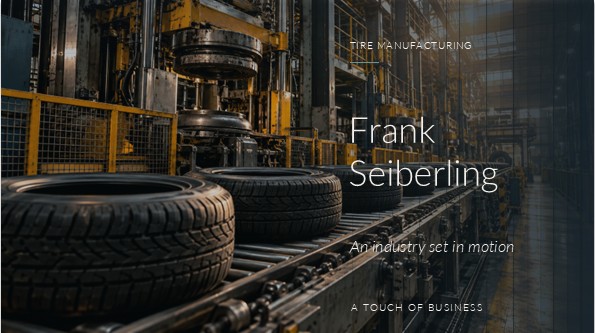
In 1921, Frank A. Seiberling lost his leadership position at the tire manufacturer he had helped establish. Goodyear Tire & Rubber Company had grown from an Akron venture into a major force in the industry, but the postwar downturn exposed serious financial pressures. A banker-led restructuring kept the company operating under different leadership.
That same year, Seiberling and his brother Charles established another tire company in nearby Barberton, Ohio. After more than two decades building Goodyear, he was beginning a second manufacturing venture.
His influence also reached beyond the tire business. Housing developments, hospitals, roads, parkland, and the family estate now known as Stan Hywet Hall & Gardens connect Seiberling’s life to the changing landscape of Akron.
A Quick Look at the Life of Frank A. Seiberling
Biography Summary
Frank A. Seiberling (1859–1955) was an American industrialist and inventor who co-founded Goodyear Tire & Rubber Company in 1898 and Seiberling Rubber Company in 1921. He helped guide Goodyear’s early growth, contributed to tire technology, and later supported major civic initiatives in the Akron area. His career combined two manufacturing ventures with an enduring local legacy in housing, public institutions, and conservation.
Profile
Name: Frank A. Seiberling (also known as F.A. Seiberling)
Born: October 6, 1859
Died: August 11, 1955, aged 95
Birthplace: Near Western Star, in what is now the Norton area of Summit County, Ohio
Education: Attended Heidelberg College in Tiffin, Ohio, for approximately two years
Known For: Co-founding Goodyear Tire & Rubber Company and Seiberling Rubber Company
Major Roles: President of Goodyear, 1906–1921; president of Seiberling Rubber until 1938; subsequently chairman until 1950
Other Contributions: Tire patents, housing developments, civic institutions, roads, and metropolitan parkland
From Agricultural Machinery to Manufacturing
Frank Seiberling was born on October 6, 1859, near Western Star, Ohio, to John Frederick and Catherine (Miller) Seiberling. His father manufactured agricultural machinery, giving the family an established connection to industrial production before Frank entered the rubber business. The family moved to Akron in 1865.
Seiberling attended Heidelberg College for roughly two years before joining his father’s farm-equipment enterprise. When the business was reorganized in 1884, he became secretary-treasurer.
He married Gertrude F. Penfield of Willoughby, Ohio, on October 12, 1887. They eventually had seven children, six of whom reached adulthood. Gertrude would later play a distinct role in the family’s cultural and community life.
A New Start in Rubber Manufacturing
Financial damage to the Seiberling family’s older manufacturing interests during the 1890s preceded Frank’s move into rubber. In 1898, he acquired former factory premises in Akron while away on business in Chicago. Together with his brother Charles W. Seiberling, he organized a company that would enter an expanding market for rubber products and tires.
The Goodyear Tire & Rubber Company was founded on August 29, 1898. Its name honored Charles Goodyear, whose earlier work on rubber vulcanization had helped establish the field; Charles Goodyear was not a founder of the new company. Goodyear’s corporate history dates the start of manufacturing to November 21 of that year.
The initial product range included carriage and bicycle tires, horseshoe pads, and other rubber goods. Automobile tires later became central to the growing enterprise. Seiberling was a co-founder from the outset, although he did not become company president until 1906; his brother Charles also held a senior financial role.
The fledgling business still faced legal and financial uncertainty. In 1902, a decision that Goodyear’s tire did not infringe an existing patent removed one obstacle, while work on tire designs continued.
Innovation Through Products, Patents, and People
Early product improvements made Goodyear’s tires easier to handle. The company introduced a straight-side tire in 1901 and a more successful quickly detachable version in 1905. Seiberling worked on tire development at the plant, alongside other contributors.
Seiberling did undertake technical work himself. A United States patent for a vehicle tire, issued in 1901, lists him as inventor. A 1910 patent covering a process of making tire shoes identifies him and Will C. State as joint inventors. Another patent, issued in 1919, names Seiberling for fabric-forming apparatus connected with cord-tire production.
Seiberling and State also worked on machinery that helped mechanize tire production. Other Goodyear engineers made substantial contributions, including Paul W. Litchfield, who joined in 1900 as the company’s first factory superintendent. The technical progress behind Goodyear’s growth involved several people, not only its co-founder.
By the mid-1910s, Goodyear had become the world’s largest tire manufacturer. Growing demand for road transport, improvements in products and production, and business leadership all formed part of that expansion. The scale of the company had changed dramatically from the enterprise established in the vacant Akron factory premises.
Moving Beyond the Automobile Tire
Seiberling’s transportation interests extended to roads and freight. He supported the Lincoln Highway Association, serving as its president from 1918 to 1921, and was involved in early work concerning pneumatic truck tires and the Wingfoot Express freight operation. His activities also included support for urban bus transport in Akron.
Goodyear also supplied an envelope for aviation pioneer Melvin Vaniman’s airship Akron, under an agreement involving Seiberling. On July 2, 1912, the hydrogen-filled airship caught fire near Atlantic City, killing Vaniman and four other crew members. Goodyear supplied a component for the project; the aircraft itself was Vaniman’s undertaking.
These ventures broadened Goodyear’s connection to transportation beyond passenger-car tires, while its core tire business continued to expand.
The 1921 Crisis and Loss of Goodyear Leadership
Goodyear’s growth brought a serious financial vulnerability into view after World War I. Demand for tires fell during the economic contraction, while the company faced heavy inventories and limited cash after a period of rapid expansion. Its financial position required restructuring rather than a routine change of management.
Investment bankers Dillon, Read & Co. played a central role in the rescue and recapitalization. Seiberling relinquished the leadership of Goodyear in 1921 as part of the terms of that reorganization. He was effectively forced out of management, although the company itself continued operating.
The financial reversal was not simply a story of one individual mistake. A later federal historical assessment links some of Goodyear’s weakness to an emphasis on production expansion over inventory and cash management. That is a retrospective interpretation alongside the documented market downturn, the company’s financial condition, and the bankers’ demands—not a complete explanation of every cause.
Building Seiberling Rubber in Barberton
In 1921, Frank and Charles Seiberling established Seiberling Rubber Company in Barberton, Ohio. It was a separate, smaller manufacturer operating in a competitive industry where large-scale production mattered. The founding followed Frank’s departure from Goodyear rather than a retirement from industrial work.
Seiberling Rubber developed a place in the competitive tire market. A 1938 Modern Tire Dealer profile described it as one of the industry’s top seven firms. It remained a smaller, family-owned manufacturer in a business where scale mattered.
The 1938 profile also reported a remark from Seiberling about starting over: “A man never hits bottom.”
Leadership gradually passed to the next generation. In February 1938, Seiberling gave up the presidency to his son James Penfield, known as J. Penfield Seiberling. Frank remained chairman of the board until retiring in 1950.
Housing, Hospitals, Roads, and Akron’s Parks
Seiberling’s involvement in Akron’s development ran alongside his business career. The city’s industrial expansion brought questions of housing, transportation, public services, and open space. His civic activities touched each of those areas, although many initiatives were collaborative rather than his work alone.
He helped finance or promote Goodyear Heights, a housing development for industrial workers, and Fairlawn Heights, a residential development. His work on Goodyear Heights began around 1910, with involvement in Fairlawn Heights recorded in 1917. Both addressed housing in a growing industrial city.
His institutional work included founding participation or support for People’s Hospital, later associated with Akron General, as well as the Akron Institute for the Blind and the Akron Settlement Association. These institutions involved other organizers and supporters, but they form an important part of Seiberling’s activities outside factory management.
Preserving green space became another significant civic commitment. The Akron Metropolitan Park District, now Summit Metro Parks, was established in 1921 with Seiberling among its important early advocates. During the district’s early development, he proposed land from his estate, participated in park leadership, and supported planning work by the Olmsted Brothers.
Summit Metro Parks credits Seiberling with donating more than 400 acres to expand Sand Run Metro Park. The district also commemorates him through the F.A. Seiberling Nature Realm, whose land includes property the park district purchased in 1964. His work for Akron’s public spaces has remained visible long after his manufacturing career.
Stan Hywet and the Seiberling Family
The family’s home became another visible part of Seiberling’s legacy. Around 1910, Frank and Gertrude began acquiring land for Stan Hywet, an estate intended as a family residence and gathering place. Architect Charles S. Schneider, landscape designer Warren H. Manning, and interior designer Hugo Huber helped create the property. Construction took place from 1912 to 1915, and the family moved in during December 1915.
The Tudor Revival estate took its name from an English phrase meaning “stone quarry,” a reference to a feature of the property. Gertrude’s artistic and musical interests contributed to the family’s cultural connections and public life in their own right. Stan Hywet was a family project, not solely a monument to Frank’s corporate success.
The estate also became associated with the beginnings of Alcoholics Anonymous through another family member. In 1935, Frank and Gertrude’s daughter-in-law, Henrietta Buckler Seiberling, arranged a meeting between Bill W. and Dr. Bob at the Gate Lodge.
Retirement, Death, and a Public Legacy
Seiberling retired from the chairmanship of his second tire company in 1950. He died in Akron on August 11, 1955, at the age of 95. By then, his career had included the creation of two rubber manufacturers and a range of civic projects that extended well beyond business ownership.
In 1957, two years after his death, the Seiberling children gave Stan Hywet to the Akron community. It opened as a historic house museum that year and survives as Stan Hywet Hall & Gardens, preserving the family’s estate and a part of Akron’s industrial-era history.
Seiberling’s career was neither an uninterrupted business success nor a story defined by the loss of Goodyear. He helped build one major tire manufacturer, then founded another after a forced departure. The housing, hospitals, parks, and preserved family estate in Akron tell a parallel story of civic work accomplished with many others.
Timeline
These milestones trace Seiberling’s life, the major changes in his manufacturing career, and the development of his civic legacy.

1859
Frank A. Seiberling is born on October 6 near Western Star, Ohio.
1865
The Seiberling family moves to Akron.
1884–1887
Seiberling becomes secretary-treasurer in the reorganized family manufacturing business in 1884 and marries Gertrude Penfield in 1887.
1898
Frank and Charles Seiberling co-found Goodyear Tire & Rubber Company on August 29; manufacturing begins in November.
1901–1906
An early straight-side tire and Seiberling’s vehicle-tire patent appear in 1901. A more successful quickly detachable tire follows in 1905, and he becomes Goodyear president in 1906.
1910–1915
A tire-making-process patent is issued jointly to Seiberling and Will C. State in 1910. The family builds Stan Hywet from 1912 to 1915 and moves in that December.
Mid-1910s
Goodyear reaches the position of the world’s largest tire manufacturer.
1918–1921
Seiberling serves as president of the Lincoln Highway Association.
1921
The financial restructuring of Goodyear removes him from leadership. He and Charles establish Seiberling Rubber Company in Barberton; the Akron Metropolitan Park District is also founded.
1924–1925
Seiberling proposes land for the developing park system and takes part in its early planning and leadership.
1938
His son J. Penfield Seiberling becomes president of Seiberling Rubber in February. Frank continues as board chairman.
1950
Seiberling retires as chairman of Seiberling Rubber.
1955
Frank A. Seiberling dies in Akron on August 11, aged 95.
1957
His children give Stan Hywet to the Akron community, and the estate becomes a historic house museum.
1965
Firestone acquires the tire-division manufacturing assets and associated dealer relationships of Seiberling Rubber, a decade after Frank’s death.
FAQs
Why did Frank A. Seiberling leave Goodyear?
Goodyear faced a cash and inventory crisis during the 1920–1921 economic downturn. A financial restructuring led by investment bankers required Seiberling to relinquish leadership in 1921. He then co-founded Seiberling Rubber Company; leaving Goodyear was not simply a planned retirement.
Was Goodyear Tire & Rubber Company named after Frank Seiberling?
No. Frank A. Seiberling and his brother Charles co-founded the company in 1898, but its name honored Charles Goodyear, the earlier rubber innovator known for work on vulcanization.
Did Frank Seiberling personally invent Goodyear’s tires?
He made documented technical contributions, including inventions named in U.S. patents. A 1910 patent lists Frank A. Seiberling and Will C. State as joint inventors. Goodyear relied on a wider team of engineers, so its full range of innovations cannot be credited to him alone.
Why did Seiberling stop being company president in 1938 but retire in 1950?
He transferred the presidency of Seiberling Rubber Company to his son J. Penfield Seiberling in February 1938 but stayed on as board chairman. He retired from the chairmanship in 1950.
Did Frank Seiberling found Alcoholics Anonymous?
No. His family’s Stan Hywet estate is associated with the organization’s origins because his daughter-in-law, Henrietta Buckler Seiberling, arranged a 1935 meeting between Bill W. and Dr. Bob at the Gate Lodge. That role should not be attributed to Frank.
What happened to Seiberling’s second tire company?
Seiberling Rubber continued operating after Frank Seiberling’s death. Effective February 1, 1965, Firestone acquired the company’s tire-division facilities and assets, together with associated dealer relationships. The documented transaction concerned that division, not necessarily the entire company.
Further Reading
- Stan Hywet Collections Archives — a route into the Seiberling family’s historical holdings.
- University of Akron Archives: Goodyear Tire and Rubber Company Records — archival collection descriptions for further study of the company.
- Hagley Museum and Library: A Name You Can Trust in Rubber (1947) — a contemporary, company-produced film to view as corporate promotion rather than independent history.
Sources
- Stan Hywet Hall & Gardens: F.A. Seiberling Biography, The Seiberling Family, Stan Hywet History, F.A. Seiberling Community Endeavors
- Goodyear Tire & Rubber Company: Company History, People Who Shaped Goodyear
- U.S. Department of the Interior: Stan Hywet Hall Historic Landmark Nomination
- Harvard Business School: Frank A. Seiberling
- Modern Tire Dealer: 1938 Seiberling Profile, Reproduced in 2026
- United States Patent Office: Vehicle-Tire (1901), Process of Making Tire-Shoes (1910), Fabric-Forming Apparatus (1919)
- Business History Review / Cambridge University Press: Michael French, Seiberling Rubber Company, 1922–1964
- Encyclopedia.com: Goodyear Tire & Rubber Company History
- Summit Metro Parks: Explore Our History, F.A. Seiberling’s Park-District Leadership, F.A. Seiberling Nature Realm
- Smithsonian Institution: The Akron Airship and Its Lifeboat
- Library of Congress: Historic American Buildings Survey: Stan Hywet Hall
- Ohio Memory / Stan Hywet: Stan Hywet Hall & Gardens Digital Collection
- California Court of Appeal: Charles D. Warner & Sons, Inc. v. Seilon, Inc. (1974)
- Centennial History of Summit County (1908): Biographical Entries for the Seiberling Family