
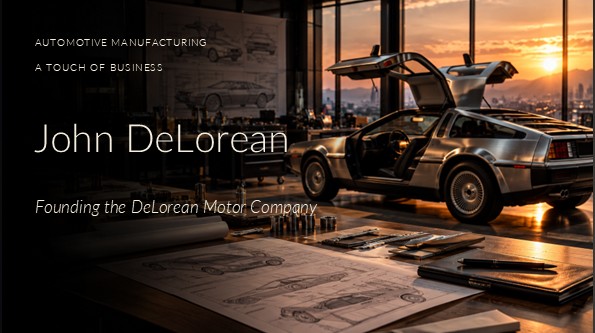
In 1981, a factory near Belfast began producing an unusual sports car: stainless-steel body panels, gull-wing doors and the name of a former top General Motors executive. It was the DeLorean DMC-12, and the man behind the company was John DeLorean.
By May 1982, the company was in receivership and production was being suspended. Yet the DMC-12 would become better known after the factory closed, when it appeared in the 1985 film Back to the Future.
DeLorean had helped shape Pontiac’s performance-car era before leaving GM to build a car under his own name. The move from established automobile divisions to a new manufacturing venture changed both his responsibilities and the risks surrounding them.
A Quick Look at the Life of John DeLorean
Biography Summary
John Zachary DeLorean (1925–2005) was an American automotive engineer and executive who became closely associated with Pontiac’s rise in performance cars, including the GTO, before leading Chevrolet and taking a senior General Motors role. After leaving GM in 1973, he founded the original DeLorean Motor Company, whose DMC-12 was built in Northern Ireland. The venture collapsed in the early 1980s; DeLorean was subsequently acquitted in two separate federal criminal cases. The DMC-12 later gained lasting recognition through film and automotive collections.
Profile
Full Name: John Zachary DeLorean
Born: January 6, 1925
Died: March 19, 2005
Birthplace: Detroit, Michigan, United States
Education: Engineering degree from Lawrence Institute of Technology (1948); postgraduate automotive engineering at the Chrysler Institute of Engineering (1952); MBA from the University of Michigan (1957)
Major Roles: Pontiac chief engineer and general manager; Chevrolet general manager; senior General Motors executive; founder of the original DeLorean Motor Company
Best Known For: His role in the Pontiac GTO program and founding the company that produced the DeLorean DMC-12
From Detroit’s Auto Industry to Engineering School
John DeLorean was born in Detroit on January 6, 1925, the eldest of four sons. His father, Zachary, was a Romanian-born foundry worker at Ford; his mother, Kathryn Pribak DeLorean, came from an Austro-Hungarian family background. The household was part of the working-class Detroit world in which automobile manufacturing was a major presence.
He attended Cass Technical High School and then Lawrence Institute of Technology. World War II-era service in the US Army interrupted his studies, but he completed an engineering degree at Lawrence in 1948. His technical education continued through the Chrysler Institute of Engineering, where he completed advanced training in 1952.
The training led into work at Chrysler and then Packard, where his engineering responsibilities included transmission-related development. He also pursued a business education, earning an MBA from the University of Michigan in 1957. By then, his career had already taken him to the company where he would become a prominent automotive executive.
At Pontiac, Engineering Became Product Leadership
DeLorean joined General Motors’ Pontiac division in 1956. He worked in a leadership environment that included Pontiac general managers Semon “Bunkie” Knudsen and Pete Estes, as the division developed a stronger identity around more appealing and higher-performance vehicles.
His responsibilities grew. Pontiac named him chief engineer in 1961, putting him in a central technical role as the division prepared vehicles that would attract a new kind of attention. The best-known example was the Pontiac GTO, introduced for the 1964 model year.
The GTO program drew on a team rather than a lone inventor. DeLorean, engineers Bill Collins and Russ Gee, and Pontiac management were involved in turning the idea of a large 389-cubic-inch V8 in a smaller Tempest-based car into a production offering. Estes supported the project, while Jim Wangers contributed to its marketing. DeLorean was important to the program’s development and public identity, but its achievement was collaborative.
The GTO became closely associated with the American muscle-car era and strengthened DeLorean’s reputation at Pontiac. In 1965, he became the division’s general manager. Pontiac introduced the Firebird in 1967, during his leadership.
His Pontiac years marked a shift from engineering assignments to decisions about products and the direction of an entire division.
Climbing General Motors—and Leaving It
In 1969, DeLorean moved from Pontiac to become general manager of Chevrolet. The promotion placed him in charge of a much larger part of GM’s automobile business. In 1972, he advanced again, taking group-level responsibility for the company’s North American car and truck operations.
DeLorean left GM in April 1973, despite his rise through the company’s ranks. He later spoke of frustration with corporate bureaucracy and a wish to create a different kind of automobile. Those were his retrospective explanations, rather than a settled account of everything behind his departure.
After leaving, he briefly served as president of the National Alliance of Businessmen, an organization concerned with employment and training opportunities, and pursued independent commercial plans. The most consequential was an automobile company bearing his own name.
Building the DeLorean Motor Company
The original DeLorean Motor Company is generally dated to 1975. DeLorean presented his proposed sports car as an alternative to ordinary industry practice, promoting the idea of an “ethical” automobile with an emphasis on safety, reliability and durability. These were ambitions for the project, not proof that the eventual production car fulfilled every promise.
Turning the idea into a marketable car required outside design and engineering expertise. Giorgetto Giugiaro designed the DMC-12’s distinctive exterior, while Lotus carried out substantial engineering work with the involvement of Colin Chapman. The finished two-seat coupé combined stainless-steel outer panels, gull-wing doors, a composite structure and a rear-mounted Peugeot-Renault-Volvo V6 engine.
DeLorean led the enterprise, but Giugiaro, Lotus and the factory workforce were essential to turning the concept into a car. A distinctive design was one achievement; producing and selling it at scale would prove a different challenge.
The Dunmurry Factory and Northern Ireland’s Stakes
In 1978, the project secured government-backed manufacturing arrangements at Dunmurry, southwest of Belfast. The factory promised substantial employment in a region facing unemployment and industrial difficulties. For DeLorean, the Northern Ireland operation offered a place to build the DMC-12; for workers and public authorities, it was also a significant industrial investment.
The scale became visible as recruitment and production expanded. On October 26, 1981, the factory had 2,557 direct employees, according to a UK parliamentary answer. The rapid buildup also brought the practical demands of training workers and establishing automobile production in a new operation.
Government assistance was substantial. A Northern Ireland Audit Office report later calculated that approximately £77 million had been provided between July 1978 and February 1982. That amount describes assistance in that specified period; it is not an all-purpose total for every public or private contribution associated with the venture.
The project had created jobs in Dunmurry, but its long-term future depended on whether enough buyers wanted the car.
When the DMC-12 Reached the Market
The DMC-12 entered production in 1981. Its unpainted stainless-steel appearance and upward-opening doors gave it a distinctive presence, but unusual styling was not enough to solve the challenges of a new automobile business.
The car reached the US market at roughly $25,000–$26,000, with a V6 rated at about 130 horsepower. That put pressure on its performance-for-price appeal. The production program had also faced development delays and early build-quality concerns. A contemporary Car and Driver first-drive assessment questioned the practical complexity of producing such an ambitious vehicle and establishing the factory behind it.
The largest problem was the gap between production and sales. Figures later discussed in Parliament put output at roughly 8,000 cars by January 1982, against just over 3,000 sold. Unsold vehicles were accumulating while the company still had a large workforce and manufacturing operation to support.
Receivership and the End of Original Production
The Northern Ireland company entered receivership in February 1982. Financing pressure, large stocks of unsold cars and the withdrawal of a prospective investor contributed to the difficulties described at the time. DeLorean continued seeking a way to secure money and keep the project going, but the company’s finances and the receivers’ decisions were not his alone to determine.
The receivers decided to suspend vehicle production and make almost all workers redundant effective May 31, 1982. The factory closed later that year. For the region, the collapse meant the loss of an enterprise that had employed thousands; it also led to years of work to recover public funds. The US parent company entered liquidation in December 1983, a separate corporate event.
About 9,000 DMC-12s were produced altogether. The car was a tangible achievement, but the original manufacturing business could not sustain itself.
The 1982 Arrest and the 1984 Jury Verdict
The criminal case that drew intense publicity began after DMC production stopped. Federal authorities arrested DeLorean at a Los Angeles hotel on October 19, 1982, during an undercover cocaine-trafficking investigation. Prosecutors alleged that he had entered a scheme involving $24 million in cocaine transactions to raise money for the failing car venture.
The case attracted extensive attention, including to covert videotape made during the investigation. At trial, DeLorean’s defense argued that informants and undercover agents had entrapped him. In August 1984, a federal jury acquitted him on all eight drug-related counts.
Jurors later described different reasons for the acquittal. Some questioned whether prosecutors had proved their case; others focused on entrapment. The verdict did not establish one shared public explanation for the jury’s decision.
Afterward, DeLorean asked reporters, “Would you buy a used car from me?” His self-deprecating response reflected the damage he believed the investigation had done to his life.
The DMC-12’s Second Life in Film
In 1985, the DMC-12 appeared as the time machine in Back to the Future. The film and its sequels gave a new public identity to a car whose original manufacturer had already stopped producing it.
The film did not rescue the DeLorean Motor Company or reopen its Dunmurry factory. Instead, it gave the stainless-steel body and gull-wing doors a lasting place in popular culture. Automotive museums have also preserved the DMC-12 as part of design and industrial history.
Its cultural recognition outlasted the original business. That success, however, did not undo the factory closure or the financial disputes surrounding DMC.
A Second Acquittal, with Business Disputes Continuing
Questions about the failed company led to a separate US criminal prosecution involving allegations that investor funds had been diverted. On December 17, 1986, a federal jury in Detroit acquitted DeLorean of racketeering, fraud and tax-law charges. The case was distinct from the drug prosecution that had ended in acquittal two years earlier.
Financial consequences continued beyond those verdicts. Public authorities pursued recovery of funds, while civil litigation and inquiries addressed corporate transactions. A later Northern Ireland government audit discussed alleged financial irregularities and recovery efforts. Those matters were separate from the US criminal verdicts and did not amount to a criminal conviction of DeLorean.
Later Ventures, Bankruptcy and Final Years
DeLorean continued to talk about making another automobile and pursued additional ventures, including DeLoreanTime watches. The years after DMC brought continuing debts and litigation, and in 1999 he filed for personal bankruptcy. That filing concerned his own finances; it was not the same event as the Northern Ireland company’s 1982 receivership or the US parent’s later liquidation.
His marriages to Elizabeth Higgins, Kelly Harmon and Cristina Ferrare ended in divorce. He was married to Sally when he died.
John DeLorean died in Summit, New Jersey, on March 19, 2005, aged 80, following a stroke. His later financial troubles contrasted sharply with the senior positions he had held at General Motors.
An Automotive Legacy with More Than One Outcome
DeLorean’s automotive career left two different kinds of achievement. At Pontiac, he helped shape successful performance cars through engineering and management work carried out with colleagues. As an independent founder, he helped bring an unusual sports car into production, but the company and its Northern Ireland factory failed commercially.
The GTO remains associated with the rise of American muscle cars; the DMC-12 remains recognizable through its styling, museum preservation and film appearances. Neither story belongs to DeLorean alone. Designers, engineers, marketers, factory workers and other collaborators were essential to what reached the public.
The enterprise that bore his name lasted only a short time as a manufacturer, but the car it built achieved an enduring cultural identity. That contrast sits alongside DeLorean’s earlier achievements at Pontiac, the loss of the Dunmurry factory and the two criminal cases in which he was acquitted.
Timeline
These milestones trace John DeLorean’s career, the rise and closure of the original car company, and events that shaped his later public profile.

1925
John Zachary DeLorean is born in Detroit on January 6.
1948–1957
Graduates from Lawrence Institute of Technology in 1948; completes advanced Chrysler engineering training in 1952; joins Pontiac in 1956; earns a University of Michigan MBA in 1957.
1961
Becomes chief engineer at Pontiac.
1964–1965
The Pontiac GTO appears for the 1964 model year, developed through a team effort. DeLorean becomes Pontiac general manager in 1965.
1969–1973
Becomes Chevrolet general manager in 1969, takes a senior North American GM car-and-truck role in 1972 and leaves GM in April 1973.
1975
The original DeLorean Motor Company is established.
1978
The government-backed Dunmurry factory project in Northern Ireland is arranged.
1981
The DMC-12 enters production in Northern Ireland. The factory employs 2,557 direct workers on October 26.
February–May 1982
The Northern Ireland company enters receivership in February. Receivers suspend production and make almost all workers redundant effective May 31.
October 1982–December 1983
DeLorean is arrested in Los Angeles on October 19, 1982, in an undercover drug case. The factory closes later in 1982; the US parent company enters liquidation in December 1983.
August 1984
A federal jury acquits DeLorean on all eight drug-related counts.
1985–1986
The DMC-12 appears in Back to the Future in 1985. In December 1986, a separate federal jury acquits DeLorean in a case involving racketeering, fraud and tax-law charges.
1999
DeLorean files for personal bankruptcy.
2005
DeLorean dies on March 19 following a stroke.
FAQs
Question: Did John DeLorean invent the Pontiac GTO alone?
Answer: No. DeLorean played a central engineering and management role, but the GTO was developed with colleagues including Bill Collins and Russ Gee, with support from Pete Estes and marketing work by Jim Wangers. Participants later gave differing accounts of who first proposed the larger engine.
Question: Where was the original DeLorean DMC-12 built?
Answer: The DMC-12 was assembled at the original DeLorean Motor Company’s factory in Dunmurry, near Belfast, Northern Ireland, beginning in 1981. Giorgetto Giugiaro designed the car’s exterior, and Lotus carried out substantial engineering work in Britain.
Question: Why did the original DeLorean factory close?
Answer: The company faced unsold inventory, weak sales relative to production, manufacturing difficulties and funding pressure. Its Northern Ireland business entered receivership in February 1982, production was suspended in May and the factory closed later that year. These events preceded DeLorean’s October 1982 arrest.
Question: Was John DeLorean convicted in the 1982 cocaine case?
Answer: No. DeLorean was arrested in October 1982 and acquitted of all eight federal drug-related charges in August 1984. His defense argued entrapment, and jurors later gave differing explanations for their decision to acquit.
Question: Was DeLorean convicted in the later investor-finance case?
Answer: No. A Detroit federal jury acquitted him in December 1986 of racketeering, fraud and tax-law charges in a separate prosecution concerning alleged diversion of company investor funds. Business losses, civil proceedings and government recovery inquiries were different matters.
Question: Did Back to the Future save DeLorean’s company?
Answer: No. The film appeared in 1985, after original DMC production had ended and the Dunmurry factory had closed. It helped make the already-built DMC-12 famous, but it did not rescue the original manufacturer.
Interviews
John DeLorean’s 1979 Dealer Speech and 1985 Recorded Interview
The DeLorean Museum’s multimedia collection includes a 1979 dealer speech and a 1985 promotional interview with DeLorean. These materials offer firsthand examples of how he publicly presented his company and discussed his work at different points in its history. Because they are subject-controlled presentations, they are especially useful for hearing his perspective, rather than for independently establishing disputed events.
DeLorean in Northern Ireland Television Archives
This BFI Replay and Northern Ireland Screen collection brings together historical UTV footage and interviews about DeLorean. It offers a contemporary visual perspective on the company and car, alongside later accounts of their history. Viewing may depend on the archive’s access arrangements.
Further Reading
Sources
- Oxford University Press: John Zachary DeLorean — Oxford Dictionary of National Biography
- Detroit Historical Society: DeLorean, John
- Lawrence Technological University: Recognized Alumni — John Z. DeLorean
- University of Michigan Ross School of Business: Celebrating a Century of Exceptional Michigan Ross Graduates
- General Motors: Retro Rides: The 1964 Pontiac GTO
- Pontiac Preservation Association: Bill Collins Jr. recollections and biography
- Hot Rod / High Performance Pontiac: 1964 Pontiac GTO: Wide-Track
- Ulster Museum / National Museums Northern Ireland: DeLorean Manufacture
- Ulster Transport Museum: DeLorean DMC-12
- Giorgetto & Fabrizio Giugiaro Designers: 1981 DeLorean DMC-12
- Haynes Motor Museum: 1981 DeLorean DMC-12 exhibit
- Hagerty: 1981 DeLorean DMC-12 model details
- Northern Ireland Audit Office: De Lorean: The Recovery of Public Funds
- UK Parliament / Hansard: De Lorean Motor Cars Ltd. — 1981 workforce figures, Public Accounts — production and sales discussion, De Lorean Motor Company — May 1982 debate
- The Washington Post: John Z. DeLorean obituary, Jurors Get Case Against DeLorean, DeLorean Acquitted of All Eight Charges, DeLorean’s post-verdict remarks
- Los Angeles Times: The Trial of John DeLorean, DeLorean Cleared in Fraud and Racketeering Case
- WardsAuto: Larger Than Life
- Car and Driver: 1981 De Lorean First Drive