
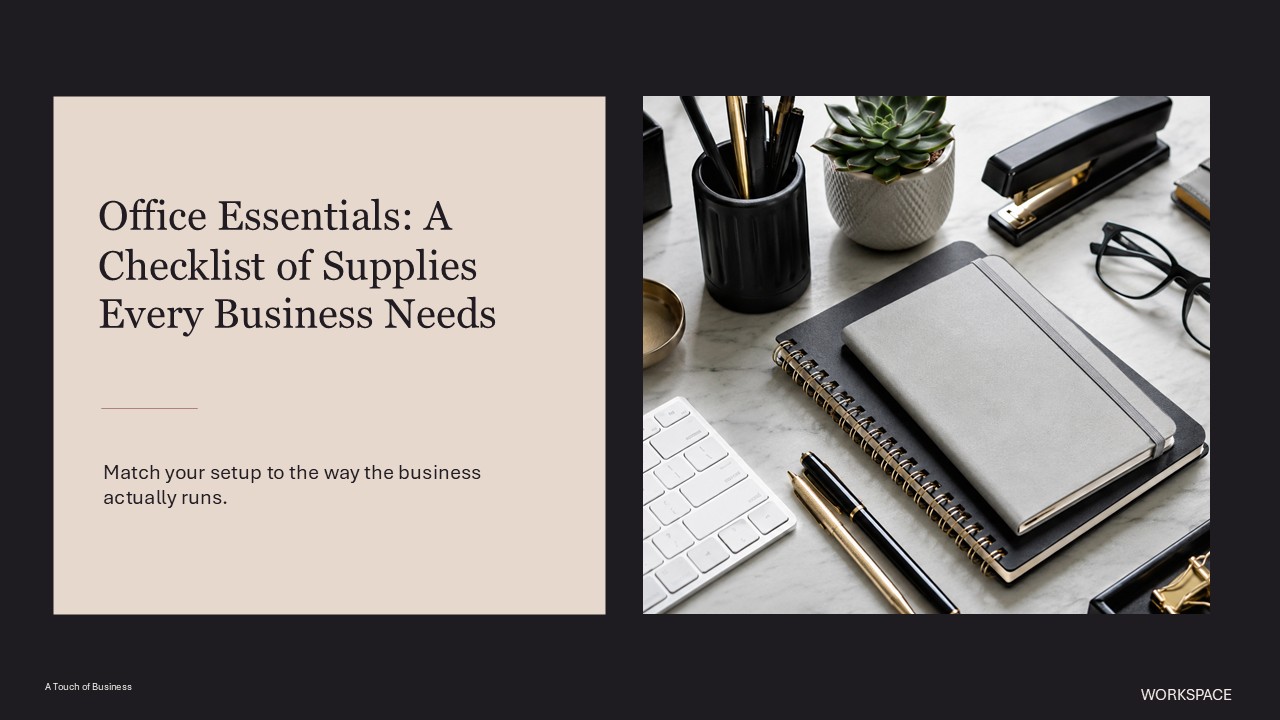
Every modern office needs certain office supplies to enable employees and teams to work smoothly. Some, such as computers, are essential for performing job-related tasks. Others, like kitchen supplies, are complementary since they enable your employees to have successful workdays.
Office Essentials
Productive workdays start with having the right equipment in place. The right office tools and supplies help you and your team perform tasks effectively. They also convey a positive image to partners, clients, and other office visitors. If you are unsure which supplies you need in your office, this guide will help you figure it out.
Essential Equipment to Have In Your Office
The essentials to have in your office depend on whether you are setting up a home or site office. The former will probably not need all these listed essential supplies. The latter, however, needs almost all of them.
1. Office Furniture
You and your team need desks, chairs, tables, cabinets, and bookshelves to do your jobs comfortably. The type of furniture to buy depends on the size of your office and how many employees you have.
When buying office furniture, consider aesthetic design and function. In the case of design, you want to acquire furniture that complements your office space while making it look professional and appealing. Your office furniture should reflect your business. It should give a good impression to clients and visitors.
The right furniture also plays a role in motivating employees. It increases their morale and productivity. This is why you should purchase furniture your team feels confident and comfortable using. Your chairs should not be so stiff that they affect your employees’ posture and comfort.
Ergonomic accessories such as monitor arms and height-adjustable desks have become standard equipment rather than optional upgrades in recent years, so it’s worth budgeting for them when you furnish new workstations.
2. Computers and Computer Accessories
Most offices today depend on computers and computer accessories to get their work done. Every employee in your workplace will likely need a computer. The type of computer you need depends on how you plan to use it.
If the computer is for day-to-day administrative tasks at the office, a desktop will do. A laptop will be ideal if you plan to use it in and out of the office. If the computer is for performing technical work such as software development, you may want to invest in a powerful one.
The computer and computer accessories essential for an office include:
- Desktops
- Laptops
- Monitors
- Chargers and headsets
- Webcams
- Keyboards and mice
- Network cables
3. Kitchen Supplies
Providing your team with food and drinks helps keep them hydrated, energetic, and motivated to work. It also aids in keeping them focused and productive, which is why you want to invest in kitchen supplies such as coffee makers, cups, and water dispensers.
You don’t need to have a kitchen to buy kitchen supplies. Just designate a small space in your office for them. Here are the kitchen supplies to get for your office:
- Tableware (cups, plates, spoons, and glasses)
- Coffee makers
- Mini fridge
- Microwave
- Water dispenser
- Cutlery
- Kitchen sink
- Water bottles
- Snack foods
- Fruits
- Coffee and tea
4. Photocopiers
Photocopiers may not be as essential as in the past, considering most businesses are now going paperless. However, you never know when you’ll need to photocopy documents for your clients or team. An in-house copier will save you money and time since you won’t have to outsource. It’s better to equip your office with this hardware regardless of how often you plan to use it.
5. Printers
A printer will come in handy when you want to convert digital documents to hard copies. Like a photocopier, you may not use this hardware daily. But when you need it, you’ll be glad to have it.
6. Scanners
A scanner does the opposite of what a printer does. It converts paper documents into digital format. A good tip would be to purchase multi-purpose hardware that can photocopy, print, and scan documents.
7. Stationery
Stationery ranks among the top essential items to have in your office. Your team won’t rely solely on computers to do their job. They still need supplies such as pens, notebooks, staplers, and paper clips to attach documents. Such stationery items are still very relevant in today’s work environment, even though most work happens digitally.
You can make your stationery items look more appealing and uniform by branding them with company elements such as name, logo, and brand colors. Branded stationery makes you look more professional to clients.
Consider purchasing the following stationery items:
- Papers
- Pens and pencils
- Staplers
- Paper clips
- Notebooks
- Paper trays
- Cardholders
- Sticky notes
- Files and folders
- Punches
- Scissors
- Highlighter pens and markers
8. Collaboration Tools
Collaboration tools, such as whiteboards and projectors, are also essential in your office. Your team will utilize these tools during meetings, presentations, and tasks that require teamwork. Below are the necessary office collaboration tools:
- Whiteboards
- Bulletin boards
- Board room TV
- Projectors
9. Telephone System
You want information to flow freely and effectively in and out of your business. The best way to make that happen is by investing in a reliable office telephone system that lets your team collaborate and stay in touch with clients and partners. As of 2026, most small businesses use cloud-based phone systems, often called VoIP, which route calls over the internet instead of relying on on-premise PBX hardware. Consider the following options:
- Conference phones
- Smartphones
- PBX phones
- VoIP phones
10. Shredders
Shredders are essential for destroying papers and documents you no longer need. They help keep your office paperless and decluttered. Consider having this office supply if your business uses a lot of documents that quickly become redundant. You can also use your shredder to destroy confidential files you wouldn’t want falling into the wrong hands.
11. Mail Supplies and Equipment
If your business regularly mails documents or ships packages to clients, consider having your mailing equipment in-house. Doing so will save you time and money since you can take advantage of postage discounts. The specific mailing equipment to purchase depends on how often you post mail.
You can purchase the following mailing supplies:
- Envelopes (of all sizes)
- Stamps
- Packing bags (for sending packages)
- Mailing machine
- Letter opener
- Envelope printer
- Packing tape
12. Filing and Storage Supplies
Filing and storage supplies are necessities in the office because they help keep your files and documents organized. They also store your important files safely and enable easy access whenever you need them. The amount of storage equipment to acquire depends on how many paper files you keep.
Examples of filing and storage supplies to purchase include:
- External USBs and hard drives
- Storage boxes
- Suspension files
- Filing cabinets
- Clip folders
- Registers
13. Dictation Machines
Dictation machines may not seem essential for an office. However, this equipment will come in handy when you need to transcribe notes, memos, meetings, seminars, and interviews.
With a dictation machine, you can dictate or record speech notes for transcription, then send the processed document to interested parties. If your business relies on transcription, consider investing in this machine.
14. First Aid Kit
In the United States, OSHA requires employers to provide adequate first aid supplies under 29 CFR 1910.151, and the agency points to the ANSI/ISEA Z308.1-2021 standard for what a compliant kit should contain. Requirements can vary by location and industry, so check your local regulations — but even where a kit isn’t strictly required, it’s worth having one. Injuries, cuts, falls, and accidents can happen at any time in the workplace, and a stocked first aid kit lets you give employees immediate care to prevent further injury.
What you need depends on the hazards in your workplace and the size of your staff. Most kits contain the following items:
- Bandages
- Plasters
- Dressings
- Scissors
- Disposable gloves
- Cleansing wipes
- Adhesive tapes
- Foil blankets
15. Cleaning Essentials
You want your employees to work in a sanitary and hygienic environment. A clean and organized office will increase their morale and productivity and give visitors a good impression. Consider stocking up on a few cleaning essentials such as:
- Broom
- Mop
- Dustpan
- Waste bins
- Duster
- Bathroom cleaner
- Vacuum cleaner
- Dish soap
- Rubber gloves
- Air freshener
Non-Equipment Office Essentials
Some supplies are non-equipment but still essential to the office. They include:
1. Office Design
Think about the design and aesthetics of your office. A well-designed office space makes employees more productive and less stressed. It eases movement around the office and grants employees their personal workspace, thus making them calm and comfortable. A good office design also gives a positive impression to clients and visitors while facilitating collaboration among your team members.
2. Internet Connection
In today’s digital environment, it’s hard to manage an office without internet access. A good internet connection enhances the flow of information in and out of your business and fosters collaboration between teams. It enhances the movement of tasks from one employee to another.
You can purchase an office modem or router to connect to the internet. Modems are suitable if you only have one or two staff. For more than three employees, you may want to get a router.
3. Business Software
Business software improves the productivity of your team. Multiple business apps and software are available, from communication apps to collaboration and project management software. The specific software you should consider depends on your work needs and business size. For more on the types of software your office may need, see Small Business Software Categories To Consider.
Conclusion
As a business owner, you want your team to have all the tools and resources they need to work effectively. Equip your office with these essential supplies and equipment. Some are functional and necessary for job-related activities, while others are complementary. Most, however, are worth having regardless of the type and size of business you run.
Resources
In the following section, you’ll find some resources you can use for ideas on how to design an office you will be happy with.
New VS Used Office Equipment
The main benefit of buying used office equipment is price. The trade-off is that quality, style, and functionality can be less consistent than with new equipment. If you are on a tight budget, used equipment is worth considering, and sometimes you can find pieces in excellent condition.
Leasing/Renting Office Equipment
Renting or leasing equipment is another option worth considering, especially if you are operating in a location on a temporary basis. As with buying used, there are trade-offs to weigh between leasing and purchasing outright, so compare the total cost over time before deciding.
Office Decor Ideas
Looking at design inspiration is a simple way to figure out what kind of decor fits your office. Bookmark ideas you like or save images as you find them, then combine your favorite elements to create the look you want for your space.
Key Points and Facts About Office Essentials
What Counts as Essential
- Essentials fall into two groups: equipment (furniture, computers, phones, printers) and non-equipment items (office design, internet access, business software).
- What you need depends heavily on whether you’re setting up a home office or a full site office — a home office rarely needs the full list.
Buying Considerations
- Furniture and equipment can be bought new, bought used, or leased — each has different trade-offs in cost, quality, and flexibility.
- As of 2026, most small businesses run their phone systems over the internet (VoIP/cloud-based) rather than on-premise PBX hardware.
Compliance and Safety
- OSHA (29 CFR 1910.151) requires adequate first aid supplies in the workplace, and the ANSI/ISEA Z308.1-2021 standard outlines what a compliant kit should contain.
Action Steps for Equipping Your Office
1. Assess Your Office Type and Size
- Determine whether you’re outfitting a home office or a full site office.
- Estimate headcount so you can size furniture, computers, and telephone systems correctly.
2. Prioritize Core Equipment First
- Start with furniture, computers, and a telephone system before adding secondary equipment like shredders or dictation machines.
- Decide which items (printer, copier, scanner) can be combined into one multi-purpose machine to save space and cost.
3. Decide Between Buying New, Buying Used, or Leasing
- Compare upfront cost against long-term quality and reliability for big-ticket items like furniture and copiers.
- Consider leasing if you’re in a temporary location or expect to scale quickly.
4. Stock Supporting Supplies
- Fill in stationery, kitchen, filing, and cleaning supplies once core equipment is in place.
- Set a restocking schedule so you don’t run out of high-use items like paper and toner.
5. Review Compliance Needs
- Check whether your location requires a first aid kit, and stock it according to ANSI/ISEA Z308.1-2021 guidance.
- Confirm your internet and phone setup can support your team size before you commit to a plan.
Checklist for Office Essentials
- Furniture
- Desks, chairs, tables, cabinets, bookshelves
- Ergonomic accessories (monitor arms, adjustable desks)
- Technology
- Computers, monitors, keyboards, mice
- Webcams, headsets, network cables
- Office Machines
- Printer, copier, scanner (or a multi-purpose device)
- Shredder
- Communication
- Cloud-based (VoIP) or PBX phone system
- Reliable internet connection (modem or router)
- Supplies
- Stationery, mailing supplies, filing and storage supplies
- Kitchen and cleaning supplies
- Safety
- First aid kit stocked per ANSI/ISEA Z308.1-2021
FAQ: Office Essentials
Do I need all of these supplies for a home office?
- No. A home office generally needs far fewer items than a full site office — focus on furniture, a computer, internet access, and basic supplies first.
Is it better to buy new or used office equipment?
- It depends on your budget. Used equipment is cheaper but can be less consistent in quality, style, and functionality than new equipment.
Do small businesses still use traditional PBX phone systems?
- Some do, but as of 2026, most small businesses use cloud-based (VoIP) phone systems that route calls over the internet instead of on-premise PBX hardware.
Am I required to have a first aid kit in my office?
- In the United States, OSHA requires adequate first aid supplies under 29 CFR 1910.151. Exact requirements vary by location and industry, so check your local regulations.
References:
- ANSI Blog — Workplace First Aid Kit Requirements: OSHA & ANSI Z308.1
- Respond and Rescue — Workplace First Aid Kit Requirements: What Every Business Owner Needs to Know
- CloudTalk — 13 Best VoIP Phone System for Small Business 2026
- CloudTalk — 11 Best Cloud Phone Systems for Small Business (2026)
- Voiso — Best Cloud Based Phone Systems For Small Businesses In 2026
- Cloud Communications — The 28 Best PBX Systems for Small Businesses in 2026
- Conklin Office — Summer Office Design Trends 2026: Top 10 Workplace Trends