
What to Expect From This Guide to Starting an Aerial Advertising Business
This guide maps the key decisions and practical steps involved in starting an aerial advertising business, from choosing an operating model and validating demand to meeting aviation rules, arranging aircraft and crews, pricing campaigns, and testing operations. The bullets present selected areas from a detailed startup path.
Inside the guide, you will find:
- Startup roadmap: Follow a practical sequence covering owner fit, business model, demand, legal setup, FAA approval, aircraft, staffing, contracts, and test flights.
- Industry interviews: Hear pilots and operators describe banner-towing training, aircraft upkeep, seasonal routines, staffing demands, campaign delivery, and owner experiences.
- Common questions: Explore pilot requirements, FAA waivers, operating areas, aircraft choices, seasonal revenue, agency buying, banner production, and weather cancellations.
- Market and model: Compare owner-operator, brokerage, and hybrid approaches while evaluating crowd density, event seasons, competition, and likely B2B clients.
- FAA requirements: Understand waiver timing, pilot credentials, approved towing equipment, aircraft records, flight logs, geographic limits, and state aviation rules.
- Financial planning: Model aircraft access, hangar costs, insurance, labor, maintenance, banners, seasonal capacity, weather losses, delayed payments, and funding.
- Campaign operations: Prepare an airfield base, banner supply, trained crews, aviation coverage, contracts, tracking, reporting, cancellation terms, and a test tow.
Proceed to weigh the regulatory timeline, capital demands, flying season, and operational discipline behind each paid aerial campaign.
As an aerial advertising business owner you may will airborne campaign services — banner towing, skywriting, and related formats — to brands, advertising agencies, event operators, and local businesses that want their message seen by large outdoor crowds.
Your clients don’t buy a product they can hold. They buy a flight window, a banner in the sky, and proof it happened. Every job runs on a brief-to-delivery process: you take the campaign details, coordinate aircraft and ground crew, execute the flight, and hand the client a flight report. Getting that process right, repeatedly, is what earns the next booking.
The startup path for this business is longer and more regulated than most. Before you can take a single paying campaign, you need an FAA Certificate of Waiver, a commercially rated pilot, an airworthy tow aircraft, approved towing equipment, and aviation insurance. None of those things happen quickly or cheaply.
If you go in undercapitalized or underestimating the regulatory timeline, you’ll run out of runway before your first flight.
This is also a business with strong seasonal concentration. Revenue in most U.S. markets clusters around warmer months and outdoor events. Fixed costs don’t pause for winter. You need to understand what your realistic flying season looks like in your intended market before you commit to aircraft, hangar space, and staff.
Ask yourself some honest questions before you go further. Do you already hold a Commercial Pilot Certificate, or will you need to hire a commercially rated pilot? Do you have the capital depth to carry aircraft ownership costs through a slow or weather-hit stretch?
Does your household have the financial cushion to support you while you build client relationships and navigate a multi-step regulatory process? Are you comfortable operating in a business where a single bad-weather week can wipe out a week’s revenue?
Talk to people who run aerial advertising operations in markets you won’t compete in directly. Ask them what the FAA waiver process actually looked like, how long it took to land their first agency client, and what their slow months cost them. Real owner insight from people with direct experience is worth more than any estimate you’ll find in a guide.
If you’ve worked through those questions honestly and you’re still interested, here’s how the startup process runs.
Red Flags Before You Start
Some of these issues are solvable. Others are genuine stop signs. Go through each one carefully before you spend anything meaningful.
The pilot question has no workaround:
If you don’t hold a Commercial Pilot Certificate and can’t afford to hire a commercial-rated pilot with banner tow training, the business can’t operate. Resolve this first.
Your market may not support the model:
Aerial advertising works best over beaches, stadium corridors, and major outdoor event circuits. If your target market doesn’t have consistent outdoor crowd density and a long enough warm season, the revenue math won’t work against fixed aircraft costs.
Established operators have a real head start in major coastal markets:
Miami, Los Angeles, and the New York metro area have long-tenured operators with existing agency relationships and aircraft already in position. A less saturated secondary coastal market or a specific event circuit may be a more realistic launch point.
The FAA waiver process takes time — and operations can’t start without it:
Every banner towing operation requires an FAA Certificate of Waiver before any revenue flights. The FAA recommends submitting the application at least 45 days before planned operations, and processing times vary. Flying without a valid waiver is a serious regulatory violation.
High fixed costs against seasonal, weather-dependent revenue create real cash flow risk:
Aircraft ownership, hangar fees, insurance, and pilot wages are ongoing costs whether flights happen or not. Revenue concentrates in warmer months and around outdoor events. A stretch of bad weather during peak season can eliminate days of bookings.
Model a worst-case scenario — a weather-impacted week during your highest-demand period — and confirm you can still cover fixed costs.
Drone-based banner towing is not a low-barrier alternative:
As of the research period, only a handful of companies had received FAA approval for commercial drone banner towing in the U.S. Consult directly with your local FAA Flight Standards District Office (FSDO) before building a startup around this model.
Used tow aircraft can carry hidden maintenance costs:
A pre-purchase inspection by a certificated airframe and powerplant (A&P) mechanic is not optional. Discovering deferred maintenance or airworthiness directive compliance issues after purchase can drain startup capital before the first flight.
Some jurisdictions ban or restrict aerial advertising entirely:
Honolulu has banned aerial advertising. Scenic resort areas and some coastal communities have ordinances limiting overflights for advertising purposes. Verify your specific operating geography before assuming legal access to desired flight paths.
Step 1: Assess Owner Fit and Pilot Credentials
Before you plan the business model or price anything out, answer the pilot question directly.
If you plan to fly campaigns yourself, you need at minimum a Commercial Pilot Certificate. The FAA requires a minimum of 250 flight hours to sit for the commercial checkride. If you’re working toward that credential, it affects your entire launch timeline.
If you don’t plan to fly yourself, your operation depends on hiring or contracting commercially rated pilots who have completed banner tow training. That’s a recurring labor cost that must be built into every pricing decision and every cash flow projection.
This is also a good time to talk to aerial advertising operators in markets you won’t compete against. Ask them what the FAA process actually looked like, what their first season cost versus what they earned, and how they found their first agency client. Those conversations will give you a far more accurate picture than any general estimate.
Step 2: Choose Your Business Model Before Any Major Spending
The model you choose determines your aircraft needs, pilot staffing, waiver applications, insurance structure, and startup costs. Settle this before you spend anything significant.
The main entry paths for a new aerial advertising business are:
- Owner-operator, banner towing focus: You own or lease tow aircraft, employ or contract commercially rated pilots, and run campaigns directly for clients. Highest capital requirement, but you control the delivery process and keep the full margin.
- Brokerage or reseller model: You sell aerial campaign packages to clients and subcontract flights to licensed operators in various markets. Lower capital entry, but margins are thinner and your delivery quality depends entirely on subcontractor reliability.
- Hybrid model: You own aircraft and operate directly in one or two anchor markets and subcontract in others.
You also need to choose your service format. Banner towing is the most accessible and widely used. Skywriting requires specialized aircraft and pilot skills that are harder to source. LED aircraft displays are primarily a nighttime event format with higher equipment costs. Blimps and airships carry capital and operational requirements far beyond what most startups can absorb.
If you’re considering drone-based aerial advertising, verify the regulatory pathway with your local FSDO before designing a startup around it. Part 107 certification alone doesn’t cover commercial drone banner towing.
The model you select drives every decision downstream — from which aircraft to buy to how you structure your client contracts.
Step 3: Validate Market Demand Before Committing to Aircraft or Leases
Before you lease hangar space or put money toward an aircraft, confirm that your intended market can realistically support the business.
Aerial advertising performs best in markets with consistent outdoor crowd concentrations. Coastal beach markets, major stadium corridors, large outdoor festival circuits, and high-density summer tourist areas are the strongest environments. A landlocked market with a short outdoor season presents a much harder revenue equation.
Research the event calendar and beach traffic patterns in your target geography. How many weekends per season can you realistically book flights? How long is the viable flying window before weather and crowd thinning shut things down?
Check for existing operators. How many licensed aerial advertising companies already serve your intended area? If you’re entering a well-covered market, you need a clear reason a client would choose you over an established operator.
The client types you’ll be selling to in a B2B model include:
- Advertising agencies placing campaigns on behalf of consumer brands
- Local and regional businesses — restaurants, auto dealers, retail, real estate firms
- Event promoters, sports teams, and venue operators
- Tourism boards and hospitality brands
- Political campaigns
Understanding who your clients are before you launch helps you position the service clearly and set up your proposal and contract process to match how those clients actually buy.
Step 4: Set Up the Legal Business Entity
Once you’ve validated the market and confirmed the model, form the appropriate legal entity before you open a bank account or sign any agreements.
Given the aviation liability exposure in this business, an LLC is a common choice. Consult both a business attorney and an aviation attorney before finalizing the structure. The risk profile here is different from a typical service business, and the right legal structure matters.
Register the business name with your state. If you’re operating under a trade name different from your legal entity name, file a DBA. Once the entity and EIN are in place, open a dedicated business bank account and keep business finances separate from personal ones from the start.
Step 5: Navigate the FAA Regulatory Process
The FAA compliance process is the most critical and time-sensitive part of your startup. Before the waiver is in hand, no revenue flights can happen. Start this step early — well before your intended launch date.
The Certificate of Waiver (CoW J550) is the core requirement:
Under 14 CFR § 91.311, no pilot may tow a banner commercially without an FAA Certificate of Waiver. The waiver is issued to the operator — the entity exercising operational control over the flight. A broker or client cannot hold it on your behalf.
To apply, submit FAA Form 7711-2 (Application for Certificate of Waiver or Authorization) to the FSDO with jurisdiction over your proposed operating area. The FAA recommends submitting at least 45 days before planned operations. The preferred submission method is through the FAA’s Web-based Operations Safety System (WebOPSS).
When issued, the CoW J550 is valid for approximately 24 calendar months. Renew through the FSDO at least 30 days before expiration.
Pilot requirements for paid banner towing are specific:
The pilot must hold at least a limited Commercial Pilot Certificate and a valid FAA second-class medical certificate. These requirements apply to every pilot conducting compensated tow flights under your operation.
The aircraft and towing equipment must be properly documented:
The aircraft must be FAA-certificated and airworthy. The tow hook, release mechanism, and tow line must be FAA-approved, and the installation must be documented in the aircraft logbook. Your FSDO will want to see this documentation as part of the waiver process.
Operations over densely populated areas or near busy airports may require additional FSDO coordination and a separate CoW J551. Confirm what applies to your specific operating geography before you submit.
You’re also required to maintain records of all aerial advertising flights for a minimum of 12 months. Set up your flight log system before you take the first revenue booking.
Contact your local FSDO early — ideally before you finalize the business plan — to understand the specific requirements and processing expectations for your operating area.
Step 6: Decide on Aircraft Acquisition or Access
Before any operational flying can happen, you need a flyable, properly equipped tow aircraft. This decision is one of the largest capital commitments in the startup.
The Piper PA-25 Pawnee is the industry standard for banner towing. Its low stall speed, strong power-to-weight ratio, and purpose-built handling characteristics make it well suited to picking up and towing banners at low speed. Other aircraft used in the industry include the Cessna 180 and 182, the Piper Super Cub, and the Citabria. The right choice depends partly on the banner sizes you plan to tow — heavier banners require more power.
Your acquisition options are:
- Purchase a used aircraft: Gives you full operational control and no dependency on a lessor’s schedule, but requires significant upfront capital plus ongoing annual inspection costs, maintenance reserves, hangar fees, and hull insurance.
- Wet lease or dry lease from an existing operator: Can reduce the startup capital requirement but limits scheduling flexibility and builds no asset equity.
- Subcontract flights entirely: Most applicable to the brokerage model; no aircraft is owned or leased.
Before purchasing any aircraft, have it inspected by a certificated A&P mechanic. Deferred maintenance or airworthiness directive compliance issues discovered after purchase can drain startup capital fast.
Confirm the tow hook, release mechanism, and tow line assembly are FAA-approved and that the installation is documented in the aircraft logbook. If the aircraft hasn’t been used for banner towing before, the towing equipment may need to be sourced, installed, and documented before the FAA waiver application can be fully supported.
Step 7: Secure Your Operational Base at an Airfield
You need somewhere to base your aircraft and assemble banners before any other operational setup begins. That means securing airfield access and ground space first.
Most aerial advertising companies operate from smaller general aviation airports rather than major commercial facilities. Smaller fields typically offer lower hangar costs, more flexible arrangements with fixed-base operators (FBOs), and easier access for tow aircraft that don’t need long runways.
Negotiate tie-down or hangar space with the airport or its FBO. Hangar space protects the aircraft from weather damage and is preferable for year-round maintenance access. Confirm the field has suitable runway length and clear approach and departure paths for a loaded tow aircraft.
Consider the distance between your base airfield and your primary operating geography. Ferry time — the flight from base to the campaign area and back — adds to your per-campaign cost and affects how you price jobs.
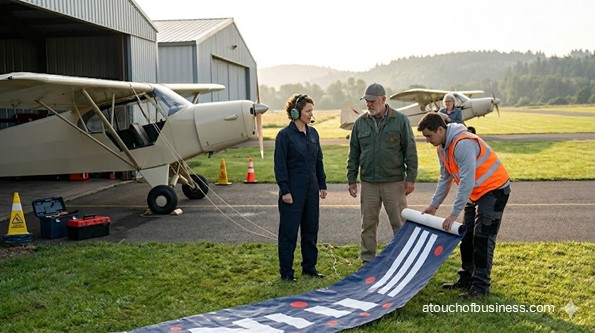
You also need flat, clear ground space at or near the airfield for banner assembly. Banners are laid out on the ground before pickup, and the layout area needs to be large enough to accommodate the longest banner you plan to tow.
Step 8: Set Up Banner Production or Establish a Supplier
Before you can deliver a campaign, you need banners. Decide whether to produce in-house or outsource before you take your first booking.
In-house banner production requires a layout area, a full set of letter panels (individual reusable letters, typically seven feet tall), lead poles, tow line assemblies, and storage. The upfront inventory investment is meaningful, but once in place, letter-based banners can be reused across many campaigns with minimal ongoing cost.
Outsourcing to an aerial banner manufacturer eliminates the inventory investment but adds per-campaign cost and lead time. Custom full-color graphic banners typically require at least two weeks of production time. Plan your booking window and client briefing timeline to account for that.
Many operators handle letter banners in-house and outsource full-color or logo-based graphic banners. That hybrid approach keeps recurring costs reasonable while giving clients more design options.
Identify at least one reliable banner supplier with confirmed lead times before you accept your first paid campaign. A client brief that arrives with a tight deadline and no banner production plan is a delivery problem waiting to happen.
Step 9: Staff Your Ground Crew and Arrange Pilots
A banner tow flight requires a trained ground crew as well as a qualified pilot. Before your first campaign, both need to be in place and practiced.
Ground crew members assemble the banner, lay it out in the pickup zone, and retrieve it after the flight. At minimum, one to two trained crew members are needed per flight. Depending on your market and season, ground crew can be hired part-time or seasonally.
Pilots must hold a Commercial Pilot Certificate and a valid second-class FAA medical certificate. Before any pilot conducts revenue flights under your operation, they must complete your company’s banner tow training program. This is both an FAA CoW requirement and standard industry practice. Training typically runs two to three weeks and is conducted by an experienced banner tow pilot.
If you’re hiring pilots as employees rather than independent contractors, you’ll need to handle state employer registration, payroll tax setup, and workers’ compensation. Check with an employment attorney or your state’s labor department for guidance specific to aviation workers.
Some states also require operators to submit pilot names, certificate numbers, and ratings to the state aeronautics division as part of an aeronautical activity license. Verify whether your state has this requirement before your first hire.
Step 10: Get the Right Insurance Coverage in Place
Aviation insurance is not optional, and general commercial insurance doesn’t cover it. You need aviation-specific coverage in place before the aircraft leaves the ground.
The core coverage types to secure are:
- Aircraft liability insurance: Covers third-party bodily injury and property damage from flight operations. Airport operators and clients — especially advertising agencies — will require proof of this coverage before you can fly or book campaigns.
- Hull insurance: Covers physical damage to the aircraft itself, both in-flight and on the ground.
- Ground risk hull insurance (not in motion): Covers the aircraft while stationary against fire, hail, vandalism, and hangar collapse.
- Workers’ compensation: Required in most states if you have employees, including pilots and ground crew.
- General business liability: Covers non-aviation business risks.
Use an aviation insurance specialist or broker. General commercial brokers often don’t have access to aviation-specific markets. Agency clients frequently require proof of liability limits of $1 million or more as a condition of booking.
Get insurance quotes early in the startup process. The premium depends on aircraft type, pilot experience, geographic operating area, and intended use. Understanding your coverage options before you commit to an aircraft purchase helps you model the true cost of ownership.
Step 11: Set Up Pricing, Contracts, and Client Operations
Before you approach a single client or agency, your delivery process needs to be defined. Clients in the B2B advertising space expect a clear scope, a professional proposal, a signed agreement, and proof the campaign ran.
Pricing in aerial advertising is typically structured as:
- Per flight hour or per campaign day, adjusted by market, banner type, and route complexity
- Separate line items for banner production when a new or custom graphic banner is required
- Ferry fees for markets that require the aircraft to travel from its base to the operating area
Your pricing must account for aircraft operating costs (fuel, maintenance reserves, insurance proration), pilot and ground crew labor, banner production or reuse amortization, and a margin that covers slow periods and weather cancellations.
Build a clear weather rescheduling policy into your service agreement before you open for bookings. The no-fly, no-pay policy — where clients aren’t charged for flights that don’t happen due to weather — is common industry practice. It protects client trust but means you absorb the cost of a cancelled day. Your pricing needs to reflect that reality.
Your standard client contract should cover:
- Campaign scope: flight window, route, duration, and banner specifications
- Weather rescheduling and cancellation terms
- Proof of performance: GPS tracking data, flight logs, and photography when available
- Payment terms, including net-30 or net-60 for agency clients
- Revision and change request process for banner specifications or flight adjustments
Agency clients will often ask for flight reports after the campaign. Build that delivery step into your process from the start. A GPS-tracked flight log with a time-stamped route is the standard proof-of-performance tool in this industry.
Set up a merchant account for client payment processing and an invoicing system that handles net-term billing. Agency clients paying on net-30 or net-60 terms create a cash flow gap between campaign delivery and payment — plan for that in your working capital needs.
Step 12: Apply for Local Business Licenses and State Aviation Requirements
Before you take the first booking, confirm that your local and state registration requirements are satisfied.
Obtain a general business license in your city or county of operations. Requirements vary by jurisdiction — check with your local city or county clerk’s office.
State-level aeronautical licensing requirements vary and must be verified:
Some states require a specific aeronautical activity license for commercial aerial advertising operators. New Jersey, for example, requires operators to provide aircraft logbooks, pilot certificate numbers, and a copy of the FAA CoW to the state aeronautics division.
Search “[your state] aeronautical activity license aerial advertising” or contact your state’s aeronautics division directly to confirm whether this requirement applies to you.
Also confirm that your airfield base is in a location properly zoned for commercial aviation operations. This is typically covered through the FBO or airport management agreement, but verify it explicitly.
Step 13: Complete Pre-Opening Readiness and Run a Test Flight
Before your first revenue campaign, run through the full operational sequence once without a paying client involved.
Conduct a test tow flight with a banner. Verify aircraft performance, tow equipment function, banner pickup and release procedures, and pilot proficiency. Run the ground crew through the full layout-to-retrieval sequence. Identify anything that needs adjustment before client campaigns are on the schedule.
Confirm the following are in place before your first revenue flight:
- FAA CoW J550 received and on file
- Aircraft annual inspection current; airworthiness certificate in aircraft
- Commercial Pilot Certificate and second-class medical current for all pilots
- Aviation liability and hull insurance bound; certificates issued
- Tow hook and release mechanism FAA-approved and documented in logbook
- Workers’ compensation and general liability in place
- State aeronautical activity license obtained where applicable
- Banner inventory or supplier confirmed with lead times established
- Client contract template finalized
- GPS tracking and flight reporting system operational
- Flight record log system established for required 12-month retention
Your first client conversation is a delivery commitment. Every item on that list needs to be resolved before you make one.
Business Plan
The business plan for an aerial advertising operation needs to address several variables specific to this model: heavy asset acquisition up front, a seasonal revenue pattern, regulatory approval timelines, and a B2B client base that pays on net terms rather than immediately.
Start with the model decision. Whether you own aircraft, lease them, or operate as a broker determines everything downstream — your capital requirement, your fixed cost structure, and your revenue ceiling per season.
Work through your cost structure before you settle on pricing. Aircraft ownership, hangar or tie-down fees, hull and liability insurance premiums, pilot labor, ground crew costs, fuel, maintenance reserves, and banner production expenses all need to be in your cost model before you quote a client. Pricing that doesn’t account for all of these will generate revenue while losing money.
The break-even question in this business isn’t just about how many flights you need per season. It’s also about whether your market has enough high-demand weekends and event windows to physically deliver that many flights. A market with eight high-crowd weekends per season has a hard ceiling on revenue potential, regardless of how well you price the work.
Model your slow periods honestly. What does your cash flow look like in the off-season, when no flights are happening but hangar fees, insurance, and loan payments continue? How long can you carry those fixed costs without revenue before the business becomes unsustainable?
Factor in weather cancellations. If you operate a no-fly, no-pay policy — and most operators do — a stretch of bad weather during peak season eliminates revenue you’ve already planned for. Your working capital buffer needs to absorb that without forcing you to cut essential costs like maintenance.
On the client side, agency payments on net-30 or net-60 terms mean you may deliver a campaign and wait up to two months for payment. Your cash flow plan needs to account for that gap, especially early on when you don’t have multiple campaigns flowing at different payment stages.
Funding options include self-funding, small business loans, and aircraft-specific financing through aviation lenders. Note that some general small business lenders won’t finance used tow aircraft. Aviation-specific lenders are more familiar with this asset class. Get pre-qualified before you commit to an aircraft purchase.
For more on structuring the financial side of your plan, see this guide on estimating startup profitability.
Opening-Day Red Flags
These are the readiness gaps that most commonly turn a first campaign into a problem. Check each one before you confirm any booking.
The FAA CoW is not yet in hand:
No revenue flights without it. If the waiver is still processing, the launch date moves. Confirming a campaign booking before the CoW is issued creates a commitment you can’t legally fulfill.
The towing equipment documentation isn’t complete:
If the FAA-approved tow hook and release mechanism installation isn’t documented in the aircraft logbook, the aircraft isn’t cleared for towing operations. Verify this before the first flight, not during preflight for the first paying campaign.
Pilots haven’t completed banner tow training under your operation:
A Commercial Pilot Certificate alone doesn’t clear a pilot to tow banners under your CoW. Each pilot must complete your company’s banner tow training program before conducting revenue flights. If that training isn’t finished, the pilot can’t be dispatched.
Ground crew hasn’t been trained and practiced:
A banner pickup depends on the ground crew laying out the grapple assembly precisely. A crew that hasn’t practiced the sequence before a live campaign introduces failure risk at the most visible point of the delivery process — the moment your client’s banner is supposed to be in the air.
The proof-of-performance process isn’t set up:
Agency clients and brand managers expect a flight report after the campaign. If your GPS tracking device isn’t confirmed operational and your reporting format isn’t ready, you’ll deliver the flight but fail the handoff. Set this up before your first booking.
Your contract doesn’t cover weather cancellation clearly:
If your service agreement doesn’t specify what happens when weather grounds the flight, the first cancellation will produce a client dispute. Establish the rescheduling or no-fly, no-pay policy in writing before it becomes an issue.
Insurance certificates aren’t ready to send:
Agency clients frequently require proof of insurance before issuing a purchase order. If your certificates aren’t ready when the client asks, the booking stalls. Have certificates ready before you pitch any agency account.
Frequently Asked Questions
Do I need to be a pilot to own and operate an aerial advertising business?
Not necessarily. You can own and manage the operation without flying yourself, but you must employ or contract at least one commercially rated pilot with banner tow training and a current second-class FAA medical certificate.
If you plan to fly the campaigns yourself, you need a Commercial Pilot Certificate, which requires a minimum of 250 flight hours.
What does the FAA Certificate of Waiver actually cover, and how long does it take to get?
The CoW J550 issued under 14 CFR § 91.311 authorizes your specific operation — including the aircraft, pilot list, and geographic area — to conduct banner towing commercially. It’s valid for approximately 24 months.
The FAA recommends submitting the application at least 45 days before planned operations. Actual processing times vary by FSDO workload and the complexity of your proposed operating area.
Can I operate in multiple geographic markets under one CoW?
Your CoW J550 covers a specific geographic area under the jurisdiction of a particular FSDO. For operations in a new area under a different FSDO’s jurisdiction, you must coordinate with that office separately.
Multi-market operations typically require either multiple FSDO coordinations or working with established subcontractors who already hold waivers in those markets.
What is the most practical aircraft for starting a banner towing operation?
The Piper PA-25 Pawnee is the industry standard. Its low stall speed, purpose-built handling characteristics, and strong performance at low speed under full power make it well suited to banner pickup and towing.
Other aircraft used in the industry include the Cessna 180 and 182, the Piper Super Cub, and the Citabria. The right choice depends partly on the banner sizes you plan to tow. Have any candidate aircraft inspected by an A&P mechanic familiar with that specific type before purchase.
Is aerial advertising a year-round business or seasonal?
In most U.S. markets, it’s strongly seasonal. Revenue concentrates in warmer months and around outdoor events.
Coastal markets in Florida and Southern California have longer viable flying seasons than northern or inland markets. Plan your cash flow and fixed costs around a realistic season length for your specific geography rather than assuming year-round revenue.
How do advertising agencies typically buy aerial advertising services?
Agencies placing campaigns for clients typically request a proposal or quote, then issue a purchase order or campaign contract. They expect invoicing with net payment terms — commonly net-30 or net-60.
They often require proof of insurance and post-campaign proof-of-performance documentation, typically GPS flight logs and a flight report. Building relationships with media buyers at agencies that run outdoor and experiential campaigns is central to the B2B revenue model.
Do I need to produce my own banners, or can I outsource that?
Both models work. In-house production requires a banner layout space, a full letter panel inventory, and assembly know-how. The advantage is lower per-campaign cost and faster turnaround on repeat bookings using standard letter banners.
Outsourcing eliminates the upfront inventory investment but adds per-campaign cost and typically requires at least two weeks of lead time for custom graphic banners. Many operators produce letter banners in-house and outsource full-color graphic banners.
What happens when weather forces a flight cancellation?
The no-fly, no-pay policy — where clients aren’t charged for flights that don’t happen due to weather — is common industry practice. It protects client trust but means you absorb the cost of a cancelled day.
Your pricing and working capital planning must account for weather cancellation frequency in your market, especially during shoulder seasons with variable conditions.
Advice From Aerial Advertising Business Professionals
The resources below come from real pilots and operators who have worked in the aerial advertising industry. They cover the day-to-day realities of banner towing, what running the operation actually looks like, and how the business works from the inside.
Before you read industry guides or review regulatory filings, spend time with these accounts. The people who have done the flying and managed the campaigns will give you a clearer picture of what you’re getting into than any checklist can.
Should You Become a Banner Tow Pilot? — with Joe Myers of Aerial Banners Inc.
Joe Myers is a commercial pilot with hundreds of hours towing banners for Aerial Banners Inc., one of the largest nationwide aerial advertising operators in the U.S.
This episode of the Aviation Careers Podcast covers what daily banner tow operations actually look like from the pilot’s seat — the pickup technique, the flight routine, and the physical and scheduling demands of the job.
Joe discusses what training to become a banner tow pilot involves and what operators look for when hiring commercial-rated pilots for towing work.
He also covers the challenges and rewards of the work — including why pilots who tow banners often describe it as among the most enjoyable flying they’ve done at the low-time stage of their careers.
If you’re building a startup around banner towing and need to understand the pilot’s role from someone who has lived it, this is a direct and practical starting point.
It’s a Bird! It’s a Plane! It’s Actually a Plane Pulling a Banner — Minnesota Star Tribune
Daniel Felt is the owner of Aerial Banners, a banner towing company he acquired in June 2024 when he purchased Big Aerial Sign Services, a long-running Minnesota operation, from its retiring founder.
This Star Tribune feature follows Felt across a full campaign day — from banner assembly at Forest Lake Airport through banner pickup and flight — giving a ground-level view of how a real operation runs.
Felt discusses the seasonal rhythm of the business, including moving his Piper PA-25 Pawnees to Florida for the winter beach season and bringing them back to Minnesota for the summer festival and event circuit.
He explains the client mix firsthand — from car dealerships and insurance agencies to political campaigns and marriage proposals — and describes how the business positions aerial advertising against digital and traditional media for local clients.
For a new owner thinking through how the business actually operates across a full season, Felt’s account is one of the most current and specific owner-level views available.
Interview: From Banner Tow Pilot to a Job with Era Alaska — Oddball Pilot
Aidan Loehr, a commercial pilot with more than 17,000 hours of professional flying experience, conducts this interview with a pilot who towed banners along the New Jersey Shore for Paramount Air before moving on to regional aviation in Alaska.
The interview covers what banner tow training actually involves and what operators are looking for in a pilot candidate before they’ll put someone in a tow plane.
The pilot explains how the hook and boom systems work, why banner towing planes need near-constant maintenance attention, and what conditions affect whether flights happen on a given day.
He also discusses the living and working realities of seasonal banner tow operations — including why most operators don’t fly early mornings and what it’s actually like to staff and run a regional operation through a summer season.
This is a frank, experience-based account that gives prospective owners a practical picture of the staffing, equipment, and operational realities that don’t always show up in regulatory guides or startup checklists.
Related Articles
- How To Start a Mobile Billboard Company
- How To Start an Advertising Agency
- How To Start an Aerial Photography Business
- How To Start a Drone Racing Business
- How To Start a Helicopter Tour Business
Sources:
- FAA (Federal Aviation Administration): 14 CFR § 91.311 Banner Towing, CoW J550 Banner Tow Waiver Notice, FAA Form 7711-2, Order 8900.1 Banner Tow Operations
- REGULATIONS.JUSTIA.COM (New Jersey Admin Code): NJ Aerial Advertising Licensing Requirements
- AERIALBANNERS.COM: Aerial Advertising Permit Requirements, Banner Tow Pilot Training, What Is Aerial Advertising
- ADQUICK.COM: Aerial Banner Advertising Overview & Pricing
- DASHTWO.COM: Aerial Advertising Formats & Costs Guide
- BLUELINEMEDIA.COM: Aerial Banner Pricing & Operational Factors
- AVGEEKERY.COM: Piper Pawnee Banner Towing Aircraft
- AIRPLANEACADEMY.COM: Commercial Pilot License for Banner Towing
- AVIATIONCONSUMER.COM: Tow Plane Aircraft Guide
- TRUSTEDCHOICE.COM: Aviation Liability Insurance Guide
- HENRIOTT.COM: Commercial UAS/Drone Insurance Guide
- MARKETINGBREW.COM: Drone Banner Advertising FAA Approval
- SMARTCITIESDIVE.COM: Drone Advertising Regulatory Landscape
- VERIFIEDMARKETREPORTS.COM: Aerial Advertising Market Overview 2026–2034
- BEACHBANNERS.COM: Beach Banners Operator Model Reference
- FAA.GOV (SAFO): FAA SAFO15002 Banner Tow Safety Alert