
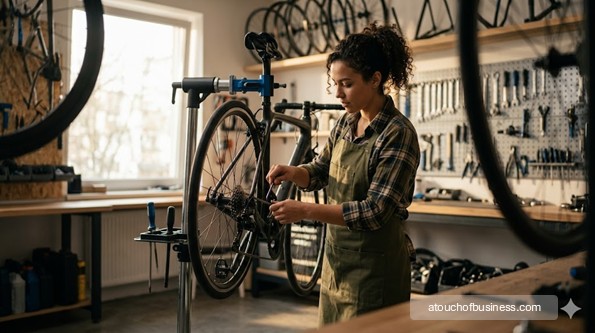
What to Expect From This Guide to Starting a Bicycle Repair Business
This guide provides an ordered path through the decisions and practical preparations involved in starting a bicycle repair business. It moves from skills and business-model choices toward shop systems, customer protection, and a tested opening process, with the bullets highlighting only selected areas.
Inside the guide, you will find:
- Startup roadmap: Move from skill assessment and market research through registration, location, tools, software, insurance, pricing, and a soft opening.
- Owner interviews: Hear from repairers and shop operators discussing mobile service, customer flow, demand swings, specialization, and different business models.
- Startup FAQs: Review answers about licensing, mechanic credentials, wholesale access, bailee’s insurance, sales tax, e-bike service, software, and buying a shop.
- Technical fit: Measure your repair skills, seasonal workload tolerance, physical demands, customer responsibility, and ability to manage backlogs accurately.
- Shop operations: Plan professional tools, parts inventory, workshop layout, work orders, bike histories, payment systems, and repair-status tracking.
- Financial planning: Calculate break-even service volume, service mix, seasonal reserves, local pricing, inventory commitments, and realistic owner capacity.
- Opening checklist: Confirm zoning, permits, insurance, supplier accounts, equipment, intake forms, payment processing, safety items, and a complete test repair.
The article opens with the mechanical ability, personal commitment, and seasonal income questions that should be settled before money is committed.
How to Start a Bicycle Repair Shop
A bicycle repair shop is a workshop-based service business where you diagnose, repair, and maintain customers’ bicycles.
Most revenue comes from labor — tune-ups, overhauls, flat repairs, brake bleeds, and wheel work — along with parts sold incidental to service.
The startup process for a bicycle repair shop is more hands-on and technical than most service businesses. You’ll need mechanical skill, the right tools, the right location, and enough operating capital to survive the slow season before the busy one arrives.
Is This Business a Good Fit for You?
The most important question isn’t whether you can find customers. It’s whether you can do the work at a professional level before you charge anyone for it.
A bicycle repair shop lives or dies on the quality of the repairs. Customers bring in bikes worth hundreds or thousands of dollars and trust you to return them in better shape than they arrived. If your diagnostic skills aren’t sharp, that trust breaks fast.
Most people think running a bike shop sounds like getting paid to do something you love. That’s partly true — but the reality is long days during peak season, physically demanding bench work, and months of slow revenue in the off-season while fixed costs keep running.
Ask yourself these questions honestly before going further:
- Can you independently diagnose and repair drivetrains, braking systems, wheels, and headsets at a professional level right now?
- Can you cover your personal living expenses for six to 12 months on irregular income?
- Does your household support the financial risk and the time commitment?
- Can you handle a 10-hour day during peak season while managing a backlog of customer bikes, parts orders, and walk-in inquiries at the same time?
If your mechanical skills need development, close that gap before opening — not after.
Talk to bicycle shop owners in non-competing markets before you commit to anything. Ask them about their daily reality, what surprised them most, how slow the winters get, and whether they’d do it again. Firsthand owner insight is worth more than any business plan projection. Prepare your questions ahead of time, and choose owners you won’t be competing against.
Also think through your entry path. Starting from scratch gives you full control but requires building a customer base from zero.
Buying an existing shop can give you an established customer list, working supplier accounts, and tools already in place — though you’ll need to verify the actual revenue, inspect the equipment, and review the lease carefully.
Franchise options in the bicycle space are limited; check current availability before assuming that path is open to you.
The best path depends on your budget, your timeline, how much support you want at launch, and what’s available in your market. There’s more on weighing those options if you want a framework for the decision.
Red Flags Before You Start
Some warning signs are worth checking before you invest in tools, sign a lease, or form an entity.
Weak local demand is the most decisive factor:
- Is there visible cycling activity in your target area — commuters, trail users, recreational riders?
- Are there bike lanes, greenways, or cycling infrastructure that suggest an active community?
- Do established shops in the area have long wait times? Long waits signal demand that isn’t being met. Short waits with satisfied customers signal a tougher market to enter.
If the local market has few cyclists and no real cycling infrastructure, the service volume needed to cover your fixed costs may not be there.
Other warning signs worth pausing on:
- You don’t yet have professional-level mechanical skills and can’t afford to hire a skilled mechanic from day one.
- Your available capital won’t cover three to six months of fixed costs beyond startup — enough to survive from one slow season to the next busy one.
- You can’t establish a wholesale distributor account, which requires a business entity, EIN, physical commercial address, and resale certificate. Without wholesale access, parts margin disappears entirely.
- You plan to also sell new bikes but haven’t accounted for the inventory commitments, margin compression, and supply chain risk that new-bike retail currently carries.
- You’re signing a lease without renewal options — a shop that builds a loyal customer base is tied to its location.
None of these automatically means don’t start. They mean verify first, then commit.
Step 1: Assess Your Skills and Fit
Skill is the foundation of a repair shop. If you can’t competently diagnose a drivetrain problem, true a wheel, press a bottom bracket, or bleed hydraulic brakes, you aren’t ready to charge customers for those repairs.
Certification from the United Bicycle Institute (UBI) — the largest trainer of certified bicycle mechanics in the U.S. — or completion of Park Tool School clinics demonstrates technical competence and adds credibility with customers.
Certification isn’t legally required, but it signals that you’ve been trained to a professional standard. It also helps when you need to credential hired mechanics later.
Beyond wrenching, think about the full picture of running a shop: customer communication, managing a backlog of work orders, ordering parts, and handling complaints when something goes wrong. These are daily responsibilities, not occasional ones.
Step 2: Decide on Your Business Model First
Most people think a bike shop is a bike shop. In practice, the model you choose before you spend a dollar shapes every other decision — your location size, lease cost, inventory investment, supplier relationships, and staffing needs.
Three common models for a repair-focused shop:
- Service-only shop: repairs and tune-ups with minimal retail parts sales. Lower inventory cost, lower revenue ceiling per customer.
- Service plus retail parts and accessories: broader revenue from consumables, tubes, tires, locks, lights, and helmets alongside repair work.
- Service plus new bike sales: highest inventory cost and complexity; requires manufacturer dealer agreements with minimum stocking and display requirements.
For most first-time owners, a service-focused model with a parts and accessories component is the most manageable starting point.
Also decide whether you’ll offer e-bike service. E-bike adoption is growing, and many shops still lack trained technicians. Offering it can differentiate your operation — but it requires specific training and additional tools. Some motor brands also require authorized service status before granting access to diagnostic software and warranty parts.
Step 3: Research Local Demand and Competition
Demand for bicycle repair has held up well compared to new bike sales, which went through a severe post-pandemic inventory glut from 2023 through 2025.
Repair-focused shops are relatively insulated from that volatility — but only if the local customer base is actually there.
Map the cyclists in your target area. Look for commuters, recreational riders, mountain bikers, families, and e-bike owners.
Visit existing shops, look at their reviews, and get a sense of their service wait times. A two-to-four-week wait for a tune-up during peak season means demand is outpacing capacity — that’s an opening.
A shop with fast turnaround and strong word of mouth means you’ll need a clear reason for customers to choose you instead.
Also look at proximity to cycling infrastructure: trails, bike lanes, commuter corridors, universities, and parks. These are reliable demand indicators for a walk-in repair shop.
Learning about local supply and demand before committing to a location can save you from a costly mistake.
Step 4: Write Your Business Plan
A solid business plan for a bicycle repair shop is less about projections and more about making sure the math works before you sign anything.
Define your service menu: basic tune-ups, major tune-ups, full overhauls, flat repairs, brake bleeds, cable replacements, wheel truing, wheel building, and any specialty work like suspension service or e-bike diagnostics.
Then map your costs. What are your fixed monthly expenses — rent, utilities, insurance, payroll if you’re hiring, and software subscriptions? How many service tickets per week does that require at your planned pricing?
That’s the break-even question you must answer before committing to a space.
A solo owner-operator has a fixed ceiling on how many bikes can be serviced in a day. If your fixed costs require more volume than one mechanic can realistically handle, either the rent is too high, the pricing is too low, or both.
Service mix matters too. Full overhauls carry much higher labor value than flat repairs or minor adjustments. Plan a schedule that includes higher-value work, not just the quick jobs that are easiest to fill.
Plan for seasonality. In most U.S. markets, spring and summer are peak season — wait times can stretch to two to four weeks. Fall and winter are significantly slower.
You need three to six months of operating capital beyond startup costs to survive the slow months before the next busy season arrives.
For more on building out the financial side of the plan, see how to write a business plan.
Step 5: Choose a Legal Structure and Register the Business
Most bicycle repair shop owners choose an LLC because repair work carries real liability exposure. If a repair fails and a customer is injured, a sole proprietorship leaves your personal assets unprotected.
A sole proprietorship is simpler and costs less to form, but it offers no separation between your personal finances and the business. Given the nature of bicycle repair, consult an attorney or business advisor before deciding.
Once you choose a structure, register the entity with your state’s Secretary of State or equivalent office. Then obtain an EIN from the IRS — you’ll need it to hire employees, open a business bank account, and establish wholesale supplier accounts.
If you’re operating under a trade name different from your legal entity name, you’ll need to file a DBA. Requirements vary by state and county.
Step 6: Find and Confirm Your Location
Your shop needs commercial or mixed-use zoning. Some light industrial zones also permit retail service businesses — but verify that the specific zoning designation permits your use before signing anything.
Before committing to a space, confirm:
- Zoning allows a retail service business at that address.
- A certificate of occupancy is in place and covers your intended use — after any build-out changes, a new certificate may be required.
- The space has adequate ventilation for solvents and degreasers used in repair work.
- Customers can bring bicycles in easily — ground-floor access, adequate door width, and nearby parking or secure bike racks matter.
- The lease includes renewal options. A shop that builds a loyal customer base can’t afford to lose its location at the end of a short lease.
For a repair-focused shop, a realistic starting footprint is 600 to 1,200 square feet for a modest operation. A service-plus-retail layout typically needs 1,500 to 3,000 square feet or more.
The right size depends on your service volume and retail ambition.
Also check signage rules with both the landlord and your local municipality before installing anything. Most jurisdictions require a permit for exterior signs, and size, placement, and illumination rules vary.
Step 7: Handle Licensing, Tax Registration, and Compliance
There’s no federal license specific to bicycle repair. Compliance requirements are primarily local and state-level.
What you’ll typically need before opening:
- A general business license from your city or county — check with the city or county clerk for requirements in your jurisdiction.
- A state sales tax permit. Most states require you to collect sales tax on parts sold. How labor is taxed varies significantly — some states tax it, some don’t, and some require labor to be separately itemized on invoices to receive different tax treatment. Check with your state’s Department of Revenue for the correct rules.
- A resale certificate so you can purchase parts from wholesale distributors without paying sales tax at the point of purchase.
- State employer accounts if you’re hiring employees at launch — this covers income tax withholding and unemployment insurance.
If you’re leasing a commercial space, your landlord is generally responsible for the certificate of occupancy — but confirm it covers your specific use as a bicycle repair shop.
See the full rundown on business licenses and permits for a broader overview of what registration typically involves.
Step 8: Set Up Supplier and Distributor Accounts
Without a wholesale distributor account, you’ll be buying parts at retail prices. That eliminates parts margin and makes it very difficult to price competitively while staying profitable.
Quality Bicycle Products (QBP) is the dominant wholesale distributor for independent bicycle retailers in North America. For a repair-focused shop, a QBP account covering consumables — tubes, tires, chains, cables, brake pads, and common replacement parts — is often the most important account to set up at launch.
Other distributors include J&B Importers/Alliance Distributors and Hawley-Lambert. To open any wholesale account, you’ll typically need your business entity registration, EIN, a physical commercial address, and a valid resale certificate.
Understand the minimum order requirements before planning your inventory commitments. Some distributors have purchasing minimums that affect cash flow.
If you plan to offer e-bike service, note that some motor system brands — Bosch, Shimano, and others — require you to complete authorized service training and register as an authorized service center before granting access to proprietary diagnostic software and warranty parts.
Step 9: Equip the Workshop
A professional bicycle repair shop is built around the bench. Every mechanic needs a dedicated repair stand, an organized tool panel, and a complete professional tool set before the first customer bike comes through the door.
Park Tool is the industry-standard brand used by professional mechanics. A complete bench setup includes:
- Floor-mount or clamp-mount repair stands — one per mechanic
- Full hex/Allen key set in T-handle style, covering all common sizes
- Torx key set (T25 is most common; other sizes vary by component)
- Torque wrench — essential for carbon frames, stems, and precision fasteners
- Cone wrenches, pedal wrench, and adjustable wrenches
- Chain tools and chain wear indicator gauges
- Spoke wrenches in multiple nipple sizes
- Cassette removal tool and chain whip
- Bottom bracket tools — coverage across multiple standards is required: BSA threaded, PF30, BB386, T47, and others
- Headset press and cup remover, fork crown race setter
- Cable cutters and housing cutters
- Derailleur alignment gauge
- Wheel truing stand, dishing gauge, and spoke tension meter
- Hydraulic brake bleed kits — mineral oil version and DOT fluid version, since different brake brands use different fluids
If you’re offering e-bike service, add diagnostic interface tools specific to the motor systems you’ll be servicing, a multimeter, and battery testing equipment.
Workshop supplies to stock before opening:
- Wet and dry chain lube, grease, anti-seize, and carbon paste
- Degreaser and biodegradable solvent cleaner
- Chain cleaning kit, shop rags, nitrile gloves, and eye protection
- Thread-locking compound, zip ties, cable end caps, and electrical tape
Safety equipment is not optional. Install a fire extinguisher rated for flammable liquid fires, stock a first-aid kit, and ensure the space has adequate ventilation.
If you’ll have employees, post the required OSHA safety information.
Layout matters more than most new owners expect. Plan the flow from customer intake to the workbench to parts staging to the pickup counter before you set up. A clear layout reduces turnaround time and helps prevent a bike from sitting past its promised completion date.
Step 10: Get Your Technology and Operations Ready
A general retail POS system won’t serve a repair shop well. You need software that manages work orders, tracks customer bike histories, handles parts-to-labor billing, and shows the status of every job in the queue at a glance.
Bicycle-specific platforms include Lightspeed Retail with WorkMate integration, Ascend by TCS, RetailEdge, and Orderry. Evaluate options based on your expected volume and whether you plan to add retail sales alongside service.
Before you take a single customer bike, your intake process needs to be airtight. Every work order should document the customer’s contact information, the bike description, the serial number, the bike’s condition at intake, the authorized scope of work, the estimated cost, the expected completion date, and the customer’s signature authorizing the work.
This protects you when a customer disputes an estimate, claims pre-existing damage, or requests repairs that weren’t discussed at intake.
Set up accounting software separately from or integrated with your POS. Keep business finances completely separate from personal ones from the first day you spend a dollar on the business.
Step 11: Fund the Business and Open a Bank Account
Startup costs for a bicycle repair shop vary significantly depending on your market, your lease terms, whether you’re buying used tools or new, your opening inventory level, and whether you’re hiring staff from day one.
The main cost categories to plan and price out:
- Security deposit and first month’s rent
- Leasehold improvements and build-out: workbench installation, tool panels, customer area, ventilation if needed
- Professional tool kit — new vs. used makes a significant difference; experienced mechanics who already own a complete toolkit reduce this cost substantially
- Repair stands — one per mechanic
- Wheel truing stand and supporting wheel-build tools
- Opening parts inventory: tubes, tires, chains, cables, housing, brake pads, and common hardware
- POS software setup and ongoing monthly subscription
- Computer, receipt printer, card reader, and label printer
- Exterior signage (permit required in most jurisdictions)
- Business registration and legal fees
- Insurance premiums — first-term payment due before you open
- Operating capital reserve — three to six months of fixed costs beyond startup
Common funding sources include personal savings, SBA 7(a) loans, equipment financing for major tool purchases, and seller financing if buying an existing shop.
Your local Small Business Development Center (SBDC) or SCORE chapter offers free counseling and can help you assess loan readiness before you apply. If you need a business loan, understand the terms and repayment requirements before committing.
Open a dedicated business bank account before any money moves. Keeping business and personal finances completely separate from day one protects your liability shield and makes accounting far less painful.
Step 12: Get Your Insurance in Place
Insurance for a bicycle repair shop has one coverage that most new owners overlook: bailee’s insurance.
Bailee’s coverage — sometimes called bailee’s customer insurance — pays to repair or replace customers’ bikes that are damaged, stolen, or destroyed while in your care.
Standard commercial property insurance does not cover property belonging to others. Without bailee’s coverage, you’re personally responsible if a customer’s bike burns in a shop fire or disappears in a break-in.
The coverage you need before accepting a single customer bike:
- General liability insurance: covers third-party bodily injury and property damage — customer slip-and-falls, a repair that fails and causes an injury. Also commonly required by commercial landlords as a lease condition.
- Bailee’s customer insurance: covers customer bikes in your possession.
- Commercial property insurance: covers your tools, equipment, and inventory against fire, theft, and covered losses.
- Workers’ compensation insurance: required in most states if you have employees. Some states require it even for a single employee. Verify your state’s threshold with your state’s workers’ compensation board.
Also ask your insurance agent about professional liability coverage — sometimes called errors and omissions — for claims that your repair work caused harm. Given the nature of the business, it’s worth the conversation.
More on what to look for when comparing policies is covered in our business insurance guide.
Step 13: Build Your Identity and Set Up the Shop for Customers
Before you open, you need a few things in place so customers can find you and trust you from the start.
- Register your business name and confirm no trademark conflicts exist.
- Register a domain and build a simple website listing your services, location, hours, and contact information.
- Set up and verify a Google Business Profile so you appear in local map searches — this is how most walk-in customers find a local repair shop for the first time.
- Install exterior signage after confirming the sign permit is approved.
- Post a customer notice explaining your policy on unclaimed bikes. Consult an attorney on the appropriate language for your jurisdiction.
- Create a printed or in-shop service pricing display so customers know what to expect before they hand over their bike.
Step 14: Join the Industry and Connect with Peers
The National Bicycle Dealers Association (NBDA) is the trade organization for independent bicycle retailers and service shops. Membership gives you access to industry data, business templates, vendor discount programs, payment processing deals through partner programs, and peer networking with other shop owners.
The resources — especially the peer forums and market data — are genuinely useful during the startup and early operating phases.
Also consider e-bike technician training through the Light Electric Vehicle Association (LEVA) if you plan to offer electric bike service. LEVA offers four levels of training and certification, from basic introduction to advanced component-level diagnostics.
Step 15: Pre-Opening Checklist and Soft Launch
Don’t take a paying customer’s bike until every item on this list is confirmed.
Legal and compliance:
- Business entity registered and EIN obtained
- DBA filed if operating under a trade name
- General business license obtained from city or county
- Sales tax permit registered with your state tax authority
- Resale certificate obtained
- State employer accounts open if hiring at launch
- Zoning confirmed for your specific address and use
- Certificate of occupancy confirmed and covers your use
- Signage permit approved before any exterior sign goes up
Operations and insurance:
- General liability insurance in force
- Bailee’s customer insurance in place before the first customer bike enters the shop
- Commercial property insurance in place
- Workers’ compensation in place if you have employees
- All wholesale distributor accounts active
- Opening parts inventory stocked and counted
- Full professional tool set in place, organized, and tested
- Wheel truing stand calibrated
- POS software installed and tested end-to-end
- Work order intake forms or digital workflow ready
- Service menu finalized and displayed at the counter
- Payment processor tested with a live transaction
- Fire extinguisher installed; first-aid kit stocked
- Accounting software connected
- Website live; Google Business Profile verified
Before your public opening, run at least one complete repair through the system from intake to pickup. Use the test to find gaps in your workflow — missing intake fields, payment steps that don’t connect to the POS, or unclear handoff between repair completion and customer notification.
A soft opening with a small group of known customers is worth doing. It’s far better to discover a process gap with a friend’s bike than with a stranger’s.
Business Plan
A business plan for a bicycle repair shop is really a set of decisions you make before you spend serious money. The goal is to answer the questions that determine whether the model works before you commit to a lease, tools, or inventory.
Start with the break-even calculation. List your projected fixed monthly costs: rent, utilities, insurance, payroll if applicable, software subscriptions, and any loan payments.
Then figure out how many service tickets per week, at your planned pricing, it takes to cover those costs. That number tells you whether your chosen location is viable.
A solo owner-operator has a ceiling on billable hours. If break-even requires more service volume than one mechanic can realistically complete, either the rent is too high, the pricing is too low, or both.
Factor in the service mix. Full overhauls and complex repairs generate significantly more labor value than basic tune-ups or flat repairs. Plan to build a schedule that includes higher-value work, not just the quick jobs that are easiest to fill.
Plan for slow months. In most markets, winter is significantly slower than spring and summer. Your operating capital reserve needs to cover fixed costs through the off-season without putting you in a cash crisis before the busy season returns.
On pricing, research what established shops in your region charge for the same services. Underpricing attracts volume but compresses labor margins that are already thin. Overpricing in a price-sensitive market drives customers away.
The right price reflects your skill level, your overhead, and what the local market supports.
Parts pricing uses a markup over wholesale cost. Your markup needs to cover the cost of carrying inventory, the occasional part that doesn’t sell, and the administrative overhead of ordering and receiving.
Understand your distributor’s minimum order terms before setting your inventory budget.
For help thinking through profit potential before you commit to major expenses, see our guide on estimating business profitability.
Opening-Day Red Flags
These are signs that you’ve moved too fast and need to stop before taking on customer work.
- Your bailee’s insurance isn’t in force yet. Don’t accept a single customer bike without it.
- Your general business license or sales tax permit isn’t complete. Operating without them is a compliance risk.
- Your wholesale distributor account isn’t active, and you have no parts inventory. You can’t complete a repair that needs a common part if you can’t source it at workable margins.
- Your POS system isn’t tested. If you can’t reliably create a work order, track its progress, and generate an invoice, you’re not ready to manage more than one or two jobs without losing track of something.
- Your work order intake process isn’t in place. Without a signed work order documenting the bike’s condition, authorized scope, and estimated cost, you have no protection if a customer disputes the repair or claims damage.
- The shop layout hasn’t been tested with an actual repair workflow. A bottleneck at the bench that slows every single job will cost you hours each week.
- You haven’t confirmed the certificate of occupancy covers your use. Operating in a space without proper occupancy approval is a code violation that can result in fines or forced closure.
Frequently Asked Questions
Do I need a special license to open a bicycle repair shop?
There’s no federal license specific to bicycle repair. At the local and state level, you’ll need a general business license from your city or county, a state sales tax permit, and confirmation that your space’s zoning and certificate of occupancy cover your intended use. Check with your city, county, and state tax authority for the requirements in your specific market.
Do I need to be a certified mechanic to open a shop?
There’s no legal certification requirement for bicycle mechanics in the U.S. Professional-level skill is a practical requirement, though. Customers bring in bikes worth significant money, and a failed repair can cause injury. Certification from the United Bicycle Institute’s Certified Bicycle Technician program, or completion of Park Tool School clinics, adds credibility and signals that you’ve been trained to a professional standard.
How do I get access to wholesale parts?
Quality Bicycle Products (QBP) is the dominant wholesale distributor for independent bicycle retailers in North America. To open an account, you’ll typically need a business entity registration, an EIN, a physical commercial address, and a valid resale certificate. Other distributors include J&B Importers/Alliance Distributors and Hawley-Lambert. Some manufacturers also offer direct dealer programs with their own requirements.
What is bailee’s insurance, and do I need it?
Bailee’s insurance covers the cost to repair or replace customers’ bicycles that are damaged or lost while in your care. Standard commercial property insurance does not cover property belonging to others. Since you’ll have customer bikes in your possession at all times, this coverage is essential. Without it, you’re personally liable if a customer’s bike is stolen, damaged in a fire, or lost while in your shop.
How do I handle sales tax on repair work?
Sales tax treatment of bicycle repair varies significantly by state. Some states tax both parts and labor. Some tax only parts. Some require that labor be separately itemized on the invoice to receive different tax treatment. Verify the rules with your state’s Department of Revenue before you write your first invoice, and consult a local accountant if the rules aren’t clear.
Should I offer e-bike repair from day one?
It depends on your local market and your current skill level. E-bike service is growing, and many shops still aren’t equipped for it. If local demand is clearly there, adding it from the start differentiates your shop. The Light Electric Vehicle Association (LEVA) offers structured e-bike technician training across four levels. Note that some motor brands — Bosch, Shimano, and others — require authorized service status before granting access to diagnostic software and warranty service.
What POS system do I need for a bike repair shop?
A general retail POS system isn’t well-suited to a repair shop. You need software that handles work orders, customer bike histories, service ticket tracking, and parts-to-labor billing in one place. Bicycle-specific platforms include Lightspeed Retail with WorkMate integration, Ascend by TCS, RetailEdge, and Orderry. Evaluate them based on expected service volume and whether you plan to add retail sales.
Is it better to buy an existing bike shop or start from scratch?
Both paths have real merits and real risks. Buying an existing shop can give you an established customer base, working supplier accounts, and tools already in place. The risks include unknown deferred equipment maintenance, inherited lease terms, and a reputation you may need to rebuild. Starting from scratch gives you full control but requires building customer trust from zero. Before committing to either path, verify actual service revenue, inspect all equipment thoroughly, have the lease reviewed by an attorney, and use your local SBDC or SCORE chapter for guidance.
Advice From Bicycle Repair Business Owners
These interviews give readers practical insight from people who have repaired bikes, managed service demand, handled customers, chosen business models, and dealt with the daily pressure of running or supporting a bicycle repair business.
Startup Entrepreneur Interview: Julia Sparks and Chariot Bike Repair
This written interview with Julia Sparks covers starting a mobile bike repair shop, building out a service van, handling house calls, managing repair flow, and balancing customer communication with daily repair work.
How to Start a Bike Shop: The Definitive Guide
This guide is built around interviews with bike business owners and explains different ways to start, including a garage-based repair model, a destination bike shop, business planning, startup costs, and service positioning.
Bicycle Repairer: Career Outlook Interview
This interview with bicycle repairer Greg Mackenzie explains repair duties, scheduling, parts ordering, inventory, customer service, and the value of developing a specialty within bicycle repair.
Repair and Run Bike Maintenance Retail Concept Expanding
This interview with Youssef Botros discusses a bike, e-bike, and scooter repair concept, including location selection, accessibility, customer convenience, mobile service, and expansion planning.
How Earl’s Bike Shop Is Handling the Pandemic Bike Boom
This podcast interview with bike shop owner Earl Serafica covers repair demand, inventory issues, customer relationships, e-bike trends, and how a shop owner responds when service pressure increases.
Interview With Lee From Paramount Sports
This written interview with co-owner Lee Ferneyhough explains how a local bike shop handled repair drop-offs, staffing, curbside service, online sales, and operating changes during a surge in bicycle repair demand.
Shop Talk: Tom Martin of TomCat Bikes
This podcast interview with Tom Martin of TomCat Bikes shares shop-owner lessons on surviving demand swings, building a niche, serving unusual customer needs, and adapting to changes in the bicycle industry.
EOY Winners: Emerging Entrepreneur — VELOFIX
This interview with Velofix co-founder Chris Guillemet offers insight into the mobile bike repair model, territory-based service, leadership, founder fit, and building a repair business around customer convenience.
Related Articles
- How To Start a Bike Rental Business
- How To Start an eBike Dealership
- How To Start a Bike Tour Company
- How To Start a Motorcycle Repair Shop
- How To Start an Outdoor Gear Retail Business
- How To Start a Camping Supply Store
Sources:
- United Bicycle Institute: Mechanic Certification Programs, Mechanic Classes
- LEVA: E-Bike Technician Training
- National Bicycle Dealers Association: Membership Benefits, Supporting Independent Bicycle Retailers
- Park Tool: Recommended Shop Tool List
- Wikipedia: Quality Bicycle Products Overview
- TRUiC: Start Bike Repair Business
- Insureon: Bike Shop Insurance Policies
- InsuredBetter: Bicycle Repair Shop Insurance
- NEXT Insurance: Bike Shop Business Insurance
- Korona POS: Start a Bike Shop
- Lightspeed Commerce: Bike Shop POS System
- Hubtiger: Repair Shop Trends 2025
- BusinessDojo: Bike Shop Industry Statistics
- Bicycle Retailer and Industry News: Consumer Demand 2024
- The Cycling Independent: Bike Business 2025
- Avalara: Sales Tax on Services
- Sharp Bicycle: Bicycle Tools List
- UpFlip: Start Bike Shop Guide
- BizBuySell: Bike Shops For Sale
- GeneralLiabilityInsure: Bicycle Shop Insurance Overview