
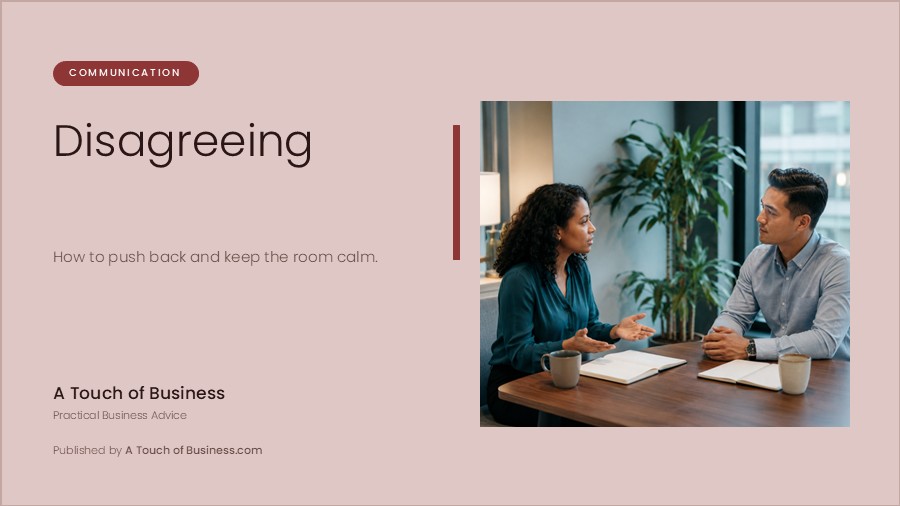
Disagreement is normal. It happens at work, at home, and everywhere in between. The real question isn’t how to avoid disagreement. It’s how to handle it without damaging the relationship.
This matters more than it used to. Workplace incivility in the U.S. hit record highs in 2024, and most workers expect it to stay the same or get worse. A poor workplace also has a real cost. Employees who see their workplace as uncivil are three times more likely to be dissatisfied with their job, and over twice as likely to consider leaving within a year.
The cost adds up in hours, too. One widely cited 2008 study found U.S. employees spend an average of 2.8 hours a week caught up in workplace conflict. Across a company, that time adds up fast.
This article is for business owners, managers, and anyone who deals with disagreement at work. It covers why disagreements turn into arguments, a diplomatic approach that defuses them, and specific steps you can use the next time you disagree with someone.
Why Disagreements Turn Into Arguments
When people disagree, they land on opposite sides of an issue. Each person sees things from their own angle. Most people believe their own view is the correct one. That’s when disagreement can turn into a contest over who’s right and who’s wrong.
AI isn't optional anymore. Start with one small step.
There’s another reason disagreements get heated. One person may hear the disagreement as a personal attack, rather than a difference of opinion about the issue.
So is there a “best” way to disagree with someone? You could take a firm stand and make it clear it’s your way or nothing. Or you could take a more diplomatic approach. Even when you have the authority to simply override the other person, the diplomatic approach usually gets a better result.
The Diplomatic Approach
You can disagree with someone politely and still end up with a result you’re both happy with. The key is getting your point across while also acknowledging the other person’s point of view. This works the same way whether you’re talking with a coworker, an employee, a business partner, or a family member.
Here’s an example, using a husband and wife disagreeing over buying a new car.
SCENARIO 1:
Husband: I say we buy the car. We need it, and with the sale going on right now, there’s no better time.
Wife: Don’t you think we have more important things to consider? We should be thinking about a college fund for our son instead.
Husband: College? He’s two years old. We have time on our side. Our car doesn’t.
Wife: Start saving for college early and it pays off in the long run.
Husband: Our priority right now is the car, not a college fund. Can you focus on what’s going on right now for once?
Wife: You can fix the car for a lot less than a brand-new one costs. Are you capable of planning for this family’s future, or is that on me too?
You can see how that disagreement got heated and personal fast. Here’s a different way to approach the same disagreement.
SCENARIO 2:
Husband: I say we buy the car. We need it, and with the sale going on right now, there’s no better time.
Wife: Don’t you think we have more important things to consider? We should be thinking about a college fund for our son instead.
Husband: I respect your concern about our finances, and you make a fair point. But I do need a reliable car for work right now. What if we bought the lower-end model instead, and put the difference toward the college fund? What do you think?
Two things worked in Scenario 2. The husband acknowledged his wife’s concern instead of dismissing it. And even though he still disagreed with her original suggestion, the outcome landed better than either person’s opening position.
At work, this looks the same. Acknowledge the concern first. Then offer a specific alternative instead of just restating your original position.
A Few Things to Keep in Mind During a Disagreement
- Don’t tell someone they’re wrong. Address the issue, not the person.
- Don’t attack someone’s character.
- Listen to the other person’s concerns before responding.
- Keep an open mind, even when you’re confident you’re right.
- Remember the other person is defending their own point of view. It usually isn’t a personal attack on you, even when it feels that way.
- Offer a solution or an alternative, not just an objection.
- Try playing “what if.” For example: “What if we go ahead and X happens? How would we handle that?”
- Use phrases like “I hear your concern about X, but what would you think about Y?” or “I see your point, but how would you feel about Z?”
Key Points and Facts About Handling Disagreements
- Disagreement itself isn’t the problem. It’s normal, and it can lead to better decisions when it’s handled well.
- Most heated arguments start for one of two reasons: both people believe they’re the one who’s right, or one person hears the disagreement as a personal attack.
- Workplace incivility reached record highs in 2024, and most workers expect it to stay the same or get worse — a sign this is a live issue, not a rare one.
- Employees who see their workplace as uncivil are three times more likely to be dissatisfied and over twice as likely to consider quitting within a year.
- A diplomatic approach — acknowledge the concern, then offer a specific alternative — tends to produce a better outcome than either person’s original position.
Action Steps for Handling Disagreements
Listen before you respond
- Let the other person finish their point before you reply.
- Repeat their concern back in your own words to confirm you understood it.
Acknowledge the concern
- Say what’s valid about their point before you explain your own.
- Avoid jumping straight to “but” — it can make the acknowledgment feel fake.
Offer a specific alternative
- Don’t just restate your original position in different words.
- Propose something that addresses part of their concern, like the lower-end car model in the example above.
Address the issue, not the person
- Keep the conversation on the decision, not on who’s more capable or more reasonable.
- Avoid questions that challenge someone’s competence or character, even when you’re frustrated.
Follow up afterward
- Check in once the decision has been made to see how the other person feels about it.
- This matters most with employees and coworkers you’ll keep working with.
Checklist for Handling Disagreements
- Before the conversation
- Get clear on what you actually want, separate from how you want to say it.
- Decide what you’re open to compromising on.
- During the conversation
- Listen fully before responding.
- Acknowledge the other person’s concern out loud.
- Offer a specific alternative, not just an objection.
- If it starts to get heated
- Stop pointing out who’s wrong.
- Refocus on the issue, not the person.
- Ask a “what if” question to shift from arguing to problem-solving.
- After the conversation
- Follow up with the other person, especially if it’s an employee or coworker.
- Note what worked so you can use it again next time.
FAQ: Handling Disagreements
Is disagreement bad for a business?
- No. Disagreement can surface problems and produce better decisions. What causes damage is disagreement that turns personal or goes unresolved.
How do I disagree with my boss without it costing me?
- Acknowledge their position first, then offer a specific alternative rather than a flat objection. The same diplomatic approach that works with a spouse or coworker works here too.
What if the other person keeps taking it personally?
- Stay focused on the issue, not their character. Remind them, if needed, that you’re addressing the decision, not attacking them.
Do I always need to compromise?
- No. Sometimes acknowledging the other person’s concern is enough, even if the decision doesn’t change. The goal is to be heard and to hear them, not to split every difference down the middle.
References:
- SHRM — The Cost of Incivility: Addressing Workplace Challenges into 2025
- SHRM — Most American Workers Experience Incivility in the Workplace
- CPP Global Human Capital Report (2008) — Workplace Conflict and How Businesses Can Harness It to Thrive
Further Reading
How To Disagree Politely
- 6 Key Tips for Disagreeing With Someone Respectfully — Inc.com
- 20+ Clever Ways to Say ‘I Disagree’ Politely and Respectfully — Tosaylib
- How to Disagree with Someone More Powerful than You — Harvard Business Review
Disagreement Quotes
Agree To Disagree
- What Does It Mean To Agree To Disagree? — Wonderopolis
- Agree to Disagree — Meaning, Origin, Examples, and Sentences — Literary Devices
How To Disagree With Your Boss
- How to Successfully Disagree With Your Boss — The Muse
- How to Disagree with Your Boss — Harvard Business Review
- The Art of Disagreeing With Your Boss The Right Way — Monster.com
How To Disagree With Your Spouse
- When You and Your Spouse Can’t Agree — Focus on the Family
- How to Fight With Your Partner In a Healthy Way — Time
- Supporting Your Spouse Even When You Disagree — MarriageToday
Courses