
What to Expect From This Guide to Starting an Art Restoration Service
This guide takes readers through the major decisions and practical steps involved in starting an art restoration service, beginning with training and specialization and continuing through studio planning, documentation, finances, insurance, and opening checks. The list offers a concise view of selected subjects explored in detail.
Inside the guide, you will find:
- Startup roadmap: Advance from skills and specialization through demand research, business setup, studio preparation, pricing, insurance, credibility, and final checks.
- Industry interviews: Hear private-practice conservators discuss studio transitions, client development, rates, project intake, and referral-based growth.
- Startup FAQs: Explore answers about licensing, professional membership, insurance, permanent records, pricing, home studios, and building client volume.
- Skills and fit: Evaluate formal training, supervised experience, specialization limits, professional responsibility, and tolerance for uneven project income.
- Studio and tools: Plan climate control, ventilation, security, examination equipment, documentation tools, safety gear, and conservation-grade materials.
- Financial planning: Compare startup costs with billable hours, break-even requirements, seasonal slowdowns, expected volume, and operating reserves.
- Risk controls: Address zoning, fire rules, chemical storage, specialized coverage, client records, signed proposals, and complete workflow testing.
The guide begins with the training and specialization questions that must be settled before committing to a studio.
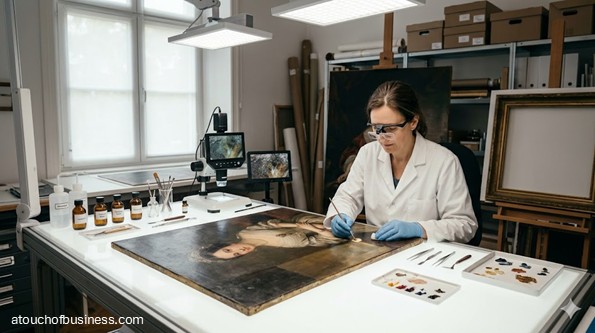
Art restoration services involve examining, treating, and returning damaged, aged, or deteriorating artworks from private collectors, galleries, estates, and institutions in improved condition. The work is done almost entirely in a controlled studio environment—on a workbench, under magnification, and with carefully selected tools and materials.
This is not a business you can start without formal training. Most credible practitioners hold a degree in art history or a related field, followed by graduate-level conservation training or years of supervised hands-on practice. Serious clients — galleries, high-value collectors, insurance companies — verify credentials before placing irreplaceable work with anyone.
The broader startup process applies here, but the sequence matters more than usual. Your credentials and studio setup must come before your first client, not after.
Revenue arrives project by project. Some jobs take days. Others take months. You may go weeks without new work while your reputation builds. Your household needs to be able to absorb that uncertainty — ideally for a year or more.
Are you genuinely drawn to the slow, precise, often solitary work of treating a damaged painting or paper piece over many hours? This matters as much as your technical training.
Talking to experienced owners before you commit is one of the most useful things you can do. Find conservation studio owners who operate in a different region or specialization so they don’t see you as a competitor. Ask them how long it took to build a paying client base, what their first year looked like financially, and what they wish they had set up differently.
Their answers won’t match your experience exactly, but the patterns are worth knowing.
Think carefully about how clients will find you. Art conservation is a referral-driven field. Gallery owners, art appraisers, insurance agents, estate attorneys, and auction house staff are the people who direct clients toward conservators. You’ll need relationships with at least a few of those people before you open, not after.
Before starting, honestly assess these fit points:
- Do you have verifiable conservation training and documented hands-on experience?
- Can you cover your living expenses during a slow ramp-up period of a year or more?
- Does your household support the income uncertainty this business carries at launch?
- Do you have any existing referral relationships with galleries, appraisers, or insurers?
- Are you comfortable working alone for long periods on precise, exacting tasks?
Red Flags Before You Start
Some of these warning signs mean you should pause and prepare more. Others mean you should reconsider the model entirely.
Your credentials are thin. High-value clients verify training and experience before placing work with a new studio. Without a credible background, you’ll be limited to low-value, low-complexity projects at correspondingly low fees. Build your credentials first.
The local market is too small. Art conservation demand concentrates in cities with active collector markets, galleries, and auction houses. A smaller market may never produce enough project volume to cover studio overhead. Validate local demand before you sign a lease.
You don’t have enough operating capital. Income is project-based and irregular. You need enough in reserve to cover at least three to six months of studio costs before consistent revenue arrives. Opening without that reserve is one of the most common reasons new studios close early.
Your studio space lacks proper ventilation. Conservation work requires solvent use. A space without a local exhaust ventilation system or fume hood isn’t suitable — regardless of how attractive the rent or location is. Confirm ventilation before signing anything.
You have no referral network in place. Clients rarely find new conservators through general searches. They rely on recommendations from gallery owners, appraisers, and insurers. Opening without a single warm referral source means a longer ramp-up to first revenue.
Step 1: Assess Your Fit, Skills, and Readiness
This step happens before anything else — before you choose a name, look at studio spaces, or talk to a lawyer.
Ask yourself directly: do you have enough training and experience to open independently right now?
Most credible conservation practitioners hold at minimum a bachelor’s degree in a related field plus substantial supervised hands-on experience. Many hold a master’s degree from an accredited conservation program.
Attempting to open without sufficient credentials doesn’t just limit your client base — it creates real liability risk when you’re handling irreplaceable objects.
Also consider the physical demands. This work involves long hours of fine motor precision, close-detail viewing under magnification, and regular exposure to solvents and chemical materials.
If another one to three years of supervised practice under an established conservator would meaningfully strengthen your position, that investment is worth making before you open independently.
Step 2: Talk to Art Restoration Studio Owners
Find conservation studio owners who work in a different region or a different specialization. They’re not your competition, so they’re more likely to speak honestly.
Prepare your questions before those conversations. Ask how they found their first clients. Ask what their cash flow looked like in year one. Ask what they’d set up differently if they were starting again today.
No two owners have identical stories, but patterns repeat. Firsthand advice from experienced owners is some of the most useful research you can do before launch.
Step 3: Define Your Specialization and Business Model
Art conservation covers several distinct specializations. Each requires different training, tools, and materials.
Common specializations include:
- Paintings on canvas or panel (oil, acrylic, tempera)
- Works on paper (watercolor, drawings, prints)
- Frames and gilded surfaces
- Sculpture and three-dimensional objects
- Textiles and furniture
At launch, only offer what you are credentialed and experienced to treat. Attempting too many specializations without the corresponding training creates liability risk and early reputation damage.
Decide which clients you’re positioning for. Private collectors and gallery owners have different expectations than insurance adjusters or estate executors. Each client type also has different documentation requirements and relationship-building timelines.
You’ll also need to decide on a client access model:
- Studio-only: clients bring artwork to you
- Mixed model: you also make on-site visits or offer pickup and delivery
On-site work adds complexity, travel costs, and separate insurance considerations. A studio-only model is simpler at launch.
Finally, decide whether to pursue membership with the American Institute for Conservation (AIC). AIC membership is not legally required, but it’s a significant trust signal for serious clients. AIC’s “Find a Conservator” directory is a primary referral source — and you need membership to be listed there.
Step 4: Validate Local Market Demand
Art conservation demand is concentrated in cities with active collector markets, established galleries, and major auction houses. New York, Los Angeles, Chicago, San Francisco, Boston, and Washington, D.C. have the deepest demand. Smaller markets have fewer clients and more price resistance.
Research local supply and demand before committing to overhead. Search the AIC conservator directory and Google for studios already operating in your area. Understand what specializations are covered and where gaps exist.
If your specialization is already well-served by established local practitioners, the ramp-up to a viable client load will be significantly longer.
Step 5: Decide How to Enter — Start or Buy
Most conservation studio owners start from scratch. You build client relationships and a reputation from the ground up. Revenue ramps up slowly, but overhead stays lower if you begin with a modest setup.
Buying an existing conservation studio is rare but possible. It transfers client relationships, equipment, and an established name. Confirm whether key client relationships are actually transferable, and whether the prior owner’s personal reputation is separable from the business itself.
There is no established art restoration franchise model in the U.S. That path isn’t realistic for this business type.
The right choice depends on your budget, existing relationships, available businesses for sale in your market, and how much financial runway you have. Read more about starting from scratch vs. buying an existing business before you decide.
Step 6: Choose a Legal Structure and Register the Business
The most common structures for a small conservation studio are a sole proprietorship, a limited liability company (LLC), or an S corporation.
An LLC is worth considering carefully. You’ll be holding high-value client artwork. The personal liability protection an LLC provides may be meaningful in that context. Talk to an attorney to confirm whether it applies to your specific situation.
If you plan to operate under a studio name rather than your personal name, you’ll need to register a DBA with your state or county.
Obtain an Employer Identification Number (EIN) from the IRS even if you have no employees. It’s required for your business bank account and tax reporting. You can apply at IRS.gov at no cost.
Step 7: Handle Legal and Compliance Requirements
No federal or state professional license is required to operate as an art conservator in the United States. Verify this with your state’s professional regulation office, as requirements can change.
You still have several compliance items to confirm:
- General business license from your city or county
- Zoning approval for the studio address, including chemical storage
- Certificate of occupancy for commercial studio space
- Local fire code requirements for storing flammable solvents
If you plan to operate from a home studio, check local home-occupation rules, your landlord’s lease terms, and whether your mortgage holder permits commercial use and chemical storage. Many residential zones prohibit commercial activities outright.
If you hire employees, OSHA’s Hazard Communication Standard applies. You’ll need Safety Data Sheets for all chemicals, proper container labeling, and hazard training. Even as a solo operator, following these practices is advisable for your own health.
Review how your state handles business licenses and permits before you open.
Step 8: Set Up Your Studio Space
Your studio is your primary tool. It needs to be fully functional before you accept the first project.
The space must accommodate a sturdy work surface large enough for the biggest artwork you plan to handle. You also need a secure, climate-controlled area for storing client artwork, proper ventilation for solvent work, and a consultation area for client meetings.
Climate control is non-negotiable. Accepted museum standards call for temperatures between 65 and 72°F and relative humidity between 45 and 55%, with minimal fluctuation. Significant deviations can damage client artwork in your care.
Ventilation is equally critical. A local exhaust ventilation system or fume hood is required for any solvent use. General room ventilation is not sufficient for organic vapor control. Consult an industrial ventilation specialist before finalizing your space.
Security also matters. Commercial-grade locks, an alarm system, and motion detection are standard expectations from clients and insurers alike.
Install UV-filtering window films or blinds. UV light causes cumulative, irreversible damage to artwork stored or treated near windows.
Before signing a lease, confirm the space can meet all of these requirements. Ventilation installation in particular can be a deal-breaker. A space that can’t support a proper fume hood or exhaust system is not suitable for this work, regardless of location or price.
Step 9: Acquire Equipment, Tools, and Conservation Materials
Conservation work requires specific, professional-grade tools and materials. Substituting non-conservation-grade products can cause irreversible damage and expose you to liability.
Core equipment categories include:
- Examination tools: UV fluorescence lamp, raking light source, stereo microscope, loupes
- Documentation: calibrated digital camera, macro lens, color reference cards, copy stand
- Workstation: height-adjustable table, easel, fine-tip brushes, scalpels, spatulas, tacking iron
- Climate monitoring: temperature and relative humidity dataloggers
- Safety: NIOSH-approved organic vapor respirator, chemical-resistant gloves, goggles, flammable storage cabinet
Source materials from specialty conservation suppliers such as Conservation Support Systems, Kremer Pigments, University Products, and Talas. These suppliers stock conservation-grade adhesives, solvents, varnishes, inpainting media, and archival papers appropriate for professional treatment work.
Step 10: Build Your Documentation System
Per the AIC Code of Ethics, conservation professionals are required to create permanent records for every project. This is both an ethical standard and your legal protection if a dispute arises.
Build these templates before you accept the first project:
- Artwork condition report form
- Written treatment proposal with itemized cost estimate (signed by the client before work begins)
- Treatment log (procedures, materials, dates)
- Treatment report with before, during, and after photographs
- Client service agreement (scope, liability terms, payment schedule)
- Artwork receipt and chain-of-custody form
All conservation records are expected to be retained permanently. Set up both a physical filing system and a backed-up digital archive before you open.
Your treatment proposal is the cornerstone of the client relationship. Clients should understand exactly what you plan to do, what it will cost, and what happens if unforeseen issues arise — before you touch anything.
Step 11: Set Your Pricing Structure
Most private-practice conservators charge by the hour. That rate must cover your studio overhead, consumable materials, documentation time, and your own compensation.
Documentation and reporting aren’t free time. Writing a condition report, maintaining a treatment log, and producing a final treatment report add real hours to every project. Factor them into your rate.
A separate fee for the initial condition assessment and treatment proposal is standard. This fee applies whether or not the client approves treatment. It covers the time to examine the artwork, photograph it, and prepare a written proposal.
Set a minimum project fee. Even small jobs require examination, documentation, and administration. A minimum ensures those jobs are worth accepting.
Research comparable rates in your specific metro market. Rates vary significantly by location, specialization, and client type. For further guidance on pricing a service business, review the fundamentals before you finalize your numbers.
Step 12: Check Profit Potential and Break-Even Reality
Before you commit to a studio lease and equipment purchases, work through the numbers for your specific situation.
Revenue is project-based with no guaranteed volume at the start. Your income depends on how many billable hours you produce each month and what your hourly rate is.
Set your monthly studio costs against the number of billable hours you’d realistically need to cover them. Then ask yourself honestly: given your expected client volume in the first year, can you reach that number?
Income is also uneven. Summer months tend to be slower for private collectors. Institutional budgets move on annual cycles. Plan for that variability, not just the productive months.
Work through the break-even math before signing anything major. Estimating profitability for a new business can help you structure that analysis.
Step 13: Secure the Right Insurance
Standard general business insurance is not sufficient for an art restoration studio. You need coverage tailored to the specific risks of holding high-value client artwork.
Key coverage types to discuss with a fine art insurance broker:
- Fine art bailee’s insurance: covers client artwork in your care, custody, and control
- Professional liability (errors and omissions): covers claims from professional judgment errors
- General liability: covers bodily injury and property damage at the studio
- Business personal property: covers your tools and equipment
Fine art bailee’s coverage is not legally required in most states, but it’s functionally required. High-value and institutional clients will often ask about it before they place work with you. Coverage limits should match the maximum value of artwork you expect to have in the studio at any one time.
Workers’ compensation is legally required in most states the moment you hire an employee. Verify the rules in your state before bringing anyone on. Learn more about business insurance to understand what a complete coverage package looks like.
Step 14: Set Up Business Banking and Payments
Open a dedicated business checking account. Keep all studio income and expenses separate from your personal finances from day one.
Set up your payment system before you send the first invoice. You should be able to accept checks, bank transfers, and credit cards. Most conservators collect a deposit when the client approves the treatment proposal, then invoice the balance on completion.
Use invoicing software that generates itemized proposals and split invoices. Track material costs per project so you can bill them accurately alongside your hourly time.
Step 15: Build Your Pre-Opening Credibility
Before you open to clients, you need a portfolio of documented conservation work. Before-and-after photographs are the primary proof of skill in this field. Draw on documented work from your training, apprenticeship, or supervised practice — with appropriate permissions.
Build a professional web presence. It needs to show your specialization, your credentials, your process, and how to contact you. Serious clients use this to vet you before they make an inquiry.
Have a written client packet ready before the first inquiry arrives. It should include your condition report form, your standard service agreement, and a clear description of how your process works from examination through final delivery.
Establish at least two or three warm referral relationships before you open. Gallery owners, art appraisers, fine art insurance agents, and estate attorneys are the people most likely to send you clients. Reach out before you’re ready — not after.
Business Plan
A written business plan for an art restoration studio is primarily a reality check. It forces you to test whether the numbers work before you spend money on a lease, equipment, or build-out.
Start with the startup cost items: studio lease and security deposit, ventilation installation, climate control equipment, examination and documentation tools, conservation materials, safety equipment, insurance premiums, legal and registration fees, and your operating capital reserve.
Then build the revenue side. What hourly rate will you charge? How many billable hours per month can you realistically expect in the first six months?
Multiply those numbers and compare them against your monthly fixed costs. That gap — if there is one — is what your operating reserve must cover.
Document your break-even point. How many hours per month at your set rate do you need to cover rent, utilities, insurance, supplies, and your own living expenses?
Be honest about whether the local market can support that volume in year one.
Address seasonality. Private collector work tends to slow in summer. Institutional project budgets move on annual cycles. Build a cash flow projection that accounts for the slow months, not just the productive ones.
Your plan should also name your target client types and explain how each one will learn you exist. Gallery referrals, insurer relationships, and estate attorney networks each work differently.
Finally, set a decision threshold. If you reach month six with fewer projects than needed to cover costs, what’s your next move? Having that written down before you open makes it easier to act without second-guessing.
For more on building out the financial and operational sections, review the guidance on writing a business plan.
Opening-Day Red Flags
Don’t accept your first client project until every item on this list is confirmed.
Your insurance is not yet in force. Fine art bailee’s coverage must be active before a single piece of client artwork crosses your threshold. Confirm the effective date before the first artwork arrives.
The ventilation system hasn’t been tested. A fume hood that isn’t drawing properly is a health and safety hazard. Test it before any solvent work begins — not during.
Climate control is unstable. If your monitoring shows fluctuations outside the target range, the studio isn’t ready to store client artwork. Diagnose and correct the issue first.
Your documentation templates aren’t finalized. The treatment proposal must be ready to send before any project begins. The condition report form and service agreement must be ready before artwork arrives.
The chemical storage cabinet isn’t in place. Solvents stored improperly are a fire hazard. Confirm your flammable storage cabinet is installed and compliant with local fire code before you bring solvents into the studio.
You haven’t tested your full workflow. Run at least one complete test project — on your own artwork or a low-value piece with consent — before your first paying client. Confirm that examination, documentation, treatment, and reporting all work end to end.
Frequently Asked Questions
Do I need a license to open an art restoration business in the U.S.?
No state-level professional license is required as of current research. Standard local requirements apply: a general business license, zoning confirmation, and a certificate of occupancy for commercial studio space. Verify with your state’s professional regulation office, as requirements can change.
Is AIC membership required to open?
AIC membership is not legally required. It is, however, a significant credibility signal for serious clients. AIC’s “Find a Conservator” directory is a primary referral source for new clients — and you need membership to appear in it. Building a practice without AIC affiliation is possible but limits your visibility.
What insurance does a conservation studio need?
At minimum: fine art bailee’s insurance, professional liability, and general liability coverage. Business personal property covers your tools and equipment. Workers’ compensation is legally required in most states the moment you hire anyone. Standard general business policies typically exclude or severely limit fine art coverage — work with a broker who specializes in this area.
What documentation must I create for each project?
Per the AIC Code of Ethics, you must create permanent records for every project. At minimum: a pre-treatment condition report with photographs, a written treatment proposal signed by the client before work begins, a treatment log, and a post-treatment report with before-and-after photographs. These records must be retained permanently.
How do art conservators typically charge?
Most private-practice conservators charge by the hour. A separate flat fee for the initial condition assessment and treatment proposal is standard. Material costs are typically itemized and billed separately. A minimum project fee is advisable to cover examination and administration on all jobs.
Can I run an art restoration studio from home?
Possibly, but with significant cautions. Most residential zones prohibit commercial use and storage of flammable materials. Some high-value clients are also uncomfortable placing irreplaceable artwork in a residential address without commercial-grade security and climate control. Confirm zoning, fire code, and lease or mortgage terms before operating from home.
How long does it take to build a paying client base?
Most new studios describe the first one to two years as a relationship-building period with limited project volume. Practitioners with existing gallery connections or prior institutional affiliations tend to build faster. Plan operating reserves to cover studio costs for at least three to six months before consistent revenue arrives.
What specialization should a new studio focus on at launch?
Only offer what you are credentialed and experienced to treat. Paintings conservation — oil and acrylic on canvas or panel — is the most common private studio specialization and tends to have the broadest client demand. A narrow, credible specialization is more effective at launch than broad claims you can’t support.
Advice From Art Restoration Professionals
Reading about how to start an art restoration service is one thing. Hearing directly from conservators who have done it is another.
The resources below feature working professionals who have opened private conservation studios, navigated early client relationships, set pricing, and built sustainable practices.
Before you read them, reach out to conservation studio owners in a different market or specialization. Talk to people who won’t see you as a competitor. Prepare specific questions about their first year, their rates, and what they’d do differently. These interviews will help you know what to ask.
The Private Project: An Art Conservation Podcast — Kelsey Marino (Apple Podcasts)
Kelsey Marino hosts this ongoing podcast series dedicated to private conservation practice.
Each episode features a working conservator who has opened or grown a private studio. Guests discuss how they made the transition from institutional work to independent practice.
Episodes cover the practical side of running a studio: how early conservators set their rates, found first clients, set up studio spaces, and secured insurance.
One episode features Elizabeth Nunan, owner and lead conservator at Flux Art Conservation Corp. She describes how she began taking private projects alongside museum work before transitioning to a full-time practice.
Another features Ana Alba of Alba Art Conservation, LLC. She explains how she balanced contract work with major east coast museums while building her own private client base.
For anyone planning to open a conservation studio, this is the most targeted resource available. The guests speak frankly about profitability, documentation burdens, and the slow process of building client trust.
Meet Julian Baumgartner of Baumgartner Fine Art Restoration — Voyage Chicago
Julian Baumgartner is the owner and conservator at Baumgartner Fine Art Restoration, the oldest conservation studio in Chicago.
He apprenticed under his father, the studio’s founder, for over a decade before taking sole ownership in 2011.
In this interview, Julian describes what it means to run a studio alone — handling conservation, client communication, administration, and logistics without support staff.
He explains how he built client trust after taking over the practice. He also speaks directly about learning to run the business side after years focused entirely on the craft.
His advice is practical and unvarnished. For anyone planning to open a paintings conservation studio, his perspective on client relationships and quality-first reputation building is worth reading carefully.
Interview With Art Conservator Elizabeth Norton — The Arkansas Art Scene
Elizabeth Norton co-founded Norton Arts, Inc. with her late husband Wendel, a trained conservator who had worked as head conservator at a New York City studio before opening independently.
The interview covers how the Nortons built their practice after relocating from New York to rural Arkansas — a market with no established collector base waiting for them.
Elizabeth explains how they started with antique dealers, then expanded to private collectors, museums, and framers who referred clients needing conservation work.
She also describes their intake process: visiting clients at the artwork’s location, conducting testing when needed, and providing a written conservation treatment report with an estimate before any work begins.
This interview is especially useful for anyone planning to open outside a major arts market. It shows how a studio can grow through referral networks built from the ground up in a smaller region.
Related Articles
- How To Start a Furniture Restoration Business
- How To Start a Doll Repair Service
- How To Start a Picture Framing Business
- How To Start an Art Appraisal Service
- How To Start an Antique Business
Sources:
- Cultural Heritage (AIC/CoOL): Become conservator overview, Ethics guidelines conservation, Setup conservation studio guide, Conservation contracts guide
- Conservation Wiki (AIC): Setup conservation lab, PMG examination documentation
- Art Business News: Cost conservation restoration
- Uhire: Art restoration pricing licensing
- Vault: Conservator career requirements
- Business Insurance USA: Art restorer insurance types
- Partners&: Art conservators insurance coverage
- The Conservation Center: Conservation intake proposal process
- Fine Arts Conservation LLC: Project workflow documentation
- OSHA: Solvent safety standards OSHA
- UNCSA: Art studio safety ventilation
- Wikipedia: Paintings conservation standards
- AristoAir: Art storage temperature humidity
- Local Approach: Conservation pricing fee structure
- Conservation Support Systems: Conservation materials supplier
- University Products: Conservation equipment tools