
What to Expect From This Guide to Starting an Appliance Repair Service
This guide explains the ordered decisions and practical steps behind starting an appliance repair service, from confirming technical ability and market demand to outfitting a mobile operation, setting prices, and completing pre-opening tests. The preview identifies several valuable areas without replacing the full discussion.
Inside the guide, you will find:
- Startup roadmap: Follow the path from fit, skills, scope, and demand through registration, vehicle setup, tools, insurance, pricing, and final checks.
- Industry interviews: Gain practical perspectives on training, customer acquisition, service-call pricing, parts management, trust, and different entry paths.
- Startup FAQs: Review answers about licenses, certifications, home-based operations, parts choices, seasonality, and manufacturer service authorization.
- Technical foundation: Consider hands-on training, voluntary credentials, federal refrigerant certification, appliance categories, and limits on offered services.
- Mobile operations: Prepare the service vehicle, tools, parts inventory, route boundaries, scheduling software, work orders, and doorstep payments.
- Financial planning: Calculate startup costs, service-call pricing, parts markup, weekly break-even volume, routing efficiency, and operating reserves.
- Local protection: Check registration, zoning, trade-specific rules, business insurance, commercial vehicle coverage, documentation, and test appointments.
The discussion starts with technical ability and owner fit before moving into the mobile service setup.
How to Start an Appliance Repair Service
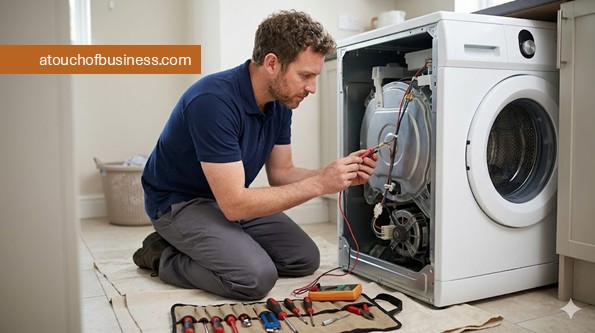
An appliance repair service sends a skilled technician directly to the customer’s home to diagnose and fix household appliances on-site. No storefront required. Your service vehicle is your shop, and every call is a new jobsite.
You’ll work on refrigerators, washers, dryers, dishwashers, ovens, ranges, and microwaves — sometimes all in the same week. You schedule service calls, drive to customers, repair what’s broken, and collect payment before you leave.
Demand is real and consistent. Nearly every homeowner will face a major appliance breakdown at some point, and the cost of a new appliance often makes repair the smarter financial choice. The U.S. appliance repair market reached approximately $7 billion in 2025, and the industry faces a genuine shortage of skilled technicians — which creates opportunity for qualified new operators.
That said, this is a trade business built on technical skill, physical reliability, and tight daily execution. Read through the full startup steps before you commit money or time.
Is This Business a Good Fit for You?
Before you invest in a vehicle, tools, or certifications, take an honest look at whether this work fits you personally.
You’ll be lifting heavy units, kneeling in tight spaces, and working inside appliances with live wiring and water connections. Ask yourself whether you genuinely enjoy hands-on troubleshooting and can handle those physical demands day after day.
Think through the income side carefully. Your first few months will be slower than your later months. Confirm your household can manage on reduced or inconsistent income while you build a customer base.
Talk with your family or partner before you launch. Their support during the ramp-up period matters more than most owners expect.
Customer trust is everything in this business. You’re entering people’s homes, working around their belongings, and handing them an invoice for a repair they can’t fully evaluate. Strong communication, punctuality, and clean work habits are as important as your technical skills.
Think through whether you’re prepared for independent field work. You’ll make judgment calls alone, manage your own schedule, and solve problems without backup. Owners who thrive here enjoy that autonomy. Owners who need structure often struggle.
Reach out to appliance repair owners in markets where you won’t compete. Ask them what surprised them about startup, what they spent money on that wasn’t worth it, and what they’d do differently. Prepare your questions in advance.
Firsthand insight from experienced owners is hard to replace — even though every owner’s path is different, the patterns they describe are useful. You can read more about the value of advice from real business owners before those conversations.
Also think about how you’ll attract your first customers and why they’d choose you. Your Google Business profile, your responsiveness, and your vehicle branding are what make you visible at launch. None of that requires a large budget — but all of it requires preparation.
Red Flags Before You Start
Watch for these warning signs before you commit to startup costs.
Your technical skills aren’t ready yet. Diagnosing unfamiliar appliances under time pressure, in front of a waiting customer, is not the moment to learn. If your experience is limited to self-teaching and home repairs, delay your launch and get formal training or hands-on work experience first.
You plan to service refrigerators or freezers without EPA certification. Handling refrigerants without EPA Section 608 certification is a federal violation. Fines can reach $45,000 or more per incident. Get certified before you accept a single refrigeration call.
Your budget can’t cover the vehicle and a cash reserve. A reliable service vehicle and a stocked tool kit are not optional for this model. If your startup funds can’t cover those basics plus several months of living expenses, build your financial position before committing.
You haven’t priced a break-even call volume. New operators who underprice service calls to win early customers often can’t recover once fixed costs compound. Know your break-even number before your first job.
You haven’t set up a parts supply chain. If you can’t complete a repair on the first visit because you have no parts stocked, you lose time, erode customer trust, and cut your daily revenue. Establish supplier accounts and stock your van before opening.
Your planned service area is too large. Excessive drive time between calls eats directly into your billable hours. If average travel between jobs exceeds 30 to 45 minutes, your service radius needs to tighten.
You’re planning to service gas appliances without checking local licensing rules. Some states and localities treat gas line connections as a separately licensed trade. Verify this before you market gas appliance repair.
Step 1: Assess Owner Fit and Technical Readiness
Confirm your technical baseline before spending a dollar on equipment or registration.
Write down the appliance types you can confidently diagnose and repair from experience — not just from watching videos. Identify the gaps. If refrigeration, gas appliances, or smart connected appliances are on your intended service list but outside your current competency, address that before launch.
Consider the physical demands honestly. You’ll lift heavy units, work in cramped spaces, and carry a stocked service van through a full day of calls. Owners who underestimate the physical side often hit fatigue and slowdowns within the first few months.
Confirm your household expenses are covered and that your family understands the income timeline before you proceed.
Step 2: Decide on Business Model and Service Scope
Decide what you’ll repair and who you’ll serve before you buy tools or register the business.
Three common service scope choices:
- General residential repair — washers, dryers, refrigerators, dishwashers, ovens, ranges, microwaves, and more. Widest market, but requires the broadest tool and parts investment.
- Appliance specialty niche — focusing on one category (refrigeration, laundry, high-end brands) or specific manufacturers. Narrower market, but allows deeper expertise and premium positioning.
- Manufacturer-authorized service — contracting with appliance brands or home warranty companies for warranty and post-warranty work. Requires meeting manufacturer training and certification requirements, but can provide a steadier call stream.
Define your service area radius at this stage. Your daily revenue depends on how many calls you complete, and drive time between calls is revenue you’re not earning. A tight, well-chosen territory consistently outperforms a sprawling one with long travel gaps.
Decide now whether you’ll service gas appliances. Gas line connections may require an additional license or permit in some jurisdictions. Verify your state’s rules before you market gas appliance repair.
Step 3: Choose Your Entry Path
Decide how you’ll enter the market before you build out your cost plan.
Three realistic paths exist for starting an appliance repair service:
- Start from scratch — build your own customer base and systems from the ground up. Lowest entry cost, full flexibility on service scope, but the longest timeline to steady revenue.
- Buy an existing route or business — acquire an established customer list, a vehicle, and possibly existing parts inventory for immediate revenue. Requires careful review of equipment condition, customer loyalty, supplier relationships, and the seller’s real reason for selling.
- Franchise (e.g., Mr. Appliance) — structured systems, brand recognition, dispatch support, and parts buying power. Requires significant liquid capital. Better suited for owners who want a proven operating model rather than a fully independent setup.
The right path depends on your budget, your experience level, your risk tolerance, and how quickly you need to generate income. A deeper look at the build-or-buy decision can help you think it through.
Step 4: Build or Verify Your Technical Skills and Certifications
Real hands-on competency is the foundation of this business. Customers expect efficient, accurate diagnosis and a repair that holds up.
Training options to consider:
- Community college or trade school appliance repair programs
- Fred’s Appliance Academy — an ISCET-recommended training campus with online and in-person options
- Manufacturer-specific training academies (Whirlpool, GE, LG, Samsung)
- Apprenticing under an experienced technician
NASTeC certification: The National Appliance Service Technician Certification, issued through the International Society of Certified Electronics Technicians (ISCET), is the most recognized voluntary credential in the industry. It covers a Basic Skills exam plus specialty modules for cooking, laundry and dishwashing, or refrigeration and air conditioning. Exam fees range from $50 to $185 depending on the modules chosen. Credentials don’t expire.
NASTeC isn’t legally required in most states, but it signals professional competency to customers and home warranty companies. Earn it before launch if you can.
EPA Section 608 certification is a federal legal requirement if you service any appliance containing a refrigerant — including refrigerators, freezers, window air conditioners, and dehumidifiers. The Clean Air Act requires this, and the requirement now covers HFCs as well as older ozone-depleting refrigerants.
Four certification types exist: Type I for small appliances with five pounds or less of refrigerant, Type II for high-pressure systems, Type III for low-pressure systems, and Universal for all equipment types. Exams are administered by EPA-approved certifying organizations. Credentials don’t expire.
Get the right EPA certification type for the appliances you plan to service. Don’t accept a refrigeration call without it.
Step 5: Research Local Demand and Competition
Confirm the market before you commit to startup costs.
Check homeowner density, housing age, and income levels in your intended service area. Older homes tend to have older appliances. Higher-income neighborhoods often have higher-end appliances worth repairing. Both factors affect your call volume and average revenue per job.
Research your competition — who is operating, what brands and appliance types they cover, their response times, and their pricing. Gaps in the market (brands they avoid, appliance types they don’t service, slow response times) are your openings.
Check whether manufacturer-authorized service networks are active in your area. These compete directly for warranty work. If your market is heavily covered by authorized providers, focus on brands or appliance types they underserve.
The industry faces a documented shortage of skilled technicians as the existing workforce ages. In markets where customers wait several days for a repair, a new operator who responds quickly and shows up reliably has a real competitive advantage from day one. Understand your local supply and demand picture before you set your territory.
Step 6: Handle Legal Structure, Registration, and Tax Setup
Get your legal foundation in order before you open a bank account or accept a paid job.
Choose a business structure. An LLC is commonly used for field service businesses because it separates your personal assets from business liability. A sole proprietorship is simpler to set up but offers less protection. Consult a CPA or attorney before deciding — the right structure depends on your income, your risk exposure, and your state’s rules. Compare your options using the guide on LLC vs. sole proprietorship.
Register your business name. If you operate under a trade name that differs from your legal name, file a DBA (doing business as). Your state’s secretary of state office or county clerk handles this.
Obtain an EIN (Employer Identification Number) from the IRS. You’ll need it to open a business bank account, file taxes, and hire employees. Apply at IRS.gov — it’s free and immediate.
Register with your state tax agency for sales tax purposes. Selling parts as part of a repair job is taxable in most states, but rules vary. Verify with your state’s revenue or taxation department before your first paid job.
State-specific licensing note: Most states don’t require a specific appliance repair technician license, but some do. California requires registration with the Bureau of Household Goods and Services (BHGS) for any appliance repair dealer, plus a contractor license from the CSLB for jobs where total cost (labor and materials combined) exceeds $1,000 — a threshold updated from $500 by Assembly Bill 2622, effective January 1, 2025. Search your state’s contractor licensing board or business licensing office to confirm what applies where you operate.
Obtain a general business license from your city or county. Check with your city hall or county clerk.
Step 7: Verify Zoning and Home Office Rules
A mobile appliance repair business runs from your vehicle, not a commercial shop — but operating from a home address still involves local rules.
Check your local zoning or planning office for home occupation rules before you store parts inventory at home, park a branded commercial vehicle on your property, or conduct any business activity from a residential address. Many jurisdictions allow home-based field service businesses but impose restrictions on visible commercial activity, signage, and storage.
If you plan to rent a small storage unit for parts overflow, confirm it’s zoned for commercial use before you sign a lease.
Step 8: Acquire and Set Up Your Service Vehicle
Your service vehicle is the most critical physical asset in this business. Choose it carefully and set it up before your first call.
A cargo van is the most practical choice for most appliance repair operators — it provides enclosed, secure storage for tools, parts, and equipment. A full-size pickup with a cap or enclosed bed is a workable alternative. Whatever you choose, the vehicle must be reliable enough for daily commercial use across a full service area.
Outfit the interior with commercial shelving units, drawer systems, and bin storage before you load a single tool. An organized van means you find what you need quickly at every job. A disorganized van costs you time and surfaces missing parts at the worst moments.
Brand the vehicle with a wrap or magnetic signs before you open. Your van moves through your service area every day — it’s visible advertising that costs nothing per impression after installation.
Keep a vehicle maintenance schedule from the start. A breakdown between jobs is a missed appointment, a damaged customer relationship, and lost revenue all at once.
Step 9: Assemble Your Tools and Parts Inventory
Do not open for business without a complete, professional-grade tool kit and a stocked van.
Essential diagnostic tools include:
- Digital multimeter and clamp meter (electrical fault diagnosis and amperage measurement)
- Refrigerant manifold gauge set, recovery machine, and certified recovery cylinders (required for any refrigerant work)
- Refrigerant leak detector
- Thermometer and temperature probe (for testing refrigerator, freezer, and oven performance)
- Non-contact voltage tester
Essential hand tools include:
- Screwdriver set: flathead, Phillips, and Torx (T10–T25 range covers most appliances)
- Nut driver set, adjustable wrench, and combination wrenches
- Pliers set: needle-nose, channel-lock, wire-cutting
- Hex key set (metric and imperial), putty knife or panel opener, wire stripper, utility knife
- Flashlight or headlamp, extension grabber for dropped hardware in tight spaces
Safety and protection equipment includes:
- Safety glasses, insulated electrical gloves, leather work gloves, steel-toed boots, knee pads
- Appliance dolly with straps, moving blankets, appliance glides, and floor protection mats
Stock your van with the most commonly replaced parts for the appliances you’ll service most — heating elements, drive belts, thermal fuses, door gaskets, water inlet valves, and drain pump motors. Completing a repair on the first visit is a direct revenue advantage.
A return trip costs you time, fuel, and scheduling complexity — and customers notice.
Set up wholesale accounts with regional parts distributors. Marcone is the largest U.S. distributor of OEM appliance parts. Sundberg America specializes in Frigidaire and related brands. Opening a wholesale account typically requires your business registration documents and sometimes a credit application. Do this before launch, not after your first order.
Step 10: Set Up Insurance
Confirm your coverage is bound and active before you enter a single customer’s home.
General liability insurance protects you against third-party property damage and bodily injury claims at a customer’s home. Appliance repair involves live water connections, electrical components, and heavy units — the risk of an incident is real. Most home warranty companies also require a certificate of insurance before contracting with an independent technician.
General liability isn’t legally required in most states, but working without it is a serious financial exposure.
Commercial auto insurance is required by law for any vehicle used for commercial purposes. A personal auto policy does not cover business use. Confirm coverage before your first service call.
Add tools and equipment coverage to protect your tool investment against theft or damage at job sites. The cost is modest relative to what a complete professional tool kit represents.
Workers’ compensation requirements vary by state and become relevant once you hire employees. Verify your state’s rules before you bring on your first technician. Learn more about business insurance options for field service operations.
Step 11: Set Up Business Banking and Payment Processing
Open a dedicated business checking account before you accept a paid job.
Separate business transactions from personal ones from the start. Mixing them creates accounting problems, complicates tax filing, and can create legal issues if your business structure is ever scrutinized. Your EIN and business registration documents are what you’ll need to open the account. Review the guide on opening a business bank account if you haven’t done this before.
Set up a mobile payment processor — Square, Stripe, or a similar platform — so you can collect payment at the customer’s home at the end of every job. Most residential customers expect to pay by card.
Set up field service management software for scheduling, work orders, parts tracking, and invoicing. Options like Jobber, ServiceWorks, FieldEdge, and Workiz are built specifically for appliance repair and similar trades. These platforms let you manage your route, create professional invoices, and track parts — all from your phone or tablet in the field.
Step 12: Build Your Pricing Structure
Set your pricing structure before your first call, not after.
Three pricing models are common in appliance repair:
- Diagnostic fee plus flat rate — charge a service call fee that covers your travel and assessment; provide a flat-rate price for the repair; many operators waive the diagnostic fee if the customer proceeds
- Time and materials — charge a service call fee, an hourly labor rate, and parts at marked-up cost; flexible for complex repairs, but requires clear communication upfront
- Hybrid — flat-rate pricing for the first hour or the diagnostic portion; time-and-materials billing if the job runs longer or the customer proceeds after diagnosis
Parts markup is standard and expected. Charging a markup on parts — typically 25% or more above your cost — covers your sourcing time, handling, and warranty exposure. Build it into every invoice.
Research what competitors in your area charge for service calls and labor before you set your own rates. Pricing varies significantly by region.
Factor every real cost into your rate: vehicle payment, fuel, insurance, tool depreciation, parts inventory carrying cost, software subscriptions, and phone. Underpricing by even a small margin per call compounds quickly. Review the guide on pricing your services before you set your numbers.
Step 13: Plan Your Profit Potential and Operating Reserve
Work out your break-even picture before you spend money on the vehicle or tools.
As a solo mobile technician, your revenue is directly tied to how many service calls you complete per day and your average revenue per call. Parts markup revenue adds meaningfully to each job — a technician who stocks the right parts and completes repairs on the first visit earns more per day than one who frequently returns to finish jobs.
Calculate your fixed weekly costs before you set prices: vehicle payment, commercial auto and liability insurance, fuel, field service software, phone, and any loan payments. That total is what you need to cover before you take home a dollar.
Plan for slower early months. Demand for appliance repair is relatively year-round, but new operators build call volume gradually. Budget an operating reserve that covers your fixed costs and personal living expenses for at least three to six months.
Owners who launch without that cushion often close before the business has a real chance to build.
Parts margins, efficient routing, and a tight service radius all work together to improve daily profitability. A technician who wastes two hours a day in traffic earns meaningfully less than one who completes six well-spaced calls in the same time. Route planning is a revenue decision, not just a logistics one. Explore how to estimate profitability for a new service business as part of this planning work.
Step 14: Establish Your Business Identity and Launch Readiness
Get your business visible and ready to receive calls before you open.
Finalize your business name and confirm it’s available in your state. Set up a business phone line separate from your personal number. Install vehicle branding — a wrap or magnetic signs — so your van works as a moving advertisement every day you’re in the field.
Build a basic website or landing page with your service area, the appliances you repair, a phone number, and a contact or booking option. Residential customers search online before they call. If they can’t find you easily, they call someone else.
Create a Google Business profile and fill it out completely — service area, phone number, business category, and hours. This is where most local service business discovery happens, and it costs nothing to set up.
Prepare your work order and service agreement template before the first call. Every job should be documented: the appliance, the problem reported, the diagnosis, the parts used, the price quoted, and the customer’s approval before work begins.
This documentation protects you in any dispute and builds the habit of professional, organized service from day one.
Set a warranty policy for labor and parts before you open. A standard approach is 90 days on labor; parts warranties vary by manufacturer. Communicate your policy to every customer at the time of the repair.
Step 15: Complete Pre-Opening Final Checks
Run through this checklist before you take your first paid call.
- EPA Section 608 certification confirmed (if servicing refrigerant appliances)
- All state and local licenses and registrations filed and active
- General liability insurance and commercial auto insurance both bound and active
- Service vehicle roadworthy, fully outfitted, stocked with tools and parts, and branded
- Wholesale parts distributor accounts open and verified
- Business bank account open and active
- Mobile payment processing tested and ready
- Field service management software set up (scheduling, work orders, invoicing)
- Work order and service agreement template ready to use
- Business phone line active
- Website or landing page live, Google Business profile complete
- Operating reserve funded for at least three to six months of fixed costs and living expenses
- Test service call completed to verify your full field workflow end-to-end
Don’t skip the test run. Work through a complete appointment — arrival, diagnosis, repair, invoice, and payment collection — before you accept a real call. Problems in the workflow are far easier to fix before a customer is watching.
Business Plan
Your business plan for an appliance repair service is a working document, not a formality. Build it around the decisions this startup requires.
Start with your service scope and entry path. Write down which appliances you’ll service, which brands, and what your initial service radius will be. Document whether you’re starting from scratch, buying an existing route, or pursuing a franchise. These decisions drive everything else in the plan.
Work out your startup cost categories: service vehicle, vehicle outfitting and branding, tools and diagnostic equipment, refrigerant recovery equipment (if applicable), initial van stock of parts, certifications, registration and licensing fees, insurance premiums, software subscriptions, and operating reserve. Get real quotes and local verification for each item — don’t estimate from general figures.
Build a break-even analysis around your actual numbers. Identify your total fixed costs per week. Divide by your realistic average revenue per service call — including parts markup. The result is the minimum number of calls per week you need to cover costs before you earn anything. If that number feels unreachable in your market, adjust your pricing or tighten your cost structure before launch.
Parts markup is a meaningful revenue contributor — not a small rounding adjustment. Stock the right van inventory, and your first-call completion rate directly boosts both daily revenue and customer satisfaction.
Plan for slow early months. Budget a personal living expense cushion alongside your business operating reserve. Owners who plan for the ramp-up period survive it.
Address your funding plan. Many solo operators launch with personal savings and vehicle financing. If you need a business loan, review your options at how to get a business loan before you approach a lender.
Document your pricing model, your parts markup policy, your warranty terms, and your service radius. These operational decisions belong in the plan because they directly affect whether you’re profitable from the first month.
Opening-Day Red Flags
Confirm these items are in order before your first paid service call.
Your EPA Section 608 certification isn’t confirmed for the appliances on your schedule. A refrigeration service call without this certification is a federal violation. Verify your certification type covers the equipment before the appointment.
Your commercial auto insurance isn’t active yet. Driving a business vehicle to a service call without commercial coverage is both illegal and financially catastrophic if an accident occurs. Confirm the policy is bound before you leave the driveway.
Your van is missing parts for the first job. Showing up without parts a common repair requires turns a profitable single visit into an unprofitable two-visit job. Check your van stock against your appointment list the night before.
You have no work order template ready. Starting jobs without written documentation — problem reported, diagnosis, quoted price, customer approval — creates disputes you can’t win. Have the template ready before the first call.
You haven’t tested your payment processing. A technician who can’t take a card payment at the door looks unprepared and may leave without getting paid. Test the payment system before the first real appointment.
Your service area is already overextended on day one. If you’ve booked appointments that require 45-minute drives between calls, you’ll run late, miss arrival windows, and lose early customers before you’ve had a chance to build a reputation. Tighten the schedule before you confirm those appointments.
Frequently Asked Questions
Do I need a license to start an appliance repair business?
Most states don’t require a technician-specific appliance repair license. However, nearly every jurisdiction requires a general business license to operate legally.
Some states — notably California — have specific appliance repair dealer registration requirements beyond a general license. If you service refrigerants, EPA Section 608 certification is a federal legal requirement, not optional.
Is NASTeC certification required?
NASTeC is voluntary in nearly all jurisdictions — it’s not a government-issued license. It is, however, the most recognized professional credential in the industry.
Some home warranty companies and manufacturer service programs prefer or require it. Earning it before launch strengthens your credibility with customers from the first call.
Can I run this business from home without a commercial shop?
Yes. Mobile appliance repair is designed to operate without a storefront — you travel to the customer. You do need to comply with local home-occupation rules if you store parts, park a branded commercial vehicle, or conduct business activity from your home address.
Verify those rules with your local zoning office before you set up a home-based operation.
What’s the difference between OEM and aftermarket parts?
OEM (original equipment manufacturer) parts are made or authorized by the appliance manufacturer and typically carry a manufacturer warranty. Aftermarket parts come from third-party manufacturers, often at lower cost.
Most technicians use OEM parts as their default for quality and reliability. Aftermarket parts may be used when OEM parts are discontinued or hard to source.
Should I start with a broad service offering or specialize?
Both approaches work, and the right choice depends on your market. Starting broad captures more call volume and is more practical in smaller markets.
Specializing in specific appliance types or brands can support premium pricing and faster expertise development, but requires a large enough market to sustain a narrower scope.
How does parts ordering work for a mobile technician?
Set up wholesale accounts with distributors like Marcone or Sundberg America for the fastest access to OEM parts. Stock the most commonly replaced parts for your appliance mix in your van.
For less common parts, order upon diagnosis and schedule a return visit when the part arrives. A well-stocked van reduces return trips and improves your daily revenue.
Is appliance repair seasonal?
Demand is relatively year-round. Refrigerator and air conditioning calls tend to peak in warmer months. Laundry and cooking appliance calls stay consistent throughout the year.
The business is less exposed to hard seasonal shutdowns than outdoor trades, but demand can soften post-holiday or during economic downturns when customers defer non-urgent repairs.
How do I become an authorized service technician for a manufacturer?
Authorization typically requires proof of liability insurance, EPA Section 608 certification, completion of manufacturer-specific training, and a demonstrated service area. Contact the service partner programs of the brands most common in your market.
Verify whether territories are open in your area before investing in a manufacturer’s training program. Some markets are already covered.
Advice From Appliance Repair Professionals
Interviews with people already working in appliance repair can help new owners understand what the business is like before they invest in tools, training, vehicles, software, ads, and parts.
These resources share practical lessons on getting started, finding customers, pricing service calls, managing parts, building trust, and deciding whether to start from scratch or buy an existing repair business.
How to Start an Appliance Repair Business in 1 Month – Q&A With a Business Owner
This written interview with Kent Berry of KBs Appliance Repair covers the background setup needed before taking the first job, including parts accounts, insurance, licensing, invoicing, business naming, branding, and local customer acquisition.
The Road to the American Dream By Way of Appliance Repair
This interview-based feature shares advice from appliance repair professionals Mike Sneed and Rochelle Ward. Readers can learn about training, starting slowly, learning the trade, technician mindset, customer service, and the opportunity inside the appliance repair field.
Murfy Surfs the Domestic Appliance Repair Market
This podcast interview with Murfy founder Guy Pezaku discusses validating an appliance repair business idea, testing demand with real customers, using field experience as market research, and building trust in a repair-focused service model.
Buying a Business & Having a Blast
This podcast interview with John Schooler focuses on buying and operating a residential appliance repair business. It gives useful insight into existing customer sources, technician teams, manufacturer and warranty relationships, employee trust, and owner fit.
Q&A With Apex Appliance Repair Owner Tom Asciolla
This short Q&A interview with the owner of Apex Appliance Repair looks at the challenges of running a small appliance repair company, keeping prices fair, maintaining quality service, and building customer confidence.
For Rick and Craig Butler, the Motto Is ‘Fix First, Replace Second’
This interview-style profile of Butler’s Appliance Repair shows how a long-running local repair shop built loyalty through trust, repair-first thinking, repeat customers, and deep community roots.
This Reddit AMA gives practical answers from a solo appliance repair business owner. Topics include automation, service call pricing, parts inventory, customer expectations, learning resources, tools, and starting from scratch.
David Oliva of RD Appliance Service Interview
This Service Alliance Group Podcast interview features David Oliva of RD Appliance Service and focuses on appliance repair business experience, service operations, and lessons other owners can apply.