
Opening a new business is a big milestone. Once your research, registration, and location are locked in, the next step is introducing your business to the people you want as customers.
This guide walks through how to plan a grand opening event, from choosing the type of event to promoting it, so your launch turns into real foot traffic and lasting customer relationships. It’s written for small business owners and managers planning their first grand opening.
How to Plan a Grand Opening
The best way to draw attention and get people excited about your new business is by hosting a grand opening event. A launch party helps create brand awareness for your target market. It generates that initial buzz with customers and enables you to build a relationship with your community.
Planning is vital when hosting a grand opening. You want to ensure your visitors have the best experience and that everything goes according to plan. Before you get swept away by all the excitement of your party, here is a comprehensive outline to help you host a successful and memorable affair.
Key Points and Facts About Grand Openings
Event type
- A grand opening can be invitation-only (good for a soft launch) or open to the public (good for maximum visibility).
- Each format calls for a different marketing and preparation approach.
Space and capacity
- Standing events generally need roughly 6 to 10 square feet per guest; seated events need roughly 8 to 18 square feet per guest, depending on layout.
- Parking availability can affect turnout as much as the event itself.
Permits and budget
- Some states and municipalities require permits for grand openings, signage, or noise — requirements vary by location.
- Setting a firm budget with a buffer for miscellaneous costs helps avoid overspending.
Promotion
- Partnering with a local charity, media outlet, or influencer can extend your reach beyond your own marketing.
- Social media is one of the most widely used and effective advertising channels for small businesses, making it a good place to focus announcement efforts.
Choose The Type of Grand Opening
Your first decision is what kind of event to hold. You can host a by-invitation-only event or one that’s open to the public. These two options call for different preparation strategies.
An invitation-only event, for instance, requires sending an invitation card — by post or email — to your target audience. This approach works well for a soft launch, where you open quietly to a small number of people.
A soft launch lets you evaluate your products, pricing, and the overall customer experience before the wider public arrives. Guest feedback helps you make any last adjustments so everything is ready when you open to everyone else.
An event open to the public calls for a different marketing approach. Instead of sending invitations, you can advertise through social media, business signage, and similar channels. Expect to plan for a larger crowd and offer incentives that motivate people to show up.
Define the Look and Feel
The way you present your business matters in a grand opening. Remember that this is the first time your clientele is visiting your new business or store. You want to ensure the look and feel of your event is appealing to them, starting with the ambiance to the décor to the customer service. Try using branded decorations and colors consistent with your brand logo.
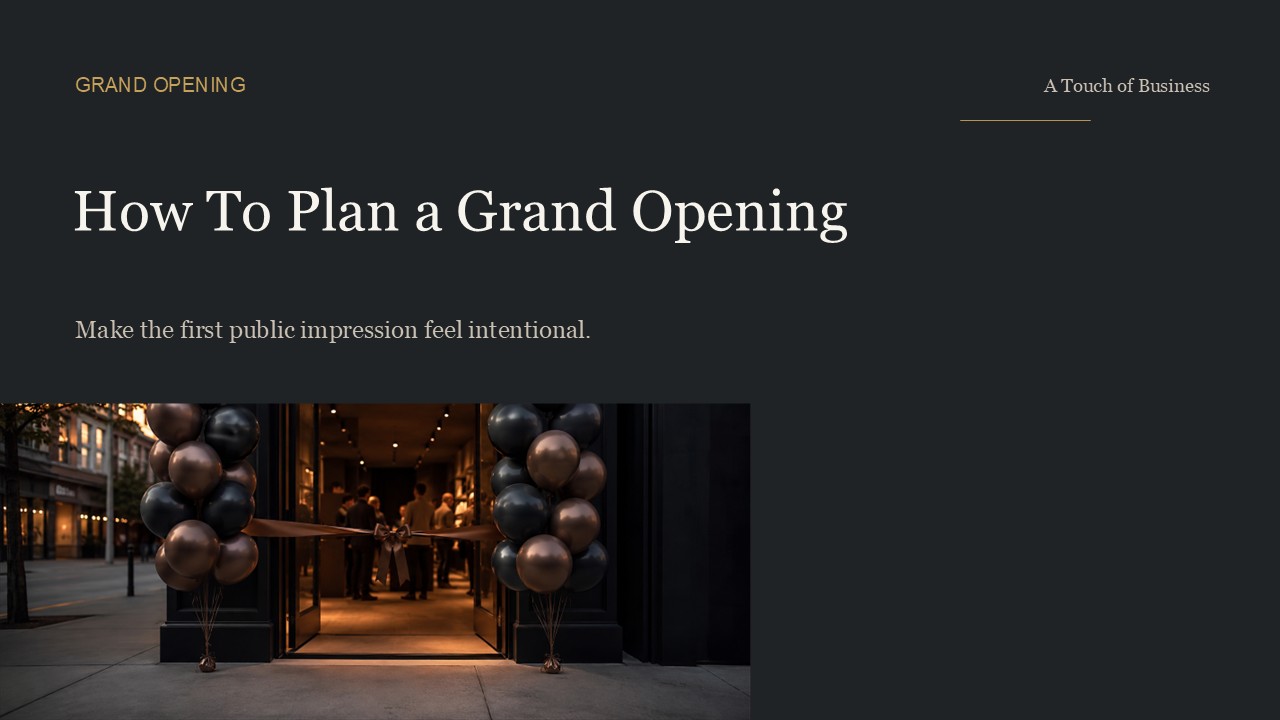
You may also want to set up a grand entrance to attract incoming visitors. For example, you can put out a red carpet, balloon, or banner at the entryway. You can also station someone near the entrance to hand out samples and coupons and welcome them to the grand opening.
Inside your venue, try drumming up the mood and excitement with live music, food, and any other forms of refreshments and entertainment. Your goal should be to ensure your visitors have the best experience. They shouldn’t get bored on your watch.
You can also consider making your grand opening a themed event where your audience dresses in costumes and colors that showcase your theme. However, you need to ensure the theme you select is consistent with what your business offers. For example, if you are opening an Italian restaurant, go for a theme that gives your audience an experience related to Italy.
Capacity Concerns
When determining the capacity of your grand opening, you want to ensure you choose a number that enables each guest to feel comfortable. Most people won’t enjoy being in a crowded and difficult-to-navigate space.
Start by measuring the size of your event space. Then figure out whether your guests will mostly be standing or seated — seated guests need more room than standing ones.
As a general planning guideline, event-industry sources put standing-crowd space at roughly 6 to 10 square feet per person, and seated arrangements at roughly 8 to 18 square feet per person — the exact figure depends on the seating style you choose, from dinner tables to classroom-style rows.
These are rough planning ranges rather than a fixed rule, so treat them as a starting point and check with your venue or local fire code for the actual limit.
Another thing you may want to consider is whether you are hosting an open house where customers walk in and out at their free will. In this case, you won’t have to worry much about maximum capacity than if visitors came to stay for the whole event.
While we’re on capacity concerns, you need to ensure parking is available and sufficient for your guests. A lack of parking may deter guests from entering your event. It can also lead to fines for visitors who park at the wrong spots. Seek permission from your local county or neighboring businesses to ensure you have adequate parking spaces.
Apply for Permits and Licenses Required
Some states and municipalities may require you to get a permit to host a grand opening for your business. It depends on the time of the event, the number of people, and the level of noise you expect. You may also have to get a permit for your business signage.
Identify Your Audience
Knowing who will be at your grand opening will enable you to tailor the event to their preferences. It will allow you to select their preferred entertainment options and use themes and décor that appeal to them.
For example, if you target baby boomers, select music they like. It wouldn’t be a good idea to play electronica or hip hop.
On the other hand, if your target audience is families with kids, you may want to have games and shows to keep the young ones occupied and entertained. Kids get bored quickly and once they do, parents may feel tempted to leave the grand opening early.
Pick Your Event Date Carefully
One of the main things to keep in mind when hosting a grand opening is choosing a suitable date for your event. You want to select a date that makes you the only event in town. It wouldn’t be a good idea to schedule it on a day set for another local function, for example, a concert or sporting event. Fewer people may show up. While at it, avoid the holiday season or days when the weather is likely to be poor.
Set Your Budget
Many small costs come with planning a grand opening, and they add up fast if left unchecked. Decide how much you’re willing to spend, commit to that number, and set aside extra for miscellaneous expenses and emergencies.
Once you know your total, estimate the cost of each individual item you’ll need. It’s smart to overestimate rather than underestimate each one, so the final tally doesn’t run past what you can spend.
Decide What to Give Out
One way to attract your target customers to the grand opening is by offering them an opportunity to win something. Giving gifts entices customers to come to your grand opening and stick around until they win something. Here are a few gift ideas to attract your target market:
- Discounts and coupons
- Free samples
- Complimentary how-to-classes
- Swag bags
- Exclusive grand opening special offer
- Huge giveaways
Giveaways don’t just build same-day foot traffic — they can also turn attendees into repeat customers afterward. Some multi-location brands lean on this pairing: a Houston-based creperie chain, for example, partners with local influencers and gives away drinks at each new location’s opening, combining a giveaway with an influencer partnership to boost its profile in a new market right away.
Partnering
Partnering with influential people and organizations is a smart move when you want to attract many people to your grand opening. A good partner can strengthen your brand’s popularity in your community and maximize your return on investment. In most cases, you want to bring in a partner with an established reputation in the community. Here are some ideas for potential partners:
Local Charity
Partnering with a local charity may seem counterintuitive when launching your business. After all, you are yet to start operations; you don’t have any sales yet and no customers to drive revenue growth. Where will you get the money to donate to the local charity? Well, you can give the profits from your grand opening to them.
By partnering with a local charity, you gain instant favor with your target market. Partnering with them shows your customers that your business doesn’t exist solely to make profits, but also seeks to better the community.
Try targeting a local charity whose supporters are your potential customers. You might lose a few funds from your sales on the grand opening, but this is nothing compared to the favor and loyalty you gain. The charity can also advertise your event to its members and patrons.
Local Media
Local media organizations can also help you gain brand visibility in the community. Reach out to local newspapers and TV or radio stations beforehand and let them know about your grand opening. They may feature your event as a story and thus drive more publicity for your business. You can also partner with local magazine outlets, but target those with relevant content.
Celebrities or Influencers
Try finding local bloggers, celebrities, or influencers in your community and get them to come to your grand opening. If the influencer can’t make the event, you can still ask them to advertise it on social media.
The celebrity you select does not have to be someone big or famous. They just need to have some influence within your town. Try targeting an influencer who shares similar interests with your target audience.
For example, if your business sells beauty products, you want to partner with someone interested in fashion and self-care products.
Influencer partnerships have also become more common industry-wide — most brands that already use influencer marketing have been increasing their investment in it, which suggests the tactic is paying off for businesses that try it.
Develop Your Invitation List
If your grand opening is for a selected few, put together the most useful invitation list you can. Beyond family and friends, invite people who are likely to find your products or services interesting. Remember that not everyone will come, so it’s fine to invite more people than your venue’s capacity.
Decide on Food and Drinks
If there is one thing your guests will appreciate finding in your grand opening, it’s free food and drinks. It doesn’t have to be heavy meals. Light refreshments can work, too.
You have two options when serving refreshments at your grand opening. You can either do it yourself or hire catering services. It depends on your budget and the quality of food and service you want. Catering will be more expensive, but it removes the hassle of ensuring every guest stays satisfied.
Consider a Ribbon-Cutting Ceremony if Appropriate
Holding a ribbon-cutting ceremony is another sure way to attract the community to your grand opening event. Ribbon-cuttings don’t happen every day. It’s something that many attendees, even passersby, will appreciate experiencing. Try getting a high-profile community member, for example, the mayor, to perform the ribbon-cutting. They may help attract even more people to your event.
Create a Script for Your Staff to Say as Visitors Arrive or Tour Your Establishment
When hosting a grand opening, you want your target customers to view and experience all you offer them. It’s a good idea to train your staff on what to say when welcoming visitors and giving them a tour. You may also want to create a script they can follow when talking to guests. Prepare them to address all possible scenarios, whether questions, suggestions, or complaints.
Prepare Your Grand Opening Announcement
Now it’s time to announce your event to the public or your selected guests. You can share the announcement through offline channels, like radio and newspapers, or online channels, such as social media and email. Social media is worth prioritizing if your time or budget is tight — it’s one of the most widely used and effective advertising channels for small businesses. The right mix depends on who you’re targeting, your budget, and your location. Aim to announce a couple of weeks ahead so people can plan to attend.
After the Event
Once you host the grand opening, don’t end your relationship with your target clientele there. Send thank-you notes or emails to thank them for attending. Offer them discounts for future visits. Gather their contact information and update them about new offers in your store.
Action Steps for Planning a Grand Opening
Step 1: Choose your event format
- Decide between an invitation-only soft launch or a public opening.
- Match your marketing plan to the format you choose.
Step 2: Plan the space and guest experience
- Measure your venue and estimate capacity based on standing or seated space.
- Confirm parking is available for the guest count you expect.
- Plan décor, entertainment, and any theme so it matches your brand.
Step 3: Handle permits and budget
- Check with your city or county about permits for signage, noise, or capacity.
- Set a total budget with a buffer, then estimate individual costs against it.
Step 4: Build your promotion plan
- Choose a date that doesn’t compete with other local events.
- Reach out to local charities, media outlets, or influencers for partnerships.
- Announce the event a couple of weeks in advance across your chosen channels.
Step 5: Follow up after the event
- Send thank-you notes or emails to attendees.
- Offer a discount for a return visit and collect contact information for future updates.
Checklist for Hosting a Grand Opening
- Venue and space
- Measured square footage and estimated max capacity
- Confirmed parking availability
- Permits and paperwork
- Confirmed signage, noise, and event permits with local government
- Confirmed alcohol permit if serving alcohol
- Budget
- Set a total spending limit
- Built in a buffer for unexpected costs
- Guest list and invitations
- Decided invitation-only vs. open to the public
- Sent invitations or scheduled the public announcement
- Partnerships
- Contacted a local charity, media outlet, or influencer
- Day-of logistics
- Confirmed décor, music, and food or drink plan
- Briefed staff on the guest script
- Follow-up
- Prepared a thank-you message and return-visit offer
- Set up a way to collect guest contact information
Conclusion
A grand opening is one of the best ways to introduce your business to the community and start building relationships with future customers. The details matter: choose the right format for your audience, plan your budget and capacity with room to spare, and get your permits sorted early. With that groundwork in place, you can focus on what matters most on the day itself — giving guests a good reason to come back.
FAQ: Grand Openings
How far in advance should I plan a grand opening?
- Most of the planning — venue, permits, partnerships — should start well before the date, and the public announcement itself typically goes out a couple of weeks ahead so people can plan to attend.
Do I need a permit to host a grand opening?
- It depends on your city or state, the size of the event, and whether you plan to use signage, serve alcohol, or expect a large crowd. Check with your local government before finalizing your plans.
Should I choose an invitation-only event or one open to the public?
- An invitation-only soft launch is useful for testing your products, pricing, and customer experience on a small group first. An event open to the public maximizes visibility and foot traffic from day one.
How do I estimate how many guests my space can hold?
- Measure your usable space, then divide by a per-person figure based on whether guests will be standing or seated — standing events generally need less room per person than seated ones. Confirm the actual maximum with your venue or local fire code.
What’s the best way to promote a grand opening?
- A mix of channels works best. Partnering with local media, charities, or influencers extends your reach, and social media is one of the most effective channels for small businesses to promote an event.
References:
- Social Tables — Event Capacity Calculator: 3 Simple Tricks
- Perfect Venue — How to Create a Foolproof Venue Capacity System
- Eventhost — How Do You Calculate How Much Space You Need for an Event?
- Chron Small Business — What Permits Are Needed to Have a Grand Opening for a Business?
- Fit Small Business — 20 Grand Opening Ideas to Promote Your Small Business
- CO Consulting — Small Business Marketing Statistics 2026