
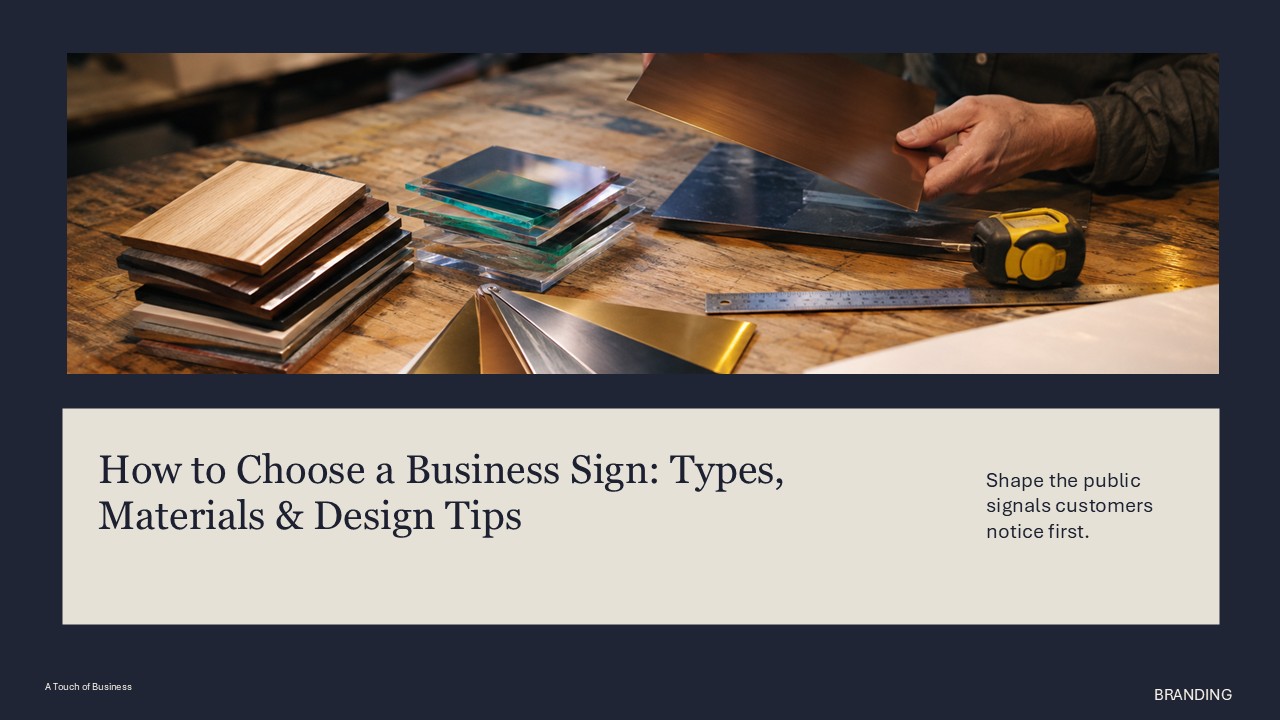
Whether you’ve just started or have been in business for a while, a company sign is one of the fastest ways to catch a prospective customer’s eye and bring them through your door. This article covers business sign types, what to consider when ordering and designing a sign, and common mistakes to avoid — useful whether you’re setting up your first storefront or replacing an old sign.
Selecting the right company sign is an essential first step to attract customers to your business. You want a sign that appeals to potential customers and showcases your brand and identity.
Here’s How to Choose a Company Sign
Before you select and set up your company sign, take a couple of minutes to go through the factors and materials to take into consideration.
What Is a Business Sign?
A business sign, otherwise known as a company sign, is a signage panel that displays the brand name, logo, and other business trademarks to identify an entity and attract customers. You can place a business sign outdoors or inside your commercial venture so it’s the first thing customers see when they walk in. It should not only appeal to potential customers but also showcase your brand and identity. Some examples of business signs include channel letters, electronic message centers, and monuments.
Types of Company Signs
There are many types of signs you can set up to meet your needs. The style you go for depends on whether you’re looking for an indoor or outdoor option.
Outdoor Signage
Let’s start by exploring outdoor business signs:
- Monument signs — A monument sign is a freestanding business sign, in most cases mounted on the ground. Many businesses place this sign next to the storefront as its own standing figure, separate from the building. If your business sits back from the road, you can also place a monument sign near the main road so passing traffic can see it.
- Pylon signs — A pylon sign, also known as a pole sign, is a freestanding outdoor sign supported on a single or double pole. These signs are often placed on properties with many businesses, such as a mall or business park. Pylon signs can have one or several lightboxes depending on how many businesses use them to advertise. Each lightbox displays the name and logo of the company, and the sign’s design often echoes the building or mall it belongs to.
- Channel letters — Channel letters are 3-D individual characters brought together to spell out a business name or logo. There are several types of channel letters. They include:
- Face-lit channel letters: the lighting sits at the face or front of the letters. This type is easy to see at night.
- Non-illuminated channel letters: these have no light source. They’re usually painted in the desired brand colors and are visible during the day, though they can be hard to spot at night.
- Reverse-lit channel letters: also known as halo-lit channel letters. The lighting sits behind the letters, producing a soft glow. This type works well if you want an appealing, ambiance-creating sign at your store.
- Blade signs — If your store is on a busy street and you want to attract foot traffic, consider a blade sign. This signage projects out from your storefront perpendicular to the building. It’s often mounted on a pole connecting to the building and can come lit or unlit. Blade signs are effective for catching the attention of potential customers passing right outside your business.
- High-rise signage — High-rise signage is a company sign placed at the top of a skyscraper or tall building. This signage is usually reserved for the chief tenant of a building. It often comes illuminated so it’s visible at night, and it can also be used to show the name of a building or who owns it.
- Neon signs — Neon signs are company signs designed using gas-discharge tubes filled with neon or other inert gases. A classic example is the “open” or “closed” lit sign used by many stores. This signage is popular with bars and restaurants, but any business can use it. It can work as an outdoor sign or, in smaller versions, indoors.
Indoor Signage
Now that we’ve covered outdoor signage, let’s talk about indoor options. Here are the types of signage to use inside your store, business, or office:
- Directories — Directories are business signs placed inside buildings, often in the lobby. You’re most likely to find this signage in multi-tenant buildings with many floors and sections. Directories help point visitors to the correct rooms and offices by displaying the name, floor, and room number of each business.
- Code signage — Code signage is required under the Americans with Disabilities Act (ADA), which sets federal accessibility standards for signs identifying permanent rooms and spaces such as restrooms, exits, and fire routes. Many states and cities layer their own additional requirements on top of the federal rules, so it’s worth checking with your local building department or a sign professional before you install code signage, rather than assuming one standard applies everywhere.
- Digital printing — Digital printing signs let you attract customers with decorative, appealing prints. You can use this signage for full-wall designs, posters, and banners. It’s cost-effective and can display photos and logos in addition to text.
Choosing the Right Material
Let’s explore some of the materials used to create business signs, along with their pros and cons.
Neon
Neon signs use less power than older fluorescent lighting, but they are not the most energy-efficient option available. Compared to LED, neon signs use significantly more electricity per foot to produce a similar amount of light. Neon is also durable and gives a distinctive light illumination, but the glass tubes can be fragile — a single crack can break the entire piece.
Acrylic
Acrylic, otherwise known as plexiglass, is a good choice if you work in a corporate setting or high-end store. This material is a solid alternative to traditional glass. It’s durable and comes in a wide range of colors. Acrylic works best for indoor use rather than outdoor, and it’s more prone to scratching than glass.
Carved Wood
Although it’s one of the oldest materials used for business signs, carved wood still gives a classic look. It can look good bolted to walls or as a monument sign latched to posts on the ground. Carved wood is durable and highly customizable.
Corrugated Plastic
Corrugated plastic is a strong choice for outdoor signage and can also work indoors, for example on restaurant menu boards. This material is waterproof and resists heat and cold. It generally lasts one to three years mounted outside, and considerably longer indoors, away from weather exposure. Corrugated plastic is also affordable and relatively easy to transport and cut.
Metal
The advantage of metal as a sign material is the range of metals and metal laminates available. You can work with solid metals such as aluminum, copper, and stainless steel, or use bronze and steel alloy. Metal withstands most environmental conditions and doesn’t require much maintenance.
Fabric
Fabric signs suit a business that’s always on the go — attending events and trade shows, for example. They give a seamless, sophisticated look. This material is lightweight, easy to transport, and machine washable. You can use fabric to make banners, flags, tents, and canopies.
PVC
PVC holds up well indoors but may not last as long outdoors. Although slightly heavier than fabric, this material is easy to cut and comes in many colors. You can use PVC to create menu boards, trade-show signs, point-of-purchase displays, and more.
Vinyl
Vinyl is less durable than some other materials but is relatively inexpensive. It works well for short-term promotions and marketing campaigns, such as store grand openings and sale advertisements. A well-made vinyl sign or banner can last roughly two to five years outdoors, depending on the quality of the vinyl and how much sun and weather it’s exposed to, so it’s worth asking about UV-resistant coatings if you want it to last closer to the higher end of that range.
Design Considerations
The elements to consider when designing a business sign depend on its intended purpose. You can use business signs to market your business, give directions, or convey safety information, among other things.
Before designing the sign, assess its purpose and your target audience. This will put you in a better place to create a design that suits your needs.
Here are a few elements to think about when designing a business sign:
Branding Elements
As you create your sign, go for a style and design that showcase your business and products or services. Your sign should be easily identifiable to customers — they should know it represents your business simply by looking at it.
Most potential customers don’t have time to read an entire sign. A glance at it should tell them who you are and what you offer. You may want to include a few branding elements, such as your name and logo, and it’s a good idea to use your branding colors in the design.
Illuminated Versus Non-Illuminated
Another factor to consider when designing your signage is whether you’d like an illuminated or non-illuminated sign. The main difference is that illuminated signs have an internal light source, while non-illuminated ones don’t — though they can rely on an external light source or use contrasting colors for night visibility.
Choosing between illuminated and non-illuminated signs depends on your location and hours of operation. Local zoning ordinances in some areas restrict or prohibit illuminated signs, and many cities also limit the hours illuminated signs can stay lit or how bright they can be, so it’s worth checking your local zoning rules before you commit to a design. If your business follows a standard daytime schedule, you also may not need illuminated signage. Illuminated signs are more costly to set up and require more maintenance.
Legibility
A business sign exists to pass information to your audience. Whether you want to attract customers or inform them about something, the text should be legible and memorable. Use a font type and size that’s easily readable from a distance, keep your text short and to the point, and avoid long or complex words.
Graphical Elements
Graphics help make your business signs more appealing and are often more memorable than text. You may want to include one or two images in your signage to help grab people’s attention.
Questions When Ordering a Business Sign
Here is a list of simple but crucial questions to ask when purchasing and setting up a business sign.
- Do I need a sign permit? Most cities require one, and as of 2026, permit fees commonly run from around $400 to $2,500 depending on your local rules and the sign’s complexity.
- How much maintenance does the sign require?
- Is there a warranty on the materials?
- Do I have to cover an installation fee?
- How long is the signage expected to last?
- What should I budget overall? As of 2026, business sign costs vary widely by type — a simple sign can start around $500, while a larger illuminated storefront sign can run from roughly $2,500 to $15,000 or more, so it helps to get a few quotes before deciding.
Common Mistakes You Should Avoid With Business Signs
As you purchase your sign, make sure you don’t make the following common mistakes.
- Wrong placement — Position your sign where customers will actually see it. Your sign may be perfectly designed, but it won’t do you any good if people don’t notice it.
- The wrong size — Choose a sign that’s the right size for who you’re targeting. High-rise signage, for instance, needs to be big enough to be viewed from the top of a skyscraper. A directory, by contrast, shouldn’t occupy a whole wall.
- Too much information — Customers may not have time to stop and read every detail. Don’t use too many words or graphics — keep the information concise.
- Too little information — Your signage needs the right amount of information. Too few details, and it might not convey the message you want.
- Incorrect colors — Avoid colors that clash with your building or brand, or the sign may look out of place.
Conclusion
A well-chosen sign grabs the attention of potential customers, showcasing your brand and the products or services you sell. There are many options to pick from, whether you need something for the outdoors — blade signs, monument signs, or high-rise signage — or the indoors, like directories or code signage.
When designing one, weigh branding, illumination, legibility, and graphics. Choose the right size and location, and check whether you need a permit before installing it in your area.
Key Points and Facts About Business Signs
- A business sign displays your brand name, logo, and other trademarks to identify your business and attract customers.
- Outdoor sign types include monument, pylon, channel letter, blade, high-rise, and neon signs.
- Indoor sign types include directories, code (ADA) signage, and digital printing.
- Sign materials each trade off differently on durability, cost, and appearance — neon, acrylic, carved wood, corrugated plastic, metal, fabric, PVC, and vinyl are common options.
- Design considerations include branding elements, illumination, legibility, and graphics.
- As of 2026, sign permits commonly cost $400–$2,500, and overall sign costs range from around $500 to $15,000 or more depending on type and size.
Action Steps for Choosing a Business Sign
Define your needs
- Decide whether you need an outdoor sign, an indoor sign, or both.
- Identify your target audience and how they’ll encounter the sign (on foot, driving by, inside your building).
Check local rules first
- Contact your local building or zoning department to ask about permit requirements and illumination restrictions.
- Confirm any ADA code signage requirements that apply to your space.
Choose type and material
- Match the sign type to your location — for example, a blade sign for foot traffic, a pylon sign for a shared property, or a monument sign for a street-facing entrance.
- Weigh material trade-offs like durability, cost, and maintenance before committing.
Design and order
- Incorporate your branding elements — logo, name, and brand colors.
- Get quotes from more than one sign company and ask about installation and warranty terms.
Checklist for Choosing a Business Sign
- Purpose and audience
- Know what the sign needs to communicate and to whom.
- Sign type
- Pick from outdoor or indoor sign types based on your location.
- Material
- Choose a material that fits your budget, setting, and expected lifespan.
- Design
- Include branding elements, decide on illumination, and keep text legible.
- Permits and budget
- Check permit requirements and local zoning rules, and set a budget that covers design, materials, and installation.
FAQ: Business Signs
Do I need a permit for a business sign?
- In most cities, yes. As of 2026, permit fees commonly range from about $400 to $2,500, depending on your location and the sign’s complexity, so check with your local building department before ordering.
How much does a business sign cost?
- As of 2026, costs vary widely by type and size — a simple sign can start around $500, while a larger illuminated storefront sign can run from roughly $2,500 to $15,000 or more.
Are illuminated signs allowed everywhere?
- No. Local zoning ordinances vary, and many restrict illuminated or animated signage, especially near residential areas, or limit the hours a sign can stay lit.
What’s the most durable outdoor sign material?
- Metal generally withstands weather well and needs little maintenance, making it a solid pick when durability matters more than upfront cost.
References:
- Identiti — ADA Signage Requirements in 2025: A Compliance Guide for Businesses
- Vintage Sign & Light — Commercial Signage Zoning Restrictions Businesses Should Know
- Visigraph — Corrugated Plastic Signs
- NorthCoast Banners — How Long Do Vinyl Banners Last Outside?
- BlinkSigns — LED vs Traditional Neon Signs: Cost & Energy Guide
- NeonSign.com — Do Neon Signs Use A Lot of Energy?
- Signs By Tomorrow — How Much Does a Custom Business Sign Cost in 2026?
- Angi — How Much Does Commercial Sign Installation Cost?