
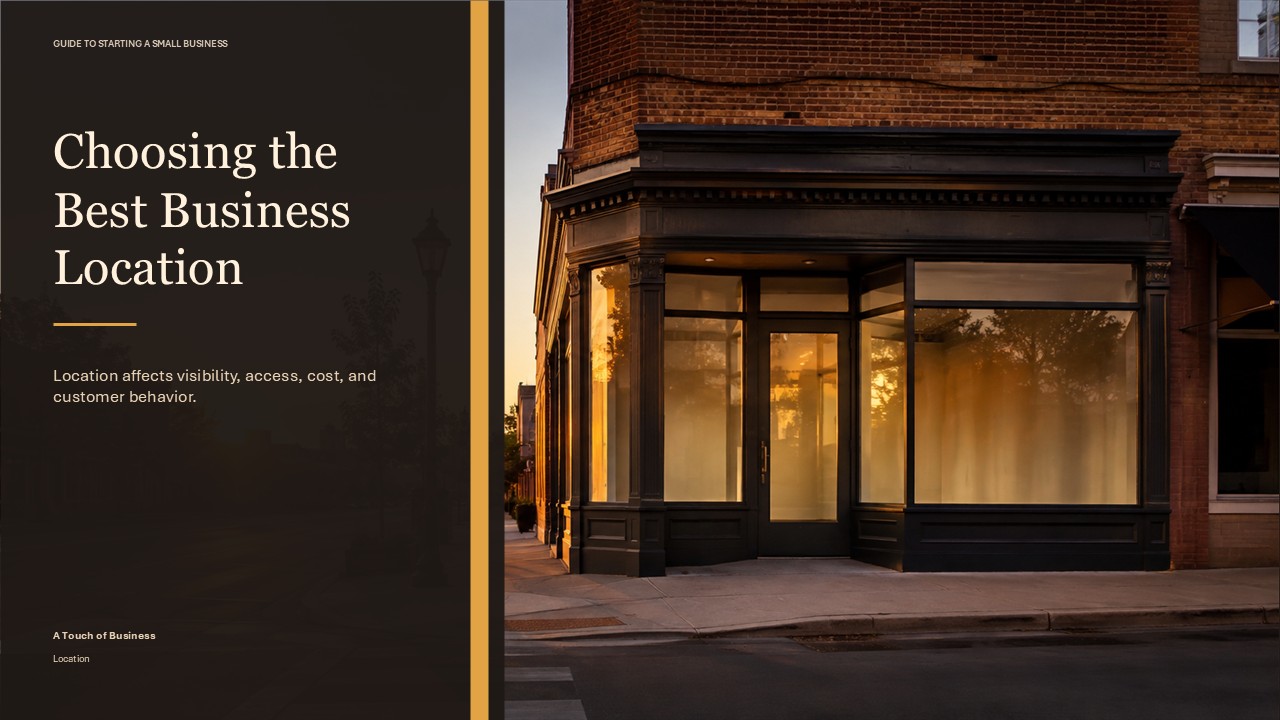
Choosing A Business Location
Part 8 of Acey Gaspard’s Guide to Starting a Small Business
Choosing a location can help your business grow, or it can quietly hold you back. The right spot makes it easier for customers to find you, buy from you, and come back again. The wrong spot can leave you working hard with very little to show for it.
In this overview, you will look at how much location really matters for your business, what to look for in a location, and how to think about the cost. This is not a complete guide to commercial real estate, but it will give you a practical way to think through your options before you sign a lease.
Does Location Really Matter for Your Business?
Location does not matter in the same way for every business. Before you look at specific addresses, step back and look at your business model.
Ask yourself which group you fit into most:
- Walk-in businesses: Retail shops, hair salons, cafes, and other businesses that depend on people seeing your location and walking in.
- Appointment-based businesses: Consultants, clinics, and professionals where people book ahead, but still visit your location.
- Service-area businesses: Plumbers, landscapers, mobile repair, and others who travel to the customer. Your office is mainly for storage, admin, and parking.
- Online or home-based businesses: Customers do not come to you. Your location matters more for cost, zoning rules, and convenience than for traffic.
If you rely on walk-in customers, your location becomes a major part of your marketing. If you are online or you travel to customers, you may be able to choose a lower-cost area and focus more on reach, service, and operations.
James’ Story: A Great Service in the Wrong Place
James loved working with computers, and he was good at it. He decided to open his own computer repair shop.
James lived about 30 miles from the nearest major city. His shop was out in the country. People liked him, and he did excellent work, but most customers did not want to drive an hour to drop off a computer and come back again to pick it up.
James believed people would make the trip because he was so good at what he did. A few people did. Most did not. They chose a closer option, even if the service was not as strong.
That matches what the research shows. A 2026 national survey found that 93.2% of consumers won’t travel more than 20 minutes for an everyday purchase or service, and 87% won’t go past 15 minutes. Once a trip takes longer than that, most people simply choose whatever is closer.
There are times when customers will travel farther. That usually happens when the business is very specialized or when there are no real alternatives. Even in those cases, a business that is too far from where its customers already are is likely missing out on a large part of the market.
Whether you are buying an existing business or starting one from scratch, your location should match how your customers behave in the real world, not just how you hope they will behave.
Step 1: Define What You Need in a Location
Once you know how much location matters for your business, decide what you actually need from the area and the building. This helps you avoid falling in love with a place that looks good, but does not fit your business.
Consider points like:
- Visibility: Can people see your sign and storefront easily from the street or walkway?
- Type of traffic: Are the people passing by similar to your ideal customers, or are they mostly in a hurry and not likely to stop?
- Parking and access: Is it easy to get in and out, park, or unload goods?
- Nearby businesses: Are there complementary businesses that can send you traffic, or is the area quiet with little reason for people to visit?
- Safety and reputation: Does the area feel safe and comfortable for your customers and staff?
- Zoning and rules: Is your type of business allowed there, and are there any restrictions you need to know about?
- Lease terms: How long is the lease, and how flexible is it if your business grows or needs to move? Check whether annual rent increases are capped at a fixed percentage, and make sure the lease names your business entity rather than you personally. That keeps a bad year in the business from putting your personal assets on the hook.
You can even give each location a simple “score” from 1 to 5 for visibility, traffic, parking, fit with your customers, and cost. This gives you a clearer way to compare different spots instead of choosing on feeling alone.
Step 2: Compare the Cost to the Potential
Many business owners choose a weaker location because the rent is lower. Lower rent feels safe, especially when you are just starting out. The risk is that you save a few hundred dollars a month on rent, but lose thousands in sales because customers do not find you or do not visit as often.
A more expensive location can make sense if it supports higher sales and profit. The key is to think in numbers, not just feelings.
Good retail space is also harder to come by right now than it has been in years. As of 2026, national retail vacancy has been running in the 4% to 6% range, well below the long-term average of around 7%. That means fewer strong spots are sitting empty and waiting for you, so it pays to move on a solid location once you find one instead of waiting for something to open up.
Look at points like:
- How much more per month will the better location cost you?
- How many extra sales or customers would you need each month to cover that difference?
- Is that increase realistic for your type of business and the traffic in that area?
- What other marketing would you need to do to make a low-traffic location work?
It is often easier to start in a solid location and build your reputation there than to struggle in a weak spot and hope to move later. Moving a business can be expensive and risky. You can lose customers, time, and momentum.
For more on matching your idea with real demand, also see Supply and Demand Considerations When Starting a Business.
Step 3: Visit and Test Potential Locations
Do not rely only on listings, photos, or what the landlord tells you. Spend time at each potential location and watch how it behaves in real life.
When you visit, try to:
- Look at the area at different times of day and different days of the week.
- Count how many people or cars pass by in a short period.
- Notice who they are and whether they match your ideal customer.
- Talk to nearby business owners about the area, the landlord, and the general flow of business.
- Check for any signs of upcoming road work, major construction, or changes that could hurt or help your traffic.
A few extra visits can give you insight that does not show up on paper. You are not just renting a building. You are choosing a place in the flow of daily life in that area.
Action Steps for Choosing a Business Location
Identify Your Traffic Dependence
- Decide which of the four business types you fit: walk-in, appointment-based, service-area, or online/home-based.
- Estimate what share of your sales would come from people noticing your business in passing.
Set Your Location Requirements
- List your must-haves for visibility, traffic, parking, and zoning.
- Score each candidate location from 1 to 5 on the factors that matter most to you.
Run the Numbers
- Calculate the monthly cost difference between your top options.
- Estimate how many extra customers each option would need to justify the cost.
Test the Location In Person
- Visit each finalist at different times of day and days of the week.
- Talk to a nearby business owner about the area before you sign anything.
Checklist for Choosing a Business Location
Use this simple checklist as you compare different options:
- Have you decided how important walk-in traffic is for your specific business?
- Do you know what kind of customers you want nearby?
- Have you listed the features you need in a location, not just what you would like?
- Have you visited each location at different times of day?
- Have you compared the extra rent to the realistic extra sales you might gain?
- Have you talked to current tenants or neighbors to learn more about the area?
- Does the lease give you enough flexibility as your business grows or changes?
- Does the lease cap annual rent increases, and is it in your business’s name?
Key Points and Facts About Choosing a Business Location
- Location matters most when your business depends on walk-in sales and repeat visits.
- Most customers will not travel far unless they have a strong reason to do so — a 2026 survey found the large majority won’t go more than 15 to 20 minutes out of their way.
- A more expensive location can pay for itself if it supports higher sales and profit, not just more traffic.
- You can often cut costs in other parts of your business to afford a stronger location that helps you grow.
- As of 2026, good commercial space is harder to find than usual, so a solid location is worth acting on.
- The value of your business can increase when you build a strong reputation in a good area over time.
Choosing a location is not about finding a “perfect” spot. It is about choosing a place that gives your business a fair chance to succeed with the customers you want to serve.
FAQ: Choosing a Business Location
Does my business need a high-traffic location?
- Only if you depend on walk-in customers. Appointment-based, service-area, and online businesses can often succeed in lower-traffic, lower-cost areas.
How far will customers really travel to reach me?
- Not far. A 2026 survey on shopping habits found the vast majority stop at 15 to 20 minutes of travel time for routine purchases — 87% won’t go past 15 minutes, and 93.2% won’t go past 20.
Should I pick the cheaper location to save money starting out?
- Not automatically. A cheaper spot only saves money if it doesn’t cost you more in lost sales than it saves in rent. Run the numbers before deciding.
What should I check before signing a commercial lease?
- Check the lease length and flexibility, whether annual rent increases are capped, and whether the lease is in your business’s name rather than yours personally.
Is it hard to find good retail space right now?
- Yes, relatively — 2026 industry data puts national retail vacancy well below its long-term average, meaning fewer strong spots are sitting open.
References
- CSP Daily News — Consumers Like to Shop Close to Home (2026)
- Colliers — Retail Market Statistics Q2 2026
- Cushman & Wakefield — U.S. Shopping Center MarketBeat Report (Q1 2026)
- SVN — Commercial Lease Negotiation in a High-Rate Era
- Business Law Southwest — How to Negotiate Commercial Lease Terms in 2026
Back to the table of contents of Acey Gaspard’s Guide to Starting a Small Business