
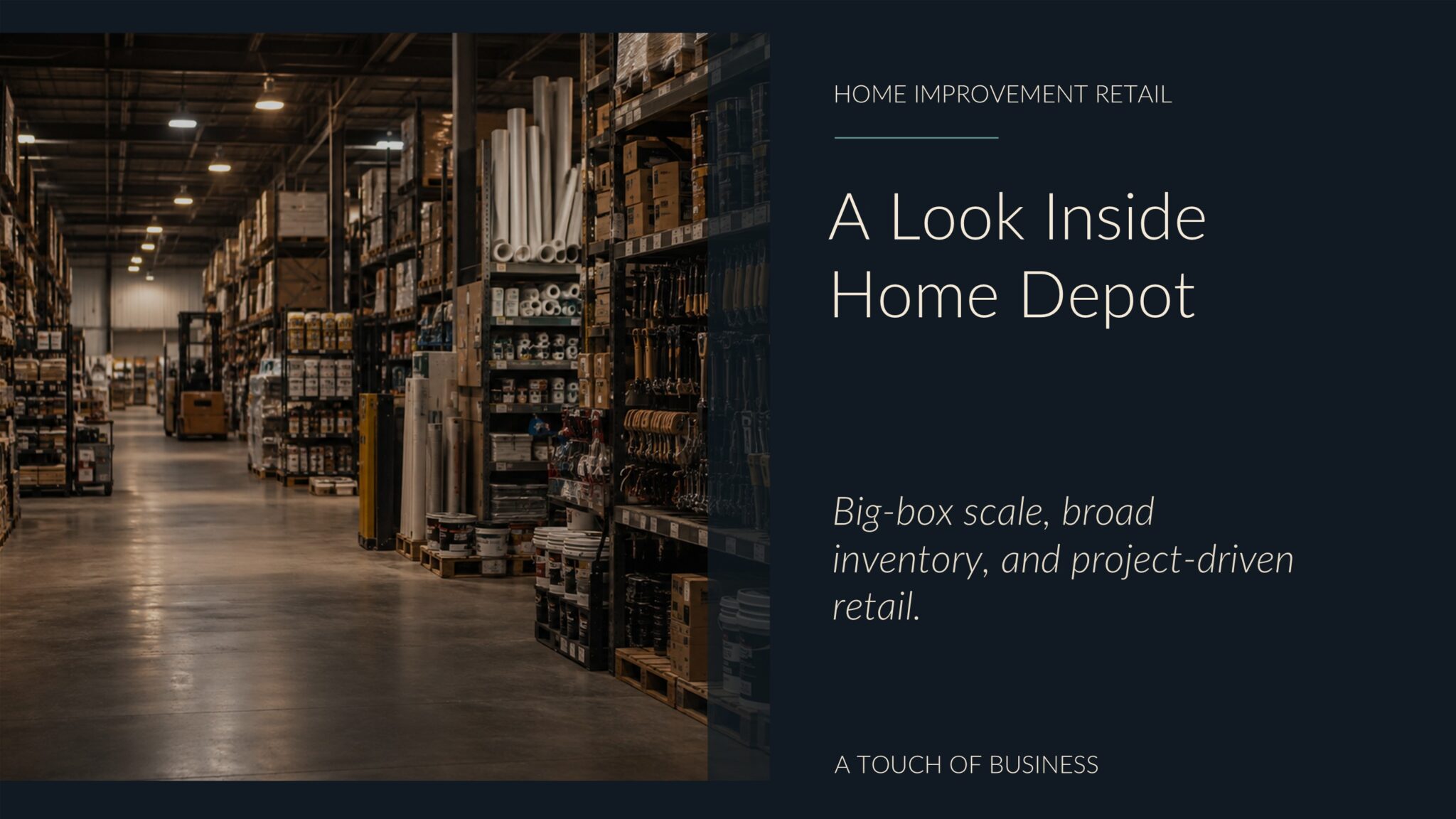
In 2007, Home Depot sold HD Supply after spending years building a much larger business-to-business distribution operation. Thirteen years later, The Home Depot, Inc. acquired HD Supply Holdings. Home Depot then acquired SRS Distribution in 2024, and SRS acquired GMS in 2025.
That arc captures an important pattern in Home Depot’s history. The business began with a large warehouse retail model, expanded that model across North America, moved into adjacent businesses, pulled back from some of them, and later rebuilt selected capabilities in different forms.
The story starts before the orange warehouse stores became familiar.
In 1978, Bernie Marcus and Arthur Blank lost their jobs at Handy Dan Home Improvement Centers and began developing a new home-improvement retail concept. The Home Depot, Inc. was incorporated that year, and the first two stores opened in Atlanta in June 1979.
A Quick Look at the History of Home Depot
Company History Summary
Home Depot grew from a warehouse-style home-improvement concept into a large North American retailer with additional distribution businesses serving professional customers.
The original model combined broad merchandise selection, competitive pricing, and associates who could help customers complete projects.
As the business expanded, Home Depot entered Canada and Mexico, built a large supply operation and later sold it, invested heavily in connected physical and digital shopping, and then rebuilt professional and maintenance, repair, and operations distribution capabilities through Interline Brands, HD Supply, SRS Distribution, and GMS.
Company Snapshot
Founded / Origin: The Home Depot, Inc. was incorporated on June 29, 1978. The first two stores opened on June 22, 1979.
Founders: Bernie Marcus and Arthur Blank, with important early help from Ken Langone, Pat Farrah, and Ron Brill.
First Stores: Atlanta, Georgia.
Industry: Home-improvement retail, with additional professional and specialty distribution businesses.
Public Company: The initial public offering took place in 1981. Home Depot began trading on the New York Stock Exchange under HD in 1984.
Current Leadership: Ted Decker, Chair, President and CEO, as of the September 22, 2026 research cutoff.
Current Scale: At the end of the second quarter of fiscal 2026, Home Depot reported 2,364 retail stores, more than 1,340 SRS locations, and more than 470,000 associates.
Current Strategic Focus: Management describes three core pillars: drive the core and culture, deliver a frictionless interconnected experience, and win with the Pro.
The Warehouse Idea Begins in Atlanta
Bernie Marcus and Arthur Blank were executives at Handy Dan Home Improvement Centers before they were fired in 1978. Handy Dan was their former employer, not a predecessor of Home Depot. After leaving, Marcus and Blank developed a plan for a much larger home-improvement warehouse built around broad selection, competitive prices, and employees who could help customers understand projects.
Ken Langone, Pat Farrah, and Ron Brill provided important help in the early period. Sources differ somewhat in how they label the expanded founding team, so Marcus and Blank are the clearest central founders while the others are best described as key early contributors.
The Home Depot, Inc. was incorporated in Delaware on June 29, 1978. The first two Home Depot stores opened in Atlanta on June 22, 1979. Early stores used warehouse spaces, open shelving, mass merchandise displays, and a one-stop do-it-yourself concept.
The service side of the model was part of the founders’ operating idea from the beginning. Bernie Marcus later summarized that philosophy by saying, “At the end of the day, we’re in the people business.”
Growth came quickly. By the period covered in the 1982 annual report, Home Depot had eight stores, had expanded into South Florida, and had completed its initial public offering. Fiscal-year sales were about $51.5 million, compared with about $22.3 million a year earlier.
The IPO took place on September 22, 1981, with shares initially trading on Nasdaq under HOMD. On April 19, 1984, the stock began trading on the New York Stock Exchange under the ticker HD.
Scaling the Model Across North America
During the 1980s and 1990s, the warehouse model expanded across the United States. International growth became part of the story in 1994, when Home Depot entered Canada through the acquisition of Aikenhead’s home-improvement warehouse operations.
Mexico followed in 2001 through the acquisition of Total Home, a four-store home-improvement chain. These moves extended the retail model beyond the United States rather than creating a fundamentally different business.
By around 2000, leadership was also moving beyond the founder-led period and into the Robert Nardelli era. That transition became especially important as management pursued growth beyond the core retail-store business.
A Bigger Supply Bet—and a 2007 Refocus
Home Depot had already been building business-to-business distribution operations when management announced a major step in January 2006: the acquisition of Hughes Supply. The transaction called for aggregate consideration of $3.47 billion, including assumed net debt, and was intended to sharply expand Home Depot Supply.
Then-chairman, president and CEO Robert Nardelli described the transaction as part of a strategy to strengthen core retail while extending into adjacent areas and new markets. The acquisition materially increased the scale of the supply business, but the strategic setting changed soon afterward.
On January 2, 2007, Nardelli resigned. The board elected Frank Blake chairman and CEO. Home Depot’s 2007 filing later described rapid deterioration in housing, residential construction, and home-improvement markets and set out a new group of priorities focused on retail, associates, stores, customer service, and capital returns.
On August 30, 2007, Home Depot closed the sale of HD Supply. The amended transaction carried an aggregate purchase price of $8.5 billion, while Home Depot reported $8.3 billion in net proceeds and retained a 12.5% equity interest valued at $325 million at closing.
The sequence became a strategic reversal and refocus. Leadership changed, the housing and home-improvement environment deteriorated, and management reset priorities around the retail business before Home Depot sold HD Supply.
The episode also shows how adjacent expansion can be reversible. Home Depot built a substantial distribution capability, sold it when priorities changed, and later returned to professional and maintenance, repair, and operations customers through a different structure.
Retrenchment, China, and a Data-Security Crisis
The retail refocus continued during the recession and housing downturn. In 2009, Home Depot closed EXPO Design Center and other non-core specialty businesses rather than continuing to expand every format it had accumulated.
China presented another adjustment. In September 2012, Home Depot announced that it would close its remaining seven big-box stores there and record an after-tax charge of about $160 million. The move was not a complete exit from China at that time. The company retained a new-formats team, two specialty stores in Tianjin, early e-commerce relationships, and sourcing operations.
Two years later, Home Depot faced a different kind of problem. In September 2014, the company confirmed a cyberattack involving custom malware in U.S. and Canadian store networks. Home Depot estimated that payment-card information for approximately 56 million unique cards had been put at risk. The company also reported malware-elimination and enhanced-encryption measures as part of its response.
Craig Menear became CEO and president effective November 1, 2014, with Frank Blake remaining chairman at that point. The next phase combined renewed professional-customer capabilities with a much larger effort to connect stores, digital shopping, fulfillment, and supply chain operations.
One Home Depot and the Return to Pro Distribution
In August 2015, The Home Depot, Inc. completed its $1.625 billion acquisition of Interline Brands, a distributor and direct marketer of maintenance, repair, and operations products. The transaction strengthened capabilities that were different from the consumer warehouse-store experience but relevant to professional and institutional customers.
Late in 2017, management launched One Home Depot, an approximately $11 billion multi-year accelerated investment program. The program covered stores, digital capabilities, supply chain, and the broader shopping experience, with management aiming to make physical and digital channels work as one interconnected system.
The core capability stayed recognizable even as the delivery system changed. The original model had combined assortment, price, and project help inside large stores. Decades later, management was adding digital ordering, fulfillment, delivery, and other capabilities around that store base rather than treating online and physical retail as separate businesses.
Fiscal 2020 brought an extraordinary increase in activity during the pandemic period. Home Depot reported sales of $132.1 billion, up 19.9% from fiscal 2019, with comparable sales up 19.7%. Craig Menear credited prior investments and associate execution as contributors to the performance.
The same year also marked a return to a familiar adjacent business. On December 24, 2020, Home Depot completed the acquisition of HD Supply Holdings, Inc. at an enterprise value of approximately $8 billion. HD Supply became a wholly owned subsidiary.
The 2020 transaction did not simply reverse the 2007 sale with no intervening corporate history. HD Supply Holdings had its own ownership history before becoming a wholly owned Home Depot subsidiary, while the acquisition restored a large professional and maintenance, repair, and operations capability to the Home Depot group.
Ted Decker became CEO and president on March 1, 2022. Under Decker, the company’s current strategy has continued to emphasize the core store business, interconnected shopping, and professional customers.
SRS, GMS, and a Larger Pro Platform
The next major expansion arrived in June 2024, when The Home Depot, Inc. completed the acquisition of SRS Distribution for an enterprise value of approximately $18.25 billion. SRS brought a large specialty-trade distribution platform into the Home Depot group.
Management’s Pro strategy increasingly emphasized capabilities that traditional Home Depot stores had not typically offered to larger professional customers, including specialized sales support, delivery, credit, order management, and deeper category assortments. SRS added a specialty-trade distribution platform built around many of those needs.
In September 2025, SRS completed the acquisition of GMS for an enterprise value including net debt of approximately $5.5 billion. GMS added more building-product categories within the SRS platform.
Together, the transactions mark another turn in a long-running pattern. Home Depot sold a major distribution operation in 2007, rebuilt selected MRO and Pro capabilities through Interline and HD Supply, and then expanded those capabilities through SRS and GMS.
The long-term outcome of the SRS and GMS acquisitions was still developing at the September 2026 research cutoff. The transactions had materially changed the company’s distribution footprint, but it would be premature to label them definitive successes or failures.
Where Home Depot Stands in 2026
For fiscal 2025, Home Depot reported sales of $164.7 billion and net earnings of $14.2 billion. At the end of the second quarter of fiscal 2026, the group reported 2,364 retail stores, more than 1,340 SRS locations, and more than 470,000 associates.
In July 2026, Home Depot announced an organizational realignment around merchandising, interconnected retail, Pro acceleration, and technology. Management continued to describe its strategic pillars as driving the core and culture, delivering a frictionless interconnected experience, and winning with the Pro.
The history remains anchored in the warehouse-store model created in the late 1970s, but the business around that model has changed repeatedly. Retail expansion, international moves, divestitures, digital investment, and professional distribution have all altered how Home Depot serves customers. At the September 2026 cutoff, the newest phase centered on coordinating Home Depot Pro, HD Supply, SRS, GMS, and the core retail network.
Timeline
This timeline highlights major verified milestones in Home Depot’s development from its 1978 incorporation through its current Pro expansion.

1978
Bernie Marcus and Arthur Blank left Handy Dan after being fired and developed the concept that became Home Depot. The Home Depot, Inc. was incorporated in Delaware on June 29.
June 22, 1979
The first two Home Depot stores opened in Atlanta.
September 22, 1981
Home Depot completed its initial public offering, with shares initially trading on Nasdaq under HOMD.
April 19, 1984
Home Depot began trading on the New York Stock Exchange under the ticker HD.
1994
Home Depot entered Canada through the acquisition of Aikenhead’s home-improvement warehouse operations.
2001
Home Depot entered Mexico through the acquisition of Total Home, a four-store chain.
2006
The Hughes Supply acquisition materially expanded Home Depot Supply.
January 2, 2007
Robert Nardelli resigned, and the board elected Frank Blake chairman and CEO.
August 30, 2007
Home Depot closed the sale of HD Supply under an amended agreement with an aggregate purchase price of $8.5 billion.
2009
Home Depot closed EXPO Design Center and other non-core specialty businesses during its broader retail refocus.
September 2012
Home Depot closed its remaining seven big-box stores in China and shifted its strategy there while retaining other activities.
September 2014
Home Depot confirmed a major payment-card breach and estimated that information for approximately 56 million unique cards had been put at risk.
November 1, 2014
Craig Menear became CEO and president.
August 24, 2015
The Home Depot, Inc. completed its $1.625 billion acquisition of Interline Brands.
Late 2017
Management launched the approximately $11 billion One Home Depot investment program to connect stores, digital capabilities, supply chain, and customer experience.
December 24, 2020
The Home Depot, Inc. completed its approximately $8 billion acquisition of HD Supply Holdings, which became a wholly owned subsidiary.
March 1, 2022
Ted Decker became CEO and president.
June 18, 2024
The Home Depot, Inc. completed its approximately $18.25 billion acquisition of SRS Distribution.
September 4, 2025
SRS completed the acquisition of GMS for an enterprise value including net debt of approximately $5.5 billion.
July 30, 2026
Home Depot announced an organizational realignment around merchandising, interconnected retail, Pro acceleration, and technology.
August 2026
At the end of the second quarter of fiscal 2026, Home Depot reported 2,364 retail stores, more than 1,340 SRS locations, and more than 470,000 associates.
FAQs
Question: Was Home Depot founded in 1978 or 1979?
Answer: Both dates mark different parts of the beginning. The Home Depot, Inc. was incorporated on June 29, 1978. The first two Home Depot stores opened in Atlanta on June 22, 1979.
Question: Did Home Depot sell HD Supply and later buy it back?
Answer: Home Depot sold HD Supply in 2007. In 2020, The Home Depot, Inc. acquired HD Supply Holdings, Inc. for an enterprise value of approximately $8 billion and made it a wholly owned subsidiary.
The intervening ownership and corporate history means the two events should not be described as though the same entity simply left and returned unchanged.
Question: Did Home Depot completely leave China in 2012?
Answer: No. Home Depot closed its remaining seven big-box stores in China in 2012, but at that time it retained specialty stores, a new-formats team, sourcing offices, and early e-commerce relationships.
Interviews & Firsthand Resources
Arthur Blank on NPR’s How I Built This
This resource points readers to Arthur Blank’s firsthand account of the period after he and Bernie Marcus were fired from Handy Dan and began developing the business that became Home Depot.
It is useful for understanding the founding circumstances and early risks from the perspective of one of the central founders.
Behind the Book: Built from Scratch
This Home Depot resource explains the background of Built from Scratch, the founder memoir written by Bernie Marcus and Arthur Blank with Bob Andelman.
It also describes the use of interviews with early participants, including Ken Langone, making it useful as a firsthand perspective on the company’s first two decades.
Sources
- The Home Depot Investor Relations: Investor FAQs, Fiscal 2008 results and specialty-business closures, China big-box store closures, 2014 malware and encryption update, Craig Menear CEO announcement, Interline Brands acquisition, Fiscal 2020 results, SRS Distribution acquisition, GMS acquisition, 2026 organizational realignment
- The Home Depot: The Home Is Where Our Story Begins, Home Depot Mexico history, HD Supply acquisition, Ted Decker CEO announcement, Q2 fiscal 2026 results, Arthur Blank / NPR resource, Behind the Book: Built from Scratch
- Home Depot Canada: About Us / Histoire
- New Georgia Encyclopedia: The Home Depot
- U.S. Securities and Exchange Commission / The Home Depot: Hughes Supply acquisition announcement, 2007 leadership change filing, 2007 Form 10-K, Amended HD Supply sale filing, Fiscal 2019 Form 10-K, 2025 Annual Report
- The Home Depot Annual Report Archive: 1982 Annual Report