
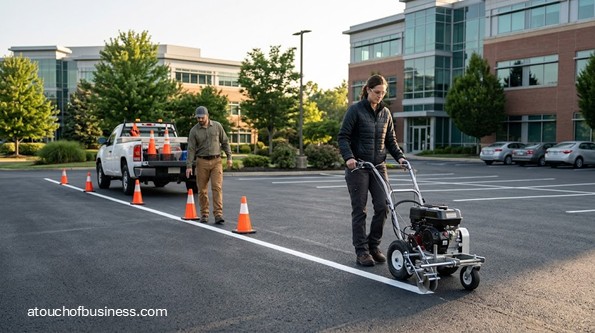
What to Expect From This Guide to Starting a Parking Lot Striping Business
This guide walks you through the key decisions and practical steps involved in starting a parking lot striping business, from evaluating the opportunity through planning, setup, and opening preparation.
Inside the guide, you will find:
- Startup steps: Follow an ordered progression from evaluating the business through registration, equipment, pricing, testing, and opening preparation.
- Business fit: Consider work hours, physical demands, seasonal slowdowns, household impact, and whether the trade suits your circumstances.
- Market demand: Examine local property demand, competing contractors, service options, and the area you plan to serve.
- Financial planning: Work through startup funding, pricing methods, minimum charges, operating capital, fixed costs, and break-even calculations.
- Equipment needs: Review striping machines, vehicles, trailers, paint, stencils, suppliers, safety gear, and specialized equipment options.
- Local requirements: Check licensing, taxes, insurance, zoning, storage restrictions, bonds, and other requirements that can vary by location.
- Startup FAQs: Find practical answers about licensing, insurance, home operation, accessible spaces, materials, seasonal work, equipment, and scheduling.
The guide begins by helping you decide whether the working conditions, schedule, financial demands, and responsibilities of striping fit your situation.
Parking Lot Striping: An Overview
Clear, accurate lines keep commercial lots organized, safe, and compliant.
As a contractor, you travel to each customer’s property to measure, layout, and paint the lines that guide traffic.
Retail centers, apartment complexes, churches, schools, and property managers all need this work on a repeating schedule.
Because you work at each site instead of from a storefront, your truck, trailer, and striping machine are your real business location.
This guide follows the general startup process most new owners use, applied specifically to this trade.
Deciding if Parking Lot Striping Fits Your Life
Before you buy any equipment, decide honestly whether this trade matches how you want to work and live.
Striping jobs often happen early in the morning or late at night, when lots sit empty.
Ask yourself if you’re willing to work those hours, in all kinds of weather.
This work also comes with real physical demands.
You’ll push a striping machine, bend for stencils, and load and unload equipment repeatedly.
Income can be uneven, especially in cold or wet climates where jobs slow for months at a time.
Be honest about whether you can cover your living expenses during that slower stretch.
Talk with your household about the time this business will take, especially in the first year.
Ask yourself these questions before moving forward:
- Can you access enough capital to buy equipment without stretching your finances thin?
- Do you have, or can you build, the measuring and layout skills this trade demands?
- Is your household prepared for early mornings, odd hours, and seasonal income swings?
- Are you comfortable with the possibility that your first year could run at a loss?
Property managers hire you because their lots need clear, accurate lines that hold up over time.
At launch, you’ll reach early customers by contacting local property managers directly and offering a free lot inspection.
Before choosing a service area, confirm there’s enough local demand to support the business.
You’ll look at that demand closely in the steps ahead.
Red Flags Before You Start
A few conditions should make you pause, adjust your plan, or reconsider before you spend on equipment.
Weather dependence is built into this trade, not a flaw in how you run it.
Most striping needs dry surfaces and moderate temperatures, so cold or rainy climates create a real off-season.
If you can’t cover expenses through several slow months, rework your funding plan before you start.
Larger paving and sealcoating companies often bundle striping into bigger contracts.
National striping franchises also compete for the same commercial clients in many markets.
Research your local competition honestly before assuming there’s room for another striping contractor.
Licensing requirements vary widely by state.
Some states only ask for a general business license, while others require a full contractor exam and bond.
Skipping this check can block you from bidding on larger commercial or municipal work later.
Per-stall and per-linear-foot pricing make it easy to underbid a job.
Once you factor in travel, insurance, and equipment costs, thin margins can quietly drain your profit.
Travel and setup costs stay fixed no matter the size of the job.
That means your profit depends heavily on how tightly you can cluster jobs by location.
This is a structural feature of the trade, not something better sales alone can fix.
ADA accessibility requirements carry real legal weight for the property owners who hire you.
Getting space counts or dimensions wrong exposes your client, and your reputation, to compliance problems.
Learn From Owners Before You Spend a Cent
Talking to other business owners costs nothing and can save you from expensive early mistakes.
Reach out to striping, paving, or sealcoating contractors who won’t compete with you directly for local jobs.
Prepare specific questions before the conversation instead of asking general ones.
Consider asking about:
- How they price small jobs versus large commercial contracts
- What their busiest and slowest months look like
- Which equipment choices they’d make differently if starting over
- How they handle scheduling around weather delays
Every owner’s path is different, but firsthand experience will sharpen your own plan.
You can also find useful perspective in firsthand accounts from other business owners who’ve been through a similar startup.
Choose Your Entry Path: Start From Scratch, Buy, or Franchise
You have three realistic ways into this business, and each one trades cost for support differently.
Starting from scratch gives you full control but leaves you to build every system and client relationship yourself.
Buying an existing striping business can hand you established clients and equipment, but you inherit its reputation, too.
Franchising gives you training, supplier relationships, and a tested operating system in exchange for ongoing fees and less independence.
Several established parking lot striping franchise brands exist, so this path is realistic for this trade.
Weigh your available budget, timeline, and how much support you want against how much control you’re willing to give up.
Learn more about starting from scratch versus buying an existing business before you decide.
Weigh Local Demand and Competition Before You Commit
Choosing where to operate means weighing how many potential clients exist against how many contractors already serve them.
Count commercial properties in your target area that need periodic restriping: retail centers, apartment complexes, churches, and schools.
Look at how many paving, sealcoating, and striping companies already compete for that same work.
Confirm the typical restriping cycle in your climate, since traffic volume and weather both affect how often lots need new lines.
If competition looks heavy and demand looks thin, adjust your service area or your specialty before you invest further.
Decide Your Service Model and Put a Plan on Paper
Before buying equipment, decide what kind of striping work you’ll focus on first.
You might specialize in simple restriping, take on new layouts and ADA compliance work, or offer higher-durability thermoplastic markings.
You’ll also decide whether you’re working solo at first or bringing on a second crew member from day one.
Many new owners start as a solo operator and add help once job volume justifies it.
Put these decisions in writing, along with your target customers, service area, and how you plan to price jobs.
A simple written business plan keeps these choices consistent as you move through the remaining steps.
Choose a Business Structure and Register It
Choosing a business structure means trading simplicity for liability protection, or the reverse.
A sole proprietorship is simple to set up but leaves your personal assets exposed to business claims.
An LLC adds a layer of separation between your personal finances and business liabilities, at the cost of more paperwork.
Once you choose a structure, register it with your state and file a DBA if you’ll operate under a different name.
Set Up Your EIN, Tax Accounts, and Bank Account
Handle these three items in order, since each one depends on the last.
Apply for a federal EIN once your business is registered.
Next, register for state sales or use tax if your state taxes striping services or materials.
Finally, open a dedicated business bank account using your registered name and EIN.
Keeping business and personal money separate from day one makes taxes and bookkeeping far simpler later.
Find Out What Licensing Your State Requires
Licensing rules for this trade vary sharply by state, so verify this before you quote a single job.
Some states require only a general business license to perform striping work.
Others require a specific pavement marking or parking-and-highway-improvement contractor license, which can involve an exam, experience requirements, and a bond.
Check with your state’s contractor licensing board directly rather than relying on assumptions from other states.
Some cities also require a separate striping contractor registration, occasionally backed by its own bond.
Call your city or county clerk’s office to confirm local rules before you start bidding jobs.
Skipping this check can shut you out of larger commercial and municipal contracts later.
You can find general guidance on business licenses and permits as a starting point for your research.
Confirm Where You Can Store Equipment and Materials
Deciding where to store your striping machine and paint means balancing convenience against local rules.
Home storage is often the cheapest option, but zoning and home-occupation rules may restrict it.
Some areas limit outdoor equipment storage, flammable material quantities, or parking commercial vehicles in residential zones.
Confirm these rules with your local planning department before assuming your garage will work.
If home storage isn’t allowed, a small storage unit or garage space is a common alternative.
If you’ll store solvent-based paint, check whether local fire code sets a storage threshold that requires a permit.
Decide How You’ll Fund Your Startup Costs
Funding decisions come down to trading upfront cost against ongoing payments or debt.
Before applying for financing, list every item you need: equipment, a vehicle, insurance, licensing, and starting materials.
Price each item locally so your funding request reflects real numbers, not guesses.
Personal savings, equipment financing, and small business loans or lines of credit are common ways to cover these costs.
A lender or your local Small Business Development Center can walk you through which option fits your situation.
Learn more about the business loan process before you approach a lender.
Get the Insurance Coverage Clients Will Expect
Skipping insurance saves money upfront but can cost you the job entirely.
Most commercial clients won’t let you on-site without proof of general liability coverage.
Add commercial auto insurance for your work vehicle, since personal auto policies generally exclude business use.
Tools and equipment coverage protects your striping machine while it’s in transit or on a job site.
Workers’ compensation becomes required in most states as soon as you hire your first employee.
Review business insurance basics before requesting quotes, so you know what to ask for.
Choose Your Striping Machine, Vehicle, and Suppliers
Your equipment choices trade cost against capacity, so match them to the jobs you’ll take first.
A walk-behind airless striping machine suits small to medium lots and is the common starting point for new owners.
A ride-on striper adds speed and cost, and makes more sense once you’re handling larger commercial volume.
You’ll also need a truck or van and a trailer to transport the machine, paint, and stencils between job sites.
Set up accounts with a traffic paint supplier and a stencil supplier before your first job.
Stock waterborne paint for most jobs and keep solvent-based paint on hand for cold weather or fresh asphalt.
If you plan to offer thermoplastic markings, budget for the extra melter and torch equipment that service requires.
Stock the Safety Gear and Work-Zone Equipment You Need
Skipping safety gear puts workers and drivers at risk, and can trigger compliance problems on public roadways.
High-visibility vests meeting ANSI/ISEA 107 standards are expected whenever you or a crew member work near traffic.
Stock traffic cones, barricades, and wet-paint signage for every job, not just larger commercial sites.
Add safety glasses, gloves, and a respirator for jobs involving solvent-based paint or thermoplastic fumes.
Keep a fire extinguisher on hand any time you’re using a thermoplastic torch.
Store a safety data sheet for every paint and chemical product you use, and keep the file up to date.
Decide How You’ll Price the Work
Your pricing method trades simplicity against accuracy, so choose deliberately rather than copying a competitor’s rate.
Per-linear-foot pricing works well for lines and curb painting, while per-stall pricing suits standard lot restriping.
Larger or more complex layouts often make more sense as a flat, per-project bid.
Set a minimum job charge that covers your travel and setup time, regardless of how small the job is.
Charge more for ADA symbols, custom stencils, and thermoplastic work, since these take more time and material.
Write your scope clearly on every estimate.
Spell out what’s included, the paint type you’ll use, and what would trigger a change order.
A vague proposal invites disputes once the job is underway.
Plan Your Operating Capital and Break-Even Numbers
This step trades a little extra planning time now for real protection against running out of cash later.
Running out of operating money is a leading reason new businesses close.
Set aside enough capital to cover fuel, insurance, paint restocking, and vehicle costs through a slow or rained-out month.
Separately, work out how many linear feet or stalls you need to stripe each week to cover your fixed costs.
Your fixed costs include insurance, any loan or lease payments, storage, and vehicle expenses.
Factor in slow seasons and no-sale periods when you run these numbers, not just your busiest month.
Use your own local prices and expected job volume for this calculation, not a generic industry figure.
Build Your Business Identity and Paperwork Before You Open
Setting up your identity and paperwork now trades a bit of upfront effort for a smoother first week of jobs.
Register your business name, and set up a simple website or listing with your phone number.
Order vehicle signage or decals, since your truck is often your most visible advertising while driving between jobs.
Prepare a standard estimate template, a signed work order or contract, and a before-and-after photo process for every job.
A written contract protects you and your client if a dispute comes up over scope or a change order later.
Set up a way to accept card payments on-site, along with invoicing for commercial clients who pay on terms.
Run a Test Job Before Your First Paid Client
Testing your equipment now trades a little time for the confidence to bid your first paid job accurately.
Practice on a private, non-commercial surface to calibrate your striping machine and confirm your technique.
Check your line width, paint flow, and stencil placement before you show up to a client’s lot.
Confirm your license, insurance documents, and supplier lead times are all ready to show a client if asked.
Once your test run looks clean, you’re ready to schedule your first paid job.
Business Plan
A workable plan turns everything above into a repeatable process you can run job after job.
Map out how a job moves from a customer’s first call to your final payment.
A typical job flow looks like this:
- A property manager or owner contacts you about faded or missing lines
- You visit the site to measure the lot and check for ADA or fire lane needs
- You send a written estimate with scope, paint type, and price included
- The client approves the estimate and you schedule the work around weather and lot access
- You complete the job, often early morning or evening to avoid disrupting parked cars
- You walk the finished lot with photos before collecting payment
Build slack into your schedule, since weather delays and drying times will shift jobs more often than you expect.
If you’re coordinating a crew, assign clear roles for measuring, machine operation, and cleanup before you arrive on-site.
Your plan should also include your break-even numbers from the step above.
Know how many jobs per week keep the business covered before you commit to a lease, loan, or major purchase.
Revisit your plan every few months rather than treating it as a one-time document.
Opening-Day Red Flags
A few pre-opening issues are worth checking twice before you take your first paying client.
Confirm your license and any required bond are fully active, not just submitted for approval.
Double-check that your general liability and commercial auto policies are in force, with certificates ready to hand a client.
Test your striping machine under real conditions, since a miscalibrated gun can ruin an entire job.
Confirm your paint and stencil suppliers can meet your timeline, especially during their busy season.
Make sure every crew member has proper high-visibility gear before working near active traffic.
Check that your vehicle and trailer meet any registration or weight-based requirements that apply in your state.
If any of these items aren’t confirmed, delay your opening date rather than risk your first job.
Frequently Asked Questions
Do I need a special license to start a parking lot striping business?
It depends on your state.
Some states require a specific pavement marking or contractor license with an exam and bond, while others require only a general business license.
Check with your state’s contractor licensing board before bidding any jobs.
What insurance do I need before taking my first client?
Most commercial clients expect proof of general liability insurance before granting site access.
You’ll also need commercial auto insurance, since personal auto policies generally exclude business use of your vehicle.
Can I run this business from my home?
Often yes, but zoning and home-occupation rules may restrict storing a commercial vehicle, trailer, or flammable paint at a residence.
Verify these rules with your local planning department before setting up storage.
How many accessible parking spaces does a lot need?
The number depends on the total spaces in that specific parking facility, with dimensions and van-accessible ratios set by federal accessibility standards.
Restriping a lot triggers this compliance obligation, so verify current requirements for each job rather than reusing an old layout.
What’s the difference between waterborne paint, solvent-based paint, and thermoplastic?
Waterborne paint suits most moderate-climate jobs and is the common starting material.
Solvent-based paint handles cold weather and fresh asphalt better.
Thermoplastic costs more upfront but lasts longer, and generally can’t go on very new asphalt.
How soon can I stripe a newly paved or sealcoated lot?
Fresh asphalt typically needs at least 24 hours to cure, and sealcoat often needs 24 to 48 hours.
Weather can extend both timelines, so confirm with the paving contractor before scheduling your work.
Should I buy a striping machine outright, or rent one first?
Renting or leasing equipment for your first few jobs is a common way to test your business model.
This lets you confirm demand before committing to a full equipment purchase.
Is this a seasonal business?
In most climates, yes.
Striping generally needs dry surfaces and moderate temperatures, which limits work during cold or wet months in many regions.
Plan your operating capital with this seasonal pattern in mind.
Interviews with Parking Lot Striping Professionals
These interviews share firsthand experiences from parking lot striping and pavement maintenance professionals. They cover getting started, finding customers, equipment, pricing, service development, operations, and business growth.
Use their experiences to compare different approaches to entering the industry, attracting customers, developing your skills, and building systems before starting your own parking lot striping business.
Building a Business on Striping Parking Lots
Chris Couri discusses how he and his partners moved from landscaping into parking lot striping after recognizing a gap in the market. The interview also covers equipment, competition, learning the work, and their decision to expand through franchising.
This interview is useful for understanding how an operator identified an opportunity, entered the business with striping equipment, differentiated the company, and considered growth beyond individual jobs.
This Husband & Wife Started a Parking Lot Striping Business
Luke and Heather Menear explain how they started 1-800-STRIPER, including buying equipment, getting their first customers, using cold calls and door-to-door sales, developing services, organizing operations, and building relationships with property managers.
This interview provides a detailed look at how a small striping operation developed from its earliest jobs into a more organized business with defined services, marketing methods, and operating systems.
EverLine Q&A with Logan Ossenfort
Logan Ossenfort discusses why he entered pavement maintenance, how his mechanical background helped him, the value line striping and maintenance provide to property owners, employee leadership, and lessons from his previous business experience.
This interview can help prospective owners think about the skills needed for the work, how customers view pavement maintenance, the importance of business systems, and the value of gaining practical work experience before becoming an owner.
Deep Dive: This Dude Quit His Job to Make $18K/Month With This
Cinco Winston, founder of True Line Striping TX, discusses leaving his job to start a pavement marking business. The conversation covers business costs, early jobs, finding customers, cash flow, pricing, networking, sales methods, and scaling.
This interview is especially useful for seeing how a striping owner approached the first stages of the business, including attracting customers, establishing credibility, pricing different jobs, and working through the challenges of building a customer base.
He Started Striping Parking Lots… Now It Makes $30K+/Month
Hunter Schenewark explains how he developed 417 Striping & Sealing after discovering the business idea through a podcast. He discusses his first jobs, customer targeting, pricing, cold email, Google Business Profile, slower months, and the possibility of expanding into paving.
This interview gives prospective owners practical examples of how a newer operator found customers, moved into larger projects, identified promising customer groups, and evaluated additional services as the business grew.