
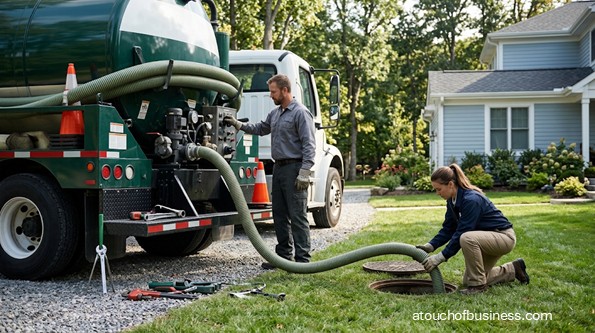
What to Expect From This Guide to Starting a Septic Tank Pumping Business
This guide walks through the key decisions and practical steps involved in starting a septic tank pumping business, from evaluating the opportunity through planning, setup, and opening preparation. The highlights below show several of the areas covered in greater depth.
Inside the guide, you will find:
- Startup steps: Follow an ordered path covering service planning, registration, equipment, pricing, customer acquisition, and final pre-opening testing.
- Industry interviews: Learn from operators discussing equipment choices, growth, seasonal demand, staffing, routes, customer relationships, and related wastewater services.
- Common questions: Review practical answers about choosing a truck and deciding when a solo operation may need additional help.
- Business fit: Consider the physical work, driving demands, income uncertainty, local septic demand, competition, and customer retention patterns.
- Local requirements: Examine licensing, permits, zoning, disposal access, CDL and DOT requirements, insurance, and other location-dependent obligations.
- Financial planning: Work through funding, truck costs, pricing, fixed expenses, route density, disposal costs, break-even thinking, and seasonal slowdowns.
- Risks and preparation: Identify equipment downtime, pollution exposure, disposal restrictions, paperwork delays, signage requirements, and other concerns before opening.
Start by deciding whether the physical work, driving, local demand, and disposal access fit the business you want to build.
What It Takes to Start a Septic Tank Pumping Business
Running a septic tank pumping business means traveling to a customer’s property with a vacuum truck to remove waste from their septic tank.
You connect a hose to the tank, pump out the sludge, scum, and liquid, and haul it to an approved disposal site.
There’s no storefront involved. Your truck, your route, and your relationship with a disposal site are the backbone of the business.
Most work comes from homeowners on septic systems rather than city sewer.
Real estate transactions add to that—sellers often need a pump-out before closing.
Property managers are another steady source, since they need service before a new tenant moves in.
For a broader map of what launching any small business involves, look at the general startup process before diving into the specifics below.
Is Septic Tank Pumping the Right Fit for You?
This work is physical. You’ll dig up buried lids, handle heavy hoses, and spend real time outside in all kinds of weather.
It’s also a business built on driving—long stretches behind the wheel, tight driveways, and rural roads that don’t always cooperate.
None of that makes it a bad fit. It just means you should be honest with yourself before you commit real money to a truck.
Think through your household’s ability to handle a slower income stretch while you build a customer base and get your first routes established.
Consider your risk tolerance too. Septic work carries real liability, and early months rarely look like a steady paycheck.
Before you spend on equipment or licensing, talk with septic pumpers or onsite wastewater technicians outside your own market.
Prepare a few specific questions ahead of time.
Ask about route density, disposal-site relationships, and what surprised them most in their first year.
Their experience won’t match yours exactly, but it’s still one of the most useful things you can do before you commit.
You can find more on learning from real business owners if you want help framing those conversations.
You’ll also want to decide early whether to start from scratch or buy an existing septic pumping business.
This decision matters more here than in a lot of trades:
- The truck is the single biggest cost in this business, which makes it capital-intensive from day one.
- Established septic pumpers tend to keep their customers for years, so building a new customer base from zero can take longer than you’d expect.
- When you buy an existing operation, you typically get a working customer list, a known disposal relationship, and equipment that’s already road-ready.
Franchising isn’t really part of this picture—there’s no established franchise model built specifically around septic pumping.
That leaves two realistic paths: starting independently or buying an existing company.
The build-versus-buy decision is worth reading closely, since it applies directly to a business this asset-heavy.
Before you go further, check whether your area actually has enough septic-served properties to support the work.
County property records or your local health department often track which addresses run on septic rather than municipal sewer.
Also look at how many pumpers already serve your area, and whether they’re at capacity or turning work away.
One more thing to check early: whether a treatment plant or approved disposal site near you will actually accept septage from an independent hauler.
Demand means little without somewhere legal to dump.
Red Flags Before You Start
None of these should scare you off. They’re just worth sitting with honestly before you spend money.
The truck is a major upfront commitment. A reliable vacuum truck is the largest single cost in this business.
That’s part of why buying an existing operation is worth serious thought.
Customers can be slow to switch pumpers. People who already have a septic company tend to stick with them.
Building a fresh customer list from scratch takes patience.
Disposal access isn’t guaranteed everywhere. Some treatment facilities limit how much septage they’ll accept from outside haulers, or don’t accept it at all.
Confirm this before you commit to a service area.
Standard liability coverage often excludes pollution claims. A basic general liability policy commonly won’t cover a septage spill or contamination claim.
This needs its own coverage from the start.
Demand can dip with the seasons. In colder regions, frozen or snow-covered ground can make some tanks hard to reach for part of the year.
A cash buffer helps you ride that out.
Step 1: Decide What Services You’ll Offer
Most septic pumpers start with straightforward tank pumping and cleaning, and that’s a completely reasonable place to begin.
Some also add septic inspections, effluent filter cleaning, or riser installation once they’re established.
Others expand into grease trap or portable toilet pumping, since the equipment and disposal relationships overlap.
You don’t need to decide all of this on day one.
Just get clear on your starting scope before you price equipment or licensing.
Also decide whether you’ll serve residential customers only, or take on light commercial and property-management accounts too.
Step 2: Register Your Business and Handle the Paperwork
Choose a legal structure for your business before you do anything else administrative.
Septic work carries real pollution and liability exposure, so weigh a sole proprietorship against an LLC or corporation with that risk in mind.
This is your call to make based on your own risk tolerance and financial situation—there’s no single right answer for every owner.
Once you’ve chosen a structure, register your business entity with your state.
File a DBA too if you’re operating under a different name.
Apply for a federal EIN through the IRS, even if you’re a solo operator with no employees yet.
Register for any required state sales or use tax and employer tax accounts.
Requirements here vary by state, so confirm what applies to your setup.
Step 3: Get Licensed to Pump and Haul Septage
This is one step you genuinely can’t skip, and it looks different depending on where you’re located.
Some states run a full licensing board with a written exam.
Others have no state-level license at all and rely on county permits instead.
Verify your state’s exact requirements before you assume you know them.
Many states and counties accept—or require—completion of a recognized vacuum truck operator training program as part of getting licensed or certified.
The National Association of Wastewater Technicians offers a widely recognized Vacuum Truck Technician course that many programs point to directly.
If your state requires an exam, plan ahead for it.
Build in time for studying, the application process, and any proof of insurance the exam board asks for.
A county or local health department permit often applies too, sometimes covering your business and each vehicle you operate separately.
Step 4: Check Zoning and Parking Rules for Your Truck
A vacuum truck is a big vehicle, and not every residential property is set up to store one.
Local zoning or home-occupation rules may restrict parking a commercial truck at your house, even though you’re not running a public-facing business there.
If you’re in an HOA or under a lease, check those restrictions too—they can be stricter than local zoning.
If home storage isn’t an option, plan for a small rented yard or commercial lot instead.
It’s better to know this before you buy a truck than after.
Step 5: Lock In Your Disposal Site Before You Buy Anything
This step matters more than it might seem, and it’s easy to get the order wrong.
Contact treatment plants and any approved land-application sites near you to confirm they’ll accept septage from an independent hauler like you.
Ask about their permitting process, how much volume they’ll accept, and their operating hours—these details shape your whole route.
Some facilities limit how much they’ll take from outside haulers, or won’t accept new haulers at all. It’s worth confirming this before you go further.
If your plan involves land-applying septage yourself rather than delivering to a treatment plant, that triggers a separate permitting process under federal and state rules.
Hauling to an already-permitted treatment facility instead is simpler, though a local hauler permit may still apply. Confirm both with your state environmental agency.
Don’t buy your truck until this piece is settled. A truck with nowhere legal to dump isn’t a working business yet.
Step 6: Line Up Funding Before You Shop for a Truck
Before you start looking at trucks, get a realistic picture of what this startup will actually cost you.
List out your major cost categories first.
That includes the truck itself, pumping equipment, licensing and permit fees, insurance, and your first stretch of operating costs.
From there, look into your funding options.
That includes equipment financing tied to the truck purchase, a conventional business loan, or an SBA-backed loan.
A business loan is worth exploring early, since financing terms can shape which truck makes sense for you.
Get this settled before you sign anything for a vehicle. It’s a much easier conversation to have before you’re committed than after.
Step 7: Choose Your Truck and Confirm CDL and DOT Requirements
Your truck size should match your local reality.
Start with typical tank sizes in your area and how far you’ll drive to dispose.
Then factor in how many jobs you want to run per day.
A truck that’s too small means more dump trips. One that’s too large means more cost and complexity than you may need yet.
Whether new or used comes down to a few things.
Weigh your budget, your comfort with unknown maintenance history, and how soon you need to start earning.
There’s no universal right answer here.
Check whether your chosen truck’s weight triggers a Commercial Driver’s License requirement—a common threshold is 26,001 pounds gross vehicle weight rating.
Smaller trucks under that threshold are available if you’d rather start without a CDL, though you’ll carry less per trip.
Once you’ve chosen a truck, register it for DOT and FMCSA compliance.
You’ll also need a USDOT number if it qualifies as a commercial motor vehicle.
Complete any state or county vehicle-specific hauler permit too.
Some jurisdictions permit each truck individually.
That permit may not transfer if you sell or replace the vehicle.
If you’ll need a CDL, confirm the class and any required endorsement—a tanker endorsement is common for this kind of work.
Step 8: Set Up Business Banking and Payment Processing
Open a dedicated business bank account before you take your first payment.
Keeping business and personal money separate protects you and simplifies your records.
You’ll also want a way to accept card payments, since most customers pay at the time of service.
Step 9: Get the Insurance Coverage This Work Requires
This is one area worth taking slowly and getting right, rather than rushing to check a box.
Standard general liability policies commonly exclude pollution and contamination claims—and that’s exactly the kind of risk this business carries.
Look for a policy that specifically includes pollution or environmental liability coverage, not just general liability alone.
Commercial auto insurance is required for your truck. A personal auto policy won’t cover business use, so don’t assume it will.
If you plan to hire, workers’ compensation is required in most states once you have employees. Confirm your state’s specific rule.
Tools and equipment coverage is also worth considering, since your pump and hoses represent a real investment to protect.
Read more about business insurance basics if you want a general primer before you start requesting quotes.
Step 10: Stock the Rest of Your Equipment and Safety Gear
Beyond the truck itself, you’ll need hoses, fittings, and quick-connects, along with backups for anything that might fail mid-route.
Riser and lid tools help you locate and open buried access points without wasting time on-site.
A sludge and scum measuring tool lets you check tank levels accurately before you decide how much needs pumping.
Stock work gloves, eye protection, and protective coveralls, along with hand sanitizer and basic decontamination supplies for after each job.
An atmospheric gas monitor matters too—you’ll use it to check conditions near an open tank access point before working.
Keep a first-aid kit on the truck at all times.
Also carry copies of your current licenses, permits, and insurance certificates.
On the administrative side, you’ll also want:
- Service invoice or work order forms
- A waste tracking log, if your state or county requires one
- Scheduling or dispatch software to manage your route
- GPS or route-planning tools to cut down on wasted drive time
Step 11: Set Your Pricing
Most septic pumpers price by a flat rate tied to tank size, which keeps quoting simple for standard residential jobs.
Oversized tanks are sometimes priced per gallon instead, since a flat rate stops making sense at larger volumes.
Many pumpers also add separate charges on top of the base rate.
That can include long travel distances, buried lids that need digging, and disposal fees passed through from the receiving facility.
Decide whether you’ll fold disposal fees into your base price or list them separately on the invoice.
Either approach works—just be consistent and clear about it.
Your most accurate pricing comes from listing your actual costs and quoting them against what similar pumpers in your area charge.
Learn more about pricing your services before you finalize your numbers.
Step 12: Decide Whether to Hire Help
Many owners start solo, and that’s a perfectly reasonable way to begin this business.
If you do hire a driver, confirm they hold the correct CDL class and endorsement for your specific truck.
Plan a mentorship or ride-along period before turning anyone loose on their own route.
Cover confined-space awareness in your training too, even though standard practice is to service tanks from the outside without entering them.
Step 13: Set Up Your Business Identity
Settle on a business name, and file a DBA if you’re operating under something other than your legal entity name.
Set up a phone number and a simple website so customers and referral partners can find and reach you easily.
Add signage or decals to your truck.
Some states require your company name or license number to be displayed on the vehicle, so check that before you finalize your design.
Step 14: Plan How You’ll Reach Your First Customers
Your first customers are likely homeowners overdue for service.
Buyers and sellers in real estate transactions are another strong source, especially when a septic inspection or pump-out is required before closing.
Property managers overseeing rental homes on septic systems round out the list.
Reach out directly to septic-permitted addresses in your service area.
Build referral relationships with real estate agents, home inspectors, and plumbers too.
Your truck itself does some of this work for you—visible, professional signage while you’re on a job builds recognition in your area.
Step 15: Run a Final Pre-Opening Test
Before you advertise broadly, run through a full job from start to finish.
That means the truck, hoses, disposal drop-off, and invoicing all included.
This helps you catch any gaps in your process while the stakes are still low.
Confirm your scheduling system, your payment setup, and your paperwork all work together smoothly.
Do this before your first real booking comes in.
Business Plan
Once you’ve worked through the steps above, pull everything into one working plan you can actually use.
Your plan should tie together everything you’ve worked out so far.
That includes your service scope, licensing path, disposal arrangement, equipment choices, funding, and pricing—all in one coherent picture.
This is also where you think through whether the business can realistically support you.
This is an asset-heavy business with real fixed costs.
Your truck payment, insurance, and disposal fees continue whether or not jobs are booked that week.
Figure out roughly how many pump-outs per week or month you’d need to cover those fixed costs before any of it becomes profit.
Route density and distance to your disposal site directly affect how many jobs you can realistically complete in a day.
Fewer jobs per day push your break-even price higher, so this is worth calculating honestly rather than guessing.
If you’re in a colder region, plan for slower stretches when frozen or snow-covered ground limits access to some tanks.
An operating capital reserve helps you get through that kind of season without financial strain.
You’re the only one who can run these numbers accurately.
They depend on your local disposal fees, financing terms, and expected route volume.
That’s not a gap in this guide—it’s simply specific to you.
Opening-Day Red Flags
A few practical things are worth double-checking right before you open, separate from the bigger decisions you’ve already made.
You have one truck, and that’s your whole capacity. If it breaks down, you have no backup service capability.
Know your mechanic and keep a maintenance reserve ready.
Licensing and DOT paperwork can lag behind good intentions.
Confirm every license, permit, and vehicle registration is actually active—not just applied for—before your first booking.
Disposal facility hours and acceptance rules can shift.
Reconfirm with your disposal site shortly before opening, since volume limits or hours can change without much notice.
Signage requirements are easy to overlook.
If your state requires a license number displayed on your truck, make sure it’s actually on there before your first job.
Frequently Asked Questions
Should I buy a new truck or a used one?
Both are reasonable choices, and the right one depends on your situation. A new truck comes with warranty coverage and no mystery maintenance history.
A used truck lowers your upfront cost but carries more unknowns. Weigh your available funding against your comfort with that uncertainty.
How do I know if I can run this solo, or if I need to hire right away?
There’s no fixed number here—it depends on your route density and how far you are from your disposal site.
If drive time keeps eating into the number of jobs you can complete in a day, that’s a signal.
It usually means solo operation is reaching its limit.
Interviews with Septic Tank Cleaning Business Professionals
These interviews share practical lessons about entering septic pumping, choosing and maintaining equipment, handling seasonal demand, finding customers, building a service reputation, managing routes, hiring help, and expanding into related wastewater services.
Readers can use the experiences to compare different ways of entering the business, identify costly operational risks, think through equipment and staffing needs, and see how experienced operators built demand before committing more money or expanding services.
Adam Fink: From Marine Corps to Building a Business From Scratch
Adam Fink discusses building Clear Creek Septic Service from a one-truck operation with his father-in-law. The conversation covers getting started before the business systems were fully in place, working through slow winter periods, handling invoicing while holding another job, buying equipment, and growing into portable sanitation and a larger regional operation.
This interview is useful because it gives a candid look at the financial pressure, workload, equipment decisions, family-business communication, and persistence involved in building a septic service company from the ground up.
How to Turn Septic Business Failures Into Growth With Jason Lambert
Jason Lambert explains how he expanded from septic tank installation into broader sewer services through acquisitions, brand consolidation, pricing decisions, advertising, hiring, delegation, reputation management, and repeat-customer strategies.
This interview is useful for understanding how a septic business can grow beyond its original service line while protecting pricing, building a team, and strengthening the local reputation that brings customers back.
Building a Business With Honesty and Transparency Featuring Dervin Witmer
Dervin Witmer explains how his excavation work evolved into a full-service septic company and pumping operation. He discusses buying an older pump truck, creating separate brands for excavation and septic work, using memorable branding and digital marketing, and adding employees as the business grew.
This interview is useful for readers considering how to position a septic company, develop a recognizable local brand, add pumping to related services, and decide when a one-person operation needs more help.
Quick Success for Ontario Septic Specialists
Brad Corey and Brock Peel describe how their separate pumping and excavation businesses came together as Canadian Sanitation. Corey explains buying and refurbishing a used pump truck, pumping after his regular work shift, and eventually moving into the business full time, while the article also covers licensing, service territory, disposal challenges, equipment, and staffing.
This interview is useful for seeing how a septic pumping operation can begin gradually, how complementary skills can strengthen a partnership, and why local regulations, disposal options, equipment condition, and driver availability need attention before expanding.
Brothers Achieve Business Ownership Dream With Successful Wastewater Services Operation
Paul and Garrett Balberde describe starting their pumping business after deciding to buy their own pumper truck. They discuss beginning without employees, refurbishing early vacuum trucks, learning through industry education, adding staff as demand grew, organizing routes, working around disposal locations, and relying on relationships and referrals.
This interview is useful because it shows the progression from owner-operated pumping to a larger wastewater service company while highlighting route efficiency, equipment decisions, customer communication, staffing, and the importance of industry relationships.
Adding Septic Pumping to Your Service Offerings
Three plumbing contractors discuss their experiences entering septic pumping, including buying used vacuum trucks, responding to existing customer demand, marketing through referrals and local outreach, avoiding excessive equipment debt, dealing with truck breakdowns, and building pumping volume at a manageable pace.
This interview article is useful for comparing several approaches to entering septic pumping and for thinking through equipment financing, customer acquisition, staffing requirements, service capacity, and the risk of expanding faster than the operation can support.
Related Articles
Sources:
- Acquiring Minds: Buy Septic Business Case Study
- ContractorNerd: Septic Contractor Insurance Guide
- EPA: Care Your Septic System, Frequent Questions Septic Systems, Domestic Septage Regulatory Guidance, Technical Resources Biosolids Managers
- Flowmark: Choose Proper Vacuum Tank Size
- Insureon: Septic Cleaning Business Insurance
- KeeVac Industries: CDL Requirements Septic Drivers, Regulations Vacuum Septic Trucks, Septic Trucks DOT Inspection
- NAWT: Wastewater Treatment Courses Training, Training Wastewater Technicians
- Nevada DPBH: Septic Pumping Contractor Permits
- OSHA / eCFR: Permit-Required Confined Spaces
- PumpLocal: Septic Pumping Pricing Guide
- Pumper Magazine: Ultimate Truck Checklist Septic, Septage Sanitation Disposal Crisis
- SepticMind: Septic Company Insurance Guide
- SepticTankHub: Septic Pumping Pricing Methods
- ServiceCore: License Pump Septic Tank
- University of Missouri Extension: Land Application Septage