
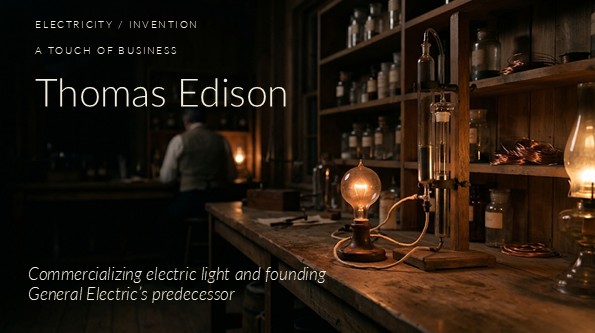
On September 4, 1882, an electric generating station on Pearl Street in Lower Manhattan began supplying customers with power for incandescent lighting. The milestone took Thomas Edison’s work beyond the laboratory: a promising lamp was now part of a working commercial electricity service.
The system required more than a filament that glowed. It depended on generators, wiring, distribution equipment, switches, fixtures, investors and skilled people able to make the components work together. That combination—technical development joined to production and business—became one of the defining features of Edison’s career.
Edison was already famous for the phonograph, and he would later pursue motion pictures, batteries and other ventures. Some worked; others cost him heavily. His story is not simply one of isolated flashes of invention, but of building organizations that could turn experiments into products and services.
A Quick Look at the Life of Thomas Edison
Biography Summary
Thomas Alva Edison (1847–1931) was an American inventor, businessman and laboratory organizer whose work helped shape sound recording, electric lighting and early motion-picture technology. Beginning as a telegraph operator, he built inventive enterprises at Newark, Menlo Park and West Orange. His electric-lighting companies became part of the corporate lineage of General Electric, formed in 1892 through a merger.
Profile
Full Name: Thomas Alva Edison
Born: February 11, 1847
Birthplace: Milan, Ohio, United States
Died: October 18, 1931, in West Orange, New Jersey
Nationality: American
Education: Brief formal schooling; taught at home by his mother; no university or technical-college education
Best Known For: The phonograph; commercially practical incandescent lighting and electrical supply systems; work in early motion pictures
Major Workplaces: Newark workshops; Menlo Park laboratory; West Orange laboratory
Corporate Connection: Edison General Electric, a predecessor of General Electric
U.S. Patents: 1,093
Honor: Congressional Gold Medal, 1928
From Railroad Sales to Telegraph Work
Edison was born in Milan, Ohio, to Samuel and Nancy Elliott Edison, the youngest of seven children. The family moved to Port Huron, Michigan, in 1854. His formal schooling was brief, and his mother, who had experience teaching, continued his education at home. Reading and practical experiments became important parts of his early learning.
As a young person, Edison sold newspapers and snacks aboard trains and even printed a newspaper for sale on the railroad. He also explored chemistry and learned telegraphy. The latter skill offered paid technical work in a communications industry built around electrical signals and mechanical equipment.
Edison traveled between telegraph jobs in American cities and was working for Western Union in Boston by 1868. He also experienced substantial hearing loss during his lifetime, including during his telegraph years, although a definite childhood cause is not established.
A Failed Vote Recorder and a Working Invention Business
Edison received his first U.S. patent in 1869, for an electric vote recorder. The device did not attract a buyer. Commercial demand would become a recurring consideration in his subsequent work.
After moving to New York in 1869, he worked with telegraph engineer Franklin L. Pope and developed printing-telegraph and stock-ticker technology. A contract for stock-ticker and related inventions brought him substantial funds—reported by the National Park Service as $40,000—and supported the expansion of his work in Newark.
At Newark, Edison employed skilled mechanics and pursued telegraph inventions, including his quadruplex system, which allowed four messages to travel over one wire. Contracts and guidance from figures such as William Orton and Marshall Lefferts also brought him into the business practices of patent protection and systematic technical documentation.
With a growing team, commercial contracts and technical facilities in place, Edison was prepared to expand beyond the Newark workshops.
Menlo Park and the Rise of the Research Laboratory
In 1876, Edison opened a laboratory and workshop complex at Menlo Park, New Jersey, bringing assistants from Newark. The operation combined experimental work with machine-shop skills and the ability to build and refine devices. Several projects could proceed at once.
His assistants, sometimes known as “muckers,” made important technical and mechanical contributions. Edison supplied leadership and direction, but the laboratory’s work cannot accurately be reduced to the work of one person. Menlo Park helped make organized research, development and commercialization a recognizable part of the inventive enterprise.
Menlo Park first drew widespread attention for a device that could reproduce the human voice.
The Phonograph Makes Edison Famous
In 1877, Edison and his staff produced a working tinfoil phonograph that could record and play back sound. Mechanic John Kruesi built the prototype from Edison’s designs or sketches. Edison received a phonograph patent on February 19, 1878, and the device attracted considerable press attention.
The nickname “Wizard of Menlo Park” attached itself to the inventor. Although the familiar story of a first demonstration using “Mary Had a Little Lamb” became widely repeated, no surviving original recording documents that initial test, and the precise date of the first demonstration is disputed.
The 1877 phonograph was only a beginning. At West Orange, Edison resumed work on recording and playback, including improvements to wax cylinders, while other researchers made advances of their own.
Electric Lighting: Building More Than a Bulb
Edison and his Menlo Park team concentrated on incandescent electric lighting beginning in 1878. Earlier inventors had already demonstrated incandescent lamps; British inventor Joseph Swan independently showed a carbon incandescent lamp in early 1879. Edison’s importance lay not in creating the first light bulb, but in helping develop a commercially feasible high-resistance lamp together with the surrounding electrical system.
An effective carbon-filament lamp emerged in 1879. On New Year’s Eve that year, the Menlo Park operation held a public demonstration of electric lighting. The display attracted interest, but serving paying customers would require dependable generating equipment, distribution lines and numerous smaller components.
Edison and his associates worked across those requirements. The Pearl Street station’s opening on September 4, 1882, showed that electricity could be delivered as a central-station service to customers in a city district. It was an early commercial milestone for an integrated lighting system—not the first use of electricity, and not an achievement attributable to a single inventor working in isolation.
The industry developed through parallel invention and corporate relationships as well. Edison and Swan business interests joined in Britain in 1883, reflecting both competition and the need to commercialize incandescent technology.
West Orange: A Larger Laboratory and a Changing Family
By 1887, Edison had established a larger research complex at West Orange, New Jersey. It became a base for a broad range of work and remained central to his career. His family life had also changed: his first wife, Mary Stilwell, whom he married in 1871, died in 1884. He married Mina Miller in 1886, and the family lived at Glenmont in West Orange. He had three children from each marriage.
From Edison Electric Companies to General Electric
Bringing electric lighting to market demanded corporate organization and financing alongside laboratory engineering. Edison promoted and developed lighting technology through a range of companies and licensed operations with outside investors, including J. P. Morgan. Companies bearing Edison’s name did not all operate under his direct personal management.
Edison General Electric Company was organized in 1889. In 1892, it merged with Thomson-Houston Electric Company to form General Electric. Edison’s name was dropped from the merged company’s name, and he left the electric-lighting business in connection with the merger.
Edison helped build a predecessor of General Electric, but the 1892 company was created through that merger, not as a new business established by Edison alone.
Direct Current, Alternating Current and a Public Dispute
The late 1880s and early 1890s also brought intense competition over how electricity should be supplied. Edison defended direct-current, or DC, systems. George Westinghouse and his associates championed alternating-current, or AC, systems, which benefited from developments including Nikola Tesla’s polyphase motor technology.
Edison raised concerns about the safety of high-voltage AC. His lighting interests also used public fears of AC in the commercial struggle. AC’s advantages for transmitting power over long distances ultimately helped it prevail in wider electricity networks. The conflict involved companies, competing engineering systems and financial interests—not simply a private duel between Edison and Tesla.
Animal electrocution experiments took place at Edison’s West Orange laboratory in the late 1880s amid investigations of killing methods and the first use of electrocution as capital punishment. Edison was involved in the legal controversy over the proposed execution of William Kemmler. His lighting interests helped obtain a Westinghouse dynamo for that execution, but that action should not be assigned to Edison personally.
Another often repeated accusation—that Edison personally arranged the 1903 electrocution of the elephant Topsy to discredit AC—has no established basis. A company associated with his name filmed the event, but the Edison Papers finds no evidence that he ordered, attended or directed the killing.
Motion Pictures and the Work of William Dickson
At West Orange, Edison proposed devices for recording and viewing motion. William Kennedy Laurie Dickson carried out much of the experimental development that produced the Kinetograph camera and Kinetoscope viewer. Edison was a central organizer and public figure, but the practical work of colleagues was essential.
The Black Maria film studio was built at West Orange in 1892–1893, and Kinetoscope parlors opened in 1894. An early surviving Edison-company film, Fred Ott’s Sneeze (1894), is associated with Dickson’s work. The company later released The Great Train Robbery (1903), directed by Edwin S. Porter—not Edison.
Motion pictures developed through further technology, competition, licensing and litigation. The Edison film production operation ended in 1918, long after the first demonstrations had brought moving images to commercial audiences.
The Costly Ore Venture and the Search for Other Markets
Not every Edison project found a sustainable market. During the 1890s, he devoted major resources to separating iron ore in New Jersey. The approach proved commercially impractical. Edison sold General Electric stock to finance the venture and lost his investment.
Work on ore-processing machinery and techniques nevertheless became relevant to a different field: Portland cement. Edison’s cement company was manufacturing cement by 1902. Technical innovation did not guarantee immediate financial success, but the enterprise established another use for some of the expertise assembled during the failed ore project.
Storage batteries posed another prolonged challenge. From 1899, Edison worked on an alkaline battery initially aimed at electric vehicles. Performance problems forced early commercial production to stop for redesign in 1904. An improved battery eventually reached production and found industrial applications, even as gasoline-powered automobiles became dominant.
Later Work, Recognition and Death
A major fire damaged much of the West Orange factory area in December 1914; work and rebuilding followed. During World War I, Edison headed the Naval Consulting Board, which examined proposals for military technology and carried out related experiments. In the late 1920s, he also investigated domestic sources of natural rubber, including goldenrod.
Edison received the Congressional Gold Medal in 1928. He died at Glenmont in West Orange on October 18, 1931, at age 84.
The Legacy of an Inventor Who Built Systems
Edison received 1,093 U.S. patents, but the number does not mean he single-handedly originated 1,093 wholly new technologies. His colleagues contributed directly to inventions for which he became the most familiar public name.
His impact is clearer when the phonograph, motion pictures and electrical lighting are considered alongside the laboratories and businesses that produced them. Edison was a prominent inventor, but he also helped establish an organized approach that linked experimentation to engineering, manufacture and commercial use.
The electric-lighting system captures that breadth: the lamp mattered, but so did the machinery, networks, people and companies needed to make it useful outside the laboratory. His commercial failures and electrical rivalries remain part of the same history.
Timeline
These milestones trace the major transitions in Thomas Edison’s life and work.

1847
Thomas Alva Edison is born February 11 in Milan, Ohio.
1854
His family moves to Port Huron, Michigan.
1860s–1871
Railroad sales and telegraph work lead into patenting, stock-ticker inventions and Newark workshops; Edison marries Mary Stilwell in 1871.
1876–1878
Edison opens the Menlo Park laboratory in 1876; the phonograph is developed in 1877 and patented in 1878.
1879
The Menlo Park team demonstrates effective carbon-filament lighting, followed by a public lighting demonstration on December 31.
1882
The Pearl Street electric station begins serving customers in Lower Manhattan on September 4.
1884–1887
Mary Edison dies in 1884; Edison marries Mina Miller in 1886; the West Orange laboratory opens in 1887.
1889–1894
Edison General Electric is formed in 1889 and merges into General Electric in 1892; the Black Maria studio and Kinetoscope exhibitions mark early motion-picture commercialization.
1890s–1909
The iron-ore venture fails commercially; Edison develops cement and alkaline-storage-battery operations, with improved battery production beginning in 1909.
1914–1918
A factory fire strikes West Orange in 1914; Edison undertakes wartime naval consulting; Edison company film production ends in 1918.
1928–1931
Edison receives the Congressional Gold Medal in 1928 and dies October 18, 1931.
FAQs
Did Thomas Edison invent the light bulb?
No. Incandescent lamps existed before Edison’s work, and Joseph Swan independently demonstrated a carbon lamp in 1879. Edison and his team contributed a commercially feasible high-resistance lamp and a practical system to generate and distribute electricity for lighting.
Did Edison found General Electric?
His electric-lighting companies helped form one of General Electric’s predecessors. Edison General Electric merged with Thomson-Houston in 1892 to create GE; Edison did not personally establish GE as a solo new company.
Why was the Pearl Street power station important?
Opened on September 4, 1882, the Pearl Street station supplied customers in Lower Manhattan through an integrated, commercial direct-current electricity service. It showed how electric lighting could operate as a central-station business, not merely a laboratory demonstration.
Was Edison the sole inventor of motion pictures?
No. Edison directed early laboratory work on moving-image devices, but William Kennedy Laurie Dickson carried out much of the experimental development of the Kinetograph and Kinetoscope. Other researchers also contributed to the field.
Did Edison electrocute Topsy the elephant?
There is no established evidence that Edison personally directed, attended or ordered Topsy’s 1903 killing. A company associated with his name filmed the event, but the personal accusation should not be presented as fact.
Further Reading
- Thomas A. Edison Papers: digital archive of Edison documents and laboratory records
- Library of Congress: Edison-company motion pictures and sound recordings collection
Sources
- National Park Service: Edison Biography, Timeline of Edison and His Inventions, Frequently Asked Questions, Birth to Pearl Street
- Rutgers University, Thomas A. Edison Papers: Detailed Biography, The Current Wars, Myth Buster: Topsy the Elephant, Chronology: 1901–1910
- Smithsonian Institution: Thomas Edison’s Inventive Life, Joseph W. Swan and Incandescent Lighting
- Library of Congress: History of the Cylinder Phonograph, Origins of Motion Pictures, History of Edison Motion Pictures, Fred Ott’s Sneeze
- Massachusetts Institute of Technology, Lemelson: Thomas Edison