
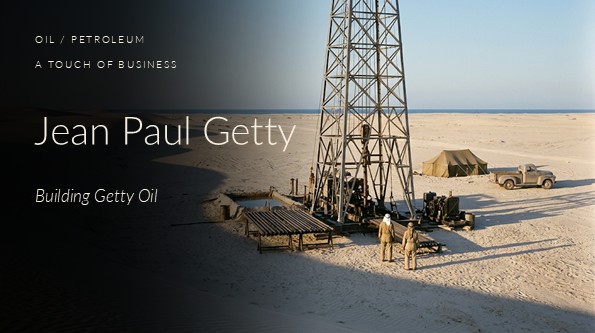
In 1949, Jean Paul Getty pursued a concession in the Neutral Zone between Saudi Arabia and Kuwait, where oil had yet to be discovered. Pacific Western Oil Corporation, which Getty controlled, agreed to pay $9.5 million upfront for the Saudi share of the zone’s mineral rights.
Oil was discovered at Wafra four years later, transforming the scale of Getty’s business. He had started out buying and selling leases in Oklahoma. By the time he pursued the Saudi concession, he was also buying his way into one of the major oil companies in the United States.
A Quick Look at the Life of Jean Paul Getty
Biography Summary
Jean Paul Getty, better known as J. Paul Getty, was an American oil businessman and art collector. He built Getty Oil through acquisitions and oil development, bringing Tidewater into the company in 1967. His private art collection became the basis of a public museum in California.
Profile
Full Name: Jean Paul Getty
Born: December 15, 1892, in Minneapolis, Minnesota
Died: June 6, 1976, at Sutton Place, England
Education: Diploma in Politics and Economics, Magdalen College, Oxford, 1913
Best Known For: Building Getty Oil and establishing the J. Paul Getty Museum Trust
From Family Lease Work to His Own Oklahoma Well
Getty got his start in oil through his father. George Franklin Getty, a Minneapolis lawyer, began investing in oil in 1903. He acquired leases in what is now Oklahoma and formed Minnehoma Oil Company. The family later moved to Los Angeles while retaining its Oklahoma oil interests.
After studying at the University of Southern California, the University of California, Berkeley, and Oxford, Paul Getty returned to the United States in 1914. By late that year he was in Tulsa, buying and selling leases for his father’s business. In 1915 he put $500 into a half interest in a lease on the Nancy Taylor allotment near Haskell. He organized Lorena Oil Company and brought in partners to finance the drilling.
The Nancy Taylor No. 1 well came in early in 1916. Getty sold his share to Cosden Oil Company for $40,000. He netted $11,000, giving him capital to put into further independent operations. He stepped away from oil briefly after his early success, returned to the family business by 1919 and went on to work with oil properties in California.
Buying Shares and Fighting for Control of Tidewater
When George Getty died in 1930, his wife, Sarah, inherited control of George F. Getty, Inc. Paul already held a stake and gained control of the family company in the 1930s. His interests extended beyond the family business. Early in the decade, he took control of Pacific Western Oil Corporation, a company organized in Delaware in 1928.
Getty later told TIME, “I made my money by buying when other people didn’t want to buy.” Buying shares gave Getty another way to acquire producing properties. Tidewater appealed for a broader reason. It could help him connect production with the work of transporting, refining and selling oil.
Getty began buying Tide Water Associated Oil shares in 1932, but the company’s management resisted his bid for control. By 1937 he controlled Mission Corporation, whose holdings gave him leverage in both Tidewater and Skelly Oil. During World War II he oversaw operations at Spartan Aircraft in Tulsa, where the company supported wartime aircraft production and pilot training.
The contest for Tidewater continued after the war. By 1951 Getty had secured control of Tidewater through his shareholdings. In 1953 he elected nearly the entire board. While he was gaining control of Tidewater, Pacific Western had committed to exploring for oil abroad.
The Neutral Zone Concession and the Wafra Discovery
Saudi Arabia and Kuwait each held an undivided interest in the Neutral Zone. Kuwait had granted a concession to American Independent Oil Company, known as Aminoil, in 1948. Pacific Western’s 60-year agreement, signed on February 20, 1949, covered the Saudi half of the mineral rights. It required a minimum annual payment of $1 million, which was credited against royalties of 55 cents per barrel.
Aminoil initially ran the onshore operations and made the first discovery at Wafra in 1953. Getty’s eldest son, George F. Getty II, worked on the venture in a management role. Aminoil and the Getty interests later formed a joint operating committee for exploration, development and gathering.
As Wafra became a major source of oil for the Getty interests, the size of Getty’s fortune drew public attention. In 1957, Fortune placed him in the highest bracket of its survey of large American fortunes, estimating his wealth at $700 million to $1 billion. TIME put him on its cover the following February.
Getty Oil Consolidates as Import Rules Change
Pacific Western took the name Getty Oil Company in 1956. Three years later the United States imposed mandatory oil import quotas. In Fortune’s account, the restrictions disrupted Getty’s plans to link production with refining and marketing. The business shifted its emphasis toward exploration and production.
Phillips acquired Tidewater marketing assets in three western states in 1966. Getty Oil merged with Tidewater the following year. Skelly continued to operate separately as a subsidiary. Getty Oil held 71 percent of Skelly through Mission Corporation in 1970, when Getty Oil and Skelly went to court over how to share import allocations. Both still refined and marketed oil.
Getty ran his business interests from abroad. He had left the United States in 1951 and moved into Sutton Place in England in 1960.
The 1973 Kidnapping of John Paul Getty III
In July 1973, kidnappers took Getty’s 16-year-old grandson, John Paul Getty III, in Rome. Getty initially refused to pay and said publicly that paying would encourage further kidnappings. The kidnappers severed the teenager’s ear and sent it to an Italian newspaper.
Getty eventually contributed about $2.2 million toward the ransom. The teenager’s father borrowed the rest from the elder Getty. TIME put the total at $2.89 million. John Paul Getty III was released in December.
From a Ranch-House Museum to the Getty Trust
Getty had collected art since the 1930s, including European paintings, decorative arts and classical antiquities. In 1953 he established the J. Paul Getty Museum Trust. The next year, he opened a museum in part of his Pacific Palisades ranch house.
Getty examined a model of the new museum at Sutton Place in 1971. The Getty Villa, modeled on an ancient Roman villa, opened in 1974. Getty never visited the completed museum. He died at Sutton Place in 1976 at age 83 and was buried on the Villa property.
After Getty’s death, the two institutions that carried his name took separate paths. Texaco acquired Getty Oil in 1984. Getty’s bequest enabled the museum trustees to expand into research, conservation, grants and education. The Getty Center opened in 1997, more than four decades after the ranch-house museum opened.
Timeline
Key dates in Getty’s oil career, family life and museum work.

1892
Jean Paul Getty is born in Minneapolis, Minnesota.
1913–1916
Getty receives his Oxford diploma, enters the family oil business and sells his interest in the Nancy Taylor No. 1 well after it comes in.
1930–1937
Sarah Getty inherits control of the family company. Paul Getty takes control of Pacific Western in the early 1930s, begins buying Tidewater shares in 1932 and gains control of Mission Corporation by 1937.
1949–1953
Pacific Western secures the Saudi Neutral Zone concession. Oil is discovered at Wafra in 1953, the year Getty establishes his museum trust.
1954–1957
Getty opens his ranch-house museum. Pacific Western becomes Getty Oil in 1956, and Fortune publishes its estimate of Getty’s wealth the following year.
1967
Getty Oil merges with Tidewater.
1973
John Paul Getty III is kidnapped in Rome in July and released in December after a ransom payment.
1974–1976
The Getty Villa opens. Getty dies at Sutton Place in 1976 and leaves a major bequest to his museum trust.
1984
Texaco acquires Getty Oil.
FAQs
Did J. Paul Getty inherit Getty Oil?
Getty got his start in his father’s oil business. Getty Oil grew out of a separate company he took control of, Pacific Western Oil Corporation. Pacific Western adopted the Getty Oil name in 1956, and Getty Oil merged with Tidewater in 1967.
What rights did Pacific Western acquire in the Neutral Zone?
Pacific Western secured Saudi Arabia’s undivided half interest in the Neutral Zone’s mineral rights in 1949. Kuwait had separately granted its share to Aminoil. After the Wafra discovery in 1953, oil from the zone became a major part of Getty’s business.
Did J. Paul Getty visit the Getty Villa?
Getty examined a model at his home in England but never visited the finished Villa. It opened in 1974, two years before he died.
Interviews
Getty on Buying Oil Companies and Collecting Art
In this 1958 cover profile, Getty looks back on his Depression-era purchases and explains what drew him to buying art. The profile captures how he explained his approach to buying oil stocks before Getty Oil and Tidewater merged.
Read TIME’s profile and interview excerpts
Further Reading
Sources
- Getty Research Institute — Getty Family Collected Papers
- Oklahoma Historical Society — Getty, Jean Paul
- National Park Service — Nancy Taylor No. 1 Oil Well Site
- TIME — The Do-It-Yourself Tycoon, The Getty Kidnapping, Catching the Kidnapers
- Fortune — The Odd Mr. Getty
- U.S. Securities and Exchange Commission — News Digest, June 17, 1957
- ICSID case archive — Saudi Neutral Zone Concession History, Exhibit CL-0360
- Exxon Background Series — Middle East Oil and Gas
- Saudi Arabian Chevron — Saudi Arabian Chevron Historical Timeline
- Delaware Supreme Court — Getty Oil Company v. Skelly Oil Company
- J. Paul Getty Museum — The J. Paul Getty Museum and Its Collections
- Getty — History of Getty, The Villa J. Paul Getty Built but Never Saw
- Los Angeles Times — J. Paul Getty III Obituary
- Federal Trade Commission staff — Petroleum Industry Mergers, Table VI E-11
- Stanford Magazine — A Godfather Delivers a Ransom Payment