
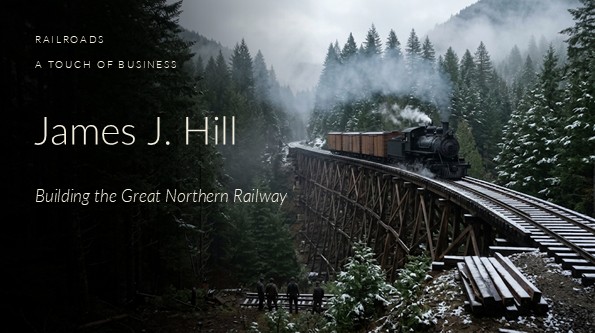
James J. Hill’s reputation as the Empire Builder rests on a railway that grew from a troubled regional carrier into a transcontinental system. Its expansion depended on financial partnerships, route surveying, and the development of traffic along the line.
As Hill’s railway interests expanded, so did the challenges surrounding them. Workers contested wage cuts, and federal antitrust enforcement placed limits on the consolidation of competing railroads. His career encompassed both the building of a transportation network and disputes over how it operated and who controlled it.
A Quick Look at the Life of James J. Hill
Biography Summary
James J. Hill was a Canadian-born American railway executive whose career began in St. Paul shipping. He helped build the Great Northern Railway and also participated in Canadian railway ventures, mining, and agriculture. He left Great Northern’s presidency in 1907 and its chairmanship in 1912.
Profile
Full Name: James Jerome Hill
Born: September 16, 1838
Died: May 29, 1916, in St. Paul, Minnesota
Birthplace: Eramosa Township, Upper Canada, now Ontario
Best Known For: Building and expanding the Great Northern Railway
Major Roles: Great Northern president until 1907; chairman until 1912
From Ontario Clerk to St. Paul Shipping Agent
A childhood accident left Hill blind in one eye, and his father’s death ended his formal education. He worked as a clerk before leaving Canada.
On July 21, 1856, the seventeen-year-old arrived in St. Paul and began working in shipping. His business interests later expanded into transportation, warehousing, and fuel. With Norman Kittson, he became involved in Red River steamboat transportation.
His family life also took root in St. Paul. In 1867, Hill married Mary Theresa Mehegan. They had ten children.
A Troubled Railroad Becomes the Starting Point
In 1878, Hill joined Kittson, Donald Smith, George Stephen, and John S. Kennedy in acquiring the troubled St. Paul and Pacific Railroad. The purchase was a shared undertaking, with Smith and Stephen helping secure financing through Kennedy’s firm and the Bank of Montreal.
The acquisition’s legal arrangements were completed in 1879. That May, the St. Paul, Minneapolis and Manitoba began operating the railway. Hill initially served as general manager and became president in 1882.
The reorganized carrier gave the partners a foundation for expansion, with Hill moving from general management into the presidency.
Hill also participated in the early Canadian Pacific enterprise and became a United States citizen in 1880. His Canadian Pacific involvement brought disagreements over business and route policies, and he resigned from its board in May 1883. His own railway interests continued to expand westward.
Committing the Railway to the Pacific
By 1887, the Manitoba railway had extended into Montana. In early 1889, Hill committed to taking the system farther, to the Pacific coast.
The Great Northern corporate reorganization took place in 1889. On February 1, 1890, Great Northern assumed the operations of predecessor companies, bringing existing lines into the expanding system.
Hill employed engineer John F. Stevens to locate a route through the Rocky Mountains. In December 1889, Stevens identified Marias Pass for the railway.
The transcontinental connection was completed on January 6, 1893, when the last spike was driven near Scenic, Washington. Great Northern linked St. Paul with Puget Sound. Across the Cascades, the original route used switchbacks; the first Cascade Tunnel opened in 1900.
Building Traffic Along the Track
Hill’s companies built in stages and reinvested earnings while encouraging immigration and promoting industries along the railway.
European advertisements and overseas agents recruited settlers. Wheat traffic connected farms with Minneapolis markets, while industries along the network supplied other business.
Great Northern’s new western extensions were built without federal subsidization. Predecessor railroads incorporated into the system, however, had benefited from Minnesota land grants, including state swampland grants supporting construction.
Historian Claire Strom connects the railway’s financing model with the need to cultivate paying traffic, placing settlement and industry alongside construction in the story of Great Northern’s growth.
Wage Cuts Bring a Strike
Completing the transcontinental line did not remove the pressures of operating it. During the depression following 1893, Great Northern reduced wages. Three reductions over eight months preceded a strike by the American Railway Union in spring 1894.
Hill agreed to arbitration, and the union won an important victory.
The Great Northern strike preceded the separate Pullman conflict later in 1894.
Northern Securities Meets Federal Antitrust Law
Railway acquisition became another major part of Hill’s career. During the later 1890s, Hill and his associates pursued control of Northern Pacific. In 1901, Great Northern and Northern Pacific jointly acquired control of the Chicago, Burlington & Quincy.
A contest with E. H. Harriman over Northern Pacific control was followed by the Northern Securities holding-company project. Hill and J. P. Morgan participated in the venture in 1901. President Theodore Roosevelt’s administration challenged the combination the following year.
On March 14, 1904, the Supreme Court affirmed the decree against Northern Securities. The Court found that the holding-company combination restrained interstate competition contrary to the Sherman Act.
The judgment barred Northern Securities from voting its railway stock or exercising control through those holdings, while allowing the stock to be redistributed. The equity antitrust proceeding restricted the holding company’s control; Great Northern continued operating.
An Agricultural Vision With Uneven Results
Hill’s interests extended beyond railway operations into mining, timber, land, and livestock. He promoted scientific agriculture and tested cattle breeds and grain on his farms.
Strom argues that Hill’s vision of small family farms had limited success, especially farther west, and that commercial agriculture developed differently from that ideal.
In Strom’s assessment, Hill’s achievements in railway management contrast with the uneven results of his agricultural efforts. He was one of several promoters of dryland settlement, whose outcomes were also shaped by environmental constraints.
Leaving the Presidency and the Railway’s Later Life
In 1907, Hill left the Great Northern presidency and remained chairman. He retired from the chairmanship in 1912, although he continued his involvement in business until his death in St. Paul on May 29, 1916.
In 1929, after Hill’s death, the replacement Cascade Tunnel opened and the named Empire Builder passenger service began. Great Northern became part of Burlington Northern in 1970.
Hill left a lasting transportation network, but expansion was only part of his legacy. Labor disputes, limits on corporate consolidation, and the uneven results of agricultural promotion also shaped the history of his enterprises.
Timeline
These milestones trace Hill’s movement from shipping work into railway ownership, expansion, and retirement.

1838
James Jerome Hill is born on September 16 in Eramosa Township, Upper Canada.
1856
Hill arrives in St. Paul on July 21 and begins working in shipping.
1867
Hill marries Mary Theresa Mehegan.
1878–1879
Hill and his partners acquire the St. Paul and Pacific. The reorganized St. Paul, Minneapolis and Manitoba begins operating in May 1879.
1880–1883
Hill becomes a U.S. citizen in 1880 and president of the Manitoba railway in 1882. He resigns from the Canadian Pacific board in May 1883.
1887–1890
The Manitoba reaches Montana by 1887. Hill commits to the Pacific extension in 1889, and Great Northern assumes predecessor operations in February 1890.
January 6, 1893
The final spike completes Great Northern’s transcontinental connection near Scenic, Washington.
Spring 1894
The American Railway Union strikes Great Northern following wage reductions. Hill agrees to arbitration, and the union wins an important victory.
1901
Great Northern and Northern Pacific jointly acquire control of the Chicago, Burlington & Quincy. Hill participates in the Northern Securities project.
March 14, 1904
The Supreme Court affirms the antitrust decree against Northern Securities.
1907–1912
Hill leaves the Great Northern presidency in 1907 and retires from its chairmanship in 1912.
May 29, 1916
Hill dies in St. Paul.
FAQs
Question: Did James J. Hill build Great Northern without government aid?
Answer: Great Northern’s new western extensions were built without federal subsidization, but predecessor railroads in the system benefited from Minnesota land grants. Describing the entire system as having received no government assistance leaves out that earlier support.
Question: Did the Northern Securities ruling close Great Northern?
Answer: No. The 1904 ruling restricted the Northern Securities holding company’s stock-based control of the railways. It did not order Great Northern to close.
Question: Did James J. Hill launch the Empire Builder passenger train?
Answer: No. The named Empire Builder passenger service began in 1929, after Hill’s death in 1916.
Interviews & Firsthand Resources
Claire Strom on Hill’s Railway and Agricultural Legacy
Agricultural historian Claire Strom discusses the relationship between railway financing, settlement, and Hill’s farming vision. The interview offers a critical assessment of his agricultural impact alongside his railway achievements. It is a modern historian’s perspective, rather than a firsthand interview with Hill.
Read the Claire Strom interview
Sources
- Minnesota Historical Society: James J. Hill, Great Northern Railway, The Hill Family, Hill House Timeline
- Minnesota Historical Society Archives: James J. Hill Papers: Biographical Note and Inventory, Great Northern President’s Records
- MNopedia, Minnesota Historical Society: Great Northern Railway History
- Dictionary of Canadian Biography: James Jerome Hill
- PBS American Experience: James J. Hill
- Federal Reserve Bank of Minneapolis: Claire Strom on Hill’s Legacy
- Federal Judicial Center: The Debs Case: Labor, Capital, and the Federal Courts of the 1890s
- National Archives: Free Speech on Trial
- Great Northern Railway Historical Society: Great Northern History
- U.S. Supreme Court, via Cornell Legal Information Institute: Northern Securities Co. v. United States, 193 U.S. 197 (1904)