
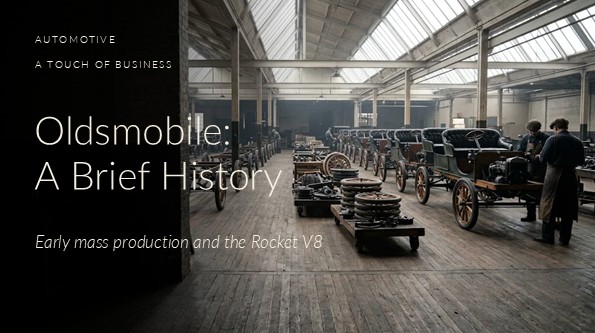
Oldsmobile built much of its identity around engineering that customers could experience: easier driving with Hydra-Matic, performance from the Rocket V8, and front-wheel drive in the Toronado. Those advances followed an early breakthrough in mass production with the comparatively affordable Curved Dash.
New products also defined Oldsmobile’s final renewal effort. Management sought younger buyers, but GM said investment had not reversed declining sales volume and unprofitability. The brand’s history ended with a tension between product development and the commercial results needed to sustain it.
A Quick Look at the History of Oldsmobile
Company History Summary
Oldsmobile developed from an independent Michigan manufacturer into a GM division and brand. Its history spans early volume production, widely adopted technology, a substantial consumer business, and an unsuccessful attempt at renewal. GM phased out the marque, with the last vehicle built in 2004.
Company Snapshot
Origin: August 21, 1897
Founder: Ransom E. Olds, backed by Lansing investors
Original Name: Olds Motor Vehicle Company
Founding Location: Lansing, Michigan
Industry: Automotive manufacturing
GM Relationship: Acquired in 1908; subsequently operated as a GM division and brand
Defining Products: Curved Dash, Hydra-Matic-equipped cars, Rocket V8 models, and Toronado
Production End: April 29, 2004
A Small Runabout Builds a Manufacturing Business
Ransom E. Olds formed Olds Motor Vehicle Company on August 21, 1897. Edward W. Sparrow and other investors supplied important financial backing. The company began with $50,000 in capital, and Olds served as general manager.
The organization changed before its best-known early car reached volume production. In 1899, Olds Motor Vehicle Company combined with Olds Gasoline Engine Works to form Olds Motor Works. Olds served as vice president and general manager, manufacturing moved to Detroit, and Oldsmobile became the trade name.
A factory fire disrupted the Detroit operation in 1901. The Curved Dash nevertheless became an early mass-production success. Its simple design and $650 price offered a comparatively affordable route into car ownership.
The commercial effort extended beyond building cars. Advertising and demonstration drives helped introduce the runabout to potential customers, including Roy Chapin’s trip from Detroit to New York. By 1904, annual production was approximately 5,000 vehicles; more than 19,000 Curved Dash models were built over 1901–1907.
Olds left in 1904 after management disagreements and established REO as a separate business. Olds Motor Works continued without him and was acquired by GM in 1908, beginning Oldsmobile’s long history within the larger manufacturer.
Within GM, Easier Driving Becomes a Selling Point
Hydra-Matic grew from work involving several GM units. Earl Thompson’s team pursued the development, while Oldsmobile general manager Charles McCuen supplied important support. GM’s Detroit Transmission Division handled manufacturing. Hydra-Matic reached customers as an option on Oldsmobiles for the 1940 model year.
The difference was practical. The earlier Automatic Safety Transmission still required a clutch; Hydra-Matic offered fully automatic operation. Nearly half of 1940 Oldsmobile buyers selected the option. Manufacturing capacity expanded, and Cadillac offered Hydra-Matic for 1941.
War then interrupted civilian production. During 1942–1945, Oldsmobile’s workforce produced military equipment, including ammunition, machine guns, and tank cannons.
The Rocket and Toronado Give Engineering a Visible Identity
The postwar Rocket V8 provided another clear expression of Oldsmobile’s engineering capabilities. Launched in 1949, it was one of the early modern high-compression overhead-valve V8s.
Originally planned for the larger 98 series, the 135-horsepower engine also powered the lighter 88. Racing gave that performance a public demonstration: Rocket-powered Oldsmobiles dominated NASCAR competition from 1949 through 1951.
Experimentation continued into the following decade, with uneven commercial longevity. The turbocharged Jetfire ran for the 1962 and 1963 model years before being dropped. A more enduring demonstration of engineering distinction arrived with the Toronado.
Launched in October 1965 for the 1966 model year, the Toronado returned front-wheel drive to an American production car after the prewar Cord. Its integrated front-drive power package was described in a contemporary technical paper by Oldsmobile and other GM engineers. Motor Trend named the Toronado its 1966 Car of the Year.
Technical distinction was one part of a broader consumer business. Cutlass became a major-selling nameplate in the mid-1970s and early 1980s, giving Oldsmobile a substantial presence beyond its showcase engineering models.
Shared Engines Test Brand Distinction
During this period of commercial scale, shared manufacturing raised questions about what an Oldsmobile buyer was receiving. GM planners used surplus Chevrolet engine capacity to supply some 1977 Oldsmobiles and vehicles from other GM divisions.
Buyers sued over undisclosed engine substitutions. GM defended the engines’ comparability. In 1979, the Seventh Circuit reversed an order approving a subclass settlement in the engine interchange litigation and sent the case back for further proceedings.
The dispute illustrates a specific tension in a multi-brand manufacturer: component sharing can conflict with customer expectations when a vehicle’s identity implies a particular engine origin. Disclosure became a material issue alongside the engineering itself.
New Designs, New Buyers, and an Unfinished Recovery
In the 1990s, the Aurora represented a fresh product and styling direction that influenced the later lineup.
By April 2000, general manager Karen Francis was emphasizing younger and female buyers. In an interview with WardsAuto, she said, “We’re reintroducing the Oldsmobile brand to today’s buyers.” Management reported improvement in the age profile of its customers.
WardsAuto reported approximately 362,000 Oldsmobile sales for 1999. Legacy names had been dropped as management changed the lineup.
The commercial outcome did not match management’s ambitions. On December 12, 2000, General Motors Corporation announced that Oldsmobile would be phased out. CEO Rick Wagoner and North America president Ron Zarrella said major investment and well-regarded new products had not reversed declining volume and unprofitability.
Wagoner’s assessment was that “there was no workable solution.” Product modernization and management’s reported progress with a younger customer base had not produced a recovery sufficient to avert GM’s exit decision.
A Phased Exit Ends With the Alero
GM’s announcement began a transition rather than an immediate halt. In September 2001, the published plan set the production endpoint at the 2004 models. Dealer operations and warranty service could continue during the transition, and GM described financial assistance for dealers.
The final Oldsmobile, an Alero sedan, was built at Lansing Car Assembly on April 29, 2004. Production ended more than a century after the original Lansing company was formed.
As of November 17, 2026, GM lists Oldsmobile among its discontinued brands and directs owners to service, recall, and parts resources. Its manufacturing history shows how repeatedly bringing engineering advances to customers could establish a distinctive brand, while leaving the challenge of sustaining demand unresolved in its final years.
Timeline
These milestones trace Oldsmobile’s origins, defining technologies, and production endpoint.

August 21, 1897
Olds Motor Vehicle Company is formed in Lansing, Michigan.
1899
Olds Motor Vehicle Company and Olds Gasoline Engine Works combine to form Olds Motor Works.
1901
The Detroit factory burns. The Curved Dash enters its early period of mass production.
1904–1908
Ransom E. Olds leaves in 1904 and establishes the separate REO business. GM acquires the Oldsmobile business in 1908.
1940 Model Year
Hydra-Matic becomes an option on Oldsmobile vehicles.
1949
Oldsmobile introduces the Rocket V8, powering both the 98 and the lighter 88.
1966 Model Year
The front-wheel-drive Toronado arrives following its October 1965 launch.
December 12, 2000
General Motors Corporation announces the phase-out of Oldsmobile.
April 29, 2004
The last Oldsmobile, an Alero sedan, is built in Lansing.
FAQs
Question: Who founded Oldsmobile?
Answer: Ransom E. Olds founded Olds Motor Vehicle Company in 1897, with financial backing from Lansing investors including Edward W. Sparrow. That business began the Oldsmobile lineage.
Question: Was REO the same company as Oldsmobile?
Answer: No. REO was a separate business established by Ransom E. Olds after he left Olds Motor Works in 1904. Olds Motor Works continued and joined GM in 1908.
Question: Why did GM discontinue Oldsmobile?
Answer: GM said investment in new products had not reversed Oldsmobile’s declining volume and unprofitability. The phase-out was announced in December 2000, and vehicle production ended in April 2004.
Question: What was the last Oldsmobile built?
Answer: An Alero sedan, built at Lansing Car Assembly on April 29, 2004.
Interviews & Firsthand Resources
Karen Francis on Reintroducing Oldsmobile
WardsAuto’s April 2000 profile captures the general manager’s effort to reach younger and female customers. It offers a contemporary view of management’s expectations shortly before GM announced the phase-out.
Read the interview-based profile
GM’s Explanation of the Phase-Out
GM’s December 2000 announcement preserves the formal explanation given by Rick Wagoner and Ron Zarrella. Included in an SEC filing, the release provides the executives’ perspective on investment, sales pressure, and the closure decision.
Read GM’s phase-out announcement
The Toronado’s Engineering Team
The 1966 SAE paper by J. B. Beltz and fellow GM engineers describes the Toronado’s integrated front-drive power package. Its public abstract offers an entry point into the engineering team’s account of the design.
View the technical paper’s abstract and publication details
Sources
- Detroit Historical Society: Ransom E. Olds
- Michigan State University Archives: Olds and the separate REO lineage
- The Henry Ford: The Curved Dash Oldsmobile, Oldsmobile Rocket V8 engine, 1949
- HISTORY: The end of the road for Oldsmobile
- Society of Automotive Historians: Automotive History Review No. 63: transmission history
- Motor Trend Classic: 1966 Oldsmobile Toronado
- SAE International: Toronado – A New Breed
- Seventh Circuit, via Justia: GM engine interchange litigation, 1979
- Oldsmobile Club of America: History of Olds
- Autoweek: Remembering Oldsmobile and its Aurora
- WardsAuto: Oldsmobile: Between a rock and soft face
- General Motors: December 2000 phase-out announcement, Discontinued brands and owner support
- Automotive Fleet: Revised Oldsmobile product lifecycle plans
- Car and Driver: The last Oldsmobile ever built