
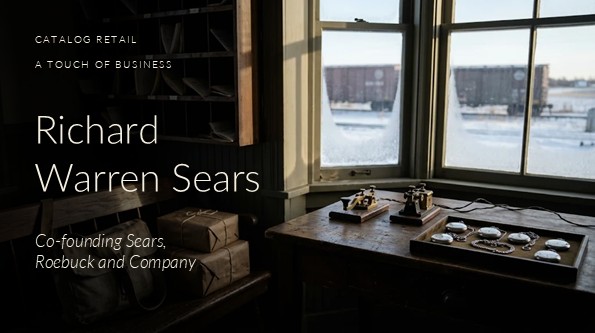
In 1886, a Minnesota railroad employee bought a shipment of watches that a jeweler had refused. Richard Warren Sears sold the watches to railroad and express agents, acquired more, and found the beginnings of a business far removed from station work.
Over the next two decades, Sears helped turn mail-order watch sales into Sears, Roebuck and Company, a catalog retailer reaching customers across the country. Its rapid growth also exposed a difficult problem: attracting orders was easier than consistently filling them.
The partnerships and management changes that followed are as important to Sears’s story as the watch shipment that started it.
A Quick Look at the Life of Richard Warren Sears
Biography Summary
Richard Warren Sears (1863–1914) was an American entrepreneur and cofounder of Sears, Roebuck and Company. Starting in railroad operations, he built mail-order ventures, partnered with watchmaker Alvah Curtis Roebuck, and helped make catalog merchandising a major force in American retail. Julius Rosenwald, Aaron E. Nusbaum, and other colleagues played important roles as the business expanded.
Profile
Full Name: Richard Warren Sears
Born: December 7, 1863
Died: September 28, 1914
Birthplace: Stewartville, Minnesota
Best Known For: Cofounding Sears, Roebuck and Company and expanding catalog retailing
Company: Sears, Roebuck and Company
Major Role: Cofounder and president until 1908
Early Work: Telegraphy and railroad-station operations in Minnesota
From Family Setbacks to Railroad Work
Richard Warren Sears was born in Stewartville, Minnesota, to James W. Sears and Eliza A. Sears. His family initially had financial resources, but his father’s business failed. Sears left secondary school and began working while still young.
He learned telegraphy and worked in railroad-station operations in Minnesota, helping support his mother and sisters. An important assignment took him to the North Redwood area. Alongside his railroad duties, Sears traded goods including lumber and coal.
Those early dealings were smaller than the venture that followed, but the railroad workplace would provide the first customers for his watch business.
The Refused Watches and a New Career
The opportunity arrived in 1886 when a jeweler rejected a shipment of watches. Sears bought the stock and resold the watches to railroad and express agents. He continued buying and selling watches after that first successful transaction.
Later in 1886, he left railroad employment and established the R. W. Sears Watch Company in Minneapolis. He advertised watches and promoted them by mail, reaching buyers without depending entirely on a storefront.
In 1887, Sears expanded into Chicago and hired Alvah Curtis Roebuck, a watchmaker who became a crucial collaborator and later a partner. Their association helped shape the business that would eventually bear both men’s names.
One Business Sold, Another Begun
Sears’s first watch venture was not simply renamed and carried forward unchanged. He sold that business in 1889, tried banking in Iowa, and then returned to selling watches and jewelry through the mail. Roebuck again joined him.
The renewed operation traded under the Warren Company name. On September 16, 1893, it became Sears, Roebuck and Company. Watches and jewelry remained part of the offering, but the business expanded into a broader range of goods.
That expansion gave Sears a much larger market to address, and catalog advertising became central to reaching it.
How the Catalog Reached Rural Customers
Sears did not invent mail-order retailing. Montgomery Ward was already operating a catalog enterprise. What Sears helped achieve was a new scale of direct selling, with particular appeal to people in rural areas who had limited access to large selections of manufactured goods.
He wrote substantial amounts of advertising and catalog copy, emphasizing selection and low prices. The approach depended on infrastructure that already existed and continued to improve: railroads could carry merchandise, while postal services linked sellers and customers. Rural free delivery was a postal development, not something Sears personally created.
The company’s printed watch-and-jewelry promotional material can be traced to 1888. Larger general-merchandise catalogs followed in the 1890s. Those publications marked different stages in the business rather than a single, universally defined first catalog.
New Partners and a Changing Company
As the enterprise developed, its ownership and leadership changed. Around 1895, Roebuck sold his ownership interest, though his connection with the business continued afterward. His original contribution as watchmaker and partner remained distinct from the roles of those who joined later.
Aaron E. Nusbaum and his brother-in-law Julius Rosenwald became important investors and business leaders in the mid-1890s. Rosenwald, in particular, emphasized the practical demands of a growing catalog operation: product quality, financial organization, stock management, and the dependable fulfillment of orders.
Sears emphasized advertising designed to generate sales. Rosenwald’s work focused more heavily on the systems needed to meet that demand. The difference was a real management contrast, but the company’s development involved more than these two men alone.
Sales Growth Outpaces Fulfillment
By 1900, Sears, Roebuck had surpassed Montgomery Ward in mail-order sales. The scale of the change was striking: the company’s sales rose from about $300,000 in 1893 to more than $10 million in 1900.
Such growth brought strain. Orders were not always filled promptly, merchandise could be unavailable, and customer service struggled. Historical business accounts also criticize some of Sears’s exaggerated or misleading advertising claims. Persuasive catalog copy could increase demand, but it could not by itself put goods on shelves or get orders shipped.
Over time, the company’s promotional practices and product standards became more restrained, while Rosenwald and other leaders worked to strengthen operations. The change was gradual, not a single reform credited to one executive.
Sears also continued experimenting with ways to spread the catalog. In a program documented in 1905, established Iowa customers could receive premiums for distributing additional catalogs.
Building the Capacity for a National Business
The company developed a large mail-order complex in Chicago during 1905–1906 to handle its growing volume of business. The facilities reflected an organizational effort closely associated with Rosenwald and other managers, not simply an individual project by Sears.
In 1906, Sears, Roebuck entered the public markets through a stock offering associated with Goldman Sachs. By then, the business had become far more complex than the operation Sears founded in Minneapolis. Its scale depended on coordinated purchasing, inventory, shipping, finance, and management as well as advertising.
Why Sears Left the Presidency
The tension between ambitious promotions and financial control remained significant. One customer coupon-and-premium plan associated with Sears became financially troublesome and drew opposition from Rosenwald and other managers. Poor health has also been cited in accounts of Sears’s withdrawal from active leadership.
In 1908, Sears resigned as company president. Rosenwald assumed the leading role. Sears’s departure from the presidency is clear, although the precise circumstances and timing of his complete retirement are less certain.
The enterprise that carried Sears’s name continued under leadership increasingly focused on the systems required to sustain its scale.
Family, Final Years, and Lasting Influence
Sears married Anna Lydia Meckstroth in 1895. He died on September 28, 1914, six years after leaving the company presidency.
His contribution to American retail lay in making catalog merchandising a large business that could reach buyers far from major shopping centers. It also depended on others: Roebuck’s early partnership, Nusbaum’s involvement in finance and management, and Rosenwald’s attention to the company’s operations.
Sears did not establish the physical department-store network later associated with the name. The first Sears retail store opened in 1925, after his death. His career belongs chiefly to the era when catalogs, advertising, rail transport, and postal services brought mass merchandising to customers who might never visit a large city store.
Timeline
These milestones follow Richard Warren Sears’s career and the early development of the company he helped create.

December 7, 1863
Richard Warren Sears was born in Stewartville, Minnesota.
Around 1878 and the early 1880s
He learned telegraphy and worked in Minnesota railroad operations, helping support his family.
1886
Sears sold watches from a refused shipment to railroad and express agents and established the R. W. Sears Watch Company in Minneapolis.
1887
He expanded into Chicago and hired watchmaker Alvah Curtis Roebuck.
1888
Printed watch-and-jewelry promotional material was in circulation.
1889
Sears sold his earlier watch venture; an Iowa banking venture preceded his return to mail-order commerce.
September 16, 1893
The Warren Company name changed to Sears, Roebuck and Company.
Around 1895
Roebuck sold his ownership interest, while Aaron E. Nusbaum and Julius Rosenwald became involved in the business. Sears married Anna Lydia Meckstroth in 1895.
1900
Sears, Roebuck surpassed Montgomery Ward in mail-order sales.
1905–1906
The company developed a major Chicago mail-order complex.
1906
Sears, Roebuck entered the public markets through a stock offering.
1908
Richard Warren Sears resigned as company president.
September 28, 1914
Richard Warren Sears died.
1925
The first physical Sears retail store opened, after his lifetime.
FAQs
Question: Did Richard Warren Sears invent mail-order retailing?
Answer: No. Montgomery Ward had established a catalog enterprise before Sears. Richard Warren Sears helped expand mail-order retailing on a large scale, particularly for customers in rural areas.
Question: When did the first Sears catalog appear?
Answer: Printed promotional material for watches and jewelry is documented in 1888. The larger general-merchandise catalogs developed during the 1890s. Different dates refer to different types of publication, so there is no single date that describes every stage.
Question: How did Roebuck and Rosenwald differ in their roles?
Answer: Alvah Curtis Roebuck joined Sears as a watchmaker and became an early business partner. Julius Rosenwald became involved later and helped strengthen product standards, financial organization, and the fulfillment of orders before taking the leading role after Sears resigned.
Question: Why did Richard Warren Sears resign in 1908?
Answer: His resignation came amid management disagreements about promotions and financial controls. A coupon-and-premium plan drew opposition from other leaders, and poor health has also been cited. Neither is established as the sole cause of his departure.
Question: Did Richard Warren Sears open the Sears department stores?
Answer: No. Sears resigned as president in 1908 and died in 1914. The company’s first physical retail store opened in 1925, under later leadership.
Further Reading
- Smithsonian Institution Archives: Richard Warren Sears portrait and historic catalog records
- University of Chicago Library: Guide to the Julius Rosenwald Papers
Sources
- U.S. National Park Service: Sears, Roebuck and Company Complex historical nomination
- Jane Addams Digital Edition: Richard Warren Sears biographical entry
- Library of Congress: Sears, Roebuck & Co. Goes Public
- Harvard Business School: Richard W. Sears, Great American Business Leaders
- Smithsonian Institution: Sears, Roebuck and Co. corporate history
- Gale Encyclopedia of U.S. Economic History: Richard Warren Sears
- WTTW Chicago: The Rise and Fall of Chicago’s Mail Order Giants
- History.com: History of Sears
- Sears Archives (preserved copies): Catalog history, History in the 1900s