
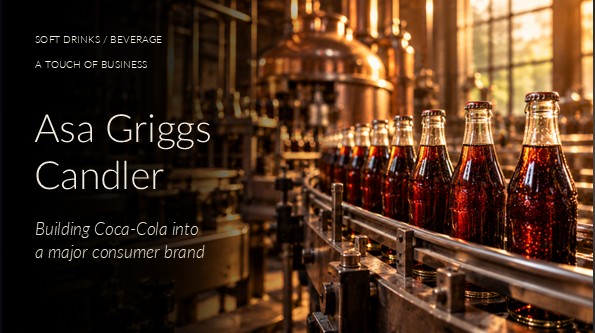
In July 1899, Asa Griggs Candler signed a contract that opened a new chapter in Coca-Cola’s growth. On behalf of the company, he granted bottling rights to Benjamin F. Thomas and Joseph B. Whitehead. From this agreement grew a distribution network developed by entrepreneurs working beyond Candler’s own business.
Candler had not invented the beverage, and the 1899 agreement was not Coca-Cola’s first appearance in a bottle. What distinguished his work was the commercial system taking shape around an existing drink: ownership rights, an incorporated business, persistent advertising, and distribution arrangements that could extend beyond Atlanta.
Coca-Cola was only part of Candler’s career. He also became an Atlanta banker, property developer, university benefactor, and mayor. When his family sold its Coca-Cola interests in 1919, he had already spent years investing in the city that helped establish his business.
A Quick Look at the Life of Asa Griggs Candler
Biography Summary
Asa Griggs Candler (1851–1929) was an American pharmacist and businessman who acquired control of Coca-Cola and organized the company behind its early national expansion. His later work in Atlanta included banking and property development, substantial support for Emory University, and service as mayor during the Great Atlanta Fire of 1917. His story connects the growth of a consumer brand with the civic institutions of the city where that brand began.
Profile
Full Name: Asa Griggs Candler
Born: December 30, 1851
Died: 1929
Birthplace: Carroll County, in the Villa Rica area of Georgia
Profession: Pharmacist, businessman, banker, real-estate developer, and civic leader
Best Known For: Building Coca-Cola’s early commercial organization and national market
Major Business Role: Founder and president of the incorporated Coca-Cola Company
Public Office: Mayor of Atlanta, 1917–1919
Institutional Role: Major Emory benefactor and longtime trustee leader
From a Georgia Pharmacy Career to Atlanta
Born in Georgia’s Carroll County in 1851, Candler was one of eleven children of a merchant and planter. Around 1870, he apprenticed in the drug trade in Cartersville, Georgia. That apprenticeship preceded his work in Atlanta as a pharmacist, where his career would later intersect with Coca-Cola.
By 1873, he was working as a pharmacist in Atlanta. The trade placed him in the same commercial setting in which Coca-Cola would first be sold, though Candler did not become involved with the drink until the following decade.
He married Lucy Elizabeth Howard in 1878, and they had four sons and a daughter. Decades later, the children would also have a consequential role in Coca-Cola’s ownership.
Buying an Existing Drink, One Interest at a Time
Another Atlanta pharmacist, John Stith Pemberton, developed Coca-Cola in 1886. It went on sale at Jacobs’ Pharmacy on May 8 that year for five cents a serving. Candler entered the story after the product had already been created.
Starting in 1888, Candler acquired ownership interests in Coca-Cola through a series of transactions. He consolidated complete control by 1891, for an aggregate sum commonly given as approximately $2,300. The often-repeated picture of a single, complete purchase in 1888 leaves out the gradual and complicated transfer of rights.
In 1892, Candler organized the incorporated Coca-Cola Company with associates including his brother John S. Candler and Frank Robinson. Robinson also played an important part in the brand’s early promotion. Candler had consolidated the rights, but building a market for the drink would require more than ownership.
Turning Coca-Cola into a Nationally Marketed Brand
Candler placed repeated promotion at the center of Coca-Cola’s expansion. Free-sample coupons encouraged trial, while advertising, branded merchandise, sales representatives, and a growing retail presence kept the name in view. The marketing increasingly presented Coca-Cola as a refreshment rather than only a product associated with a pharmacy’s medicinal offerings.
Distribution grew alongside the advertising. Coca-Cola established syrup manufacturing in Dallas by 1894, then Chicago and Los Angeles by 1895. In its 1895 annual report, the company claimed that Coca-Cola was consumed in every U.S. state and territory.
By 1898, sales had reached Canada, Hawaii, and Mexico. The business was moving well beyond its Atlanta beginnings, although Coca-Cola’s later worldwide scale would emerge under subsequent leadership.
Bottling Rights Bring New Entrepreneurs into the Story
Meanwhile, bottling created another way for Coca-Cola to reach customers. Joseph Biedenharn had put the beverage into bottles in Vicksburg, Mississippi, in 1894. Five years later, Candler entered the agreement with Thomas and Whitehead that helped establish a much larger bottling system.
On July 21, 1899, Candler signed that bottling-rights contract on the Coca-Cola Company’s behalf. The original grant had territorial exceptions, so it did not instantly give the bottlers unrestricted rights throughout the country. The agreement is sometimes remembered for its nominal one-dollar consideration, but the practical development of the system depended on contracts, investment, operators, and later arrangements.
Thomas and Whitehead, joined later by John T. Lupton and local licensees, developed the network. A contract bottling plant opened in Chattanooga in 1899 and another in Atlanta in 1900. These operators made investments and arrangements of their own; Candler did not personally establish every plant.
The now-familiar contour bottle came later still. Bottlers approved the design in 1916 after work by the Root Glass Company. It was one more contribution to Coca-Cola’s growth that should not be credited to Candler personally.
Beyond Beverages: Buildings, Banking, and Druid Hills
As Coca-Cola expanded, Candler’s interests spread into Atlanta banking and property. His activities included Central Bank and Trust, the downtown Candler Building, and development associated with Druid Hills. The businessman identified with a soft drink was also investing in the physical and financial development of his city.
The Candler Building offers a concrete example. Land for the project was acquired in 1903, construction began in 1904, and the seventeen-story building opened in 1906. The building carried Candler’s name and marked his investment in downtown office development.
In Druid Hills, his involvement followed the landscape-planning work associated with Frederick Law Olmsted. Candler became a leader of the Druid Hills Corporation after a transition in 1908. He was an important developer and later resident, not the originator of the neighborhood’s landscape design.
A Million-Dollar Commitment to Emory
Education became a major part of Candler’s public work. His brother Warren Akin Candler was a Methodist bishop and an important leader in Emory’s history. Asa’s own relationship with the institution included financial commitments and service in trustee leadership.
In a letter dated July 16, 1914, Asa Candler offered $1 million toward establishing a Methodist-related university in Atlanta. He also contributed 75 acres for the campus. The gifts were part of the longer process of establishing a university in Atlanta.
Emory’s new university organization received its charter in 1915, and the earlier college’s relocation from Oxford to Atlanta was realized in 1919. Candler served as president of Emory College’s trustees from 1906 to 1919 and as president of the university’s board from 1915 until his death in 1929.
A Growing Brand Faces Federal Scrutiny
As Coca-Cola’s market grew, the beverage also faced federal regulatory scrutiny. Its earliest history involved coca-derived ingredients, and cocaine had been removed before the Supreme Court dispute of 1916. That later case concerned different issues: caffeine and whether the product’s name raised misbranding questions under federal food-and-drug law.
In United States v. Forty Barrels and Twenty Kegs of Coca-Cola, the U.S. Supreme Court reversed a lower-court judgment favorable to Coca-Cola and remanded the case for further proceedings. It was litigation about the company’s product, not a personal prosecution of Candler, and the ruling did not finally resolve all questions of the drink’s safety.
From Private Business to Atlanta City Hall
Candler was elected mayor of Atlanta in 1916 and served from 1917 to 1919. Municipal financial concerns formed part of the setting for his election. His move into government also marked a transition in his business responsibilities, as significant interests, including Coca-Cola holdings, passed into his children’s hands.
On May 21, 1917, a devastating fire swept through Atlanta. Historical estimates put the damage at about fifty blocks and 1,563 homes, with roughly 10,000 people left homeless. Crews used dynamite in an attempt to create firebreaks, and the city faced a major recovery effort.
As mayor, Candler took part in the emergency response and recovery. The aftermath unfolded amid Atlanta’s racial segregation, with unequal access and relief across affected neighborhoods.
Wartime infrastructure posed another municipal concern. During World War I, Candler made substantial personal loans associated with water and sewer work for the prospective Camp Gordon military facility. His years in office thus included fiscal pressure, disaster response, and the demands of a city supporting wartime activity.
The 1919 Sale and a Change in Coca-Cola Leadership
Candler had transferred significant Coca-Cola interests to his children by the time he entered city politics. In 1919, the Candler family sold its company interests to an investor group led by Ernest Woodruff in a transaction valued at approximately $25 million. The $25 million described the family transaction, not an established personal payout to Asa Candler.
Ernest Woodruff’s son, Robert W. Woodruff, became Coca-Cola’s president in 1923. The international expansion associated with Robert Woodruff’s leadership belongs to that later period. Candler had helped create the company’s earlier commercial foundation; successors took the business in further directions.
Later Years and a Legacy Shared with Others
Lucy Elizabeth Howard Candler, his wife since 1878, died in 1919. Candler remained connected to business and Emory in his later years. He disposed of Central Bank and Trust in 1922, and his involvement in Emory’s governance continued. His health declined, including a disabling stroke in 1926. He died in 1929.
The Coca-Cola enterprise changed hands and continued to grow after Candler’s active involvement ended. Pemberton had created the drink; Robinson and the bottlers helped build its early identity and reach; and the Woodruffs shaped a later period of expansion.
Candler’s achievement was to take an existing beverage and build the organization that marketed it widely. His years in banking, real estate, higher education, and public office gave his life a second center of gravity in Atlanta. Both strands, built through his own decisions and the work of others, remain essential to his story.
Timeline
These milestones trace Candler’s life from Georgia pharmacy work through Coca-Cola’s development, his Atlanta civic commitments, and the transition to later company leadership.

December 30, 1851
Asa Griggs Candler is born in the Carroll County/Villa Rica area of Georgia.
Around 1870–1873
Candler apprentices in the drug trade in Cartersville around 1870 and is working as an Atlanta pharmacist by 1873.
1878
Candler marries Lucy Elizabeth Howard.
1886
John Stith Pemberton introduces Coca-Cola at Jacobs’ Pharmacy in Atlanta, before Candler’s involvement.
1888–1891
Candler acquires Coca-Cola interests through a series of transactions and consolidates control by 1891.
1892
Candler incorporates the Coca-Cola Company with business associates.
1894
Joseph Biedenharn bottles Coca-Cola in Vicksburg, Mississippi, and syrup manufacturing extends to Dallas.
1895
Syrup manufacturing expands to Chicago and Los Angeles. The company claims Coca-Cola is consumed in every U.S. state and territory.
1898
Coca-Cola sales have reached Canada, Hawaii, and Mexico.
July 21, 1899
Candler signs the bottling-rights agreement with Benjamin F. Thomas and Joseph B. Whitehead on behalf of the Coca-Cola Company.
1903–1906
Land is acquired and construction proceeds on Atlanta’s Candler Building, which opens in 1906.
1908
Candler assumes a leading role in the Druid Hills Corporation following earlier landscape-planning work.
July 16, 1914
Candler signs his letter offering $1 million toward the establishment of the Atlanta university associated with Emory.
1915
Emory’s new university organization receives its charter.
1916
Candler is elected mayor of Atlanta. The U.S. Supreme Court reverses and remands the Coca-Cola caffeine and misbranding case.
May 21, 1917
The Great Atlanta Fire devastates large areas of the city during Candler’s mayoralty.
1919
The Candler family sells its Coca-Cola interests to a group led by Ernest Woodruff for approximately $25 million. Lucy Candler dies, and Emory College’s move to Atlanta is realized.
1922
Candler disposes of Central Bank and Trust.
1923
Robert W. Woodruff becomes president of Coca-Cola under the later ownership era.
1926–1929
Candler suffers a disabling stroke in 1926 and dies in 1929.
FAQs
Did Asa Griggs Candler invent Coca-Cola?
No. Atlanta pharmacist John Stith Pemberton developed Coca-Cola in 1886. Asa Griggs Candler began acquiring interests in the beverage in 1888 and later organized the company that expanded its market.
How much did Asa Griggs Candler pay for Coca-Cola?
Approximately $2,300 is the commonly cited aggregate price for Candler’s acquisition of Coca-Cola interests. He acquired the rights through several transactions beginning in 1888 and consolidated ownership by 1891; it was not one simple purchase of the entire business on a single day.
Who first bottled Coca-Cola?
Joseph Biedenharn bottled Coca-Cola in Vicksburg, Mississippi, in 1894. The better-known 1899 bottling-rights agreement with Benjamin F. Thomas and Joseph B. Whitehead helped establish a larger contractual distribution network.
Did Asa Griggs Candler personally sell Coca-Cola for $25 million in 1919?
No. Candler had already transferred significant company interests to his children. The Candler family’s interests were sold to an investment group led by Ernest Woodruff for approximately $25 million. That transaction price should not be treated as Candler’s personal payout.
Did Coca-Cola win its 1916 Supreme Court case?
The Supreme Court reversed a lower-court decision favorable to Coca-Cola and sent the case back for further proceedings. The litigation addressed caffeine and possible misbranding under federal law; it was not a personal criminal case against Candler or a definitive Supreme Court finding that the beverage was harmless.
Was Emory’s Candler School of Theology named specifically for Asa Candler?
The school’s history does not establish whether its name was meant to honor Asa Griggs Candler, his brother Warren Akin Candler, or both. Both brothers had important connections to Emory, but the intended individual namesake remains uncertain.
Further Reading
- Bartow J. Elmore, Citizen Coke: The Making of Coca-Cola Capitalism — A book-length resource for readers interested in the wider development of the Coca-Cola business.
Sources
- New Georgia Encyclopedia: Asa Candler (1851–1929)
- Emory University: Asa Griggs Candler archival guide, History of the Board of Trustees, Century in the City, Asa Candler’s July 16, 1914 letter, Candler School of Theology history
- Georgia Historical Society: Birthplace of Coca-Cola
- The Coca-Cola Company: The Asa Candler Era
- U.S. District Court, via Justia: The Coca-Cola Bottling Co. v. The Coca-Cola Co. — historical findings
- Harvard Business School: Asa G. Candler
- Olmsted Network: Druid Hills history
- National Park Service: Candler Building, National Register nomination
- Atlanta History Center: Great Atlanta Fire of 1917
- U.S. Supreme Court, via Cornell Legal Information Institute: United States v. Forty Barrels and Twenty Kegs of Coca-Cola (1916)
- Drug Enforcement Administration Museum: Coca
- Etowah Valley Historical Society: Asa Griggs Candler and his early pharmacy career
- TIME: Contemporary coverage of Asa Candler’s death
- HISTORY: Coca-Cola sold in glass bottles for first time
- American Business History Center: How Chattanooga Brought Coca-Cola to the World
