
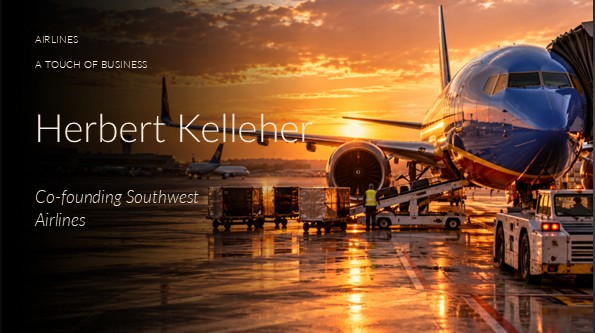
The airline that would become Southwest Airlines won permission to operate within Texas in 1968. Yet it would be three more years before the first passengers boarded. Rival carriers challenged the authorization in court, and Herb Kelleher, a San Antonio lawyer working with aviation entrepreneur Rollin King, helped defend the proposed airline through the long legal fight.
When Southwest finally launched service on June 18, 1971, three Boeing 737s connected Dallas, Houston and San Antonio. Kelleher helped establish the company, but others ran its early daily operations. Years later, he would move from legal adviser and board member to the chief executive’s office, where his leadership became closely identified with the airline’s growth and culture.
A Quick Look at the Life of Herb Kelleher
Biography Summary
Herbert David “Herb” Kelleher (1931–2019) was an American lawyer who cofounded Southwest Airlines with Rollin King and later led the carrier as chairman and chief executive. His career connected Southwest’s early legal battles with decades of low-fare growth, operating discipline and an employee-centered philosophy. It also overlapped with documented controversies in the company’s history.
Profile
Full Name: Herbert David Kelleher
Common Name: Herb Kelleher
Born: March 12, 1931, Camden, New Jersey
Died: January 3, 2019, Dallas, Texas, aged 87
Education: Wesleyan University (1953); New York University law degree (1956)
Known For: Cofounding Southwest Airlines with Rollin King and leading the airline as chairman and chief executive
Major Roles: Southwest chairman beginning in 1978; brief president and CEO stint in 1978; interim CEO in 1981 and permanent CEO from 1982 to 2001; chairman emeritus from 2008
Recognition: National Aviation Hall of Fame, 2008
From New Jersey to a Texas Law Practice
Kelleher was born in Camden, New Jersey, and grew up in nearby Audubon. He attended Haddon Heights High School and was the youngest of four children born to Harry Aloysius and Ruth Violet Kelleher. An older brother died during World War II, and his father, a Campbell Soup Company executive, died while Kelleher was young.
Kelleher later remembered long conversations with his mother about ethics, business and respect for other people. He described those talks as important to him, a reflection he shared when discussing his life and leadership.
He worked at a Campbell Soup plant in his youth, studied English and philosophy at Wesleyan University and graduated in 1953. A law degree from New York University followed in 1956. He also met Joan Negley during his college years; they married in 1955 and had four children: Julie, Michael, Ruth and David.
After clerking for a New Jersey Supreme Court justice and practicing law in his home state, Kelleher moved to Texas in the early 1960s. He practiced in San Antonio and later said he had been looking for entrepreneurial opportunity. Among his clients was Rollin King, whose airline proposal would bring Kelleher into an unfamiliar business.
Rollin King’s Three-City Airline Proposal
Rollin King, an aviation entrepreneur and Kelleher’s client, proposed an airline serving three Texas cities: Dallas, Houston and San Antonio. The aim was frequent, inexpensive service on short routes. King supplied the initial airline concept; Kelleher joined the effort as a legal and business collaborator.
The planned carrier would operate entirely within Texas. That distinction mattered because the proposed routes fell outside the federal Civil Aeronautics Board’s then-existing system for interstate carriers, although the airline still needed approval from Texas regulators. On March 15, 1967, the venture was incorporated as Air Southwest.
The airline’s beginnings also acquired a famous anecdote. Kelleher recalled a bar conversation and a three-city route sketched on a cocktail napkin. King later denied that any napkin was involved. The airline plan was real; the napkin remains a disputed part of the founding story.
Winning the Right to Fly
The Texas Aeronautics Commission granted the airline an intrastate operating certificate in February 1968. Incumbent carriers challenged the authorization, setting off litigation that delayed the planned start. Kelleher represented the new airline as it defended its ability to operate.
A favorable Texas Supreme Court ruling did not end every challenge. A 1971 opinion addressed further attempts by Braniff and Texas International to prevent service from starting. Kelleher later recalled that, when the venture ran short of money, he offered to work without legal fees and cover associated expenses.
The company, renamed Southwest Airlines, finally began service on June 18, 1971. Experienced aviation executive Marion Lamar Muse handled much of the young carrier’s operations and fundraising. Kelleher’s legal efforts had helped open the way; Muse and Southwest’s staff now faced the practical challenges of running an airline.
When Four Planes Became Three
A legal victory did not settle Southwest’s finances. By 1972, the young airline had four aircraft but needed cash. The company sold its fourth plane, leaving the operating team to maintain a demanding schedule with three.
To keep the schedule going, terminal operations leader Bill Franklin and his colleagues developed turnarounds of roughly ten minutes—the time a plane spent on the ground between flights. The faster turns became a defining element of Southwest’s cost-conscious operating model. It was the operations team’s response to a pressing financial problem.
Southwest also competed aggressively on fares. During a 1972 Dallas–Houston fare confrontation, Braniff offered a $13 alternative to Southwest’s $26 fare. Southwest responded by letting customers choose a $13 ticket or a $26 ticket accompanied by a complimentary bottle of liquor. The promotion reflected the unconventional marketing that distinguished the young airline, with Muse central to its early campaigns.
Southwest recorded its first annual profit in 1973. Its employee profit-sharing plan took effect on January 1 of the same year. The legal fight to start the airline had given way to the continuing challenge of keeping its low-fare service viable.
The Lawyer Becomes the Airline’s Leader
Kelleher had spent much of Southwest’s first decade as a lawyer, cofounder and director while others managed daily operations. That changed in March 1978, when he became chairman. He also briefly held the president and CEO offices later that year.
In September 1981, he returned as interim president and chief executive, taking those positions permanently in February 1982. He remained CEO until June 2001. What had begun as a legal role was now a long-term responsibility for the airline’s strategy and management.
Colleen Barrett became one of the important partners in that work. She had been Kelleher’s legal assistant and later rose through Southwest’s executive ranks, helping develop its customer-service and workplace culture. Barrett described their professional relationship as an egalitarian partnership, making clear that the airline’s identity was not the product of one executive alone.
The Hiring Policy Southwest Was Ordered to Change
Southwest’s early marketing was built in part around female flight attendants and highly visible uniforms. That approach existed alongside a female-only hiring policy for flight attendants and ticket agents, as well as a height restriction that became the subject of federal litigation.
On June 12, 1981, a federal district court found the airline’s challenged hiring practices discriminatory under Title VII of federal civil-rights law. A subsequent consent decree created a $1 million back-pay fund for men excluded by the policy. The ruling was a finding against Southwest Airlines, not a finding that Kelleher was personally liable or had individually designed the policy.
The judgment complicates Southwest’s later reputation for employee loyalty. Its early employment policies violated federal law even as the company later became known for employee loyalty.
Low Costs and an Employees-First Philosophy
As Southwest expanded, its business model emphasized low fares, short-haul and point-to-point flying, quick aircraft turns and relatively simple onboard service. Standardizing much of the fleet around Boeing 737s also supported cost control, although Southwest operated Boeing 727s during parts of its history. The design required practical discipline as well as public enthusiasm.
Kelleher argued that employee treatment was central to how Southwest operated. In a 2004 interview, he stated, “You put your employees first.” He explained his ordering as employees, then customers, then shareholders: in his view, well-treated staff would deliver better service and that would support the business. This was his management philosophy, not proof that any one practice alone produced the carrier’s profits.
Discipline was the other side of his approach. As he put it in that interview, “We have had to have extreme discipline in not departing from the strategy.” Southwest’s profit-sharing program, extensive union representation and tradition of avoiding involuntary layoffs during his tenure were also part of its employment culture. Colleen Barrett played a substantial role in shaping the airline’s customer service and workplace practices.
Southwest drew attention not just for its low costs, but for the way its leaders sought to involve and retain employees. The combination became a widely studied feature of the airline’s business model.
Publicity With a Purpose—and the Southwest Effect
Kelleher was willing to become part of Southwest’s public image. His appearances in costume, including dressing as Elvis, and his widely noted fondness for Wild Turkey whiskey and cigarettes complemented an airline brand that used humor to make itself recognizable. Yet the public performances sat beside a serious focus on fares and operating costs.
In March 1992, a disagreement over the advertising slogans “Plane Smart” and “Just Plane Smart” produced an unusual event: Kelleher and Kurt Herwald of Stevens Aviation competed in a staged arm-wrestling match at the Dallas Sportatorium. Kelleher lost. The companies were able to share the wording, and the charity-oriented publicity event became known as “Malice in Dallas.” It was neither a court verdict nor a serious physical confrontation.
Beyond the publicity, Southwest’s low-fare model affected airline competition. A 1993 U.S. Department of Transportation study helped popularize the term “Southwest Effect” for the pattern of lower fares and greater demand when low-cost carriers entered particular markets. The findings described those markets, not a universal outcome on every route.
The Long Argument Over Dallas Love Field
Southwest’s first routes stayed within Texas, outside the federal framework for interstate carriers. After nationwide airline deregulation in 1978, its home airport, Dallas Love Field, became the focus of a different constraint. The 1979 Wright Amendment restricted long-haul interstate service from that airport.
Love Field’s restrictions remained contentious long after Kelleher became CEO. As chairman, he appeared before the U.S. Senate Commerce Committee in 2005 to discuss the Wright Amendment. Congress passed repeal legislation in 2006, but the main operational restrictions remained until 2014. For Southwest, access to markets was still shaped by law as well as by business strategy.
Handing Over the CEO Role Without Leaving Southwest
In August 1999, Southwest announced that Kelleher had been diagnosed with prostate cancer and had begun radiation treatment. The announcement brought public attention to leadership succession. It does not establish that his illness caused his eventual decision to leave the chief executive’s office.
Southwest announced a leadership change in March 2001. Effective June 19, Jim Parker succeeded Kelleher as chief executive, while Colleen Barrett became president and chief operating officer. Kelleher remained chairman and continued working on strategic matters. The transition was not an immediate handoff to Gary Kelly.
The September 11 attacks occurred after Kelleher had left the CEO role. Southwest remained profitable and avoided mass layoffs in the period after the attacks under its incoming leaders, including Parker and Barrett, and its employees. Gary Kelly succeeded Parker as CEO in July 2004.
In July 2007, Southwest announced that Kelleher would step down as executive chairman at its next annual meeting. Gary Kelly was elected chairman on May 21, 2008, and Kelleher became chairman emeritus. By then, Southwest said it had more than 500 aircraft and operated thousands of flights each day—a measure of its scale in 2008, not a statement about its present-day fleet.
A Maintenance Dispute During the Final Chairmanship
During Kelleher’s last months as executive chairman, Southwest faced a separate regulatory controversy. In March 2008, the Federal Aviation Administration proposed a penalty of roughly $10 million concerning the company’s compliance with aircraft-maintenance directives. Southwest disputed the agency’s characterization.
In March 2009, after Kelleher had left the chairmanship, Southwest disclosed a $7.5 million settlement with the FAA covering this and other compliance matters. The agreement called for maintenance and engineering changes and more access to information for the regulator. It included neither an admission of wrongdoing nor a finding of violation. This was a company-level settlement, not a finding that Kelleher personally violated aviation-safety rules.
Later Recognition and a Shared Legacy
Kelleher entered the National Aviation Hall of Fame in 2008. After leaving the executive chairmanship, he continued to hold public roles, including chairing the board of the Federal Reserve Bank of Dallas beginning in July 2010. In October 2014, a road approaching Dallas Love Field was named in his honor.
Herb Kelleher died on January 3, 2019, at age 87. He was survived by his wife Joan and three of their children, Michael, Ruth and David; their daughter Julie had died earlier. He was buried at the Texas State Cemetery on January 9.
Kelleher’s career stretched from defending a small airline’s right to fly to overseeing a business model studied across the industry. Rollin King’s original proposal, Lamar Muse’s early management, the airport teams’ innovations, Colleen Barrett’s partnership and later leaders’ decisions were all part of Southwest’s development. So were the company’s discriminatory hiring practices and regulatory disputes. The airline Kelleher came to symbolize was both a far-reaching commercial achievement and the work of many people.
Timeline
These dates trace the main shifts in Kelleher’s life and Southwest Airlines’ early development, leadership and later legacy.

1931
Herbert David Kelleher is born on March 12 in Camden, New Jersey.
1953–1956
Graduates from Wesleyan University in 1953, marries Joan Negley in 1955 and earns a law degree from New York University in 1956.
Early 1960s
Moves to Texas and practices law in San Antonio.
1967–1968
Air Southwest is incorporated on March 15, 1967. Texas regulators grant a state operating certificate in February 1968, which incumbent airlines challenge.
1971
Southwest Airlines launches passenger flights between Dallas, Houston and San Antonio on June 18.
1972–1973
Southwest sells its fourth aircraft and develops faster turns to operate with three. Its employee profit-sharing plan takes effect in 1973, the same year it records its first annual profit.
1978
Kelleher becomes Southwest chairman and briefly holds the president and CEO offices.
1979
The Wright Amendment restricts long-haul interstate service from Dallas Love Field.
1981–1982
A federal court finds Southwest’s challenged hiring policy discriminatory in 1981. Kelleher becomes interim CEO that year and takes the role permanently in February 1982.
1992–1993
Kelleher joins the “Malice in Dallas” arm-wrestling publicity event in 1992. Federal transportation research publicizes the “Southwest Effect” in 1993.
1999
Southwest announces Kelleher’s prostate cancer diagnosis and radiation treatment.
2001
Jim Parker becomes CEO and Colleen Barrett becomes president and chief operating officer on June 19; Kelleher remains chairman.
2004–2006
Gary Kelly becomes CEO in 2004. Kelleher testifies on the Wright Amendment in 2005, and legislation in 2006 begins its eventual phase-out.
2008–2009
Kelleher becomes chairman emeritus in May 2008 and enters the National Aviation Hall of Fame that year. In 2009, Southwest and the FAA settle a maintenance-compliance dispute without an admission or finding of wrongdoing.
2014
Major Wright Amendment restrictions end; a road approaching Dallas Love Field is named for Kelleher.
2019
Kelleher dies on January 3, aged 87, and is buried at the Texas State Cemetery on January 9.
FAQs
Question: Did Herb Kelleher found Southwest Airlines by himself?
Answer: No. Rollin King proposed the three-city Texas airline, and Kelleher joined him as a cofounder and legal collaborator. Early executive Lamar Muse and a wider team of employees were central to turning the proposal into an operating airline.
Question: Was Southwest Airlines actually designed on a cocktail napkin?
Answer: Kelleher told a story about sketching the Texas route on a cocktail napkin, but King later denied that a napkin was involved. The bar-and-napkin account remains a disputed part of Southwest’s founding lore, not a confirmed surviving document.
Question: When did Herb Kelleher become Southwest’s CEO?
Answer: He briefly held the role in 1978, became interim CEO in September 1981 and was appointed permanently in February 1982. His sustained term as CEO ended in June 2001.
Question: Who succeeded Herb Kelleher as CEO of Southwest?
Answer: Jim Parker succeeded Kelleher as chief executive in June 2001, when Colleen Barrett became president and chief operating officer. Gary Kelly became CEO in 2004 and chairman in 2008.
Question: What was the Southwest Effect?
Answer: The “Southwest Effect” refers to a pattern highlighted in 1993 U.S. transportation research: when low-cost airlines entered particular markets, airfares tended to fall and passenger traffic rose. The findings described the markets studied, not a universal outcome on every route.
Question: Was Kelleher personally found liable in Southwest’s hiring-discrimination case?
Answer: No personal-liability finding against Kelleher is established by the retained court decision. A federal court ruled in 1981 that Southwest Airlines had used discriminatory hiring practices, including female-only policies for flight attendants and ticket agents. The legal judgment was against the airline.
Interviews
Herb Kelleher on Employees, Strategy and Culture
In a 2004 strategy+business interview, Kelleher explains why he placed employees ahead of customers and shareholders in his management philosophy. He also discusses Southwest’s simple business strategy, cost discipline and the challenge of competitors trying to copy the model.
Kelleher Recalls Southwest’s Difficult Beginning
TIME’s 2007 “Airline Maverick” interview offers Kelleher’s firsthand account of the airline’s origins and its early financial struggle. It is particularly useful for understanding how he described his own commitment to the venture, while keeping his recollections distinct from a fully documented founding scene.
Herb Kelleher on Leadership, Culture and Family Memories
The Motley Fool republished a longer Kelleher interview following his death in 2019. In it, he discusses the conversations he remembered having with his mother, his approach to hiring and leadership, and his professional relationship with Colleen Barrett.
Colleen Barrett on Leadership at Southwest
Colleen Barrett describes Southwest’s employee and customer-service approach in this Wharton interview. She also discusses her longstanding working relationship with Kelleher, giving readers the perspective of an executive who helped shape the airline’s culture.
Further Reading
- Southwest Airlines History — Our History: Institutional archive of milestones, historical advertising and maps.
- Harvard Business School — Come Fly with Me: A History of Airline Leadership: A broader historical perspective on airline leadership.
Sources
- Texas State Historical Association: Herbert David Kelleher, Southwest Airlines
- Texas State Cemetery: Herbert David Kelleher memorial
- The Washington Post: Herb Kelleher obituary, Southwest Chairman Has Cancer, Herb Kelleher Has Done It His Way
- The Motley Fool: Herb Kelleher on Leadership, Culture, and Life
- Southwest Airlines History: Herb & Rollin: The Birth of Southwest Airlines, The Birth of the 10-Minute Turn, The Southwest Effect, Historical FAQs
- Court records: Texas Aeronautics Commission v. Betts (1971), Wilson v. Southwest Airlines (1989)
- Southwest Airlines / SEC filings: 2008 Proxy Statement, Southwest Airlines ProfitSharing Plan, 2009 Form 10-Q: FAA settlement
- Southwest Airlines announcements: Kelleher, Barrett and Kelly contracts, New Chairman of the Board, The Wright Amendment Flies Away, Response to Maintenance Allegations
- Los Angeles Times: Southwest CEO to Step Down; Successor Named, Wrassling Over the Plane Truth (Associated Press)
- strategy+business: Herb Kelleher: The Thought Leader Interview
- TIME: Airline Maverick
- Harvard Business School: Herbert D. Kelleher — Business Leaders Profile
- Knowledge at Wharton: Colleen Barrett on Southwest Leadership
- PBS American Experience: The Golden Age of Flight Wasn’t So Golden for Flight Attendants
- U.S. Senate / Government Publishing Office: Wright Amendment Hearing (2005), Senate Report 109-317 (2006)
- National Aviation Hall of Fame: Herbert “Herb” David Kelleher
- World Bank Group / PPIAF: Quantifying the Southwest Effect