
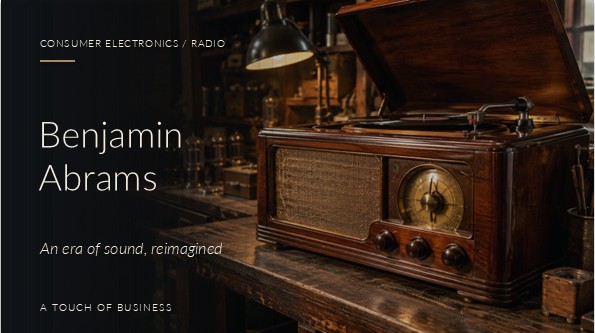
When Benjamin Abrams acquired assets from the troubled Emerson phonograph business in 1922, he took charge of an established name at a turning point. His subsequent career followed that name from recorded music into radios, television, and a wide range of household electronics.
Those changes did not follow a straight line of success. The company found a market for inexpensive compact radios during the Depression, adapted its manufacturing during World War II, and later faced falling profits as the television business matured. Abrams’s career was shaped by those successive shifts in what Emerson made and sold.
A Quick Look at the Life of Benjamin Abrams
Biography Summary
Benjamin Abrams (1893–1967) was a Romanian-born American businessman who acquired Emerson phonograph assets in 1922 and became a leading executive in the Emerson radio and electronics business. His leadership spanned the rise of compact radios, wartime manufacturing, consumer television, and wider product diversification. He also supported educational television and scientific work. Emerson was acquired by National Union Electric in 1965; Abrams’s leadership period ended in 1966.
Profile
Full Name: Benjamin Abrams
Born: 1893, Romania
Died: 1967
Known For: Developing the Emerson radio and consumer-electronics enterprise from assets acquired in 1922
Principal Business: Emerson Radio & Phonograph and related Emerson operations
Leadership Period: 1922–1966
From Immigrant Childhood to the Phonograph Trade
Born in Romania in 1893, Benjamin Abrams came to the United States at the age of 12. He worked while still young, including as a piano tuner and in newspaper or magazine sales. Long before he headed an electronics manufacturer, his work involved selling products directly to customers.
A biographical tribute published in 1962 described a brief period in New York City public schools and said Abrams began assembling or manufacturing phonographs in 1915. It also placed him in a Brooklyn distributorship for Emerson phonographs in 1916. Although written many years later as a tribute to his career, the account describes his early involvement in the trade before he took on a larger role.
A Troubled Record Company Changes Hands
Victor Hugo Emerson founded Emerson Phonograph Company in 1915. It sold phonographs and recorded discs, but the enterprise entered receivership in December 1920 amid a downturn in the record business. The difficulties created an opening for new ownership.
Abrams’s association with Emerson had begun with phonograph distribution. In 1922, it took a different form: a $50,000 offer from Abrams was accepted for assets associated with Emerson and Regal records, including equipment, recording masters, and trademarks. The acquisition was followed by a series of reorganizations rather than the straightforward continuation of the original company.
New recording arrangements followed that year. The reorganized Emerson operation relied for a time on licensed recordings, then resumed original Emerson releases by September. Abrams also held a presidency at the Brooklyn-based Grand Talking Machine Company, which sold phonographs and related goods. His early management responsibilities remained rooted in recorded sound, even as radio offered a different line of business.
The Emerson Name Moves Into Radio
In February 1924, Abrams launched Emerson Radio Corporation. Later that year, the radio and phonograph interests briefly operated together as Emerson Radio & Phonograph Corporation before further changes to their corporate arrangements. The shift was not a single, permanent renaming of the company he had acquired in 1922.
Emerson marketed a combination radio and phonograph in 1924, bringing broadcasting and recorded music together in one product. The combination reflected the overlap between the established phonograph trade and the expanding market for radio receivers.
The separation of businesses continued. Recording rights were sold to the Scranton Button Company late in 1924, while the old Emerson record label carried on under reorganized interests until around 1927. The radio business, rather than the original record operation, became the center of Abrams’s subsequent career.
Compact Radios Find a Market During the Depression
Emerson made one of its most consequential product shifts in 1932 by introducing small, relatively low-priced radio receivers during the Great Depression. Known as “Peewee” or compact sets, they offered consumers a smaller alternative to larger radios.
A 1962 tribute highlighted the Model 25-A, describing it as a six-pound set priced at $25. Other company histories document a range of compact receivers and strong sales during the 1930s. Their small size and comparatively accessible prices helped define Emerson’s place in the radio market.
By the late 1930s, compact receivers had become an important part of Emerson’s identity. The business Abrams had taken over through a record-company asset purchase was now known for a different type of consumer product.
War Production and the Move Into Television
World War II changed Emerson’s manufacturing work. The company shifted significant production away from civilian radios and toward military electronics. In 1943 it also became publicly held, changing the structure of a business that had grown under the Abrams-era management.
After the war, television offered another important product category. Emerson introduced a postwar consumer television receiver in 1947. A company history describes an early ten-inch model priced at about $375.
Television soon accounted for a substantial share of the company’s business. By fiscal 1950, Emerson reported approximately $74.2 million in sales. The transition from radios to television widened the enterprise’s product reach, though it also introduced the business to another evolving and competitive market.
Educational Television and Scientific Support
Abrams’s connection with television extended beyond selling receivers. In June 1952 he announced a $100,000 Emerson initiative to help launch noncommercial educational stations. Under the announced arrangement, the first ten qualifying stations would each receive $10,000.
In April 1953, he traveled to Houston to present an early grant to KUHT, the University of Houston television station. Educational broadcasting was thus a public commitment during the same period that television had become important to Emerson’s commercial operations.
Abrams also helped finance laboratories at the Weizmann Institute of Science in Israel. They were dedicated in December 1954 in a ceremony linking New York and Rehovot through an electronically transmitted signal. His support for broadcasting and scientific facilities added a public and philanthropic dimension to his business career.
Diversification Meets a Difficult Business Period
Emerson’s product range widened in the 1950s. The company entered air conditioning through its 1953 acquisition of Quiet Heet, was manufacturing tape recorders by 1955, and purchased the DuMont consumer-products business in 1958. Radios and television sets remained important, but they were no longer the full extent of the operation.
Broader operations did not protect Emerson from a sharp downturn. A specialist company history reports that sales fell from about $87.4 million in fiscal 1955 to $73.9 million in fiscal 1956. Net profit in 1956 was approximately $84,852, a narrow return for a company of that size.
The same history credits Abrams with responding through cost controls. Emerson consolidated manufacturing in Jersey City and adopted printed-circuit production methods. By fiscal 1959, the company reported around $2.7 million in net profit on $67.4 million in sales. The result marked an improvement in profitability even though sales remained below their mid-decade peak.
By 1965, a Harvard Business School profile places Emerson’s operations at about 20 subsidiaries and more than 100 products. That range illustrates how far the business had developed beyond its origins in phonograph records.
Recognition, Sale, and Final Years
Abrams received public recognition for his business and community activities. In May 1962 he was honored at a Society for the Advancement of Management event at C. W. Post College. His educational television and scientific initiatives were by then established parts of his public work.
The business changed ownership in 1965 when National Union Electric Corporation acquired Emerson. The acquisition brought an end to the company’s period as an independently owned Abrams-era enterprise. Harvard Business School dates Benjamin Abrams’s leadership through 1966, separating the ownership change from the end of his management career.
Abrams died in 1967. The Emerson name continued under later owners, but their subsequent decisions and business results belong to a different chapter of the company’s history.
What Benjamin Abrams Left Behind
Abrams’s lasting business contribution was the development of an Emerson enterprise that changed repeatedly with its markets: from record-related assets to compact radios, wartime electronics, television, and a wider range of household goods. Each new product era brought different opportunities and demands.
The compact radios of the 1930s, the expansion into television, and the manufacturing response to falling mid-1950s profits show both the opportunities and the pressures of that career. His educational broadcasting initiative and contribution to the Weizmann Institute are separate parts of the same life, beyond Emerson’s sales figures.
Timeline
These dates mark important developments in Benjamin Abrams’s life and the Emerson businesses associated with his career.

1893
Benjamin Abrams is born in Romania.
1915–1916
Victor Hugo Emerson establishes the original Emerson Phonograph Company. A later biographical account places Abrams in phonograph work and an Emerson Brooklyn distributorship during these years.
1920
The original Emerson business enters receivership in December.
1922
Abrams acquires Emerson-related record assets. The recording businesses are reorganized and Emerson releases resume.
1924
Abrams launches Emerson Radio Corporation in February. The radio and phonograph interests are briefly combined before further reorganization.
1932
Emerson introduces its compact “Peewee” radio sets.
1942–1943
Emerson produces military electronics during World War II and becomes publicly held in 1943.
1947
Emerson introduces a postwar consumer television receiver.
1952–1954
Abrams announces an educational television grant program, presents an early grant to KUHT, and helps finance laboratories dedicated at the Weizmann Institute.
1953–1959
Emerson diversifies into other products. A decline in mid-1950s profits is followed by manufacturing changes and higher reported profitability in fiscal 1959.
1962
Abrams is recognized at a Society for the Advancement of Management event.
1965–1966
National Union Electric acquires Emerson in 1965. Abrams’s leadership period ends in 1966.
1967
Benjamin Abrams dies.
FAQs
Did Benjamin Abrams found Emerson?
No. Victor Hugo Emerson established the original Emerson Phonograph Company in 1915. Abrams acquired assets associated with the business in 1922 and launched an Emerson radio company in 1924.
What made Emerson’s compact radios important?
The small, relatively inexpensive radios introduced in 1932 became a strong product line during the Depression and helped establish Emerson’s identity in the radio market.
Did Benjamin Abrams invent the radio–phonograph combination?
Emerson marketed a combined radio and phonograph in 1924 while Abrams led the business. That does not establish him as the individual designer or inventor of the product.
What changed at Emerson in 1965 and 1966?
National Union Electric Corporation acquired Emerson in 1965. Abrams’s leadership is recorded as ending in 1966. The ownership transaction and his departure are separate milestones.
How did Abrams support educational television?
He announced a $100,000 Emerson initiative in 1952 offering $10,000 apiece to the first ten qualifying noncommercial educational stations. He presented an early award to the University of Houston’s KUHT in 1953.
What was Abrams’s connection to the Weizmann Institute?
Abrams helped finance laboratories at the Weizmann Institute of Science in Israel. Their December 1954 dedication connected ceremonies in Rehovot and New York by an electronic signal.
Sources
- Harvard Business School: Benjamin Abrams leadership profile
- United States Congress / Government Publishing Office: Congressional Record, May 28, 1962, biographical tribute
- Allan R. Sutton / Mainspring Press: Emerson Records: The Complete Discography (1915–1928)
- Emerson Radio: Emerson Through the Years
- International Directory of Company Histories / Encyclopedia.com: Emerson Radio Corp. company history
- Science Museum Group: Emerson Radio Corporation collection history
- Weizmann Institute of Science: Time Tunnel, archival retrospective