
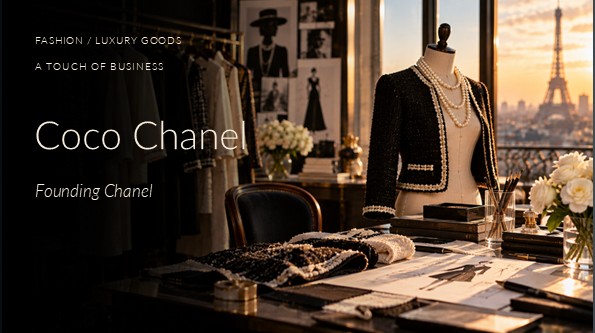
On 5 February 1954, Coco Chanel returned to Paris couture with her first new collection in years. She was 70. Her house had reopened its premises the previous year, but the fashion world had changed during her absence.
French reviews were initially cool. In the United States, however, her emphasis on easy movement and simple tailoring drew a warmer response. The clothes revived an approach she had been developing since the days of jersey sportswear and relaxed resort clothing.
Behind the comeback was a life marked by striking changes in fortune, financial partnerships, and conflict. Chanel had built an influential design business, but her record during the German occupation would complicate any simple celebration of her achievements.
A Quick Look at the Life of Coco Chanel
Biography Summary
Gabrielle Bonheur Chanel (1883–1971), known as Coco Chanel, was a French couturière and the founder of the Chanel fashion house. She expanded from hat-making into resortwear and couture, popularized understated designs, and launched Chanel N°5 with perfumer Ernest Beaux. Her career also involved contested business arrangements, a major labor dispute, and documented wartime misconduct.
Profile
Full Name: Gabrielle Bonheur Chanel
Known As: Coco Chanel
Born: 19 August 1883, Saumur, France
Died: 10 January 1971, Paris, France, aged 87
Nationality: French
Best Known For: Founding Chanel; influential women’s clothing, Chanel N°5, the Chanel suit, and the 2.55 shoulder bag
Major Roles: Milliner, couturière, fashion entrepreneur
Resting Place: Bois-de-Vaux cemetery, Lausanne, Switzerland
From a Modest Childhood to a Trade in Clothing
Gabrielle Chanel was born in a hospice in Saumur in 1883, into a family of modest means. After her mother’s death, she spent part of her childhood in a religious institution at Aubazine. Sewing was among the skills associated with her upbringing there.
Later stories about her childhood sometimes obscured those beginnings. A 1931 profile, for example, described her as growing up with an aunt rather than in an institution. The contrast between that public account and her childhood at Aubazine is an early example of the mythology surrounding her life.
As a young woman, she did sewing work and sang in cafés. Around 1907, the nickname “Coco” became associated with her performances.
Hats, Influential Backers, and the First Paris Shop
Chanel’s first steps into fashion were helped by relationships as well as by her own work. Étienne Balsan introduced her to a wealthy social circle and provided a setting for early hat-making. Arthur “Boy” Capel, an Englishman with whom she had a relationship, supplied important financial support for her commercial venture.
In 1909, Chanel established a hat-making enterprise at 160 boulevard Malesherbes in Paris, assisted by experienced milliner Lucienne Rabaté. In 1910, she opened the Chanel Modes boutique at 21 rue Cambon.
Her hats reached Parisian theatrical figures. In October 1910, Comœdia Illustré published an image of Chanel wearing her own creations, giving the work visibility beyond her immediate clientele.
Rue Cambon would remain central to her business, but the next expansion took Chanel to the French seaside resorts.
Deauville and Biarritz: From Millinery to Couture
Chanel opened a boutique in Deauville in 1912. Around 1913, she began selling casual and sporting clothes, including jersey garments, taking the business beyond its original focus on hats.
Jersey and sailor-inspired clothing offered soft, practical alternatives to the more elaborate and structured daywear familiar to fashionable women. By 1916, fashion publications were showing Chanel’s jersey ensembles. A surviving silk-jersey sailor-style garment from that year illustrates the direction her clothing had taken.
In 1915, Chanel opened a couture house in Biarritz, serving a fashionable seaside clientele during the war years. By 1918, she had established her couture operations at 31 rue Cambon in Paris, an address distinct from the original shop at number 21.
At these resorts and in Paris, Chanel made informal fabrics and shapes part of high-end fashion. Arthur Capel, whose financial backing had helped the young business, died in a motor accident in 1919.
The Little Black Dress and a More Flexible Idea of Elegance
Chanel’s designs repeatedly drew on shapes and materials associated with sportswear, workwear, and men’s clothing. She refined them for women who could afford couture, emphasizing movement, clean lines, and understated surfaces rather than heavy decoration.
Her treatment of black clothing became especially influential. In 1926, American Vogue promoted a streamlined black Chanel dress and described it as “the frock that all the world will wear.” The publicity helped position a simple black dress as versatile modern fashion.
Chanel did not invent black dresses. Nor did she invent the women’s tailored suit. Her contribution lay in popularizing, recombining, and persistently refining existing forms until they became closely associated with her name.
Imitation pearls and costume jewelry added deliberate ornament to otherwise restrained clothes. Tweed tailoring, soft fabrics, and jewelry could be worn as parts of a coordinated look rather than as separate design statements. Those relationships among garments and accessories became increasingly important to the house’s visual identity.
Chanel N°5 Turns a Fashion Name Into a Fragrance Business
Chanel moved into fragrance in 1921 with Chanel N°5, developed in collaboration with professional perfumer Ernest Beaux. Her name was now attached to a product beyond clothing.
On 4 April 1924, Chanel joined Pierre and Paul Wertheimer to create Société des Parfums Chanel. The arrangement gave the perfume business access to industrial production and distribution resources beyond her couture operations. Théophile Bader also held an interest in the venture.
The ownership split commonly reported for the perfume company was 70 percent for the Wertheimer interests, 20 percent for Bader, and 10 percent for Chanel. This division applied to the separate fragrance enterprise, not to the whole of Chanel’s fashion business.
Chanel later disputed the division of benefits and control in the perfume business. During the German occupation, she would attempt to exploit anti-Jewish measures to gain control from her partners, taking the commercial dispute into a far more serious realm.
Beyond the Paris Salon: Britain, Performance, and Jewelry
As Chanel’s business developed, her work and social world extended beyond Paris couture. She was connected to British aristocratic circles, including the Duke of Westminster, and drew on practical British country and sporting clothes. In 1927, she opened a London salon or atelier.
She also moved among artists and performers. Her connections included Jean Cocteau and the Ballets Russes, for which she contributed costumes to the 1924 ballet Le Train Bleu. These projects placed her clothing in a wider creative world rather than only in boutiques and fittings.
In 1931, Hollywood producer Samuel Goldwyn engaged Chanel for film costume work. Her recorded projects included Tonight or Never and, the following year, The Greeks Had a Word for Them. The move demonstrated an attempt to take her fashion presence into a different commercial medium, without establishing a simple story of success or failure in Hollywood.
Chanel expanded her jewelry work as well. In 1932, she presented Bijoux de Diamants, a collection of high jewelry distinct from the imitation pearls and costume pieces associated with her clothes. Fashion, accessories, performance, and fragrance now formed several different expressions of the Chanel name.
The 1936 Strike Exposes Conflict Behind the Couture House
The workforce that helped make Chanel’s clothes was not always in agreement with management. During the French strike wave of June 1936, employees occupied the rue Cambon premises.
Contemporary newspapers reported opposition to piecework and resistance by management to collective-contract demands. L’Intransigeant described a shutdown and the dismissal of 300 workers while the occupation continued. Negotiations brought the dispute to an end by early July.
The strike laid bare tensions between an established couturier and the people whose work sustained her business. Chanel’s success had not spared her house from the wider labor unrest of the 1930s.
War Closes the Couture House—but Not Every Chanel Business
After France entered the Second World War in September 1939, Chanel closed her couture house. The perfume and accessories boutique at 31 rue Cambon continued operating, however, so the closure did not mean every Chanel commercial activity ceased.
During the German occupation, Chanel lived at the Hôtel Ritz in Paris and had a relationship with Hans Günther von Dincklage, a German official associated with intelligence work. This relationship is an established element of her wartime history, but it does not on its own establish every allegation later made about her intelligence activity.
A separately documented act concerned the perfume company. In May 1941, Chanel appealed to occupation authorities in an attempt to take advantage of anti-Jewish “Aryanization” measures and obtain greater control of Parfums Chanel from the Jewish Wertheimer partners. The Wertheimers had arranged protective stewardship through industrialist Félix Amiot; her effort to take control did not succeed.
This was no ordinary dispute over royalties. Chanel had tried to use policies targeting Jewish business owners to her own advantage, although the attempt failed.
Intelligence documents add another layer, but with important limits. An archivist discussing German Abwehr records said Chanel was registered as an agent or source; the same archivist cautioned that the file did not establish whether she knew of that registration. AFP reported the German code name “Westminster” and identifier F7124, as well as a German initiative in 1943 involving possible contact with Winston Churchill through her English connections. Those records and reports do not by themselves establish all the tasks Chanel knowingly performed.
A French intelligence note from November 1944 recorded an informant’s allegation about Chanel’s activity as von Dincklage’s agent in 1942–43. That is an allegation preserved in an intelligence file, not a court finding. After the liberation of Paris in 1944, Chanel was briefly questioned or detained and then released. The documented record does not establish an espionage conviction.
In the postwar years, Chanel spent time in Switzerland and remained away from couture. Her documented business maneuver and the questions raised by intelligence files would cast a lasting shadow over her reputation.
Returning to Couture at 70
Chanel reopened her Paris couture premises in 1953 and presented her comeback collection on 5 February 1954. At 70, she reentered a fashion world reshaped by Christian Dior’s New Look and other postwar designs.
The new collection again favored more mobile silhouettes and simple suits, continuing an approach visible in her prewar work. Its reception was mixed: much of the French response was reserved or unfavorable, while some American and French observers recognized the clothing’s appeal.
The revived Chanel suit became one of the most recognizable results of her return. Its understated tailoring and comfortable structure carried forward ideas already visible in her earlier work.
In February 1955, Chanel introduced the quilted 2.55 shoulder bag with a strap that allowed it to be carried on the shoulder. It joined the suit and other accessories as a lasting design associated with her lifetime work, though later handbag variations belong to later stages of the company’s history.
Shoes, Recognition, and the Final Working Years
Working with shoemaker Massaro, Chanel developed distinctive two-tone footwear that became part of her later look. As with her suits and accessories, she continued refining a recognizable design rather than relying on a single new fashion statement.
In 1957, Chanel received a Neiman Marcus fashion award in the United States. She continued designing and refining clothes into the 1960s, long after her first jersey garments had attracted attention.
In a February 1959 television interview with Pierre Dumayet, Chanel called a collection just a week old already out of fashion: “elle est déjà démodée, elle a une semaine.” The remark conveys her own view of how quickly fashion changes.
Another French interview was filmed in 1969. That December, the Broadway musical Coco, with Katharine Hepburn playing Chanel, opened—one indication that her life had become material for popular performance while she was still alive.
Gabrielle Chanel died at the Ritz in Paris on 10 January 1971, aged 87. She was buried at Bois-de-Vaux cemetery in Lausanne. A French television obituary reported that she had been working on a new collection shortly before her death.
Later Resistance Papers Do Not Resolve the Wartime Questions
Decades after Chanel’s death, a different claim entered public discussion. A 2023 Victoria and Albert Museum exhibition drew attention to a 1948 French document naming Chanel and a 1957 certificate referring to an “Eric” Resistance network. The papers were presented as suggesting a connection with the French Resistance.
Historian Guillaume Pollack, after examining the relevant military archive file, raised serious doubts about that conclusion. He pointed to limited corroborating testimony, questions about the named network, and the late date of the certificate. His criticism did not establish that the paperwork was forged; it challenged how much the documents could prove.
Whether Chanel performed specific Resistance service remains unresolved. The later paperwork does not erase her documented attempt to exploit anti-Jewish measures, nor does an intelligence registration alone answer what she knowingly did for German officials.
A Lasting Design Language and a Divided Legacy
Chanel’s long influence came from consistent refinement as much as from individual products. Jersey sportswear, streamlined black dresses, costume jewelry, suits, fragrance, shoulder bags, and two-tone shoes created a recognizable design language that fashion museums continue to examine.
Her work depended on financial supporters, skilled employees, perfumers, and other collaborators. Nor can the influence of her designs erase the attempt to take advantage of anti-Jewish economic persecution during the war. Alongside that documented action stand still-disputed questions about her intelligence connections and Resistance claims. Both the creative influence and the troubling record remain part of Coco Chanel’s legacy.
Timeline
These milestones trace the development of Chanel’s work, major setbacks, and later historical reassessments.

1883
Gabrielle Bonheur Chanel is born on 19 August in Saumur, France.
Childhood
Following her mother’s death, Chanel spends part of her youth at a religious institution in Aubazine and learns sewing skills.
Around 1907
Café singing becomes associated with the nickname “Coco.”
1909–1910
Chanel establishes a hat-making enterprise on boulevard Malesherbes in 1909 and opens Chanel Modes at 21 rue Cambon in 1910.
1912–1916
She opens in Deauville, expands into jersey sportswear, establishes a Biarritz couture house in 1915, and gains fashion-press attention for jersey garments in 1916.
1918–1919
Her couture establishment takes shape at 31 rue Cambon in 1918. Early financial backer Arthur Capel dies in 1919.
1921–1924
Chanel launches N°5 with perfumer Ernest Beaux in 1921. In 1924, she forms Société des Parfums Chanel with the Wertheimer brothers and designs costumes for Le Train Bleu.
1926–1927
American Vogue gives prominence to a black Chanel dress in 1926. Chanel opens a London salon or atelier in 1927.
1931–1932
Chanel undertakes film costume work with Samuel Goldwyn and presents the Bijoux de Diamants high-jewelry collection.
1936
Employees occupy the rue Cambon premises during a labor dispute that ends after negotiations.
1939–1944
Chanel closes couture operations in 1939 while perfume and accessories sales continue. In 1941 she attempts to use anti-Jewish measures against the Wertheimer perfume interests. She is questioned and released after the 1944 liberation of Paris.
1953–1955
The couture premises reopen in 1953. Chanel presents her comeback collection on 5 February 1954, aged 70, and introduces the 2.55 shoulder bag in February 1955.
1957–1959
Chanel receives a Neiman Marcus fashion award in 1957 and appears in a French television interview in February 1959.
1969–1971
The musical Coco opens on Broadway in 1969. Chanel dies in Paris on 10 January 1971, aged 87.
2023
An exhibition publicizes documents suggesting Resistance membership; historian Guillaume Pollack later challenges whether the archive file confirms any active service.
FAQs
When did Coco Chanel open her first shop?
Chanel began a hat-making enterprise in Paris in 1909 and opened the named Chanel Modes boutique at 21 rue Cambon in 1910. Her Deauville boutique opened in 1912, before she expanded further into sportswear.
Did Coco Chanel invent the little black dress?
No. Black dresses existed before Chanel. She helped make a streamlined black dress a highly publicized, versatile fashion choice, particularly after American Vogue featured her design in 1926.
Who created Chanel N°5?
Coco Chanel introduced N°5 in 1921 in collaboration with professional perfumer Ernest Beaux. A separate perfume company, created with Pierre and Paul Wertheimer in 1924, supported its wider commercial development.
Was Coco Chanel a Nazi spy?
German intelligence records registered Chanel as an agent or source, but a French archive expert said they did not establish whether she knew of the registration. A later French report alleged activity connected to German official Hans Günther von Dincklage; it was not a court verdict. Separately, Chanel’s attempt to benefit from anti-Jewish “Aryanization” measures against her perfume partners is documented. She was questioned and released in 1944, with no espionage conviction established in this record.
Was Coco Chanel in the French Resistance?
A 2023 exhibition publicized later French paperwork suggesting Resistance membership, including a 1957 certificate. Historian Guillaume Pollack questioned the archival support for actual wartime service. Whether Chanel carried out specific Resistance work remains unresolved.
Why are 1953 and 1954 both given as dates for Chanel’s comeback?
The couture premises reopened in 1953, while Chanel’s public comeback collection was presented on 5 February 1954. Born in August 1883, she was 70 at the time of the fashion show.
Interviews
Chanel on Fashion in a 1959 French Television Interview
In this interview with Pierre Dumayet, Chanel discusses her current collection and her view of fashion’s changing demands. The preserved recording gives readers a chance to hear her express those views directly rather than through later biographical commentary. It is especially useful for the period after her return to couture.
A 1969 Interview From Chanel’s Later Years
This French television footage records Chanel speaking near the end of her life about clothing and changing customs. The interview was rebroadcast on 11 January 1971, shortly after her death. It offers a firsthand perspective on the late phase of her career.
Further Reading
- Janet Flanner, “31, Rue Cambon” (1931) — A contemporary portrait of Chanel’s public persona and business, best read cautiously for claims about her early life.
- Amy de la Haye, Chanel: Couture and Industry — A specialist historical study of couture and the Chanel enterprise.
Sources
- Palais Galliera / City of Paris Fashion Museum: Gabrielle Chanel. Fashion Manifesto — Exhibition Dossier and Chronology
- Victoria and Albert Museum: Gabrielle Chanel: Dressing the Modern Woman, What Makes CHANEL So Iconic?, Gabrielle Chanel in Britain, Gabrielle Chanel. Fashion Manifesto
- Cambridge University Press / Enterprise & Society: From the Margins to the Core of Haute Couture
- Metropolitan Museum of Art: Gabrielle “Coco” Chanel and the House of Chanel
- The New Yorker: Janet Flanner, “31, Rue Cambon” (1931)
- CHANEL: 1910s Chronology, 1920s Chronology, 1930s Chronology, 1950s Chronology
- Associated Press / The Guardian: French Archives Contain Nazi and Resistance War Files on Celebrities
- Le Monde: Chanel’s Secretive Owners, the Wertheimers
- The New York Review of Books: The Cut of Coco
- The Guardian: Coco Chanel Exhibition and Resistance Documents
- France 24 / inkl: Historian Questions Chanel Resistance Claims
- Institut national de l’audiovisuel: Coco Chanel N°1 (1959), Dernière Interview de Coco Chanel (1969)
- Bibliothèque nationale de France / RetroNews: Coco Chanel, Star de la Mode Comme de la Presse
- National Museums Scotland: 100 Years of the Little Black Dress
- Agence France-Presse / Times of Malta: London’s V&A Hosts New Chanel Exhibition