
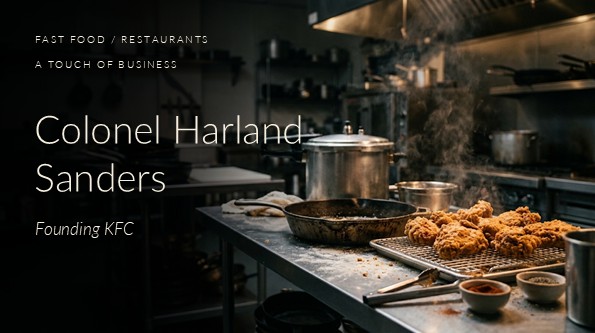
When highway changes reduced traffic to his Corbin restaurant, Colonel Harland Sanders already had a foothold beyond Kentucky: Pete Harman had become his first franchisee in Utah. Sanders sold the Corbin business in 1956 and concentrated on persuading other restaurant operators to serve his chicken.
The expansion that followed drew on years of restaurant work. By the time Sanders sold KFC to investors in 1964, more than 600 franchises were operating. He then continued traveling for the brand into his eighties, remaining publicly associated with a business he no longer owned.
A Quick Look at the Life of Colonel Harland Sanders
Biography Summary
Harland David Sanders was an American restaurateur and the founder of Kentucky Fried Chicken, or KFC. His business combined a proprietary seasoning blend with a pressure-frying process that other restaurant operators could use. Franchisees helped develop the business, while Sanders remained involved after selling it.
Profile
Full Name: Harland David Sanders
Common Name: Colonel Sanders
Born: September 9, 1890
Birthplace: Near Henryville, Indiana
Died: December 16, 1980, in Louisville, Kentucky, aged 90
Best Known For: Founding Kentucky Fried Chicken
Major Roles: Restaurateur, franchise promoter, and KFC brand ambassador
Honor: Horatio Alger Award, 1965
From Family Cooking to a Varied Working Life
Sanders grew up on a family farm near Henryville, Indiana. After his father died during his childhood, he helped cook and care for his younger siblings while his mother worked.
His formal schooling ended before he completed secondary school. Before entering the restaurant business, he worked in farming, streetcar operations, railroad work, and insurance sales. He also served in the U.S. Army.
By about 1930, Sanders was serving meals to travelers at his service station in the Corbin area of Kentucky.
A Roadside Restaurant and a Faster Cooking Process
The meal business developed beyond the service station. The Harland Sanders Cafe building that survives today opened in 1940, and Sanders operated the restaurant until 1956.
Around 1940, pressure frying became central to his chicken preparation. Sanders recalled adopting pressure cooking to serve orders faster. The National Register history of his cafe describes a preparation time of approximately nine minutes, compared with thirty minutes or more for skillet cooking.
Sanders paired the cooking method with a proprietary seasoning blend, promoted as eleven herbs and spices. Both became central to the product he offered other restaurant operators.
Sanders later received a patent for a process of producing fried chicken under pressure. The application was filed in 1962, and U.S. Patent 3,245,800 was granted in 1966. His invention concerned the frying process; the patent did not establish that he had invented the pressure cooker itself.
Pete Harman Takes the Chicken to Utah
Pete and Arline Harman were already in the restaurant business when they met Sanders at a Chicago restaurant convention in 1951. In 1952, Pete Harman became the first KFC franchisee in the Salt Lake City area.
Harman’s franchise extended Sanders’s chicken beyond his own restaurant. Sanders went on to recruit other operators to serve the product using his seasoning and preparation method.
Harman also helped develop family takeout meals and packaging, contributing to the business beyond serving Sanders’s chicken.
Losing Road Traffic and Concentrating on Franchises
Highway changes reduced the traffic reaching Sanders’s Corbin business. In 1956, he sold the restaurant and devoted himself more fully to franchise recruitment.
Sanders carried cooking equipment and seasoning on sales trips, demonstrating the chicken to prospective operators. Early franchise arrangements paid him a few cents per chicken, with payments described as four cents and later five.
During the 1950s, Sanders also adopted his signature public appearance. His title of Colonel came from an honorary commission by Kentucky’s governor, separate from his earlier Army service.
Selling KFC Without Leaving Public Life
As the franchise business expanded, Sanders struggled to manage its growth. He sold the business to investors for $2 million in 1964, when the network had grown to more than 600 franchises.
According to William Whitworth’s contemporary profile, Sanders retained the Canadian business, and the sale agreement included territorial exceptions.
After the sale, Sanders’s work shifted toward representing KFC. He continued traveling as a brand ambassador into his eighties, and his image remained associated with the company.
Sanders expressed his preference for continued work in a remark to Whitworth: “You’ll rust out quicker ’n you’ll wear out.”
Public Criticism and a Franchisee’s Defamation Claim
Representing KFC did not prevent Sanders from criticizing its food. He complained publicly about the gravy and said the chicken differed from his original preparation.
A Bowling Green franchisee sought damages over published remarks. In 1978, the Kentucky Supreme Court affirmed dismissal of the defamation complaint for failure to state a claim. Sanders’s remarks concerned KFC generally and did not identify that particular restaurant.
The decision did not establish the accuracy of Sanders’s claims about nutrition or food quality.
In a Tokyo interview with Stars and Stripes, Sanders emphasized product consistency. He said he had remained with the company because, in his view, it was returning to earlier methods.
The Restaurant Behind the Brand
Sanders died in Louisville, Kentucky, on December 16, 1980, at the age of 90. His image continued to represent KFC after his death.
The Corbin restaurant preserved another part of his story. Harland Sanders Cafe was added to the National Register of Historic Places in 1990, and the restored restaurant also became a museum.
Sanders’s lasting public identity carried a tension: he remained KFC’s representative while openly questioning how the company prepared its food.
Timeline
These milestones follow Sanders’s life from Indiana to the restaurant and franchise business that became KFC.

September 9, 1890
Harland David Sanders is born near Henryville, Indiana.
About 1930
Sanders serves meals to travelers at his service station in the Corbin area of Kentucky.
1940
The surviving Harland Sanders Cafe opens.
1952
Pete Harman becomes the first KFC franchisee in the Salt Lake City area of Utah.
1956
Sanders sells the Corbin restaurant and concentrates on franchise expansion.
1964–1966
- Sanders sells the business to investors for $2 million in 1964.
- He receives the Horatio Alger Award in 1965.
- His pressure-frying process patent is granted on April 12, 1966.
March 14, 1978
The Kentucky Supreme Court affirms dismissal of a Bowling Green franchisee’s defamation complaint over Sanders’s published remarks.
December 16, 1980
Sanders dies in Louisville, Kentucky, aged 90.
1990
Harland Sanders Cafe is added to the National Register of Historic Places.
FAQs
Question: Was Colonel Sanders a military colonel?
Answer: His famous title was an honorary Kentucky distinction conferred by the state’s governor. Sanders had served in the U.S. Army, but the title was separate from that service.
Question: Did Colonel Sanders start KFC at 65?
Answer: Sanders had been serving travelers food since about 1930, and Pete Harman became his first franchisee in 1952. The 1956 sale of his Corbin restaurant marked a fuller commitment to franchise recruitment, rather than the beginning of his restaurant career.
Question: Where was the first KFC franchise?
Answer: The first KFC franchise was in the Salt Lake City area of Utah, where Pete Harman licensed Sanders’s chicken in 1952. Sanders’s own restaurant business was in Kentucky.
Question: Did Colonel Sanders retire after selling KFC?
Answer: No. After selling the business in 1964, Sanders continued traveling as KFC’s brand ambassador into his eighties.
Interviews
William Whitworth’s Contemporary Profile
Whitworth’s 1970 profile combines interviews with Sanders and reporting on the business. It offers a contemporary perspective on the founder’s continuing work after the sale, including his own comments about staying active.
Read Kentucky-Fried in The New Yorker
Sanders on Product Consistency
Paul Long’s Tokyo interview gives Sanders room to explain his views on consistent preparation and changes within KFC. His comments offer firsthand perspective on why he said he remained associated with the company.
Read the Stars and Stripes interview
Sources
- Biography.com: Colonel Harland Sanders
- Smithsonian Magazine: How Colonel Sanders Built Kentucky Fried Chicken
- National Park Service: Harland Sanders Cafe Historic Nomination, National Register Record
- Indiana Historical Bureau: Colonel Harland Sanders Historical Marker
- KFC: Our History
- KSL: Pete Harman and the First KFC Franchise
- The New Yorker: William Whitworth, Kentucky-Fried
- Horatio Alger Association: Harland Sanders, Class of 1965
- Google Patents: U.S. Patent 3,245,800: Pressure-Frying Process
- Kentucky Supreme Court, via Hall Approved: Kentucky Fried Chicken of Bowling Green, Inc. v. Sanders
- Harvard Business School: Harland Sanders
- Stars and Stripes: Paul Long’s Tokyo Interview with Colonel Sanders
- Sanders Cafe & Museum: Historic Restaurant and Museum