
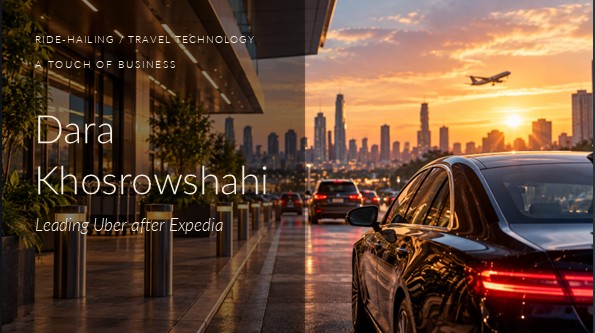
In 2017, Dara Khosrowshahi left the company he had led for 12 years to become chief executive of Uber. At Expedia, he had overseen the expansion of an established online-travel business. At Uber, he faced leadership upheaval, workplace allegations, regulatory conflict and substantial financial losses.
Early in his tenure, Khosrowshahi introduced new cultural principles and confronted the controversies Uber had inherited. He later led the company through an uneasy stock-market debut and a pandemic that sharply reduced demand for rides. Those years brought significant changes to Uber’s operations and finances.
Khosrowshahi’s journey to that role began in Tehran, from which his family departed during Iran’s revolutionary upheaval. An engineering education, investment banking and years working alongside Barry Diller preceded his move into the business of transporting people.
A Quick Look at the Life of Dara Khosrowshahi
Biography Summary
Dara Khosrowshahi is an Iranian-born American executive who led Expedia from 2005 to 2017 and became Uber’s CEO in 2017. His career connects online-travel acquisitions with Uber’s attempts to reshape its culture, improve operating performance and develop delivery and autonomous-transport services. As of October 24, 2026, he remained Uber’s CEO and a director.
Profile
Full Name: Dara Khosrowshahi
Birthplace: Tehran, Iran
Upbringing: Tarrytown, New York, after his family’s departure from Iran
Education: Brown University, Class of 1991; bioelectric engineering concentration
Known For: Leading Expedia and serving as CEO of Uber
Major Roles: IAC chief financial officer; Expedia president and CEO; Uber CEO and director
Current Role: Uber CEO and director as of October 24, 2026
Leaving Iran and Starting Again in New York
Khosrowshahi was born in Tehran. His family left Iran in 1978, during the unrest that preceded the culmination of the Iranian Revolution in 1979. In interviews, he and his mother, Lili, described a prosperous earlier life connected to a family business and the disruption that followed their departure.
According to Khosrowshahi’s recollection, the family first traveled to France, expecting the turmoil in Iran to pass. They ultimately reached the United States with help from an uncle. His mother and he have described a substantial reversal in family circumstances as they rebuilt their lives. In a later interview, Khosrowshahi recalled that his father returned to Iran and was unable to leave for a period while his mother raised him and his brothers in America.
He grew up in Tarrytown, New York. Decades later, the family’s departure from Iran remained a recurring subject in his interviews about his early life.
From Brown Engineering to Barry Diller’s Business
At Brown University, Khosrowshahi studied engineering, concentrating in bioelectric engineering, and graduated in 1991. He later singled out a European Intellectual History course as influential in how he thought about storytelling and business leadership.
After graduation, he entered investment banking. He worked at Allen & Company from 1991 to 1998, becoming a vice president in 1995. During this period he came into contact with media executive Barry Diller. Khosrowshahi later recalled meeting Diller as a client and wanting to work with him.
In 1998, Khosrowshahi joined Diller’s IAC business as vice president of strategic planning. He moved through senior planning and operating positions, including a period as president of USA Networks Interactive, and became IAC’s chief financial officer in January 2002. He was selected to lead IAC Travel from January 2005. Diller credited his knowledge of travel businesses and involvement in company acquisitions, including Expedia and Hotels.com.
The series of positions brought Khosrowshahi from finance into increasingly direct operating responsibility. His next role would give him sustained leadership of a public company.
Expedia and the Expansion of an Online-Travel Portfolio
When IAC spun off Expedia in August 2005, Khosrowshahi became president and CEO of the established online-travel business. Acquisitions became a prominent part of its expansion under his leadership.
Expedia bought Wotif in 2014 and Travelocity assets in January 2015. It completed its acquisition of Orbitz Worldwide, valued at roughly $1.6 billion in enterprise value, in September 2015 and acquired HomeAway that December.
Expedia’s reported annual revenue grew from approximately $2.12 billion in 2005 to $10.06 billion in 2017, as acquisitions broadened its business. The 2017 total covers a full year, including the months after Khosrowshahi left in August.
In a 2025 interview, he described learning to be an operator at Expedia as well as applying lessons from finance and capital allocation. When he left in August 2017, he had been chief executive for about 12 years. Expedia named Mark Okerstrom, described by the company as a key operating partner, as his successor and said Khosrowshahi would remain a director.
Taking Charge of Uber in a Corporate Crisis
Uber’s board chose Khosrowshahi as its next chief executive in late August 2017, and his formal service as CEO and director began in September. Co-founder Travis Kalanick had stepped down as CEO that June. Khosrowshahi arrived as Uber faced allegations of workplace harassment and discrimination, board turmoil, regulatory disputes and financial losses.
Khosrowshahi later recalled that he was initially reluctant when approached about the role. He said a conversation with Spotify’s Daniel Ek about the potential to have an impact influenced his thinking.
One of his earliest public measures was a revision of Uber’s corporate cultural norms. In November 2017, the company introduced principles developed with employee input that emphasized accountability and customer service. One norm stated, “We do the right thing. Period.”
London presented an immediate regulatory challenge. In September 2017, the city’s transport authority refused to renew Uber’s private-hire operator licence, citing safety and governance concerns. Khosrowshahi publicly apologized for earlier company mistakes, and Uber appealed. In June 2018, a court granted Uber a conditional 15-month probationary licence.
Khosrowshahi also publicly disclosed in November 2017 that a 2016 data breach had affected information relating to about 57 million users worldwide, including driver’s-licence numbers for roughly 600,000 U.S. drivers. Both the breach and its initial nondisclosure occurred before he became CEO. In September 2018, Uber agreed to a $148 million multistate settlement concerning the incident and failure to report it, with compliance obligations for the company.
A Fatal Autonomous-Vehicle Crash and a Strategic Shift
In March 2018, an experimental vehicle operated by Uber’s Advanced Technologies Group struck and killed a pedestrian in Tempe, Arizona. The National Transportation Safety Board identified the distracted safety operator’s failure to monitor the road as the probable cause, with shortcomings in Uber ATG’s safety-risk assessment and oversight among the contributing factors.
Uber subsequently changed the structure of its autonomous-driving efforts. It agreed in December 2020 to sell its in-house Advanced Technologies Group to Aurora. The deal closed in January 2021, alongside Uber’s $400 million investment in Aurora and a commercial collaboration. Autonomous transportation remained part of Uber’s plans, now increasingly pursued through partners.
Reflecting on the decision in 2025, Khosrowshahi cited the fatal accident, pandemic-era capital pressure, tension between developing autonomous technology and working with other developers, and Uber’s relative strength in platform software rather than hardware.
An Uneasy IPO and the Pandemic’s Financial Shock
Uber went public in May 2019. Its initial public offering priced shares at $45, but the stock opened at $42 and ended its first trading day roughly 9% below the offer price. The public listing was an important corporate milestone, although the first day’s market reaction was weak.
COVID-19 sharply reduced ride-hailing demand in 2020. In early May, Uber announced plans to eliminate about 3,700 jobs; later that month, it expanded the combined total to roughly 6,700 positions, about 23% of staff. Khosrowshahi waived his base salary for the remainder of the year.
Uber concentrated more attention on rides and delivery. It agreed in July 2020 to acquire Postmates for approximately $2.65 billion in stock, closing the purchase that December. The deal strengthened Uber’s U.S. delivery operation during a period when food delivery was becoming more important to the company.
The layoffs, Postmates acquisition and sale of the autonomous unit marked a period in which Uber cut back in some areas while investing in others. Its subsequent financial results showed a business operating on a different footing.
Uber Reaches an Annual Operating-Profit Milestone
For 2023, Uber reported its first full year of positive operating income under generally accepted accounting principles (GAAP): about $1.11 billion, compared with an operating loss of roughly $1.83 billion in 2022.
Uber also reported approximately $37.28 billion in revenue and 9.45 billion trips in 2023. Khosrowshahi called it an “inflection point” for the company. The improved results came as questions about labor protections and passenger safety continued to follow Uber.
Worker Protections and Passenger Safety Disputes
Khosrowshahi has defended a model in which app workers receive more benefits and protections while retaining nonemployee flexibility. In a 2020 opinion essay, he argued for portable support and contended that conventional employment arrangements could limit drivers’ choices.
In June 2024, the Massachusetts attorney general announced a settlement of wage-law litigation involving Uber and Lyft. Together, the companies agreed to $175 million in payments and driver protections, including an hourly earnings standard for covered driving time.
Corporate accountability also remained in focus. The 2022 Uber Files investigation examined leaked documents about aggressive lobbying and regulatory tactics, largely from the years before Khosrowshahi became CEO. Uber acknowledged past mistakes while asserting that it had changed its approach since 2017.
In February 2026, a federal jury found Uber liable on an apparent-agency theory in a civil sexual-assault case involving a driver and passenger and awarded $8.5 million. The jury did not find the company negligent or its safety systems defective in that trial, according to reporting, and Uber said it would appeal. Continuing litigation and labor disputes showed that legal and safety challenges remained part of Uber’s story after the 2017 leadership reset.
Autonomous Partnerships, Expansion Plans and New Cuts
Uber’s later autonomous-transport strategy emphasized partnerships. In September 2024, it and Waymo announced an expanded arrangement for autonomous ride-hailing in Austin and Atlanta. Waymo would provide the autonomous-driving technology, while Uber handled fleet management and dispatch activities. Waymo rides became available within the Uber app in Austin in March 2025.
The company’s operating scale continued to increase. For 2025, Uber reported approximately $52.02 billion in annual revenue and $5.57 billion in GAAP operating income. For the second quarter of 2026, it reported about 3.9 billion trips, $14.2 billion in revenue and $1.9 billion in GAAP operating income.
Uber also pursued further expansion through acquisition. On July 16, 2026, it announced a conditional takeover proposal for Delivery Hero at €41.50 per share, with an implied equity value of about $14.8 billion according to Uber. The offer was still pending on October 24, 2026, with closing expected in the second half of 2027, subject to required approvals and other conditions.
In August 2026, Uber outlined plans to invest more than $10 billion in robotaxi initiatives over the coming years. The following month, on September 2, Khosrowshahi announced another reorganization aimed at reducing staff by about 10%, removing management layers and simplifying organizational structures. Reuters put the potential cuts at approximately 3,300 corporate jobs.
In his employee memorandum, Khosrowshahi pointed to organizational complexity after years of growth and called for redirecting resources toward future priorities. By October 2026, the longer-term effects of the announced restructuring were still to be seen.
A Career Still Being Defined
Across IAC, Expedia and Uber, Khosrowshahi has worked with consumer-facing technology businesses whose reach, responsibilities and operating conditions have changed. Expedia’s acquisition-led expansion and Uber’s moves in delivery, cost management and autonomous transportation show recurring questions about how to grow a platform and where to invest.
As of October 24, 2026, improved operating results stood alongside labor and passenger-safety disputes, another restructuring and a pending acquisition. Khosrowshahi was still leading Uber through the competing demands of growth, accountability and changing transportation technology.
Timeline
These milestones highlight the major changes in Khosrowshahi’s life and leadership career.

1978
Leaves Iran with his family during revolutionary upheaval.
1991–1998
Graduates from Brown University in 1991 and works at Allen & Company, becoming a vice president in 1995.
1998–2005
Joins IAC, holds senior strategic and operating positions, and serves as CFO from January 2002 to January 2005.
2005
Becomes head of IAC Travel in January and CEO of the spun-off Expedia business in August.
2014–2015
Expedia adds Wotif, Travelocity assets, Orbitz Worldwide and HomeAway.
August–September 2017
Uber selects Khosrowshahi as CEO in August; his formal tenure begins in September.
November 2017
Introduces new Uber cultural norms and discloses a 2016 company data breach.
March 18, 2018
An Uber ATG test vehicle kills a pedestrian in Tempe, Arizona; a later federal safety investigation identifies operator and organizational failures.
May 2019
Uber holds its initial public offering, pricing shares at $45.
2020–2021
Uber announces pandemic job reductions, closes its Postmates acquisition in December 2020 and completes its ATG sale to Aurora in January 2021.
2023
Uber reports its first full year of positive GAAP income from operations.
2024–2025
Massachusetts announces an Uber/Lyft driver settlement; Uber expands its Waymo partnership and launches Waymo rides in Austin through its app.
2025
Uber reports approximately $52.02 billion annual revenue and $5.57 billion GAAP operating income.
July–September 2026
Uber announces a pending Delivery Hero offer, and Khosrowshahi later outlines plans for an approximately 10% staff reduction.
FAQs
Did Dara Khosrowshahi found Uber or Expedia?
No. Expedia was already an established business when he became its CEO in 2005, and Uber existed before he took over in 2017. His leadership role at both companies should not be confused with founding them.
Did Khosrowshahi become Uber CEO in August or September 2017?
Uber’s board selected him in late August 2017, but the company dates his formal CEO and board service from September. The dates refer to different stages of his appointment.
Why did Uber sell its in-house self-driving unit?
Uber sold its Advanced Technologies Group to Aurora, closing the transaction in January 2021. Khosrowshahi later cited the fatal 2018 test-vehicle crash, capital demands during the pandemic, conflicts with potential partners and Uber’s comparative strengths in software and platform operations as his reasons for moving away from in-house development.
Was Khosrowshahi running Uber when the 2016 data breach occurred?
No. He became CEO in 2017 and publicly disclosed the earlier breach that November. Uber reached a multistate settlement concerning the breach and its reporting in 2018.
Had Uber completed its proposed Delivery Hero deal by October 2026?
No. As of October 24, 2026, the takeover proposal was still subject to conditions, with completion expected in the second half of 2027.
Interviews
A Family’s Departure from Iran: The CBS Conversation
In a June 2025 CBS News interview, Khosrowshahi and his mother, Lili, discuss leaving Iran and rebuilding their lives in the United States. Their firsthand reflections bring a family perspective to his early biography.
Expedia, Uber and Autonomy: The Stratechery Interview
In a February 2025 interview with Ben Thompson, Khosrowshahi discusses lessons from Expedia, his consideration of the Uber CEO position and reasons for selling the in-house autonomous-development unit. The conversation is especially useful for understanding his own account of major career decisions.
Childhood and Career: The NDTV Transcript
Prannoy Roy’s 2018 interview includes Khosrowshahi’s recollections of family separation following their departure from Iran and the path into his early career. The published transcript allows readers to see his descriptions in fuller context.
Brown University: Education, Culture and Leadership
In this 2018 Brown University conversation, Khosrowshahi reflects on his education and how he thinks about culture and leadership. It connects the university years with questions he encountered as Uber’s CEO.
Returning to Brown to Discuss Technology
In April 2025, Khosrowshahi spoke with Brown University president Christina H. Paxson about leadership, his background, AI and autonomous vehicles. The conversation gives readers a later perspective on topics central to his work at Uber.
Further Reading
Sources
- Uber / Uber Investor Relations: Dara Khosrowshahi Leadership Profile, “2016 Data Security Incident” (November 21, 2017), “Uber Announces Pricing of Initial Public Offering” (May 9, 2019), “Uber Completes Acquisition of Postmates” (December 1, 2020), “Uber Announces Results for Fourth Quarter and Full Year 2023” (February 7, 2024), “Uber Announces Results for Fourth Quarter and Full Year 2025” (February 4, 2026), “Uber Announces Results for Second Quarter 2026” (August 5, 2026), “Building a simpler, faster Uber” (September 2, 2026), “Ride into the future with Waymo on Uber in Austin” (March 4, 2025)
- SEC filings and company announcements: 2026 Proxy Statement, Khosrowshahi Director Biography, 2004 IAC Travel succession announcement and background biography, Expedia’s 2015 Form 10-K (2015 acquisition completions and portfolio), Expedia 2017 Form 10-K (full-year revenue), “Expedia, Inc. Completes Acquisition of Orbitz Worldwide” (September 17, 2015), “Expedia to Acquire HomeAway” (November 4, 2015), “Expedia, Inc. Announces New CEO” (August 30, 2017), Form 8-K reporting May 2020 cuts and CEO base-salary waiver, 2020 Form 10-K, subsequent-events note confirming January 2021 Aurora/ATG closing, Second-Quarter 2026 Form 10-Q, pending Delivery Hero takeover
- Brown University: “Uber CEO talks Open Curriculum, culture change, diversity and flying cars” (October 19, 2018), “Uber CEO and Brown alumnus talks Open Curriculum, artificial intelligence and career advice” (April 10, 2025)
- CBS News: Jo Ling Kent, “Uber CEO Dara Khosrowshahi on being behind the wheel” (June 29, 2025)
- Stratechery: “An Interview with Uber CEO Dara Khosrowshahi About Aggregation and Autonomy” (February 13, 2025)
- NDTV: “Uber CEO Dara Khosrowshahi Speaks to NDTV: Full Transcript” (2018)
- Expedia: “Expedia, Inc. Reports Fourth Quarter, Full-Year 2005 Results”
- Reuters and syndicated Reuters reporting: “Uber officially welcomes Expedia’s Dara Khosrowshahi as CEO” (August 30, 2017), “Put on probation, Uber wins London license to avoid ban” (June 26, 2018), “Uber tumbles 9% in rocky stock market debut” (May 10, 2019), “Uber to focus on core rides, delivery business as it cuts 23% of workforce” (May 18, 2020), “Uber to lay off 10% of staff in biggest cuts since COVID” (September 2, 2026), “Uber doubles down on robotaxi plans, shares fall on weak profit forecast” (August 5, 2026)
- The New Yorker: “At Uber, a New C.E.O. Shifts Gears” (March 30, 2018)
- TechCrunch: “These are Uber’s new ‘cultural norms’” (November 7, 2017)
- Sky News: “Uber boss Dara Khosrowshahi apologises to London for mistakes we’ve made” (September 25, 2017)
- California Department of Justice: “$148 Million Settlement with Uber over 2016 Data Breach and Cover-Up” (September 26, 2018)
- U.S. National Transportation Safety Board: HWY18MH010, Tempe Automated Test Vehicle Collision (2018; findings issued subsequently)
- Massachusetts Attorney General: “AG Campbell Reaches Nation-Leading Settlement with Uber and Lyft” (June 27, 2024)
- International Consortium of Investigative Journalists: “About the Uber Files investigation” (July 10, 2022), including company response
- Associated Press: “Uber found liable in sexual assault case and ordered to pay $8.5 million” (February 2026)
- Waymo: “Waymo and Uber expand partnership to bring autonomous ride-hailing to Austin and Atlanta” (September 13, 2024)
- Star Tribune: “I’m the CEO of Uber. Gig workers deserve better” (August 2020)