
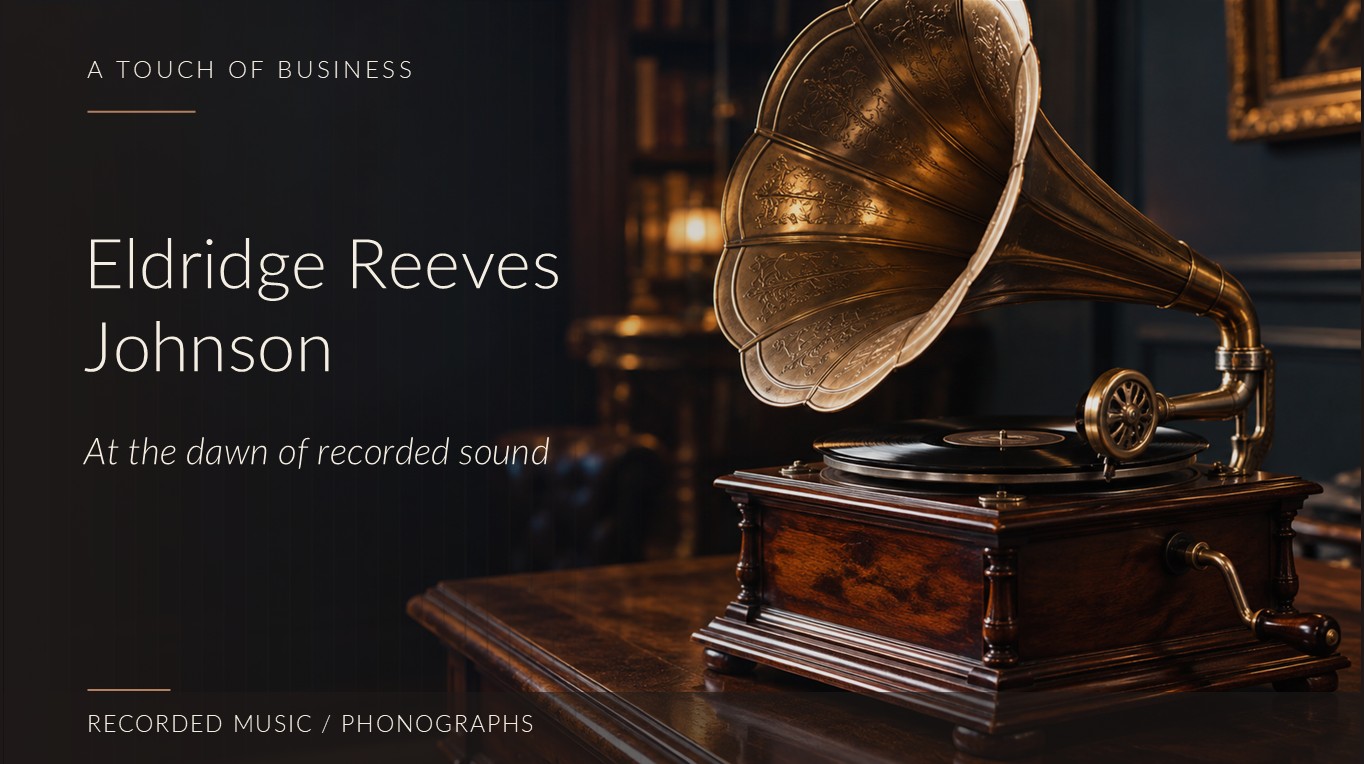
In the mid-1890s, the young disc-record business had a mechanical problem: a hand-cranked gramophone could struggle to keep a record turning at a steady speed. In Camden, New Jersey, machinist Eldridge Reeves Johnson began supplying spring-driven motors and developing mechanisms to regulate playback.
The work took Johnson far beyond supplying machine parts. His manufacturing business became central to the creation of the Victor Talking Machine Company, a venture built around both records and the machines that played them. In 1906, Victor introduced the Victrola, with its horn enclosed inside a cabinet designed for the home.
A Quick Look at the Life of Eldridge Reeves Johnson
Biography Summary
Eldridge Reeves Johnson (1867–1945) was an American machinist, inventor, and business leader identified with the founding and growth of Victor Talking Machine Company. Beginning with mechanical improvements to disc-playing machines, he helped develop a large business built on records, record players, recorded performances, and distinctive advertising. After his leadership of Victor ended in 1927, his activities included support for medical physics, archaeology, museum collections, and a Smithsonian deep-sea expedition.
Profile
Full Name: Eldridge Reeves Johnson
Born: 1867, Wilmington, Delaware, United States
Died: 1945
Known For: Building the Victor Talking Machine Company and contributing to the development of disc-playing technology and the Victrola era
Training: Schooling in Dover, Delaware, followed by a machinist apprenticeship in Philadelphia
Primary Business: Eldridge R. Johnson Manufacturing Company; Victor Talking Machine Company
Major Role: Long-serving president of Victor, beginning shortly after its incorporation in 1901 and ending in 1927
Later Activities: Support for University of Pennsylvania research and collections, archaeology, and Smithsonian marine science
Recognition: Recording Academy Trustees Award, awarded posthumously in 1985
From Delaware Schooling to a Camden Machine Shop
Johnson was born in Wilmington, Delaware, in 1867 and spent much of his youth in the Dover area. He completed his schooling there in 1882. Instead of proceeding to college, he entered the mechanical trades, taking an apprenticeship in Philadelphia and subsequently working in Camden, across the Delaware River.
His early working life was rooted in machinery rather than entertainment. He worked in machine shops and eventually acquired a Camden shop formerly associated with the Scull family. By about 1894, the concern operated as the Eldridge R. Johnson Manufacturing Company. Industrial and bookbinding machinery were among its lines of work.
The Spring Motor That Connected Johnson to Recorded Music
Emile Berliner had already developed the disc gramophone before Johnson entered the field. Early hand-cranked models, however, could suffer from uneven speed. In the mid-1890s, Berliner’s enterprise turned to Johnson’s shop for spring-driven motors; a Philadelphia industrial history places an order for roughly 200 motors during this period.
Johnson did more than supply an existing component. He developed mechanisms for driving and regulating disc playback. His U.S. Patent 601,198, granted on March 22, 1898, described a gramophone and actuating device with power transmission and governor-controlled speed. A further spring-motor patent followed in 1901. In its specification, Johnson described an aim to provide “a simple and compact motor which can be cheaply constructed.”
These patents documented Johnson’s mechanical contributions, not the invention of the original disc gramophone. His work also involved collaborators: a patent for sound recording and reproducing issued in 1899 named Johnson and Alfred Corning Clark as joint inventors.
But the disc business faced more than engineering problems. Berliner’s American enterprise encountered patent disputes and financial difficulties around the turn of the century. Johnson’s manufacturing operation and its associated rights would become part of the business consolidation that followed.
How Victor Was Founded—and How Johnson Became Its President
Before Victor existed, Johnson had established the Consolidated Talking Machine Company and accumulated interests in the production and sale of gramophones and recordings. Berliner’s patent and trademark interests were also part of the business arrangements that led to a new corporation.
The Victor Talking Machine Company was incorporated on October 3, 1901. Johnson is commonly described as Victor’s founder, but its three legal incorporators were Leon F. Douglass, Albert C. Middleton, and Charles K. Haddon. Johnson’s existing business and technical work were central to the new company.
The initial corporate minutes named John T. Cross, not Johnson, as Victor’s first president. Cross authorized the purchase of Johnson’s business, resigned, and Johnson then became president. The resulting company brought together manufacturing operations, recorded-music activity, patents, and trademark rights. Johnson went on to lead Victor for roughly a quarter of a century.
Leon F. Douglass was also an important business collaborator in Victor’s early development.
Building a Business Around Machines, Records, and Performers
Victor’s opportunity extended beyond making a dependable record player. A machine gave its owner a way to listen; a growing catalogue of discs gave that owner more reasons to use it. Under Johnson’s leadership, the company developed both parts of the business and advertised the quality of its recordings.
Operatic and orchestral performances gave Victor’s premium catalogue a public identity. Victor promoted premium orchestral and operatic recordings under Red Label/Red Seal branding in the early 1900s. Among its prominent artists was Enrico Caruso, who recorded “Vesti la giubba” for Victor on February 1, 1904.
Turning performances into records required more than a reliable player. Harry O. Sooy, Raymond Sooy, and their colleagues carried out important acoustical recording work. Johnson participated in some early engineering experiments, while the studio staff handled the specialized work needed to produce master recordings.
The catalogue also extended beyond classical music to popular and dance recordings, jazz, spoken word, and material marketed to different ethnic audiences. Some of Victor’s products reflected the segregated marketing categories and stereotypes of the era. Those were features of the company’s commercial history, not documented personal decisions by Johnson in each case.
Victor also developed a recognizable image: Nipper listening to a gramophone in Francis Barraud’s 1899 painting His Master’s Voice. Johnson obtained American rights to use the artwork through Berliner in 1901, and the image became a distinctive emblem of Victor records and machines.
Victor also expanded its manufacturing operations, establishing its own Camden record-pressing plant in 1905.
The Victrola Moves the Gramophone Into the Home
Earlier gramophones commonly displayed a large external horn. The Victrola, introduced by Victor in 1906, enclosed that horn in a furniture-style cabinet with storage for records. It offered a different way to fit a talking machine into the home.
Johnson held talking-machine patents from this period, including one granted in 1906. Victor’s designers, engineers, manufacturing workers, and business associates also contributed to the product’s development and success.
The Victrola became one of Victor’s most successful product lines. Its enclosed design, the availability of records, celebrity performers, and the company’s branding reinforced one another. Customers were buying access to performances as well as an object to place in their homes.
By the 1920s, Victor’s Camden industrial complex occupied roughly 51 acres and included 38 buildings. The company employed more than 13,000 people. Its reach rested on factory production as much as on the appeal of the machines and recordings.
Patent Disputes and a Changing Sound Industry
Victor’s expansion also brought legal battles over its products and patents. In Straus v. Victor Talking Machine Co. (1917), the U.S. Supreme Court rejected the company’s attempt to enforce resale-price restrictions through licensing conditions on products it had sold. In another patent dispute, Victor Talking Machine Co. v. Starr Piano Co. (1922), a federal appellate court sustained an adverse result for Victor. Both cases concerned Victor’s commercial and patent practices.
In the 1920s, the way Americans could hear music was changing. Commercial radio competed for listeners and contributed to weaker record sales. At the same time, acoustic recording technology was giving way to methods using electrical equipment and microphones.
Victor adopted electrical recording in 1925 through technology licensed from Western Electric. The transition required work by Victor’s recording engineers and Western Electric personnel, including changes to equipment and studio practice. It represented a significant shift in the company’s recording methods, not an invention attributable solely to Johnson.
Johnson Leaves Victor Before the RCA Acquisition
In late 1926, investment groups associated with J. & W. Seligman and Speyer & Co. negotiated to acquire Victor. Johnson was involved in the negotiations, and the transaction closed in January 1927. His leadership of Victor ended with that transfer of control.
RCA acquired Victor in 1929, in a separate transaction. The later RCA Victor name can obscure the distinction: Johnson’s interests had passed to the banker-backed buyers two years earlier, not directly to RCA.
Victor continued manufacturing and recording under subsequent ownership. For Johnson, the end of company leadership was followed by a more visible role in collecting and supporting institutional research.
Manuscripts, Medical Physics, and Museum Support
Johnson’s cultural patronage had started before he left Victor. In 1920, he purchased Chinese Tang-period horse reliefs for the University of Pennsylvania Museum. Collecting and institutional support became a larger part of his public life after 1927.
In 1928, Johnson acquired the original handwritten manuscript of Lewis Carroll’s Alice’s Adventures Under Ground, after the dealer A. S. W. Rosenbach had purchased it at auction. The manuscript is distinct from the later published book Alice’s Adventures in Wonderland. It remained in Johnson’s ownership until his death, was sold from his estate in 1946, and was presented to the British nation in 1948.
Scientific support became another focus. In 1929, Johnson helped establish and fund the Eldridge Reeves Johnson Foundation for Medical Physics at the University of Pennsylvania. Its purpose was to bring physical methods—including sound, light, heat, and electricity—to the study of disease. Johnson also served for twenty years as a trustee of the university.
Supporting Archaeology and a Smithsonian Expedition
Johnson financed the first three seasons, from 1931 through 1933, of the University of Pennsylvania Museum’s archaeological expedition at Piedras Negras in Guatemala. Museum archaeologists, including J. Alden Mason and subsequent field leaders, directed the excavations. Johnson’s contribution was financial and institutional support, not personal leadership of the archaeological fieldwork.
In 1933, his yacht Caroline became the vessel for the Johnson–Smithsonian Deep-Sea Expedition. Johnson made the equipped yacht available at his expense and participated aboard it. Smithsonian zoologist Paul Bartsch directed the scientific effort.
Expedition scientists studied organisms from the Puerto Rico Trench region and undertook depth soundings, land collecting, and work in meteorology and chemistry.
Death and the Legacy of Victor
Eldridge Reeves Johnson died in 1945. His central business achievement was to connect improvements in disc playback with the manufacture and sale of recorded music on a large scale. Victor became a company where machines, records, marketing, and performers all mattered.
That work was never his alone. Berliner’s disc gramophone, Douglass’s partnership, the Sooys’ recording expertise, performers, and the Camden workforce all formed part of the enterprise Johnson led.
Johnson’s name is also preserved beyond the recording industry. The Johnson Victrola Museum opened in Dover in 1967, presenting his story through talking machines, recordings, and Victor artifacts. In 1985, the Recording Academy honored him posthumously with a Trustees Award. University and Smithsonian records preserve the scientific and cultural projects he supported.
The work he supported at Penn and the Smithsonian shows another dimension of that career. After helping to build a recording enterprise through the contributions of many specialists, Johnson used his resources to back scientific and cultural projects led by others.
Timeline
These milestones trace Johnson’s development from machinist to Victor leader and later supporter of cultural and scientific work.

1867
Eldridge Reeves Johnson is born in Wilmington, Delaware.
1882
Johnson completes schooling in Dover, Delaware, before entering the mechanical trades.
1880s–1890s
He trains as a machinist in Philadelphia, works in Camden, and develops the machinery business known by about 1894 as Eldridge R. Johnson Manufacturing Company.
Mid-1890s
Johnson’s shop supplies spring-driven motors for Berliner’s disc-gramophone business.
1898–1899
Johnson receives an 1898 patent for gramophone drive and speed-control technology; a separate sound-machine patent names him jointly with Alfred Corning Clark in 1899.
1901
Victor Talking Machine Company is incorporated on October 3. John T. Cross briefly serves as president before Johnson assumes the position; a Johnson spring-motor patent is granted in December.
1904–1905
Caruso records “Vesti la giubba” for Victor in 1904, and Victor establishes a Camden record-pressing plant in 1905.
1906
Victor introduces the internal-horn Victrola, a record player housed in a furniture-style cabinet.
1917
The U.S. Supreme Court rejects Victor’s attempt to enforce resale-price restrictions through post-sale licensing conditions.
1920
Johnson purchases Tang-period horse reliefs for the Penn Museum.
1922
Victor receives an adverse federal appellate decision in a patent dispute with Starr Piano.
1925
Victor adopts electrical recording using Western Electric technology.
1926–1927
Investment bankers negotiate an acquisition of Victor in late 1926; the sale closes in January 1927, ending Johnson’s leadership.
1928–1929
Johnson acquires the original Alice’s Adventures Under Ground manuscript in 1928 and supports the establishment of a University of Pennsylvania medical-physics foundation in 1929. RCA separately acquires Victor in 1929.
1931–1933
Johnson finances the first three seasons of the Penn Museum expedition to Piedras Negras, Guatemala.
1933
The Johnson–Smithsonian Deep-Sea Expedition conducts research aboard Johnson’s yacht Caroline.
1945
Johnson dies.
1946–1948
The Alice’s Adventures Under Ground manuscript is sold from Johnson’s estate in 1946 and presented to the British nation in 1948.
1967
The Johnson Victrola Museum opens in Dover, Delaware.
1985
Johnson receives the Recording Academy’s Trustees Award posthumously.
FAQs
Question: Did Eldridge Reeves Johnson invent the gramophone?
Answer: No. Emile Berliner developed the disc gramophone before Johnson became involved. Johnson made important improvements to motors, playback speed regulation, and other talking-machine mechanisms, documented by his patents.
Question: Was Eldridge Reeves Johnson the person who formally incorporated Victor?
Answer: Johnson was central to founding and building Victor, and he became its long-serving president. However, its 1901 incorporation named Leon F. Douglass, Albert C. Middleton, and Charles K. Haddon as the original incorporators. John T. Cross served briefly as president before Johnson took the role.
Question: How was the Victrola different from older gramophones?
Answer: Victor’s 1906 Victrola enclosed the acoustic horn within a furniture-like cabinet and provided storage for records. Many earlier gramophones displayed their horns externally, so the Victrola presented the talking machine in a form suited to household furnishing.
Question: Did Eldridge Reeves Johnson sell Victor to RCA?
Answer: Not directly. A purchase by investment groups closed in January 1927, ending Johnson’s Victor leadership. RCA acquired the company in 1929 through a separate transaction.
Question: What was Johnson’s connection to Nipper, the Victor dog?
Answer: Nipper appeared in Francis Barraud’s painting His Master’s Voice, made in 1899. Johnson obtained American rights to use the image through Berliner in 1901; he neither created the painting nor originated the dog character.
Question: What did Johnson do after leaving the recording business?
Answer: Johnson supported medical-physics research at the University of Pennsylvania, funded archaeological work at Piedras Negras, supplied his yacht for a Smithsonian expedition, and collected the original manuscript of Lewis Carroll’s Alice’s Adventures Under Ground. His museum support had begun even before he left Victor.
Question: What date did Eldridge Reeves Johnson die?
Answer: Johnson died in 1945, but his exact death date is unsettled. Reputable references give either November 14 or November 15.
Further Reading
- Hagley Museum & Library: RCA–Victor Minute Books, 1901–1929 — an archive of corporate records for exploring the company’s early governance.
- American Heritage Center: Eldridge Reeves Johnson Papers — a finding aid for correspondence, diaries, photographs, and other papers.
- Library of Congress: National Jukebox — a collection of historical recordings, especially early Victor material.
- Library of Congress: Acoustical Recording — a guide to the technology used before electrical recording.
Sources
- Delaware Division of Historical and Cultural Affairs: Johnson Victrola Museum History; Johnson Victrola Museum Rededication.
- Encyclopedia of Greater Philadelphia: Recording Industry.
- Library of Congress: Emile Berliner and the Gramophone; Enrico Caruso, “Vesti la giubba,” 1904.
- Harvard Business School: Great American Business Leaders: Eldridge R. Johnson.
- EBSCO Research Starters: Eldridge R. Johnson.
- U.S. Patent records: Gramophone and Actuating Device Therefor (1898); Sound Recording and Reproducing Machine (1899); Spring-Motor (1901); Talking Machine (1906).
- Allan R. Sutton / Mainspring Press: Victor’s 1901 Incorporation and Original Minutes.
- Journal on the Art of Record Production: The Sooy Dynasty of Camden.
- U.S. courts: Straus v. Victor Talking Machine Co. (1917); Victor Talking Machine Co. v. Starr Piano Co. (1922).
- University of Pennsylvania: Eldridge Reeves Johnson Foundation Professorship; Piedras Negras Expedition Records; A Brief History of the Penn Museum.
- Smithsonian Institution: Johnson–Smithsonian Deep-Sea Expedition; Remembering the First Smithsonian Expedition to Puerto Rico.
- British Library: Alice’s Adventures Under Ground, Add MS 46700.
- RCA: RCA Legacy and Victor Acquisition.
- Recording Academy: Trustees Award Recipients.