
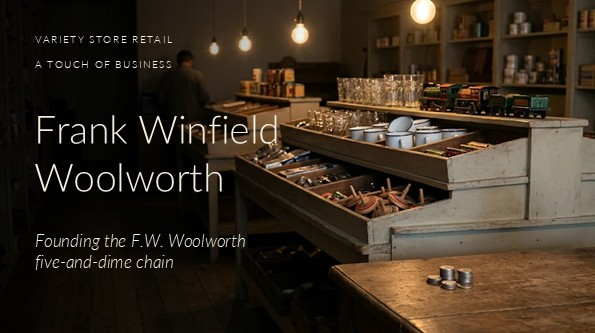
Frank Winfield Woolworth’s first store failed in Utica, New York, in 1879. A new venture in Lancaster, Pennsylvania, succeeded that June, giving him a foothold in retailing. More unsuccessful openings followed before the chain grew.
The five-and-dime chain grew through that uneven beginning. Low-priced merchandise, volume buying, and a network of fellow retailers became the basis of a business whose name would also appear on the world’s tallest building.
A Quick Look at the Life of Frank Winfield Woolworth
Biography Summary
Frank Winfield Woolworth was an American variety-store founder whose career developed from dry-goods employment into an international retail enterprise. His brother Charles Sumner Woolworth and other affiliated merchants participated in its growth. The business expanded to Britain in 1909 and underwent a major consolidation in 1912.
Profile
Full Name: Frank Winfield Woolworth
Born: April 13, 1852
Died: April 8, 1919
Birthplace: Rodman, New York
Best Known For: Founding the F. W. Woolworth five-and-dime chain
Spouse: Jennie Creighton, married in 1876
From the Family Farm to Watertown’s Stores
Woolworth was born to farming parents, John Hubbell Woolworth and Fanny McBrier. In 1859, the family moved to a farm near Great Bend, New York. His education included common schooling and some commercial-college instruction in Watertown.
In 1873, he entered the Watertown dry-goods trade with Augsbury & Moore. Moore & Smith was another important early employer.
In 1878, his employer’s store successfully sold merchandise at a five-cent counter. Woolworth’s independent venture followed. The low-price counter was an existing idea around which he would build a chain.
Utica Failed; Lancaster Established a Foothold
After the Utica failure, Woolworth opened his successful Lancaster store on North Queen Street in June 1879.
Looking back in a 1901 interview excerpt reproduced by the Library of Congress, Woolworth recalled an opening day when trade became strong in the afternoon and evening, followed by an order for replacement merchandise. He also recalled the pace of expansion: “For the first ten years the growth was slow.”
Further stores failed after Lancaster’s success, before Scranton became another successful location. Ten-cent merchandise also broadened the original five-cent offering, expanding the range of goods associated with the business.
By 1886, the chain had seven stores.
Buying in Volume and Building a Network
Woolworth’s stores combined counter displays with inexpensive merchandise that customers could inspect and select. Purchasing was equally important: larger orders helped secure prices that made nickel-and-dime retailing possible.
As the chain expanded, Woolworth moved to New York in 1886 for access to suppliers. A European buying trip followed in 1890.
His brother Charles Sumner Woolworth, known as Sum, operated stores and participated in the growing network. Other affiliated merchants would also take part in the company’s eventual consolidation.
By 1900, Woolworth’s chain numbered 59 stores.
British Stores and a 596-Store Consolidation
The business incorporated in 1905. Four years later, the first British branch opened on Church Street in Liverpool. The British stores used threepence and sixpence prices, adapting the low-price format to a different currency.
A larger organizational change followed in 1912. Woolworth’s business combined with affiliated retailers to form a 596-store company under the F. W. Woolworth name.
The participating businesses included those of Sum Woolworth, Seymour Horace Knox, and Fred Morgan Kirby. Earle Perry Charlton and W. H. Moore & Son also joined the consolidation.
Goldman Sachs, Lehman Brothers, and Kleinwort, Sons & Co. underwrote the 1912 financing. Expansion now involved combining established businesses under one name.
Commissioning the Woolworth Building
Woolworth’s skyscraper project began before the retail consolidation. He commissioned architect Cass Gilbert in 1910. Construction at 233 Broadway followed from 1911 to 1913.
The resulting tower rose 792 feet, with Gothic ornament over a steel frame. It accommodated the retail company’s offices and other tenants. Irving Bank was involved in the undertaking, and Woolworth made arrangements with its president, Lewis Pierson.
At the opening ceremony on April 24, 1913, President Woodrow Wilson activated the building’s illumination from Washington. The Woolworth Building was then the tallest building in the world, a distinction it retained until 1930.
The tower gave the retail name an architectural presence far beyond the merchandise counter.
The Business After Woolworth
Frank Winfield Woolworth died on April 8, 1919, in Glen Cove, Long Island. The company continued after his death.
Its segregated Southern lunch counters became sites of civil-rights protests, including the Greensboro sit-ins in 1960. The protests occurred decades after the founder’s death.
The remaining United States Woolworth stores closed in 1997. The corporate succession subsequently used the names Venator Group and Foot Locker.
Woolworth’s career extended from individual store experiments to a network of merchants and a consolidated company. The name above the stores belonged to one founder; the business’s growth involved many participants.
Timeline
These milestones trace Woolworth’s life and the development of his retail business.

April 13, 1852
Frank Winfield Woolworth is born in Rodman, New York.
1873
Woolworth enters the Watertown dry-goods trade with Augsbury & Moore.
1878–1879
Successful five-cent sales at his employer’s store precede Woolworth’s independent venture. His Utica store fails in 1879; a successful Lancaster store opens that June.
1886–1900
The chain grows from seven stores in 1886 to 59 by 1900.
1905
The earlier Woolworth business incorporates.
1909
The first British branch opens on Church Street in Liverpool.
1910
Woolworth commissions Cass Gilbert to design the Woolworth Building.
1912
Woolworth’s business and affiliated retailers consolidate into a 596-store company.
April 24, 1913
The Woolworth Building’s opening ceremony takes place. It is the world’s tallest building.
April 8, 1919
Woolworth dies in Glen Cove, Long Island.
FAQs
Question: Was Lancaster the location of Woolworth’s first store?
Answer: Lancaster was the location of his first successful store. Frank Winfield Woolworth’s earlier venture in Utica, New York, failed in 1879. The Lancaster store opened in June of that year.
Question: Did Frank Woolworth build the chain alone?
Answer: His brother Charles Sumner Woolworth and other affiliated merchants were important participants. The 1912 consolidation combined their businesses into a 596-store company under the F. W. Woolworth name.
Question: Did Woolworth design the Woolworth Building?
Answer: Woolworth commissioned the building in 1910; Cass Gilbert was its architect. The tower opened in 1913 and remained the world’s tallest building until 1930.
Sources
- National Park Service: Woolworth Building nomination and history
- Oxford University Press, American National Biography: Frank Winfield Woolworth: early-life extract
- New York City Landmarks Preservation Commission: Woolworth Building, First Floor Interior
- Library of Congress: Woolworth’s Five and Dime, Nickels, Dimes, and F. W. Woolworth
- Tredyffrin Easttown Historical Society: Club Members Remember Shopping at Woolworth’s
- Goldman Sachs: F. W. Woolworth’s 1912 financing
- Historic England: Woolworth’s Church Street, Liverpool, archive
- HISTORY: Woolworth Building