
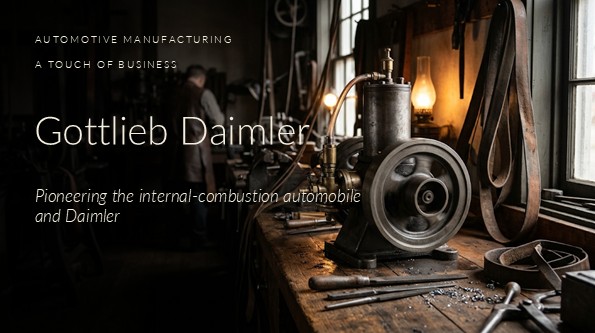
In 1882, Gottlieb Daimler left a technical leadership position at Gasmotorenfabrik Deutz following disagreements with management. In Cannstatt, he established an experimental workshop in a converted greenhouse in the garden of his villa. Wilhelm Maybach followed him there.
Their goal was a small, lightweight petrol engine suitable for mobile uses. The work extended from an experimental power unit to a motorcycle, a motor carriage and boats.
A Quick Look at the Life of Gottlieb Daimler
Biography Summary
Gottlieb Daimler was a German engineer, inventor and industrialist whose career helped establish the early automobile industry. Trained as a gunsmith and in mechanical engineering, he later founded Daimler-Motoren-Gesellschaft (DMG).
Profile
Name: Gottlieb Daimler (also known as Gottlieb Wilhelm Daimler)
Born: March 17, 1834
Died: March 6, 1900, in Stuttgart-Cannstatt
Birthplace: Schorndorf, Württemberg
Education: Gunsmith apprenticeship; studies at Stuttgart’s Polytechnic School, 1857–1859
Best Known For: Developing lightweight, high-speed petrol engines and early motor vehicles with Wilhelm Maybach
Company: Daimler-Motoren-Gesellschaft (DMG)
From Schorndorf to Engineering Workshops
Daimler was born above a bakery and wine bar in Schorndorf’s Höllgasse. His father, Johannes Däumler, was a master baker. Gottlieb trained as a gunsmith from 1848 to 1852.
Practical experience in mechanical engineering took him to Alsace, followed by studies at Stuttgart’s Polytechnic School from 1857 to 1859. Further work took him to France and Britain.
At the Bruderhaus engineering works in Reutlingen, Daimler began his lifelong collaboration with Wilhelm Maybach. His subsequent career led through Karlsruhe and into engine manufacturing at Deutz.
Working With Maybach at Deutz
Daimler joined Gasmotorenfabrik Deutz in 1872 in a technical leadership role. Maybach helped bring Nikolaus Otto’s engine into production under Daimler’s direction. Their experience at Deutz provided an engine-building background for the independent work that followed.
Management disagreements ended Daimler’s employment at Deutz in 1882. In Cannstatt, he and Maybach began independent work on a compact engine suitable for vehicles.
A Portable Engine Takes Shape in Cannstatt
Daimler and Maybach equipped the converted greenhouse as a workshop and testing station. Large, stationary gas engines were customary; Daimler and Maybach sought a smaller petrol engine that could be installed in vehicles.
An initial high-speed engine with hot-tube ignition was developed in 1883. The upright engine known as the “grandfather clock” followed during the mid-1880s.
German patent 34926 records one stage of that development, with protection effective from April 3, 1885. The specification names G. Daimler in Cannstatt. Maybach remained central to the engineering and design work behind the engine program.
Putting the Engine on the Road and Water
The 1885 Reitwagen applied the new engine to a wooden, cycle-like vehicle fitted with support wheels. Daimler’s son Paul undertook early test rides on the pioneering petrol-powered motorcycle.
A four-wheeled motor carriage followed in 1886. Daimler and Maybach installed an engine in a coach, adapting an existing vehicle to mechanical power. Their engine also found application in boats.
Further vehicle development produced the steel-wheeled car displayed at the Paris World Exhibition in 1889. It combined a two-cylinder V-engine with a four-speed transmission.
Carl Benz was developing a separate vehicle. His three-wheeled Patent Motor Car integrated the chassis and engine as one design, and he applied for its patent in January 1886. Daimler and Maybach’s converted carriage and Benz’s integrated vehicle represent distinct contributions to early automobile development.
From the Workshop to Daimler-Motoren-Gesellschaft
A factory in Cannstatt followed in 1887, expanding Daimler’s work beyond the experimental premises. Daimler-Motoren-Gesellschaft was established in 1890.
Demand for vehicles remained limited, and engines continued to be DMG’s production focus until about 1895.
International licensing spread the engines, particularly in France and Britain. Daimler’s engineering work was reaching beyond Cannstatt even as his position within DMG changed.
Leaving DMG and Continuing Work With Maybach
Maybach left DMG in 1891, but his work with Daimler continued outside the company. Daimler financed development work at Hotel Hermann beginning in autumn 1892.
Daimler also left DMG amid disagreements with the company’s partners. Their collaboration continued through the separation from the business.
Daimler and Maybach returned to DMG in 1895. Maybach reentered as technical director, with British industrialist Frederick R. Simms helping facilitate his return.
Family and the End of Daimler’s Life
Daimler married Emma Kurz in 1867, and the couple had five children. Emma died in 1889. In 1893, he married Lina, née Schwend and widow Hartmann; they had two children.
Gottlieb Daimler died in Stuttgart-Cannstatt on March 6, 1900. His collaboration with Maybach had continued through successive employers, independent experimentation and their changing roles within DMG.
From Daimler’s Work to the Later Company
Maybach’s landmark first Mercedes design followed Daimler’s death. In 1926, DMG and Benz & Cie. merged to form Daimler-Benz AG, bringing together companies that had developed through separate paths in early motoring.
Daimler’s birthplace in Schorndorf and the garden-workshop memorial in Cannstatt preserve places associated with his life and work. The Cannstatt workshop marks the independent phase of a career in which engineering collaboration continued through changes in employment and company control.
Timeline
These milestones trace Daimler’s training, independent development work and changing company role.

1834
Gottlieb Daimler is born on March 17 in Schorndorf, Württemberg.
1848–1852
Daimler completes a gunsmith apprenticeship.
1857–1859
Daimler studies at Stuttgart’s Polytechnic School.
1872
Daimler joins Gasmotorenfabrik Deutz in technical leadership.
1882–1883
After leaving Deutz, Daimler establishes an experimental workshop in Cannstatt. Maybach joins him, and an initial high-speed engine is developed in 1883.
1885–1886
The Reitwagen applies engine power to a cycle-like vehicle in 1885. A four-wheeled motor carriage follows in 1886.
1887–1890
A Cannstatt factory follows in 1887. The steel-wheeled car is exhibited in Paris in 1889, and DMG is established in 1890.
1891–1895
Maybach leaves DMG in 1891. Daimler also leaves the company and finances Maybach’s outside design work. Both return in 1895.
1900
Daimler dies on March 6 in Stuttgart-Cannstatt.
1926
DMG and Benz & Cie. merge to form Daimler-Benz AG.
FAQs
Question: Did Gottlieb Daimler and Carl Benz develop the same vehicle together?
Answer: Their vehicles were developed separately. Benz created an integrated three-wheeled motor vehicle, while Daimler and Maybach developed engines and a converted four-wheeled carriage. DMG and Benz & Cie. merged in 1926, after Daimler’s death.
Question: What did Wilhelm Maybach contribute to Daimler’s work?
Answer: Maybach was Daimler’s engineering collaborator and designer, central to the engine and vehicle work. Their partnership began at the Bruderhaus works in Reutlingen and continued through Deutz, Cannstatt and their changing roles at DMG.
Question: Was Britain’s Daimler Motor Company the same business as DMG?
Answer: No. The British enterprise grew from Frederick R. Simms’s licensing activity and a separate company formation. It became the Daimler Motor Company in 1896; it was a distinct business from Daimler-Motoren-Gesellschaft in Germany.
Sources
- Deutsche Biographie / Neue Deutsche Biographie: Gottlieb Wilhelm Daimler
- Deutsches Historisches Museum: Gottlieb Daimler biography, 1886 motor-carriage photograph record
- Mercedes-Benz Group: Gottlieb Daimler, Wilhelm Maybach, Daimler birthplace, Cannstatt garden-workshop memorial, Beginnings of the automobile, Benz Patent Motor Car
- German Patent and Trade Mark Office: Wilhelm Maybach and early automobile development, Original Daimler engine patent 34926
- German Historical Institute: The First Four-Wheeled Daimler Motor Car
- National Motor Museum Trust: 1899 12hp Daimler and the British company’s origins