
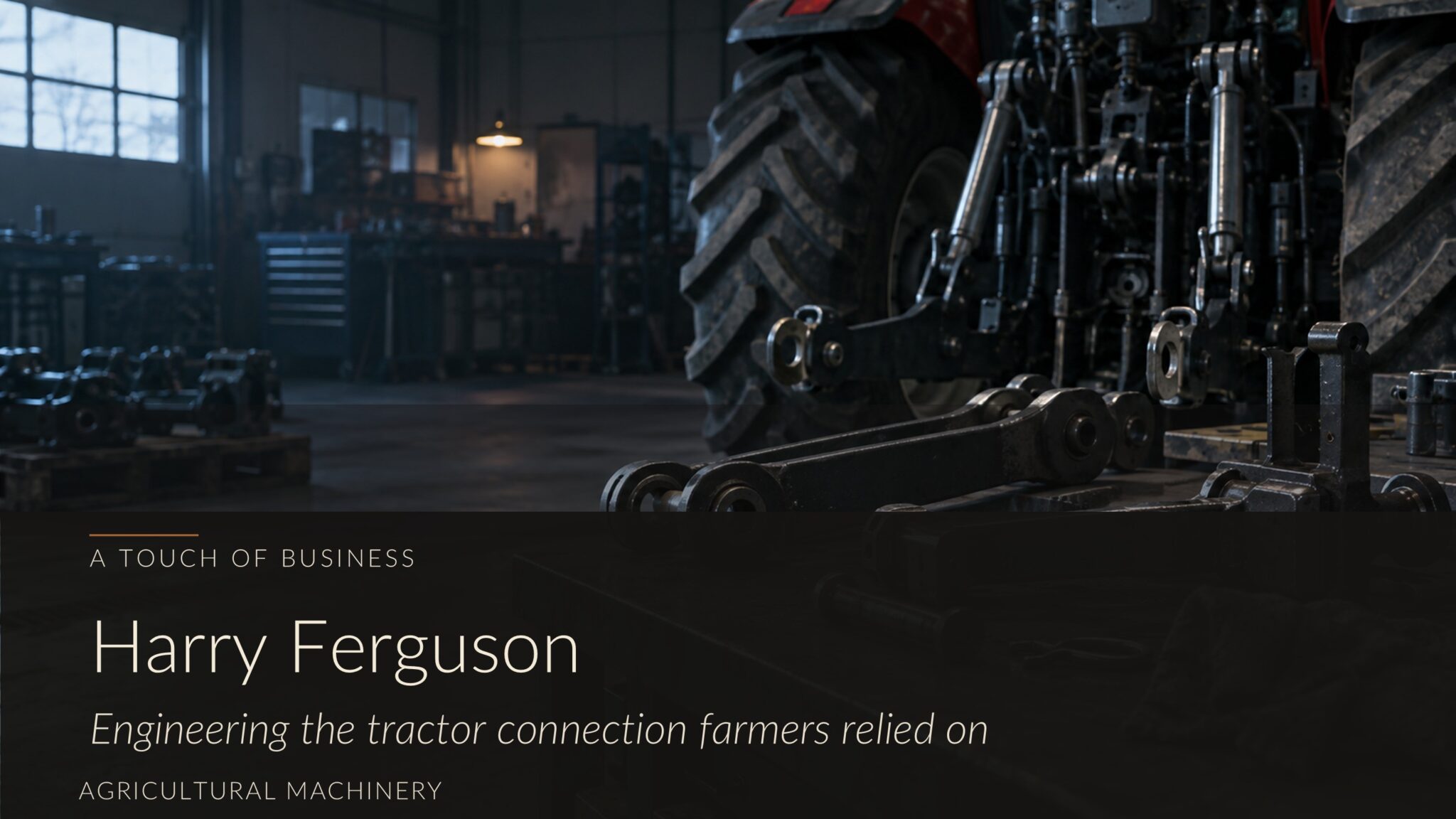
Harry Ferguson spent much of his engineering career pursuing an idea that was larger than any single tractor part. He wanted the tractor and its implement to work as one coordinated machine.
That idea developed into the Ferguson System, centered on a hydraulic three-point linkage and draft control. The system allowed tractor and mounted implement to work together more effectively, supported lighter machinery, and became foundational to modern tractor design.
Ferguson reached that point through a career that crossed several fields. He worked with motorcycles and cars, designed and flew his own monoplane, developed tractor prototypes, entered partnerships with David Brown and Henry Ford, built a separate production path around the TE20, and later turned to four-wheel-drive research.
A Quick Look at the Life of Harry Ferguson
Biography Summary
Henry George “Harry” Ferguson was an engineer and inventor best known for developing the Ferguson System, which integrated tractor and implement through a hydraulic three-point linkage and draft-control system. His work moved from aviation and motor vehicles into agricultural machinery, where his ideas reached large-scale production through Ford and later through the Ferguson TE20.
Profile
Full Name: Henry George “Harry” Ferguson
Born: 4 November 1884
Died: 25 October 1960
Birthplace: Growell, near Annahilt, County Down, Ireland
Education: Local schools and evening classes at Belfast Technical College
Best Known For: Developing the Ferguson System and hydraulic three-point linkage for tractors and implements
Major Fields: Agricultural machinery, mechanical engineering, aviation and motor vehicles
Major Business Connections: Harry Ferguson Ltd., Ford and Massey-Harris-Ferguson
From Farm Work to Machines
Harry Ferguson was born on 4 November 1884 at Growell, near Annahilt in County Down. His parents were James Ferguson, a farmer, and Mary Ferguson, née Bell.
He attended local schools until about the age of fourteen and then worked on the family farm. That background gave him firsthand familiarity with agricultural work before his career shifted toward machinery.
In 1902 Ferguson left farm work and joined the Belfast garage business of his older brother Joseph Bell “Joe” Ferguson as an apprentice. He also attended evening classes at Belfast Technical College.
By 1907 the Ferguson garage business had become a major Irish motor business. Harry raced motorcycles and cars as publicity for the firm, adding practical experience with engines and vehicles before his attention moved to aviation.
Aviation Becomes an Engineering Test
In 1909 Ferguson began working on powered flight. After studying contemporary aviation developments and attending flying meetings, he designed and built a monoplane.
On 31 December 1909 he successfully flew the aircraft at Hillsborough, County Down. The flight covered about 130 yards at roughly 15 feet.
Ferguson became the first Irishman to design, build and fly his own aeroplane. His Hillsborough flight is also regarded as the first well-documented powered flight in Ireland.
An earlier flight was attributed to Joseph Cordner, but that claim could not be confirmed. Ferguson’s 1909 flight was well documented.
He continued experimental flying through 1910 and 1911 and suffered crashes while developing the aircraft. The aviation work also contributed to friction with his brother. Ferguson later established his own Belfast motor business, May Street Motors, which became Harry Ferguson Ltd.
The Tractor Problem Changes His Direction
During the First World War, labor and horse shortages increased pressure on agriculture. Ferguson was selling an American tractor and, in 1917, was asked to organize large-scale tractor demonstrations.
The demonstrations exposed problems in contemporary tractor ploughs and implements, many of which were still heavily derived from horse-drawn designs. Ferguson began pursuing a different idea: the tractor and implement should operate as an integrated mechanical unit.
That same year, Ferguson and his long-time engineering collaborator Willie Sands designed a plough for a tractor converted from a Ford Model T car. Ferguson went on to develop an early two-point linkage and then a triangular three-point arrangement for attaching implements.
The linkage transferred forces through the tractor in a way that reduced the tendency for the front end to lift when an implement struck resistance. It also made a lighter tractor-and-implement combination practical.
The Ferguson System Takes Shape
Ferguson refined the linkage through the 1920s and introduced hydraulic control so the tractor could respond automatically to changes in draft.
In 1926 he obtained a patent for plough draft control. The three-point linkage and hydraulic control system became defining elements of the Ferguson System.
The importance of the system went beyond the hitch itself. Ferguson approached the tractor and mounted implement as one coordinated working machine. Implements could be raised, lowered and controlled from the tractor, while the linkage helped manage the forces created during field work.
That systems approach became the foundation for Ferguson’s later prototypes, tractors and commercial partnerships.
The Black Tractor and the Search for Scale
Turning the Ferguson System into a successful production tractor took years of development and several business arrangements.
Ferguson formed a partnership in the United States in the mid-1920s to manufacture ploughs for Ford tractors. The venture ended after Ford stopped tractor production.
In 1933 Ferguson built a prototype in Belfast that became known as the Black Tractor. It combined major Ferguson System innovations and became an important step in the development of his tractor design.
In 1936 he entered a partnership with David Brown, leading to production of the Ferguson-Brown tractor. The partnership later ended after disagreements over design direction. Ferguson favored lighter machines, while Brown moved toward larger and heavier tractors.
The next major change came in 1938, when Ferguson gained access to a manufacturer capable of producing tractors on a much larger scale.
The Handshake Agreement With Henry Ford
In October 1938 Ferguson demonstrated his tractor and Ferguson System to Henry Ford at Ford’s Fair Lane estate in Michigan.
The demonstration led to a verbal gentleman’s agreement, associated with a handshake. Ford would manufacture the tractor, while Ferguson would market it and supply or develop the implement system.
A plaque Ferguson presented to Ford in 1940 referred directly to “our Gentleman’s Agreement,” preserving Ferguson’s own description of the arrangement.
Production of the Ford-Ferguson 9N began in 1939. The tractor incorporated Ferguson’s hydraulic three-point system and brought his design into large-scale production in the American market.
By the end of 1941, tens of thousands of Ford-Ferguson tractors had been produced. By 1947, production had risen to more than 300,000.
The Ford partnership gave the Ferguson System large-scale commercial reach in North America. But Ferguson’s American business was also closely tied to an arrangement that Ford management would later end.
The TE20 Opens a Separate Production Path
While the Ford-Ferguson tractors were being produced in the United States, Ferguson also pursued British manufacturing.
In 1946 the Standard Motor Company began producing the Ferguson TE20 at Coventry. The first TE20 rolled off the Banner Lane assembly line on 6 July.
The tractor combined a relatively light design with Ferguson’s hydraulic three-point implement system. It gave Ferguson a mass-market tractor platform under his own name rather than one tied only to Ford production.
More than half a million tractors in the TE20 family were produced over the following decade.
The Ford Partnership Ends in a Lawsuit
Ford management ended the Ford-Ferguson arrangement in the late 1940s and created its own distribution structure for Ford tractors.
Ferguson sued Ford Motor Company. His complaint included allegations of patent infringement and unlawful destruction or appropriation of his tractor business, along with conspiracy, antitrust violations and deliberate infringement.
Those were allegations made in Ferguson’s case, not findings that a court ultimately established as fact.
The dispute continued for several years. In 1952 Ferguson accepted a $9.25 million settlement in the patent-infringement dispute.
By then, the TE20 had already established a separate production path for Ferguson tractors beyond the Ford relationship.
Merging With Massey-Harris
In 1953 Harry Ferguson Ltd. merged with Massey-Harris to form Massey-Harris-Ferguson.
Ferguson became chairman of the merged company, but he resigned in July 1954 after disagreements over design changes.
The business later became known as Massey Ferguson. By that point, Ferguson had moved away from day-to-day leadership of the agricultural machinery company and toward another area of engineering research.
Four-Wheel Drive Becomes His Final Major Focus
After leaving the merged agricultural business, Ferguson concentrated more heavily on four-wheel drive, automatic transmission and road-vehicle safety.
Harry Ferguson Research developed experimental road vehicles using full-time four-wheel-drive concepts and anti-skid braking research. The Ferguson P99 racing car became a visible demonstration of the four-wheel-drive system.
Ferguson did not live to see the P99’s best-known racing result. He died on 25 October 1960 at his home in Stow-on-the-Wold, Gloucestershire.
Barbiturates were found to be involved in his death. The coroner’s jury returned an open verdict because it could not determine whether the death was accidental or intentional.
In 1961, after Ferguson’s death, Stirling Moss drove the Ferguson P99 to victory in the Oulton Park Gold Cup. Oulton Park records the result as the only Formula One race victory for an all-wheel-drive car.
A Legacy Built Around the Tractor as a System
Harry Ferguson’s lasting influence rests most clearly on the way he rethought the relationship between tractor and implement.
The three-point linkage and hydraulic control system became foundational to modern tractor design, and the three-point hitch remains a standard concept in agricultural machinery.
His career also extended beyond tractors. Ferguson moved through motor vehicles, aviation, agricultural machinery and later four-wheel-drive research, repeatedly working on mechanical systems in which multiple components had to operate together.
The Ferguson System carried that approach furthest. It moved from experimental linkages and prototypes into mass-produced tractors, and its central design concept continued long after Ferguson’s individual partnerships and companies changed.
Timeline
The following timeline highlights major milestones in Harry Ferguson’s life and engineering career.

4 November 1884
Harry Ferguson is born at Growell, near Annahilt in County Down, Ireland.
About 1898
He leaves school and works on the family farm.
1902
Ferguson leaves farm work and joins his brother Joe Ferguson’s Belfast garage as an apprentice. He also attends evening classes at Belfast Technical College.
1909
He designs and builds a monoplane.
31 December 1909
Ferguson successfully flies his monoplane at Hillsborough, making the first well-documented powered flight in Ireland and becoming the first Irishman to design, build and fly his own aeroplane.
1911
After separating from his brother’s business, Ferguson establishes his own Belfast motor business.
1913
He marries Mary Adelaide “Maureen” Watson.
1917
Large-scale tractor demonstrations expose Ferguson to problems in existing tractor-plough systems. He begins intensive work on integrating tractor and implement.
1926
Ferguson obtains a patent for plough draft control, a key development in the Ferguson System.
1933
He builds the Ferguson Black prototype in Belfast.
1936
The Ferguson-Brown partnership leads to production of the Ferguson-Brown tractor.
October 1938
Ferguson demonstrates his tractor system to Henry Ford at Fair Lane and enters the handshake agreement with Ford.
1939
Production of the Ford-Ferguson 9N begins with Ferguson’s hydraulic three-point system.
6 July 1946
The first Ferguson TE20 rolls off the Banner Lane assembly line in Coventry.
Late 1940s
The Ford-Ferguson relationship ends, and Ferguson begins litigation against Ford Motor Company.
1952
The Ford dispute ends with Ferguson accepting a $9.25 million settlement in the patent-infringement litigation.
1953
Harry Ferguson Ltd. merges with Massey-Harris to form Massey-Harris-Ferguson.
7 July 1954
Ferguson resigns as chairman after disagreements over design changes.
Mid-1950s onward
He concentrates increasingly on four-wheel drive, automatic transmission and road-vehicle safety research.
25 October 1960
Ferguson dies at his home in Stow-on-the-Wold, Gloucestershire.
1961
Stirling Moss drives the Ferguson P99 to victory in the Oulton Park Gold Cup.
FAQs
Question: Was Harry Ferguson the first person to fly an aeroplane in Ireland?
Answer: Harry Ferguson made the first well-documented powered flight in Ireland on 31 December 1909 and became the first Irishman to design, build and fly his own aeroplane. An earlier flight was attributed to Joseph Cordner, but that claim could not be confirmed.
Question: What did Harry Ferguson develop for tractors?
Answer: Ferguson developed the Ferguson System, centered on a hydraulic three-point linkage and draft control. The system connected tractor and implement as one coordinated working unit and became foundational to modern tractor design.
Question: What was Harry Ferguson’s handshake agreement with Henry Ford?
Answer: In 1938 Ferguson demonstrated his tractor system to Henry Ford at Fair Lane. They entered a verbal gentleman’s agreement under which Ford would manufacture the tractor while Ferguson would market it and supply or develop the implement system.
Question: Why did Harry Ferguson sue Ford?
Answer: After Ford management ended the relationship, Ferguson sued Ford Motor Company and alleged patent infringement and unlawful destruction or appropriation of his tractor business, along with other claims. The dispute ended in 1952 with Ferguson accepting a $9.25 million settlement. The settlement did not establish every allegation in Ferguson’s complaint as a judicial finding.
Question: What was the Ferguson TE20?
Answer: The Ferguson TE20 was a post-war tractor manufactured at Coventry beginning in 1946. Its relatively light design and hydraulic three-point Ferguson System gave Ferguson a large-scale tractor platform separate from Ford.
Question: How did Harry Ferguson become connected to Massey Ferguson?
Answer: Harry Ferguson Ltd. merged with Massey-Harris in 1953 to form Massey-Harris-Ferguson. Ferguson became chairman but resigned in 1954. The business later became known as Massey Ferguson.
Question: Did Harry Ferguson work on cars after tractors?
Answer: Yes. After leaving the merged agricultural machinery company, Ferguson focused on four-wheel drive, automatic transmission and road-vehicle safety. His research organization developed the P99 racing car, which Stirling Moss drove to victory in the 1961 Oulton Park Gold Cup.
Question: How did Harry Ferguson die?
Answer: Harry Ferguson died on 25 October 1960. Barbiturates were involved in his death, but the coroner’s jury returned an open verdict because it could not determine whether the death was accidental or intentional.
Sources
- Ulster Transport Museum / National Museums NI: Harry Ferguson and Aviation, Harry Ferguson, Ferguson Black Tractor
- The Henry Ford: Ford-Ferguson Tractor Advertisement, Ford Model 9N Prototype Tractor, Gentleman’s Agreement Plaque, Ford Tractor Product Literature Collection, Ferguson Settlement Note
- Massey Ferguson: Our Innovations, 175th Anniversary History, TE20 History, 175th Anniversary Fact Sheet
- U.S. District Court / Justia: Ferguson v. Ford Motor Co. (1948)
- Ferguson Family Museum: The Ferguson P99
- Oulton Park / MotorSport Vision: Oulton Park History