
In 1892, Henry Clay Frick was a leading manager of Carnegie’s steel interests when a dispute at the Homestead Works became a deadly confrontation. Company management locked out workers and brought in Pinkerton agents to secure the plant. Pennsylvania militia later arrived, and management ultimately retained control. The conflict became one of the defining events of Frick’s public life.
Yet Homestead is only one chapter in his story. Frick had built an extensive coke business before entering steel leadership, survived an assassination attempt, broke with Andrew Carnegie, and continued to hold business interests. He also assembled a collection of paintings and provided for his New York residence to become a museum after his death.
A Quick Look at the Life of Henry Clay Frick
Biography Summary
Henry Clay Frick (1849–1919) was an American industrialist, coke producer, steel executive, and art collector. His company supplied a fuel essential to steelmaking; his alliance with Andrew Carnegie helped connect coke production with an increasingly integrated steel operation. His industrial career was marked by severe mining and labor tragedies, while his later collecting laid the foundation for The Frick Collection in New York.
Profile
Full Name: Henry Clay Frick
Born: December 19, 1849, West Overton, Pennsylvania
Died: December 2, 1919, New York City, aged 69
Known For: H. C. Frick coke enterprises, leadership at Carnegie Steel, the 1892 Homestead labor conflict, and the art collection that became The Frick Collection
Major Roles: Coke producer; chairman of Carnegie steel interests beginning in 1889; director of U.S. Steel
Spouse: Adelaide Howard Childs Frick
From West Overton to the Coke Fields
Frick was born in West Overton, Pennsylvania, on December 19, 1849. His mother, Elizabeth Overholt Frick, belonged to the Overholt family, whose enterprise included the distillery operated by his grandfather Abraham Overholt. The surrounding economy connected agriculture, distilling, and coal. His family connections placed him near the region’s distilling and coal economies, although his household’s financial circumstances remain unclear.
His formal education was limited. He attended Mount Pleasant Institute and spent a brief period at Otterbein College in Ohio. He then worked in bookkeeping and other commercial roles, including work associated with his grandfather’s distilling business.
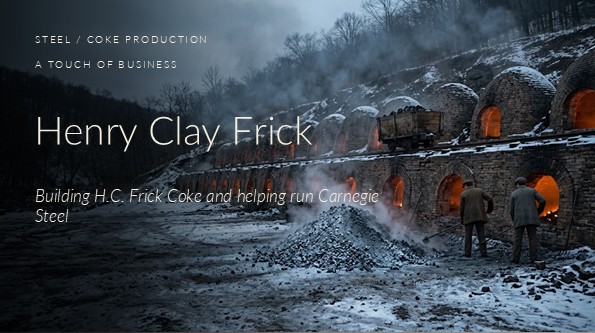
By about 1871, Frick had borrowed money to enter a partnership in coke production. Beehive ovens heated local bituminous coal to produce coke, a carbon-rich fuel used in blast furnaces for ironmaking. The growing iron and steel industries needed large quantities of this material, and Frick’s enterprise grew alongside that demand.
During the 1870s he acquired interests in coal lands and coke ovens and bought out early partners. His firm became known as H. C. Frick & Co., later H. C. Frick Coke Company. Around the age of thirty, he had become a millionaire. His growing business supplied an essential input to steel producers.
A Coke Supplier Joins Carnegie’s Steel Empire
Frick’s expanding supply business brought him into an alliance with Andrew Carnegie. Their commercial association was announced around the time of Frick’s wedding trip in 1881 and was formally established by 1882. Carnegie acquired a significant interest in the coke enterprise, connecting the production of fuel more closely to steelmaking.
In 1889 Carnegie chose Frick to chair Carnegie Bros. & Co., part of the steel interests later organized as Carnegie Steel. Frick played a leading managerial role as the business became more integrated and consolidated. Carnegie remained the dominant owner, however, and the company’s growth cannot be credited to either man alone.
The working relationship carried disagreements about management and labor. Carnegie’s public image was more sympathetic to workers than the hard line his company took at Homestead. He nevertheless supported Frick during that confrontation. The partnership that had joined a coke supplier to a powerful steel producer would eventually unravel.
Marriage, Clayton, and Family Loss
Frick married Adelaide Howard Childs in Pittsburgh on December 15, 1881. Surviving courtship letters provide a glimpse of the relationship before their marriage. The couple acquired Clayton, their Pittsburgh home, in 1882 and moved there in 1883; the house was later enlarged.
They had four children: Childs, Martha Howard, Helen Clay, and Henry Clay Frick Jr. Martha died in 1891, and their youngest son, born in 1892, died in infancy. Childs and Helen survived to adulthood. The deaths came amid a demanding period in the family’s business and public life.
The Johnstown Flood and Frick’s Club Connection
Three years before Homestead, another catastrophe had connected Frick’s name to a larger public controversy. He was a member of the South Fork Fishing and Hunting Club, which owned the South Fork Dam when it failed on May 31, 1889. Floodwaters devastated communities downstream, including Johnstown. The officially recorded death toll was 2,209, with the possibility of additional unrecorded deaths.
The dam had existed before the club acquired it. Its history included earlier damage and rebuilding, while alterations during club ownership contributed to concerns about its safety. The club’s members faced criticism after the flood, but the club was not held legally responsible.
Frick’s membership did not, by itself, make him responsible for the dam’s engineering. His individual role in its ownership or alterations has not been established.
The Human Costs of the Coke Business in 1891
Before the better-known events at Homestead, Frick’s coke operations were associated with two major tragedies in 1891. On January 27, an explosion at Mammoth No. 1 Mine, operated by H. C. Frick Coke Company, killed 109 miners. The scale of the loss exposed the dangers facing miners in the company’s operations.
A separate confrontation developed during the coke-region labor strike over wages and working conditions. Evictions from company housing, the use of security forces, law enforcement, and strikebreaking contributed to an increasingly violent dispute.
On April 2, striking workers were killed in the Morewood confrontation at a Frick-associated coke operation. A Pennsylvania historical marker records seven deaths in the shooting and two subsequent deaths. Accounts identify armed officers at the confrontation but do not establish that Frick personally ordered the shooting.
Mammoth and Morewood were distinct events: one a mine explosion, the other a labor confrontation. Together they form an important background to the more widely remembered labor battle of the following year.
Homestead: A Lockout Turns into Armed Conflict
At the Homestead Works in 1892, negotiations over wages and organized labor broke down. Acting for Carnegie Steel management while Carnegie was abroad, Frick locked out the workforce and made preparations to reopen the plant with nonunion labor. Workers and supporters resisted. Although the episode is commonly called the Homestead Strike, the management lockout was central to its development.
Frick arranged for about 300 Pinkerton agents to travel by water to secure the works. On July 6, a sustained gun battle broke out between the agents and defenders of the plant area. People were killed on both sides. Fatality counts vary in historical accounts, though deaths on both sides are undisputed.
Carnegie supported Frick’s position. In a July 7 telegram preserved in archival descriptions, Carnegie wrote, “Let grass grow over works.” In a July 8 public interview, Frick explained management’s terms and said the company would have no further dealings with the Amalgamated Association as an organization. Their statements made the executives’ position clear even as the dispute continued.
Pennsylvania militia reached Homestead on July 12. The plant reopened under management control, and organized resistance ultimately ended in November. The Amalgamated Association’s standing at the works was severely weakened. Frick directed management’s response, while Carnegie’s support, worker resistance, the Pinkerton deployment, and state intervention all shaped the conflict.
The Attempt on Frick’s Life
On July 23, 1892, anarchist Alexander Berkman entered Frick’s Pittsburgh office and shot and stabbed him in an unsuccessful assassination attempt prompted by the Homestead conflict. Frick survived his wounds, and Berkman was imprisoned.
The assault was Berkman’s act. It should not be portrayed as an operation ordered by the Homestead union. Descriptions of the struggle and Berkman’s capture vary.
The Carnegie Partnership Breaks Apart
By the later 1890s, differences about authority, finances, and their working relationship had strained Frick and Carnegie’s partnership. Frick had already moved away from some active management duties into an honorary-chairman role. He resigned from the Carnegie Steel board on December 5, 1899.
Carnegie sought to buy out Frick’s interests on terms Frick contested. Frick brought a lawsuit, and the dispute ended in a settlement in 1900. According to The Frick Collection’s institutional history, the March settlement provided Frick roughly $30 million in securities. The settlement ended the business dispute.
In 1901 J. P. Morgan organized U.S. Steel, bringing Carnegie’s operations into the new corporation. Frick became a director. His separation from Carnegie did not mean retirement from business: he continued to hold interests in finance, railroads, and corporate boards.
From Collecting Paintings to Planning a Museum
Frick’s art collecting had begun well before his split with Carnegie. An 1881 purchase of a landscape by Pennsylvania painter George Hetzel marks the start of his recorded acquisitions. Early interests included local and contemporary landscapes; over time, the collection expanded toward major European Old Master paintings, including works associated with artists such as Rembrandt, Vermeer, Van Dyck, and Gainsborough.
Collecting became a more substantial activity in the 1890s and later. Frick worked with dealers and specialists, among them M. Knoedler & Co., Joseph Duveen, and Roger Fry. Archival purchase records show that he sometimes examined works on approval and at other times acquired them without personally inspecting them first. The records show a collecting practice that combined personal viewing with advice and purchases arranged through specialists.
In 1905 the family began living in a leased Vanderbilt mansion at 640 Fifth Avenue in New York. Frick then commissioned a purpose-built residence at 1 East 70th Street, designed by Thomas Hastings of Carrère and Hastings. Constructed in 1912–14, it was both a family home and a setting for the collection. The family moved into the residence in 1914.
Frick’s will of June 24, 1915, provided for the house, its furnishings, and the art to become a public museum after Adelaide’s lifetime use of the home. The will described a purpose of “encouraging and developing the study of the fine arts.” The Frick Collection records a $15 million endowment provision. This was a plan for an institution that others would later have to bring into operation.
The House After Frick’s Death
Henry Clay Frick died at his 70th Street residence on December 2, 1919, shortly before his seventieth birthday. Adelaide continued to live in the mansion until her death in 1931. Trustees then adapted the house for museum use, and The Frick Collection opened to the public in December 1935.
The family’s cultural work also continued through Frick’s daughter Helen Clay Frick. Beginning in 1920, she created the Frick Art Reference Library and later played a major role in establishing the Frick Pittsburgh’s institutions. Those were her undertakings, not projects her father personally founded after his death.
Frick’s will also left an initial 151 acres for a Pittsburgh public park. Frick Park opened in 1927 and grew with later additions and stewardship. As with the museum, the public institution took shape through the efforts of people working after the original bequest.
An Industrial and Cultural Legacy
Frick helped build a major coke supplier and held significant power in Carnegie’s steel business. His career also remains inseparable from fatal industrial hazards, labor violence, and the defeat of organized workers at Homestead. Those events cannot be explained simply as the acts of one executive, but neither can his central managerial role be omitted.
The art collection he assembled became a museum through his will and later work by trustees and staff. His life therefore leaves two enduring lines of history: industrial expansion and its human costs, and private collecting that became a public cultural resource.
Timeline
These dates highlight major milestones in Frick’s business, family, labor, and collecting history.

1849
Henry Clay Frick is born in West Overton, Pennsylvania, on December 19.
Around 1871
He enters the coke business with borrowed capital and partners.
1881–1883
He marries Adelaide Howard Childs, establishes a business alliance with Carnegie by 1882, and moves into Clayton with his family in 1883.
1889
Frick becomes chairman of Carnegie’s steel interests. He is also a member of the club that owns the South Fork Dam when it fails on May 31.
1891
The Mammoth No. 1 Mine explosion kills 109 miners on January 27. Striking workers are killed in the separate Morewood confrontation on April 2.
1892
Frick oversees the Homestead lockout; the battle with Pinkerton agents occurs July 6, militia arrives July 12, and organized resistance ends in November. Berkman attacks Frick on July 23; Frick survives.
1899–1901
Frick resigns from the Carnegie Steel board in December 1899. His legal dispute with Carnegie ends in a 1900 settlement. He becomes a U.S. Steel director after its creation in 1901.
1914–1915
The Frick family occupies its new New York mansion; a 1915 will provides for the house and collection to become a museum after Adelaide’s lifetime.
1919–1927
Frick dies in 1919. Helen begins the Frick Art Reference Library in 1920. Frick Park opens in Pittsburgh in 1927.
1931–1935
After Adelaide’s death in 1931, trustees adapt the house; The Frick Collection opens in December 1935.
FAQs
What did Henry Clay Frick produce before becoming a steel executive?
Frick built a coke-production enterprise. Coke is a carbon-rich fuel produced from coal and used in blast furnaces for ironmaking. His supply business became commercially linked to Carnegie’s steel operations.
Was the 1892 Homestead conflict a strike or a lockout?
It is commonly called the Homestead Strike, but it involved a management lockout, worker resistance, a deadly confrontation with hired Pinkerton agents, and Pennsylvania militia intervention. Management ultimately retained control of the plant.
Did Henry Clay Frick personally cause the Johnstown Flood?
Frick belonged to the South Fork Fishing and Hunting Club, which owned the dam when it failed in 1889. That connection does not establish that he personally ordered specific dam alterations or caused its failure. The club was not held legally responsible for the flood.
Did Frick found U.S. Steel?
No. J. P. Morgan organized U.S. Steel in 1901. Frick, formerly a leading executive in Carnegie’s steel interests, served as a director of the new corporation.
Why did The Frick Collection open in 1935 rather than in Frick’s lifetime?
Frick’s will allowed his wife Adelaide to use the New York residence during her lifetime. She died in 1931; trustees then converted the residence for museum use, and the collection opened to the public in December 1935.
Further Reading
Sources
- The Frick Pittsburgh Museums & Gardens: The Frick Family: Henry, Adelaide, Helen, Childs
- U.S. National Park Service, Johnstown Flood National Memorial: Henry Clay Frick (1849–1919)
- PBS / American Experience: A Tough Partner: Henry Clay Frick and Andrew Carnegie
- University of Pittsburgh Library System: Resources on the 1892 Homestead Steel Strike: Carnegie Steel & Pinkertons (archival correspondence guide)
- U.S. Library of Congress: Homestead Strike: Topics in Chronicling America (introduction and timeline)
- American Social History Project / City University of New York, Who Built America?: Frick’s Fracas: Henry Frick Makes His Case (1892 Pittsburgh Post interview transcription)
- PBS / American Experience: Henry Clay Frick (1849–1919), Emma Goldman feature
- Pennsylvania Historical and Museum Commission historical marker via ExplorePAHistory: Mammoth Mine Explosion
- Penn State University Libraries: Pennsylvania Mines and Mining: Accidents (Mammoth Mine listing and original-records guide)
- Pennsylvania Historical and Museum Commission historical marker via ExplorePAHistory: Morewood Massacre
- Ohio State University eHistory: The Coke Region Troubles (reproduced 1891 contemporary perspective with editorial context)
- U.S. National Park Service: South Fork Fishing and Hunting Club
- U.S. National Park Service: The South Fork Dam (history and timeline)
- U.S. National Park Service: Johnstown Flood National Memorial: Frequently Asked Questions
- The Frick Pittsburgh: The Courtship and Wedding of Henry and Adelaide (archival letters and contemporary reporting)
- Preservation Pittsburgh: Frick Park (historical origins and 1919 bequest)
- U.S. National Park Service: Carnegie Libraries: The Future Made Bright (Teaching with Historic Places; Homestead discussion)