
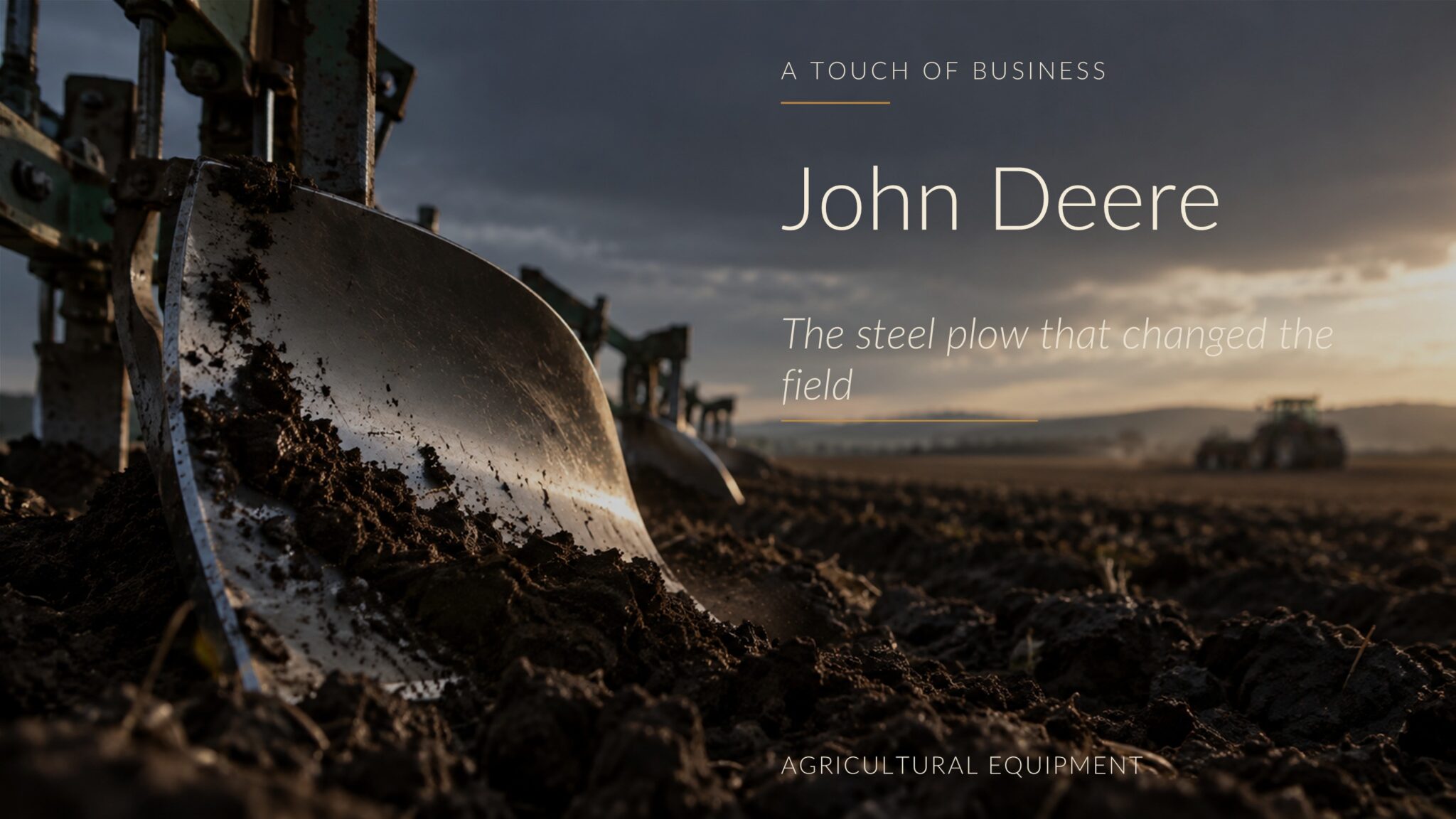
In 1837, John Deere made a plow in Grand Detour, Illinois, that worked successfully in the sticky, root-filled soil of the prairie. Its steel cutting share and smoothly finished moldboard addressed a practical problem that existing plows struggled with.
The result did more than establish Deere’s reputation. Demand rose, production increased, and his work began shifting from local blacksmithing toward manufacturing.
The achievement is often reduced to a simpler story: John Deere invented the steel plow. He did not. Steel had been used in plows before Deere’s 1837 design. His larger significance came from developing and commercializing a successful self-scouring prairie plow and building a manufacturing enterprise around it.
A Quick Look at the Life of John Deere
Biography Summary
John Deere was an American blacksmith and plow manufacturer whose 1837 prairie plow became the turning point in a career that grew from small-scale blacksmithing to large-scale manufacturing in Moline, Illinois. The enterprise he helped build was incorporated as Deere & Company in 1868.
Profile
Full Name: John Deere
Born: February 7, 1804
Died: May 17, 1886
Birthplace: Rutland, Vermont
Best Known For: Developing and commercializing a successful self-scouring prairie plow
Company / Organization: Deere & Company
Major Roles: Blacksmith, plow manufacturer, company president, and mayor of Moline
From Vermont Blacksmith to Illinois
John Deere was born in Rutland, Vermont, on February 7, 1804. His family moved to Middlebury while he was still a child. After his father, William, left for England and did not return, Deere was raised in Vermont by his mother, Sarah.
As a young man, Deere learned blacksmithing through an apprenticeship in Middlebury. He married Demarius Lamb in 1827 and worked as a blacksmith in Vermont.
Those years also brought business setbacks. Fires destroyed shops, debts followed, and a weak Vermont economy added to Deere’s financial difficulties. In 1836, he left Vermont for Grand Detour, Illinois, where he resumed blacksmithing. His family followed later.
The move placed Deere in a farming region where heavy prairie soil created problems for plows designed for different conditions. That practical challenge became the setting for the breakthrough that changed the scale of his work.
The 1837 Prairie-Plow Breakthrough
Deere’s 1837 plow combined a steel cutting share with a smoothly finished moldboard. The design proved usable in the sticky, root-filled prairie soil and became the foundation of his reputation.
A familiar company story says Deere made his first plow from a discarded or broken sawmill blade. The exact construction of the 1837 plow is uncertain, however. Early Deere plows are documented with a steel share and a wrought-iron moldboard rather than an all-steel structure.
Deere was also not the first person to use steel in a plow. John Lane had made a plow in Chicago in 1833 with steel strips on the moldboard. Deere’s distinction was not a lone-inventor claim. It was the development and successful commercialization of a self-scouring prairie plow, followed by the manufacturing operation that grew around it.
An 1843 advertisement captured the product’s practical appeal by saying the plow “scours perfectly bright in any soil.” The wording was promotional, but it emphasized the polished working surface Deere was selling.
Demand Turns Blacksmithing Into Manufacturing
The change in scale came quickly. Deere produced about 10 plows in 1839, 40 in 1840, 75 in 1841, 100 in 1842, and about 400 in 1843.
On March 20, 1843, Deere entered the earliest documented partnership agreement with Leonard Andrus. Later accounts sometimes place their partnership earlier, but 1843 is the documented starting point for the formal partnership.
By then, Deere’s work had moved beyond individual blacksmith jobs into repeat plow production. The next shift would move the manufacturing operation to Moline.
Moving Production to Moline
Deere shifted his manufacturing operation to Moline in 1847–1848. By 1848, he had formed a Moline business association with Robert N. Tate and John M. Gould.
Moline offered advantages for manufacturing and distribution, including transportation connections and access to power and materials. Production rose sharply after the move.
The new Moline firm produced about 700 plows in its first year. Output reached about 1,600 in 1850 and about 10,000 in 1857.
The numbers marked a clear change in Deere’s career. A business that had begun with small batches in Grand Detour was now producing plows by the thousands.
The Panic of 1857 and a Leadership Transition
Rapid expansion did not remove financial risk. The Panic of 1857 put the business under strain and led to a reorganization.
Charles Deere assumed greater management responsibility while John Deere remained president. The company avoided bankruptcy and continued operating.
The transition changed John Deere’s role without ending his connection to the business. Operational leadership increasingly shifted to Charles, while John remained in the senior position of president.
Later Product Work and Deere & Company
John Deere continued to be associated with plow development after the 1837 breakthrough. On February 21, 1865, he received U.S. Patent No. 46,454 for an improvement in plows that included replaceable components.
The 1865 patent covered later improvements. It was not a patent for Deere’s original 1837 prairie plow.
Demarius Deere died in 1865. Two years later, John Deere married her sister, Lucinda Lamb.
In 1868, the business was incorporated as Deere & Company. Deere remained president after Charles had taken on greater management responsibility.
From Manufacturer to Mayor of Moline
Deere’s public role later extended beyond the company. He served as mayor of Moline from 1873 to 1875.
The mayoralty was a smaller part of his life story than the growth of the plow business, but it marked another change in role: the blacksmith who had arrived in Illinois decades earlier was now serving in municipal office in the city where his manufacturing enterprise had taken root.
John Deere’s Legacy Beyond the “Steel Plow” Story
John Deere died in Moline on May 17, 1886, at age 82. His industrial legacy is clearer when separated from the popular claim that he invented the first steel plow.
Earlier makers had experimented with steel before Deere. What distinguished his career was the combination of practical refinement, successful commercialization, and manufacturing scale. A plow developed for prairie conditions became the basis of an enterprise that grew from hundreds of plows to thousands and was incorporated as Deere & Company in 1868.
The wider impact of increasingly effective prairie plowing was more complicated. Later historians and museum curators have connected intensive prairie conversion with habitat loss and soil erosion. Those environmental consequences belong to the broader history of agricultural expansion rather than to a claim about Deere’s personal intention.
Timeline
This timeline highlights important milestones in John Deere’s life, plow development, manufacturing career, and later civic role.

1804
John Deere was born on February 7 in Rutland, Vermont.
1820s
Deere apprenticed as a blacksmith in Middlebury, Vermont.
1827
Deere married Demarius Lamb.
1836
Deere left Vermont for Grand Detour, Illinois, and resumed blacksmithing.
1837
Deere made a successful prairie plow using a steel share and a smoothly finished moldboard.
1843
The earliest surviving Deere-Andrus partnership agreement was dated March 20.
Production reached about 400 plows.
1847–1848
Deere shifted his manufacturing operation to Moline. By 1848, his Moline business association with Robert N. Tate and John M. Gould was in place.
1850
Production reached about 1,600 plows.
1857
Production reached about 10,000 plows.
The Panic of 1857 brought financial strain and a management reorganization in which Charles Deere assumed greater responsibility while John Deere remained president.
1865
John Deere received U.S. Patent No. 46,454 for an improvement in plows.
Demarius Deere died.
1867
John Deere married Lucinda Lamb.
1868
The business was incorporated as Deere & Company.
1873–1875
John Deere served as mayor of Moline.
1886
John Deere died in Moline on May 17 at age 82.
FAQs
Question: Did John Deere invent the steel plow?
Answer: No. Steel had been used in plows before Deere’s 1837 work, including a Chicago plow made by John Lane in 1833. Deere became known for developing and successfully commercializing a self-scouring prairie plow suited to difficult soil conditions.
Question: Was John Deere’s first plow made from a saw blade?
Answer: The broken-saw-blade story is part of the traditional company account, but the exact construction of Deere’s 1837 plow is not fully established. Early Deere plows are documented with a steel share and a smoothly finished wrought-iron moldboard, so an all-saw-blade description is too definite.
Question: Why was John Deere’s plow important on the prairie?
Answer: Its polished working surface and steel cutting share helped the plow move through sticky prairie soil without soil adhering as severely to the moldboard. That addressed a practical problem farmers faced with plows designed for other soil conditions.
Question: When did John Deere move to Moline?
Answer: The date is not completely settled. Smithsonian historical research places the move in 1847, while Deere & Company and the City of Moline use 1848 for the move or new Moline partnership. A careful date range is 1847–1848.
Question: Did John Deere patent his original 1837 plow?
Answer: John Deere’s documented 1865 patent covered later improvements in plows, not his original 1837 prairie plow.
Sources
- Smithsonian Institution / U.S. National Museum: John Deere’s Steel Plow
- National Inventors Hall of Fame: John Deere
- Vermont Historical Society: John Deere’s Middlebury
- EBSCO Research Starters: John Deere
- Deere & Company: History & Heritage
- City of Moline, Illinois: Past Mayors, City of Mills
- United States Patent record / Google Patents: US46454A — Improvement in Plows
- Illinois State Historical Society: First Steel Plow, The
- Smithsonian Magazine: John Deere’s Plow and the Transformation of the Prairie