
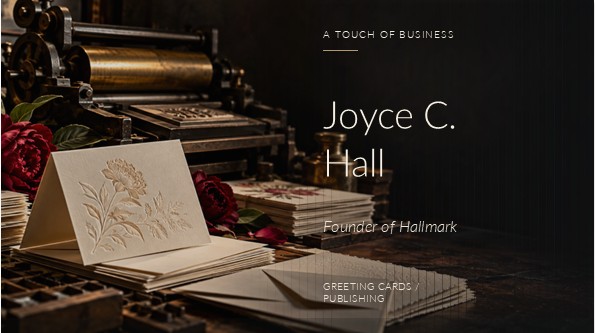
On Christmas Eve 1951, a company best known for greeting cards sponsored a live opera on NBC. Joyce C. Hall had approved Hallmark’s support for Gian Carlo Menotti’s Amahl and the Night Visitors, the broadcast that began a television drama undertaking later known as Hallmark Hall of Fame.
Four decades earlier, Hall had arrived in Kansas City carrying postcards and started a mail-order operation in a YMCA room. Between that small beginning and the 1951 broadcast came a devastating fire, a move into making greeting cards, and the steady development of a nationally recognizable brand.
A Quick Look at the Life of Joyce C. Hall
Biography Summary
Joyce Clyde Hall (1891–1982) was an American entrepreneur who founded the Kansas City business that became Hallmark Cards. Building on postcard-selling experience shared with his brothers, he helped turn a small wholesale venture into a leading American greeting-card company. His leadership extended to product development, store merchandising, national advertising, cultural sponsorship, private ownership, and philanthropy. He handed the president and chief executive roles to his son Donald in 1966 but remained chairman until his death.
Profile
Full Name: Joyce Clyde Hall
Also Known As: Joyce C. Hall; J. C. Hall
Born: August 29, 1891
Birthplace: David City, Nebraska
Died: October 29, 1982, in Leawood, Kansas
Education: Left high school before graduating; briefly attended Spalding’s Commercial College; received an honorary diploma from David City High School in 1962
Best Known For: Founding the business that became Hallmark Cards and developing its national brand
Company: Hall Brothers Company, later Hallmark Cards, Inc.
Major Roles: Company president and chief executive until 1966; board chairman until 1982
Family: Wife Elizabeth Ann Dilday Hall; children Elizabeth Ann, Barbara Louise, and Donald J. Hall
Honor: Inducted posthumously into the Television Academy Hall of Fame in 1985
Learning the Card Trade in Nebraska
Joyce Clyde Hall was born in David City, Nebraska, on August 29, 1891. His parents, George Nelson Hall and Nannie Dudley Houston Hall, had three sons, including Joyce, and a younger daughter, Marie. George traveled as a Methodist lay preacher, and the family experienced financial difficulties. Nannie obtained a divorce and custody of the children in 1901.
Hall learned the card trade through his older brothers. In 1905, William was managing the Norfolk Book Store. Joyce swept floors, stocked shelves, waited on customers, fetched newspapers, and paid attention to advertising. Rollie, the other older brother, learned to sell by traveling from one community to another.
Around 1907, the brothers organized the Norfolk Post Card Company to wholesale cards to retailers from William’s store. Joyce helped sort and pack inventory while Rollie called on potential buyers. By the time he left Nebraska, Joyce had worked with both card inventory and retail customers.
Hall joined traveling sales routes in 1908 and left high school without graduating. Decades later, when David City High School granted him an honorary diploma in 1962, he encouraged students to continue on to college. In a later reflection, Hall used the phrase “gift of poverty” to describe his childhood.
Starting Again in a Kansas City YMCA Room
In January 1910, Hall moved to Kansas City, Missouri, at age 18 with postcard inventory. He began a mail-order operation from a small room at the YMCA and enrolled at Spalding’s Commercial College, leaving the course as his business activity expanded.
Hall later described a straightforward method of reaching retailers in towns that traveling salespeople did not regularly visit: assemble assortments of postcards, mail sample lots, and include an invoice. The volume of mail and merchandise became awkward for the YMCA and post office, and he rented separate business space. The method drew on the family trade while giving him a wider market to pursue.
Rollie joined him in Kansas City later in 1910, and their mother and sister followed in early 1911. The Kansas City venture thus brought Joyce and Rollie back into business together.
The product itself soon needed to change. By 1912, the postcard craze was fading as cheap competing cards multiplied. Joyce and Rollie turned greater attention to higher-quality engraved greeting cards sold with envelopes, initially using Kansas City’s Smith-Pierce Engraving Company to produce them. An enclosed greeting could offer buyers something different from a message visible on the back of a postcard.
Fire, Debt, and the Move into Printing
On January 11, 1915, a fire destroyed the brothers’ Kansas City premises and inventory. The loss left a reported $17,000 in debt. A piano business made space available for them to resume operations, and the brothers continued the shift toward greeting cards.
In the aftermath of the fire, they moved into producing their own cards, obtaining engraving and printing equipment rather than relying entirely on outside manufacturers. The transition to in-house production unfolded over the period following the 1915 loss. It gave the business the capacity to publish cards under the Hall Brothers name.
Hall later recalled the commitment to engraved cards with envelopes in direct terms: “We were ready to bet our future on them.”
The expanding Kansas City business ultimately brought all three brothers together. William joined the operation in 1921. That same year, Joyce married Elizabeth Ann Dilday. They had three children: Elizabeth Ann, Barbara Louise, and Donald J. Hall.
When Hall Brothers Company incorporated in 1923, Joyce served as president, Rollie held the senior sales role, and William was vice president and treasurer.
From Decorative Paper to a Name of Its Own
The brothers also found an opportunity beyond greeting cards. During the 1917 Christmas season, their retail store ran short of conventional gift tissue and sold decorated French envelope-lining paper as an alternative. The improvised substitute developed into a commercial line of decorative gift-wrap paper, helping popularize a product category that already existed.
By 1927 the enterprise had passed $1 million in annual sales. The next year, Joyce chose “Hallmark” as the brand to identify its greeting cards, borrowing the idea of a goldsmith’s hallmark as a sign of quality while retaining the family name. The branded cards appeared well before the legal company name changed from Hall Brothers to Hallmark Cards, Inc., in 1954.
Branding was accompanied by advertising. In 1928, Hall wrote the copy for the company’s first national magazine advertisement, placed in Ladies’ Home Journal. Rather than waiting for shoppers to encounter an anonymous card in a store, the company was asking readers to recognize and seek out its name.
Hall Brothers added licensed imagery to its products as well. In 1931 the company entered a Disney character-licensing agreement.
Hall also worked on how cards were presented inside shops. Open racks let customers browse merchandise that retailers had often kept in drawers, and the Eye-Vision display system aided merchandising and sales monitoring. A U.S. patent granted in 1937 named Joyce C. Hall as inventor of a rack design that angled rows of cards for easier viewing.
Radio, Advertising, and the Hallmark Promise
National magazine advertising had made Hallmark more visible in print, but Hall was willing to try a different medium even when agencies questioned whether it would work for greeting cards. In 1938 the company sponsored Tony Wons’ Radio Scrapbook on Chicago station WMAQ. Wons read sentiments from cards and directed listeners to look for the Hallmark name. The company went on to expand into network radio.
Radio joined an approach that connected the product’s message with the company’s identity. In 1944, Hallmark adopted “When You Care Enough to Send the Very Best,” wording supplied by Hallmark sales and marketing executive Ed Goodman. Hall approved and promoted that brand promise; Goodman, rather than Hall, developed the famous phrase.
The slogan reinforced a strategy already evident in the product displays and magazine campaigns: give customers a recognizable name to look for and a reason to associate it with quality.
Philanthropy and an Art Collection
Hall’s interests as a company leader also reached beyond sales. In 1943, Joyce, his wife Elizabeth, and his brother Rollie established the educational and charitable organization now known as the Hall Family Foundation. Its objectives included education, health, welfare, and social services in the Kansas City region.
Visual art became a prominent part of Hallmark’s identity. The company introduced a Hallmark Gallery Artists card line in 1948, and Hall backed the International Hallmark Art Awards, which began in 1949. The program combined a juried competition with traveling exhibitions. According to the Hallmark Art Collection’s archives, more than 10,000 artists responded to the first call for entries, and related acquisitions helped form a substantial corporate modern-art collection.
The 1949 awards also encountered criticism. In the anticommunist climate of the period, U.S. Representative George Dondero attacked some of the artists and judges, and protests in France challenged an American corporate-backed exhibition. Those controversies concerned the art program; they did not establish political affiliations or misconduct by Hall or the artists.
Through its cards, competitions, and exhibitions, Hallmark made art part of its public identity. Television would give that association a new setting.
Bringing Hallmark to Television
Hall’s decision to sponsor Amahl and the Night Visitors took that connection between business and the arts onto television. The live NBC production premiered on December 24, 1951. Hallmark’s account describes the sponsorship as a way Hall could thank the people who purchased the company’s cards.
The production began the dramatic-programming venture that became known as Hallmark Hall of Fame. The 1951 premiere aired in black and white; a 1953 presentation of Amahl became an early landmark in sponsored color television.
Hall framed the programming decision in terms of the audience he wanted to reach. “We didn’t set out to get the largest audience on TV — we wanted the best,” he said in a statement preserved by the Television Academy. It was his own explanation of Hallmark’s quality-oriented approach to programming.
Television also changed the scale at which the brand could be encountered. A company whose products were purchased for personal messages was now associated with extended dramatic productions viewed at home.
Keeping Hallmark Private and Sharing Its Success
As Hallmark grew, Hall maintained a preference for private ownership rather than a public stock listing. A later U.S. Tax Court account of the company’s history records his view that private ownership made it possible to pursue longer-range decisions without the same pressures associated with public markets.
In 1956, the company established an employee profit-sharing plan intended to give employees a stake in the business’s success. Hall also envisioned ownership interests involving the Hall family, employees, and charitable purposes. He and Elizabeth transferred shares into family trusts over time. His estate plan also provided for a significant stock interest to pass through the employee plan.
Family trusts, the employee plan, and charitable interests all had roles in Hall’s approach to ownership, while Hallmark remained a private company.
Passing Leadership to Donald Hall
In March 1966, after roughly 56 years leading the Kansas City enterprise, Joyce Hall passed the president and chief executive roles to his son, Donald J. Hall. Joyce continued as board chairman.
Donald directed the company’s next phase of operations and expansion. Father and son also championed a redevelopment project near Hallmark’s Kansas City headquarters, moving their civic ambitions beyond greeting cards.
Crown Center’s Ambitions and Its Costs
In the late 1960s, Joyce and Donald Hall championed Crown Center, a mixed-use redevelopment project involving about 85 acres near Hallmark’s Kansas City headquarters. Ground was broken on September 16, 1968. Donald, already chief executive, took a substantial role in carrying out the development.
Crown Center was an ambitious investment in the company’s home city, but it also created financial strain. A subsequent U.S. Tax Court account described Crown Center Redevelopment Corporation as a Hallmark subsidiary and recorded that the development was unprofitable and required subsidies from Hallmark during the period examined.
The development also became the setting for a catastrophe. On July 17, 1981, suspended walkways collapsed at Crown Center’s Hyatt Regency hotel, killing 114 people and injuring hundreds. That subsidiary owned the hotel, while Hyatt operated it. Litigation followed involving multiple corporate, design, and construction parties.
Joyce was Hallmark’s board chairman when the disaster occurred, while Donald had led the redevelopment effort during the 1970s. The company’s ownership of the hotel does not establish that Joyce made the deficient engineering decisions or that a court found him individually liable.
Death, Estate, and a Wider Legacy
Elizabeth Hall died in 1976. Joyce C. Hall died at his home in Leawood, Kansas, on October 29, 1982, at age 91, survived by their children Elizabeth Ann, Barbara Louise, and Donald. At his death Hallmark was the leading U.S. greeting-card company, though it faced significant competitors, including American Greetings.
His estate arrangements provided for his children while directing the bulk of the residual estate toward charitable purposes. A 1989 U.S. Tax Court decision subsequently addressed the valuation of Hallmark stock held in his estate.
The Television Academy inducted Hall into its Hall of Fame in 1985, three years after his death. The distinction reflected his role in bringing dramatic programming into the Hallmark business. Donald and subsequent leaders would oversee the company’s later development.
From the postcard routes of Nebraska to the television productions associated with Hallmark, Hall’s career linked product design with the ways people encountered it: in stores, through advertising, and on screen. Behind the familiar brand were the work of his brothers, company colleagues, employees, and eventually his son. Their contributions formed part of the enterprise Hall helped build and kept privately held.
Timeline
These milestones trace the principal changes in Joyce C. Hall’s life, Hallmark’s development, and the later events that shaped its legacy.

August 29, 1891
Joyce Clyde Hall is born in David City, Nebraska.
1905–1908
He works at William Hall’s Norfolk Book Store, participates in the brothers’ postcard trade, and leaves high school to travel on sales routes.
January 1910
Hall moves to Kansas City and starts a postcard mail-order operation from a YMCA room. Rollie joins him later that year.
1912–1916
Joyce and Rollie shift toward engraved greeting cards with envelopes. A January 1915 fire destroys their business premises and inventory; in its aftermath, the brothers move into producing their own cards.
1917
The brothers’ store sells decorated paper for gift wrapping, leading toward a commercial gift-wrap line.
1921–1923
Joyce marries Elizabeth Ann Dilday in 1921. William joins the Kansas City business, and Hall Brothers Company incorporates in 1923.
1928
Hall introduces the Hallmark brand name, and the company places its first national magazine advertisement.
1931–1938
The company signs a Disney licensing agreement in 1931. Hall files a card-rack patent application in 1935, granted in 1937, and backs radio advertising in 1938.
1943–1944
Joyce, Elizabeth, and Rollie establish a charitable foundation in 1943. In 1944, Hallmark adopts the slogan written by executive Ed Goodman.
1948–1949
Hallmark introduces the Gallery Artists card line and launches the International Hallmark Art Awards.
December 24, 1951
Hallmark sponsors the NBC premiere of Amahl and the Night Visitors, initiating the television venture later known as Hallmark Hall of Fame.
1954–1956
Hall Brothers Company takes the name Hallmark Cards, Inc., in 1954. Employee profit sharing begins in 1956.
1962
Hall receives an honorary high-school diploma in David City.
March 1966
Donald J. Hall succeeds his father as president and chief executive officer. Joyce remains board chairman.
September 16, 1968
Ground is broken for the Crown Center redevelopment near Hallmark’s Kansas City headquarters.
July 17, 1981
Walkways collapse at Crown Center’s Hyatt Regency hotel, killing 114 people and injuring hundreds.
October 29, 1982
Joyce C. Hall dies in Leawood, Kansas, at age 91.
1985
The Television Academy inducts Hall into its Hall of Fame posthumously.
FAQs
Did Joyce C. Hall start Hallmark alone?
Joyce C. Hall established the Kansas City postcard business in 1910, but it grew from a postcard operation developed with his brothers Rollie and William in Nebraska. Rollie joined him in Kansas City in 1910, William followed in 1921, and all three held important company responsibilities.
Did J. C. Hall invent gift wrapping?
No. The Hall brothers helped develop the commercial market for decorative gift-wrap paper after selling decorated paper as an alternative to tissue in 1917. People had wrapped gifts before that, and neither Joyce Hall nor his company originated the entire practice.
Who wrote Hallmark’s “When You Care Enough to Send the Very Best” slogan?
Hallmark executive Ed Goodman supplied the phrase, which the company adopted in 1944. Joyce C. Hall approved and promoted it, but he was not its author.
Why did Hallmark sponsor Amahl and the Night Visitors?
J. C. Hall approved Hallmark’s sponsorship of the 1951 NBC production. Hallmark described the program as a way of thanking card buyers, while Hall publicly emphasized quality programming rather than seeking the largest possible television audience. That broadcast started the dramatic-programming venture later known as Hallmark Hall of Fame.
Was Hallmark a publicly traded company under Joyce C. Hall?
No. Hall favored keeping Hallmark privately held, in part to support longer-range decision-making. The company also established employee profit sharing in 1956, within a broader ownership approach involving the Hall family, employees, and charitable interests.
Did Joyce C. Hall graduate from high school?
Not during his school years. He left high school in 1908 while working in the postcard trade. David City High School later awarded him an honorary diploma in 1962.
Was Joyce C. Hall personally responsible for the Hyatt Regency walkway collapse?
The documented record establishes that a Hallmark subsidiary owned the hotel, Hyatt operated it, and multiple parties became involved in litigation after the July 17, 1981 collapse. It does not establish that Joyce C. Hall personally made the defective engineering decisions or that he was found individually liable. He was Hallmark’s board chairman at the time.
Sources
- Nebraska State Historical Society: The Halls of Hallmark: The Nebraska Years
- Hallmark Corporate: Founding: 1910s, Early Innovation: 1910s–30s, Building a Brand: 1930s–50s, Leadership, Donald J. Hall timeline
- University of Nebraska–Lincoln, Encyclopedia of the Great Plains: Hallmark Cards, Inc.
- The Henry Ford: Through the Years with Hallmark Ornaments
- U.S. Patent 2,067,051: Joyce C. Hall, Rack (1937)
- The Paley Center for Media: Amahl and the Night Visitors, 1951 broadcast record
- Television Academy: Joyce C. Hall Hall of Fame tribute, Joyce C. Hall biography
- Hallmark Channel: About the Hallmark Hall of Fame
- Hallmark Art Collection: International Hallmark Art Awards
- The Nelson-Atkins Museum of Art: Hall Family Foundation and Hallmark art history
- Hall Family Foundation: Our History
- Grand Lake Area Historical Society: Hall Family
- United States Tax Court: Estate of Hall v. Commissioner (1989)
- Missouri State Archives: 1981 Hyatt Skywalk Collapse Collection
- United Press International: Joyce C. Hall obituary and estate report (1982)