
When Stanford University opened in 1891, its name commemorated a boy who had died at 15. Leland Stanford and his wife, Jane, had founded the institution in memory of their only child, turning part of their wealth toward an educational project on their Palo Alto Stock Farm.
Much of that wealth came from the Central Pacific Railroad. Before becoming a university co-founder, Stanford had helped lead the building of the western portion of the first transcontinental railroad, an enterprise that depended largely on Chinese workers.
A Quick Look at the Life of Leland Stanford
Biography Summary
Leland Stanford was a lawyer and merchant who became a Central Pacific Railroad co-founder, California’s first Republican governor and a U.S. senator. His career joined private business with public power; his later educational philanthropy was a shared undertaking with Jane Stanford.
Profile
Full Name: Amasa Leland Stanford, commonly known as Leland Stanford
Born: March 9, 1824
Died: June 21, 1893
Birthplace: Watervliet, New York
Spouse: Jane Lathrop Stanford
Major Roles: Central Pacific Railroad president; California governor, 1862–1863; U.S. senator, 1885–1893
From Legal Practice to California Commerce
Born to Josiah Stanford and Elizabeth Phillips in Watervliet, New York, Stanford attended Clinton Liberal Institute and Cazenovia Seminary. He studied law, was admitted to practice in 1848 and moved that year to Port Washington, Wisconsin, where he worked as a lawyer.
He married Jane Lathrop in Albany in 1850. Two years later, Stanford moved to California and joined his brothers’ provision business, supplying the mining economy. By the mid-1850s, his commercial activity was centered in Sacramento.
By 1860, Stanford was the sole proprietor of the Sacramento store. Railroad ownership and elected office would soon expand his responsibilities beyond commerce.
A Railroad President in the Governor’s Office
Stanford co-founded the Central Pacific Railroad in 1861 and became its president. He belonged to the group conventionally called the Big Four, alongside Collis P. Huntington, Mark Hopkins and Charles Crocker.
The same year, California voters elected Stanford governor. He took office in January 1862 as the state’s eighth governor and its first Republican to hold the position. For nearly two years, his railroad presidency and gubernatorial duties overlapped.
Railroad development was part of his public agenda. In his inaugural address, Stanford advocated federal land and credit assistance for a Pacific railroad and emphasized its national importance. As governor, he also approved public grants that included financial assistance to the Central Pacific, a business in which he held a personal interest.
Stanford broke ground for Central Pacific construction in January 1863. His gubernatorial term ended that December, while his railroad work continued.
His public agenda also included restricting Asian immigration. In his 1862 inaugural address, Stanford characterized Asian immigrants through a racist hierarchy and endorsed measures aimed at “the repression of the immigration of the Asiatic races.”
Chinese Labor and the Road to Promontory
The Central Pacific’s eastward construction faced mountain barriers and labor shortages. Chinese workers became the great majority of its construction workforce, performing hazardous mountain and tunnel work as the line advanced toward a connection with the Union Pacific.
The workers’ contribution came under unequal conditions. Chinese laborers received lower pay, lived in separate camps and paid for their own food and lodging. In June 1867, workers between Cisco and Truckee struck for higher wages and shorter hours. During the week-long strike, the Central Pacific cut off food and supplies to their camps.
Stanford also participated in securing other construction labor. By August 1868, he had negotiated an agreement with Brigham Young to provide Mormon laborers for grading work.
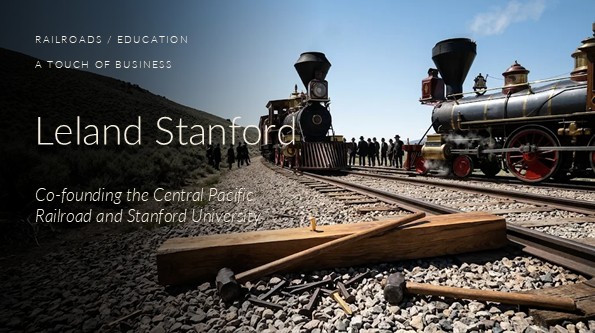
On May 10, 1869, the railroad completion ceremony took place at Promontory Summit in Utah Territory. Stanford participated as Central Pacific president in the ceremonial last-spike event. The junction connected the Central Pacific’s western work with the Union Pacific’s line.
The Central Pacific’s dependence on Chinese workers stood in tension with Stanford’s exclusionary political rhetoric. Their labor was central to the railroad that generated much of the wealth later used to establish Stanford University.
Horse Photography at the Palo Alto Stock Farm
Stanford’s interests also extended to horses and the study of their movement. In 1872, he commissioned Eadweard Muybridge to photograph a horse at speed, testing whether all four feet left the ground at some point during its stride.
Muybridge developed sequential photographic methods, and Stanford’s Palo Alto Stock Farm hosted motion research in 1878–1879. Stanford supplied patronage and the initial question; Muybridge carried out the photographic work.
A Family Memorial Becomes a University
Leland and Jane’s only child, Leland Stanford Jr., was born in 1868. He died of typhoid fever in Italy in March 1884, aged 15. The university his parents subsequently established was intended as his memorial.
Stanford procured a California enabling act in March 1885. On November 11 that year, he and Jane executed the university’s Grant of Endowment, conveying properties to trustees and outlining the institution’s objectives and governance.
Working with founding president David Starr Jordan, the Stanfords sought a nonsectarian, coeducational institution combining liberal arts with scientific and engineering education.
The university opened on October 1, 1891, on the Palo Alto Stock Farm, enrolling 555 students in its first year.
Senate Service and the University’s Financial Uncertainty
University founding coincided with Stanford’s return to elected office. His service as a Republican U.S. senator began in March 1885, and he was reelected in 1891. In the Senate, he chaired the Committee on Public Buildings and Grounds.
Stanford died in Palo Alto on June 21, 1893, while still a senator, and was buried in the mausoleum on the university grounds. After his death, the university faced serious financial shortages. Jane personally supported the institution through that period.
Railroad debt also became the subject of a civil claim against Stanford’s estate. In United States v. Stanford, the federal government sought to hold the estate liable for a share of federal subsidy-bond obligations because of Stanford’s railroad stock ownership.
In March 1896, the Supreme Court affirmed dismissal of the government’s suit. The Court held that the federal railroad-aid legislation did not impose the asserted personal shareholder liability for those bonds. Its ruling left other possible bases of liability undecided.
A Legacy Built Through Shared Undertakings
The university carried forward a memorial Leland and Jane Stanford had created together, with Jane sustaining it after his death. Its origins also remain connected to the railroad wealth that helped finance it and the Chinese laborers whose work made that wealth possible.
Timeline
These milestones trace Stanford’s changing roles in law, commerce, railroads, politics and education.

1824
Leland Stanford is born on March 9 in Watervliet, New York.
1848–1852
- Stanford is admitted to legal practice and moves to Wisconsin in 1848.
- He marries Jane Lathrop in 1850.
- He moves to California and enters his brothers’ provision business in 1852.
1861–1863
- Stanford co-founds the Central Pacific and becomes its president in 1861.
- Elected governor in 1861, he serves from January 10, 1862, to December 10, 1863.
1867
Chinese railroad workers between Cisco and Truckee begin a strike on June 24.
May 10, 1869
Stanford participates in the railroad completion ceremony at Promontory Summit.
1872–1879
Stanford commissions Muybridge’s horse photography in 1872; the Palo Alto Stock Farm hosts motion research in 1878–1879.
1884
Leland Stanford Jr. dies in Italy on March 13, aged 15.
1885
- Stanford’s Senate service begins on March 4.
- The university’s founding grant is executed on November 11.
October 1, 1891
Stanford University opens.
June 21, 1893
Stanford dies in Palo Alto while serving in the Senate.
1896
The Supreme Court affirms dismissal of the government’s subsidy-bond shareholder claim against Stanford’s estate.
FAQs
Question: Why is Stanford formally named Leland Stanford Junior University?
Answer: The university commemorates Leland Stanford Jr., the only child of Leland and Jane Stanford. He died of typhoid fever at 15, and his parents jointly founded the institution in his memory.
Question: Did a rejection by Harvard lead the Stanfords to establish their university?
Answer: No. The familiar Harvard-snub story misrepresents the founding. The Stanfords consulted Harvard president Charles Eliot for advice about creating a memorial institution; the encounter was not a rejected memorial offer.
Question: Was the railroad’s last-spike ceremony at Promontory Point?
Answer: No. The May 10, 1869 ceremony took place at Promontory Summit, Utah Territory. Promontory Point is a different location.
Interviews
Stanford’s 1862 Inaugural Address
This speech presents Stanford’s public positions as he began his governorship. It addresses assistance for a Pacific railroad and includes his racist arguments for restricting Asian immigration, offering firsthand context for the relationship between his politics and railroad career.
Sources
- California State Library — Leland Stanford biography, 1862 inaugural address
- National Governors Association — Amasa Leland Stanford
- United States Senate — California senators
- Dickinson College, House Divided — Congressional Biographical Directory: Leland Stanford
- PBS American Experience — Leland Stanford
- Stanford University — University history, Historic milestones, Founding and organization
- Stanford American Studies — Chinese Railroad Workers in North America Project
- National Park Service — Chinese Labor and the Iron Road, Golden Spike questions and historical locations
- Library of Congress — Transcontinental Railroad
- Metropolitan Museum of Art — Muybridge motion study
- California State Parks — Muybridge and the Development of Motion Pictures
- U.S. Supreme Court, hosted by Justia — United States v. Stanford (1896)
- Hoover Institution — Biographer Norman Tutorow on Stanford
- The Harvard Crimson — Seeing Red: Stanford v. Harvard