
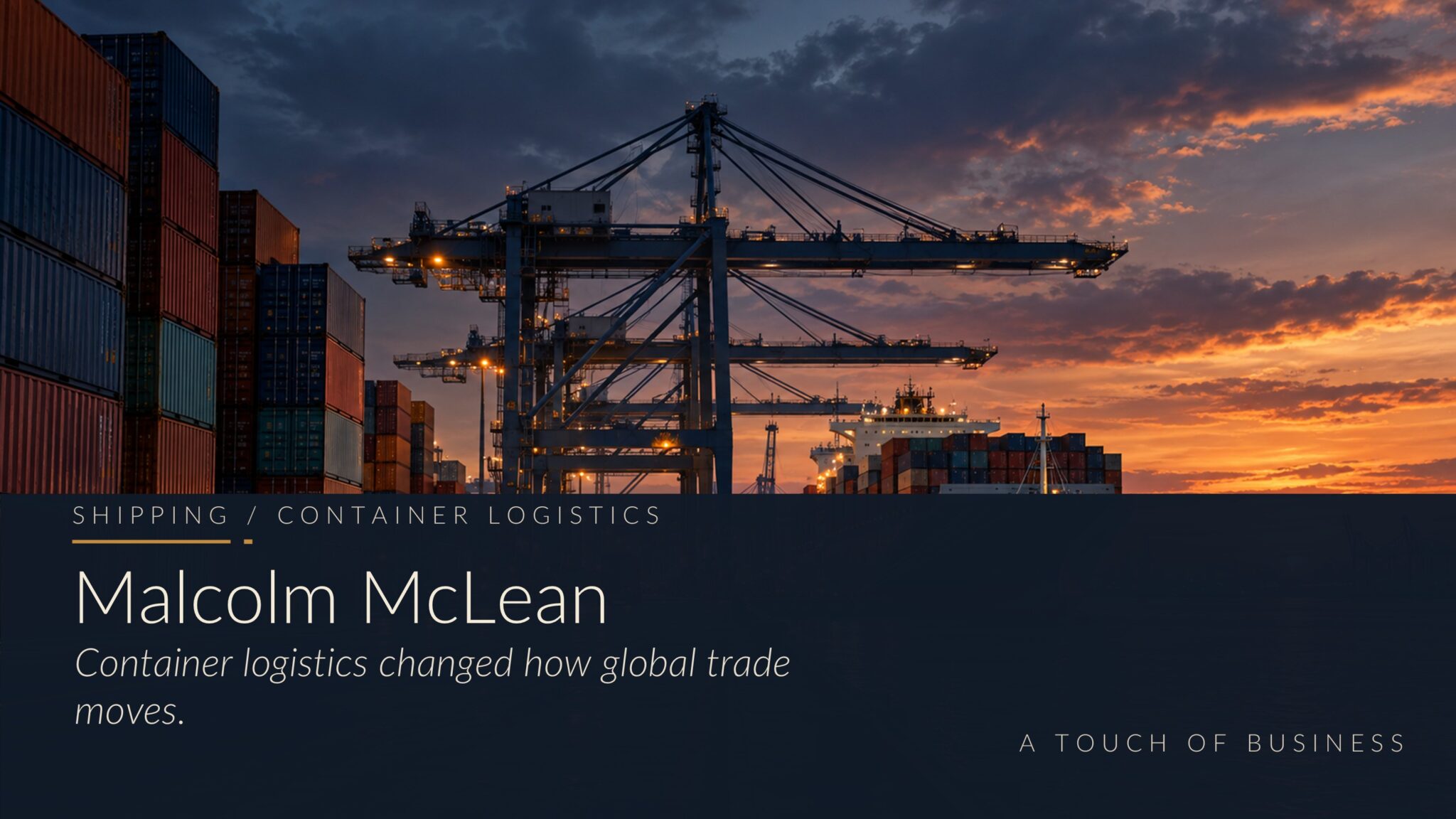
On April 26, 1956, the converted tanker Ideal X left Port Newark, New Jersey, bound for Houston, Texas, with 58 detachable freight containers on its deck. Malcolm McLean, a North Carolina trucking entrepreneur, was backing a practical test of a different way to move cargo between road and sea.
Conventional waterfront freight moved through docks in individual crates, sacks, and barrels, often requiring repeated loading and unloading. McLean’s approach kept goods inside a removable container that could travel on a truck chassis and aboard a ship. The potential saving in handling was substantial. But proving the idea would take more than one voyage: vessels, cranes, terminals, and transport companies all had to work together.
McLean had built one of the country’s largest trucking businesses before turning to ships. Containerization would become his defining achievement, but his later record also included a failed shipping strategy and another attempt to connect freight across land and sea.
A Quick Look at the Life of Malcolm McLean
Biography Summary
Malcolm McLean, also known as Malcom McLean, was an American entrepreneur who helped make modern container shipping commercially workable. After building a major trucking company, he acquired the maritime business that became Sea-Land Service. His subsequent ventures included United States Lines, whose corporate bankruptcy marked a serious setback, and Trailer Bridge, founded in 1991.
Profile
Name: Malcolm P. McLean (also widely spelled Malcom McLean)
Born: 1913 or 1914, in the Maxton area of North Carolina
Died: May 25, 2001, in New York City, aged 87
Education: High school; did not attend college
Known For: Pioneering an integrated commercial system of shipping freight in detachable containers
Major Businesses: McLean Trucking, Pan-Atlantic Steamship Company / Sea-Land Service, United States Lines, and Trailer Bridge
Recognition: Inducted posthumously into the National Inventors Hall of Fame in 2008
From the Maxton Area to a Growing Truck Fleet
McLean grew up in a farming family near Maxton in southeastern North Carolina. His father also worked as a mail carrier. After completing high school in 1931, McLean worked in a grocery store and at a service station. He did not go on to college.
In the mid-1930s, during the Depression, he bought a secondhand truck and began hauling agricultural products and supplies for rural customers. He initially drove loads himself, then added vehicles and hired drivers as the business grew.
Growth was not uninterrupted. During an early economic downturn, customers were lost and the operation had to contract. McLean returned to driving before the business expanded again. His brother and sister also played roles in building the trucking enterprise.
By 1940, the business had about 30 trucks. It grew through new routes and acquisitions, and pursued lower operating costs through diesel equipment, fuel-purchasing arrangements, and conveyor-belt cargo handling at a Winston-Salem facility. This attention to operating costs would also figure in the shipping business McLean later pursued.
By the early 1950s, McLean Trucking had become one of the largest American trucking businesses. A Harvard Business School account records 1,776 trucks and 37 terminals. Yet even a large trucking fleet still depended on the way cargo was handled at the next stop in its journey.
Seeing a Freight Problem Beyond the Highway
The cost of ocean freight was not limited to the time a ship spent at sea. Transferring cargo among trucks, warehouses, docks, and ship holds took hours of labor and exposed the goods to damage, loss, or theft. A container that stayed packed through those transfers could reduce much of that handling.
McLean later recalled delivering cotton to a New Jersey pier in 1937 and waiting while workers handled the bales one by one. “I had to wait most of the day to deliver the bales,” he recalled. He said the experience made him think about transferring a loaded truck body instead. The story comes from his later recollections, and the precise pier location remains disputed.
By the early 1950s, McLean was examining coastal shipping as an alternative for some overland freight. He initially considered taking loaded trailers aboard vessels. Removing the cargo body from its wheels and chassis made better use of shipboard space and allowed the freight boxes to be stacked.
Freight containers had existed before McLean. His contribution was developing a commercially workable system that joined the boxes, ships, loading facilities, and inland transport into one chain.
Selling the Trucking Stake to Build a Shipping Business
McLean’s plan required more than finding a suitable ship. It also involved regulatory barriers: restrictions on common control of competing transportation carriers complicated his ability to operate a major trucking business and a shipping line together. In 1955, he sold his controlling interest in McLean Trucking and moved into maritime transport.
He acquired the Pan-Atlantic Steamship Company, associated with the Waterman shipping enterprise in Mobile, Alabama. Its vessels and operating base gave the container project a starting point at sea. The Pan-Atlantic operation was formally renamed Sea-Land Service in 1960.
Engineers and naval architects were essential to turning the proposal into working equipment. Mechanical engineer Keith Tantlinger developed important container corner fittings and locking arrangements. Naval architect Charles Cushing contributed to ship layouts and later became Sea-Land’s chief naval architect. Other specialists worked on vessels, cranes, stacking, and secure transfer between ship and shore.
McLean himself was listed as the inventor on a freight-shipping apparatus patent filed in 1954 and granted in 1958. That patent was one part of a larger undertaking in which the engineering and commercial contributions were shared among many people.
McLean had given up control of his established trucking business while the new maritime operation was still unproven. Historian Marc Levinson quoted his explanation of such a commitment: “You’ve got to be totally committed.”
The Ideal X Makes the Container Idea Work
The Ideal X was a converted World War II-era T-2 tanker, not a modern container ship built from the keel up for stacked cargo boxes. Its detachable containers were approximately 35 feet long, allowing their freight to remain inside while the box moved between land and sea.
Port accounts describe the loading of the 58 containers in under eight hours. The vessel reached Houston in about five days, where the containers could be transferred back onto truck chassis. The demonstration established that the planned handling process could work from departure to arrival without repacking the goods at every interchange.
A historical comparison recounted by the Federal Reserve Bank of Richmond put conventional dock handling at about $5.83 per ton and loading the Ideal X at 15.8 cents per ton. These figures describe dockside cargo-handling costs, not the full cost of shipping a load of freight.
The successful voyage did not end the problem of building a container network. A single converted ship was useful as a demonstration, but routine large-scale service required ships that could hold more boxes, ports equipped to lift them, and customers willing to use the new system.
Building Sea-Land While Ports and Workers Adapted
The next notable step came on October 4, 1957, when Gateway City entered container service from Port Newark. The converted freighter had below-deck cells for stacking containers and space for additional units above deck. Its capacity of 226 containers showed how much more freight a specially arranged vessel could accommodate than the original tanker demonstration.
The container operation invested in routes, terminal equipment, ship conversions, and customers. Building that network was expensive. From 1957 to 1960, it encountered weak demand and losses estimated at about $8 million. A successful voyage had not made the broader business immediately profitable.
Ports needed cranes, container storage areas, and workable connections to trucks and railways. Other shipping companies and port authorities did not all welcome the new approach. Dockworkers and maritime unions also saw that handling sealed boxes with machinery could reduce the number of workers needed for traditional cargo transfers. Negotiations, labor disputes, compensation arrangements, and early-retirement provisions formed part of the transition.
Expansion continued despite those difficulties. The operation began Puerto Rico service in 1958, formally adopted the Sea-Land Service name in 1960, and extended to the West Coast through the Panama Canal in 1962. Each new route depended on suitable ships, terminals, and connections to inland transport.
From Compatible Containers to an International Network
Container shipping could not reach its wider potential if each carrier and port relied on incompatible equipment. Common container dimensions, corner fittings, and handling interfaces became increasingly important. Industry participants and government-backed standards efforts worked toward compatibility, while McLean agreed to allow relevant Sea-Land patents to be used royalty-free.
Sea-Land’s growth crossed the Atlantic as well. On May 3, 1966, its ship Fairland arrived in Rotterdam, an important early event in dedicated transatlantic container service. Rotterdam operators and related businesses began reorganizing facilities around the method. The voyage should not be mistaken for the first instance of any container crossing the Atlantic; the larger change was the development of a regular, integrated service.
Military demand then contributed to container shipping’s expansion in Asia. In 1967, Sea-Land secured a U.S. military contract to move freight during the Vietnam War. The arrangement helped the company extend container operations across the Pacific. With containers moving west carrying military supplies, commercial return services from Asia—including Japan—offered a way to carry goods in the opposite direction.
Sea-Land Changes Hands
In 1969, R. J. Reynolds acquired control of Sea-Land in a transaction reported at about $160 million. McLean stepped away from daily management around 1970, though he remained on the Reynolds board until 1977. His business interests also included agriculture and Diamondhead, a residential development on the Mississippi Gulf Coast. Meanwhile, Sea-Land continued under its new corporate owner.
United States Lines: A Second Strategy and a Major Setback
McLean returned to shipping-company ownership in 1978 by acquiring United States Lines. This time he favored exceptionally large, relatively slow, fuel-efficient container vessels intended to keep costs low for each unit of freight carried.
In the mid-1980s, United States Lines operated an around-the-world service using 12 very large container ships. Contemporary maritime reporting put their construction cost at about $570 million. But falling fuel prices reduced the advantage of slow, efficient vessels; global overcapacity and competitive freight rates brought further pressure. The fleet’s low-cost promise did not translate into a sustainable business.
On November 24, 1986, United States Lines and its parent McLean Industries, along with related corporate entities, filed for Chapter 11 bankruptcy protection. Ships were laid up, and contemporary reporting described approximately 1,200 layoffs following the filing. McLean was also replaced as president and chief executive of the parent company.
Trailer Bridge and McLean’s Final Years
After the United States Lines collapse, McLean remained involved in freight transport. In April 1991, he founded Trailer Bridge, which developed an integrated shipping connection between the continental United States and Puerto Rico. Its first sailing followed in 1992.
McLean died in New York City on May 25, 2001, at the age of 87. At his funeral, container ships sounded their whistles, and Charles Cushing—the naval architect who had worked on Sea-Land’s ships—delivered the eulogy. The National Inventors Hall of Fame inducted McLean posthumously in 2008.
The Legacy of a Connected Shipping System
McLean did not originate the concept of a freight box, nor did he personally design all the mechanisms that made containers compatible. His enduring contribution was to make an integrated arrangement commercially workable: sealed containers could be lifted between vehicles and ships, secured aboard vessels, processed at suitable terminals, and connected to longer journeys.
Containerization helped reduce handling costs, theft, and damage while making long-distance freight more predictable. It also displaced traditional waterfront work and contributed to wider shifts in manufacturing and trade. The people affected by those changes did not all experience them in the same way.
A 2001 Los Angeles Times obituary quoted McLean from a 1999 Journal of Commerce interview: “Customers change the world, not the one who moves the freight.” His later career did not follow an uninterrupted path of business success, but the integrated freight system he helped establish endured beyond any one company or fleet.
Timeline
These milestones trace McLean’s progression from regional trucking to international container shipping and his later transportation ventures.

1931
Completes high school in North Carolina.
Mid-1930s
Buys a secondhand truck and begins hauling freight for rural customers.
1940
McLean Trucking reaches approximately 30 trucks.
Early 1950s
The trucking business becomes one of the largest in the United States.
1955
Sells his controlling trucking interest and acquires the Pan-Atlantic shipping operation.
April 26, 1956
The Ideal X sails from Port Newark toward Houston with 58 detachable cargo containers.
October 4, 1957
The Gateway City enters container service with below-deck cells and a capacity of 226 containers.
1958–1962
The company starts Puerto Rico service in 1958, adopts the Sea-Land Service name in 1960, and extends service to the West Coast through the Panama Canal in 1962.
May 3, 1966
Sea-Land’s Fairland arrives in Rotterdam on an early dedicated transatlantic container service.
1967–1968
Sea-Land’s Vietnam-era U.S. military freight operations help support transpacific service and commercial cargo movements from Asia.
1969
R. J. Reynolds acquires control of Sea-Land.
1978
McLean acquires United States Lines and pursues large, relatively slow container ships.
November 24, 1986
United States Lines, McLean Industries, and related companies file for Chapter 11 bankruptcy protection.
1991–1992
McLean founds Trailer Bridge in 1991; the company’s first sailing follows in 1992.
May 25, 2001
McLean dies in New York City at age 87.
2008
He is inducted posthumously into the National Inventors Hall of Fame.
FAQs
Did Malcolm McLean invent the first shipping container?
No. Containers and related freight-handling methods existed before McLean. His principal achievement was making an integrated, commercially workable system in which detachable containers could move among trucks, ships, ports, and other transport connections.
Did McLean design the shipping container system entirely by himself?
No. He organized and financed the business, while specialists made essential technical contributions. Keith Tantlinger developed important fittings and locking mechanisms, and naval architect Charles Cushing worked on ship designs.
Why did McLean sell his trucking interest in 1955?
Regulatory restrictions on common ownership of competing transport carriers complicated his plan to operate trucking and shipping together. He sold his controlling interest in McLean Trucking to pursue a maritime business built around detachable freight containers.
What made the Ideal X voyage important?
Its April 1956 voyage carried 58 detachable containers from Port Newark toward Houston, demonstrating how cargo could be moved between ship and truck chassis without unpacking its contents at the waterfront. The experiment preceded the development of larger, more specialized container-carrying ships.
Why is his name sometimes spelled Malcom instead of Malcolm?
Both spellings refer to the same shipping entrepreneur. The U.S. patent record lists Malcolm P. Mclean, while the National Inventors Hall of Fame and several maritime histories use Malcom McLean.
Was Malcolm McLean born in 1913 or 1914?
The National Inventors Hall of Fame gives November 14, 1913, while several other institutional histories give 1914. McLean was born in the Maxton area of North Carolina, but published accounts do not agree on the year.
Did McLean personally go bankrupt after United States Lines failed?
United States Lines, its parent McLean Industries, and related corporate entities filed Chapter 11 petitions in November 1986. Those company filings do not establish that McLean filed for personal bankruptcy.
What did McLean do after United States Lines collapsed?
He founded Trailer Bridge in 1991. The company began sailing in 1992, linking freight movements between the continental United States and Puerto Rico.
Interviews
McLean on Containerization in Winds of Change
The Port Authority of New York and New Jersey’s historical feature includes a documentary excerpt featuring McLean explaining the container idea. It offers a firsthand perspective alongside images and material about the early Port Newark operation. It is a documentary excerpt rather than a complete published interview transcript.
Smithsonian Containerization Oral Histories
The Smithsonian National Museum of American History’s Containerization Oral History Collection contains interviews and related archival material gathered from industry participants during 1995–1998. Accounts from people involved in technical and operational aspects of shipping give readers perspectives beyond the central entrepreneur’s story. The catalog does not establish that McLean himself was one of the interviewees.
Explore the oral history collection
Further Reading
- Marc Levinson, The Box: How the Shipping Container Made the World Smaller and the World Economy Bigger — A history of container shipping’s development, business economics, and wider effects.
- Brian J. Cudahy, Box Boats: How Container Ships Changed the World — A specialist account of the ships and maritime changes associated with containerization.
Sources
- National Inventors Hall of Fame: Malcom McLean, inductee profile
- Smithsonian Magazine: Marc Levinson on the history of the shipping container
- Harvard Business School Working Knowledge: The Truck Driver Who Reinvented Shipping
- Federal Reserve Bank of Richmond: The Voyage to Containerization
- North Carolina Department of Natural and Cultural Resources: Malcolm McLean, Containerization Innovator
- PBS / WGBH: Malcom McLean, innovator profile
- Smithsonian National Museum of American History: Transforming the Waterfront, Containerization Oral History Collection
- Port Authority of New York and New Jersey: Port Newark: How Malcom McLean Changed the World
- Port Houston: Ideal X
- U.S. Patent: Patent US 2,853,968, Apparatus for Shipping Freight
- Transportation Research Board: Brian J. Cudahy, The Containership Revolution
- Netherlands National Archives: The Fairland at Rotterdam, May 3, 1966
- ECT Hutchison Ports: 60 Years of Milestones
- U.S. Naval Institute: U.S. Merchant Marine in 1986
- U.S. Bankruptcy Court for the Southern District of New York: In re McLean Industries, Inc. (1987)
- Trailer Bridge: Company history, Celebrating 30 Years
- The Washington Post: Malcolm McLean Dies (2001)
- Los Angeles Times: Malcom McLean; Pioneered Use of Shipping Containers (2001)