
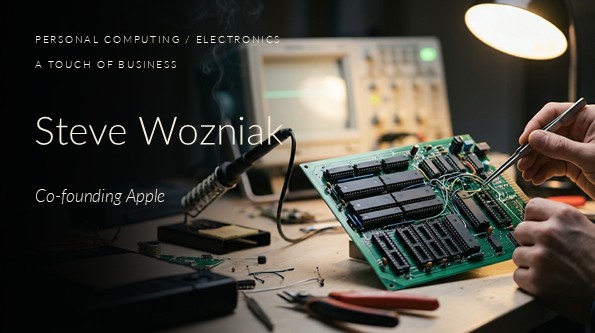
Steve Wozniak developed the Apple I among fellow computer enthusiasts. He later recalled sharing designs freely with members of the Homebrew Computer Club. Steve Jobs saw a commercial opportunity, and an order for 50 assembled boards brought Wozniak’s engineering into a new business.
The Apple II carried that partnership beyond the hobbyist market. With its keyboard, case and color graphics, Wozniak’s next computer offered a more complete system for ordinary users—and helped establish Apple in personal computing.
A Quick Look at the Life of Steve Wozniak
Updated November 3, 2026.
Biography Summary
Steve Wozniak is an American electronics engineer, Apple cofounder and educator. Beyond Apple, his career has included technology ventures, practical computer teaching and support for educational institutions. His public work continued into 2026, including discussions of computing and artificial intelligence.
Profile
Full Name: Stephen Gary Wozniak
Common Name: Steve Wozniak; Woz
Born: August 11, 1950
Birthplace: San Jose, California
Education: B.S. in electrical engineering and computer science, University of California, Berkeley, 1986
Best Known For: Cofounding Apple and designing the Apple I and Apple II
Awards / Honors: National Medal of Technology, jointly with Steve Jobs, 1985; Computer History Museum Fellow, 1998; National Inventors Hall of Fame, 2000
Learning Electronics Before There Was an Apple
Wozniak grew up in the San Jose area and attended Homestead High School. His father was an electrical engineer, a connection Wozniak later described as important to his own learning. In a 2026 interview, he recalled teaching himself electronics by ten and designing computers on paper when he could not afford the chips needed to build them.
He attended the University of Colorado and De Anza College before Berkeley. His studies were interrupted by work for electronics companies, including Hewlett-Packard, where he designed calculators.
“I never wanted to start an industry” was how Wozniak described his early ambitions in 2026. He said he wanted recognition from other engineers for his designs.
Two Steves, Different Contributions
Bill Fernandez introduced Wozniak to Steve Jobs in 1971. Their shared interest in electronics produced a collaboration before either became an Apple cofounder: building and selling blue boxes that allowed unpaid long-distance telephone calls. Wozniak handled the electronics; Jobs helped sell the devices.
The partnership also involved games. Wozniak later recalled helping Jobs reduce the number of chips in Atari’s Breakout design.
In a 1984 interview, Wozniak distinguished their interests: he wanted a computer with a keyboard and display, while Jobs thought about products and selling computers to a broader public.
From Homebrew Designs to an Order for 50 Boards
Wozniak developed the Apple I in 1975 and showed his design at the Homebrew Computer Club. The club provided a community in which enthusiasts could exchange technical ideas and demonstrate their work.
Jobs saw a market beyond the club. Paul Terrell’s Byte Shop ordered 50 assembled Apple I boards. To help finance the early effort, Wozniak sold his HP-65 calculator and Jobs sold his Volkswagen; supplier credit also helped pay for parts.
The Apple I was a board rather than a complete consumer system. Customers still needed additional components, including a case and power supply.
On April 1, 1976, Wozniak, Jobs and Ronald Wayne formed the Apple Computer Company partnership. Incorporation followed in January 1977, with Mike Markkula’s funding and business planning supporting the enterprise’s expansion.
The familiar garage story captures only part of that beginning. In a 2013 interview, Wozniak said he did design work in his apartment and his HP cubicle. The Jobs family garage, he recalled, was used for testing and packing boards.
The Apple II Reaches Beyond the Hobbyist
The Apple II changed what a buyer received. Wozniak’s 1977 design placed the electronics, keyboard and power supply in a consumer case, with color graphics and BASIC built in. A television could serve as the display. Apple demonstrated the machine at the first West Coast Computer Faire in April and began shipping it in June.
The Apple II offered a more complete tool for home, work and school, helping establish Apple in the personal-computer market.
Storage remained a separate challenge. The original Apple II did not ship with a disk drive. Wozniak subsequently designed a disk controller using just eight integrated circuits, and he and Randy Wigginton supplied early disk software for a January 1978 demonstration.
The disk system also depended on other programmers. Paul Laughton, working through Shepardson Microsystems, developed higher-level Apple II DOS software under contract. Disk support in 1978 and the VisiCalc spreadsheet in 1979 expanded the computer’s practical uses.
A Crash, College and the US Festivals
A private-plane crash interrupted Wozniak’s Apple work in 1981. He took time away and returned to Berkeley that year to resume his unfinished education.
During his time away from regular Apple work, Wozniak organized the US Festivals in 1982 and 1983. The events combined music with technology displays but incurred substantial financial losses.
His Apple involvement resumed: a 1984 interview described him as an Apple Fellow with speaking duties and technical projects. In 1985 he took leave again. That year he founded CL9 to develop a programmable remote control, continuing his engineering work outside Apple’s regular operations.
Wozniak completed his Berkeley bachelor’s degree in electrical engineering and computer science in 1986. He had used a student alias, Rocky Clark or Rocky Raccoon Clark. He later explained that he requested the longer name on his diploma to reduce the expectations associated with being a famous computer designer.
His departure concerned regular operational work, rather than every connection with Apple: the Computer History Museum’s Fellow profile describes a continuing employee affiliation. Wozniak also rejected a portrayal of habitual fighting with Jobs, expressing appreciation for his former partner’s vision in a 2013 interview.
Putting Computers in Other People’s Hands
Teaching became a substantial part of Wozniak’s work beyond Apple. He supplied equipment and practical computer instruction in schools, including the Los Gatos district, and supported educational and cultural institutions in San Jose.
In a 2005 interview, Wozniak recalled teaching computers for eight years to children and teachers. He said he wrote his own materials and paid the costs himself.
His public engagement also included digital rights. In 1990, Wozniak offered matching financial support to the Electronic Frontier Foundation and joined its board that October, according to cofounder John Perry Barlow’s account.
Wozniak continued working with technology ventures alongside his educational activities. Wheels of Zeus pursued wireless location technology. In February 2009, his appointment as Fusion-io’s chief scientist was reported, following service on its advisory board.
Wozniak also linked humor with creativity. As he put it in the 2005 interview: “Pranks are just a creative form of logic.”
Woz U and Questions About Instruction
Wozniak co-founded Woz U in October 2017, entering technology education through a training venture. In 2018, CBS reported complaints about Woz U instruction.
In the company’s October 2018 response, Wozniak said he advised its educational philosophy as a cofounder and board member but did not handle daily operations. Woz U said review procedures had addressed content problems.
Public Life Beyond Apple
Illness interrupted a planned public appearance in November 2023. Wozniak told ABC News on November 9 that an MRI after he became ill in Mexico City showed a minor stroke. He said he had left hospital and was flying home. He did not deliver his planned World Business Forum talk.
A separate legal dispute concerned cryptocurrency scam videos using Wozniak’s identity. Wozniak and other plaintiffs sued YouTube and Google, alleging that platform conduct helped the scam. The defendants invoked Section 230 immunity.
In March 2024, a California appellate court ruled that most claims were barred by Section 230. It nevertheless reversed the judgment to allow the plaintiffs to amend allegations involving verification badges that might fall outside that immunity. The ruling did not establish fraud liability or award damages.
By January 2026, he was appearing publicly at Lehigh University in conversation with its president, Joseph Helble. Wozniak advocated greater AI accountability and source attribution, while saying that AI could help generate ideas.
The Tech Interactive named him its 2025 James C. Morgan Global Humanitarian honoree, recognizing his support for accessible learning. Its January 2026 announcement scheduled the presentation for later that month.
Engineering That People Could Use
The Apple II and its compact disk controller show Wozniak’s ability to turn economical circuitry into useful computing tools. His later teaching put him directly alongside students and teachers, writing lessons as well as supplying equipment. Designing computers and helping others use them became distinct, substantial parts of his career.
Timeline
Key milestones trace Wozniak’s work from electronics and Apple to education and public advocacy.

August 11, 1950
Born in San Jose, California.
1971
Bill Fernandez introduces Wozniak and Steve Jobs.
1975–1976
Develops the Apple I and shares it with Homebrew enthusiasts. On April 1, 1976, forms the Apple partnership with Jobs and Ronald Wayne.
1977–1978
Apple incorporates in January 1977. The Apple II debuts that spring and ships in June; an early disk system is demonstrated in January 1978.
1981–1983
A plane crash interrupts his Apple work in 1981; he returns to Berkeley. Organizes the US Festivals in 1982 and 1983.
1985–1986
Takes leave from Apple, founds CL9 and shares the National Medal of Technology with Jobs in 1985. Completes his Berkeley degree in 1986.
1990
Offers matching financial support to the Electronic Frontier Foundation and joins its board.
1998–2000
Named a Computer History Museum Fellow in 1998 and inducted into the National Inventors Hall of Fame in 2000.
2009
His appointment as Fusion-io chief scientist is reported in February.
2017–2018
Co-founds Woz U in October 2017. Complaints about instruction are reported in 2018; the company issues a response.
2023–2024
Reports a stroke and hospital discharge in November 2023. In March 2024, an appellate court permits amendment on a limited issue in the YouTube lawsuit.
2026
Speaks at Lehigh University about computing and AI. The Tech Interactive announces his selection as its 2025 humanitarian honoree.
FAQs
Question: Did Steve Wozniak or Steve Jobs design Apple’s first computers?
Answer: Wozniak designed the Apple I and Apple II. Jobs helped commercialize the products, while other collaborators supplied important business and software contributions.
Question: Was the first Apple computer designed in a garage?
Answer: Wozniak said the design work took place in his apartment and HP cubicle. In his account, the Jobs family garage was used for testing and packing boards, rather than serving as the location of all the engineering.
Question: Did Steve Wozniak finish college after cofounding Apple?
Answer: Yes. Wozniak completed his Berkeley bachelor’s degree in electrical engineering and computer science in 1986, following an interrupted education.
Question: Did Steve Wozniak leave Apple completely in 1985?
Answer: Wozniak left regular operational work in 1985, but an undated Computer History Museum profile describes a continuing employee affiliation. It does not establish his current duties or compensation.
Interviews
Apple Engineering in 1984
Danny Goodman’s contemporary interview examines Wozniak’s contribution to Apple and his distinction between engineering a computer and selling a product. It also describes his work at Apple after his earlier hiatus.
Teaching and Creativity: Berkeley, 2005
This conversation covers Wozniak’s computer teaching, the materials he created and his explanation of the name used on his diploma. His reflections on humor give readers another way into his thinking about creativity.
The Garage Story and Working With Jobs, 2013
Wozniak gives a detailed account of the garage’s limited role in Apple’s beginnings. He also responds directly to a question about his relationship with Jobs.
Engineering Ambitions and AI, 2026
Lehigh’s interview returns to Wozniak’s early electronics learning and his recollection of sharing designs with hobbyists. It also presents his views on AI accountability and attribution.
Further Reading
Sources
- Encyclopedia of World Biography / Encyclopedia.com: Steve Wozniak biography
- National Inventors Hall of Fame: Steve Wozniak induction profile
- Computer History Museum: 1998 Fellow profile, Apple’s early partnership and development, The Apple II, Apple II DOS source code and technical history, Apple@50 Timeline, Honorary Council profile
- Lehigh University: Four Questions with Steve Wozniak (2026), Lehigh public conversation (2026)
- Berkeley Engineering: Inventor and Apple cofounder, Forefront interview (Fall 2005)
- Los Angeles Times: Wozniak takes leave (1985)
- United States Patent and Trademark Office: 1985 technology-medal laureates
- Creative Computing: Danny Goodman interview (1984)
- Cal Alumni Association: Woz Up
- Digital Collegium / Link Journal: Six Questions with Steve Wozniak (2013)
- Officially Woz: Official biography
- The Tech Interactive: Global Humanitarian honoree announcement
- Electronic Frontier Foundation: Early history of the EFF (1990)
- EE Times: Fusion-io appointment (2009)
- CBS News: Woz U complaints (2018)
- Woz U: Woz U response (2018)
- California Court of Appeal: Wozniak v. YouTube, LLC (2024)
- ABC News: Wozniak reports stroke (2023)