
SpaceX’s fourth Falcon 1 launch reached orbit on September 28, 2008, after three failed attempts. The company Elon Musk had established six years earlier had achieved the first orbital flight by a privately developed liquid-fueled rocket.
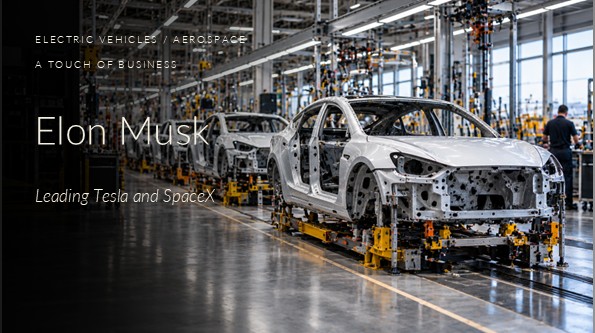
That year, Musk also became Tesla’s chief executive, and NASA awarded SpaceX a major cargo-resupply contract. The entrepreneur whose early companies had worked in online publishing and payments was now leading businesses in vehicle manufacturing and spaceflight.
A Quick Look at the Life of Elon Musk
Biography Summary
Elon Musk is a South African-born entrepreneur and the chief executive of Tesla and SpaceX. His career began with Zip2 and X.com, which became part of PayPal, and later expanded into social media and AI. Ownership of Twitter, the launch of xAI and a temporary U.S. government role added new responsibilities to his industrial businesses.
Profile
Full Name: Elon Reeve Musk
Born: June 28, 1971
Birthplace: Pretoria, South Africa
Education: Queen’s University; University of Pennsylvania, degrees in physics and economics, formally awarded in 1997
Major Roles, 2026: Tesla CEO; SpaceX CEO, chief technical officer and chairman
Other Ventures: X, xAI, Neuralink and The Boring Company
Coverage Through: November 4, 2026
From Pretoria to North American Universities
Born in Pretoria in 1971, Musk was the son of Maye Musk, a Canadian-born model, and Errol Musk, a South African engineer. As a young teenager, he created and sold a computer game called Blastar.
He moved to Canada, studied at Queen’s University in Kingston, and subsequently attended the University of Pennsylvania. At Penn, he studied physics and economics. He left in 1995, although his degrees were formally awarded in 1997.
Musk later recalled wanting to reach the United States and obtaining Canadian documentation through his mother. His early internet businesses followed his studies in North America.
Setting Aside Graduate Plans for Zip2
In 1995, Musk set aside graduate-study plans at Stanford to pursue internet entrepreneurship. He co-founded Zip2, with his brother Kimbal participating in a business that supplied maps, directories and online publishing services to newspapers.
Musk described keeping a route back to graduate study while testing the business opportunity. In a 1999 interview, he said, “I’m not a born risk taker.” He recalled taking deferred admission at Stanford.
Zip2 expanded with venture financing and relationships with major newspaper publishers. Mohr Davidow backed the company, while newspaper clients gave its software a place in the developing market for online local information.
Compaq acquired Zip2 in 1999 for approximately $307 million. Musk’s next venture took his internet work into financial services.
X.com and the Transition to PayPal
Musk launched X.com in 1999 as an online financial-services company. Its 2000 merger with Confinity brought together businesses working in digital payments; the combined company became PayPal.
Payments using an email address and transactions on eBay were central to PayPal’s growth. Musk later recalled that the company had faced difficulties surviving its early years.
In 2002, eBay acquired PayPal for approximately $1.5 billion in stock. Musk also established SpaceX that year, extending his business activity into spaceflight.
SpaceX Moves from Failed Launches to NASA Cargo Work
SpaceX’s early launch program encountered three consecutive Falcon 1 failures before the fourth attempt reached orbit in September 2008. The company then moved toward a new operational commitment: supplying the International Space Station.
NASA awarded SpaceX a $1.6 billion contract that December for 12 International Space Station cargo flights.
Dragon returned from orbit in December 2010 and visited the International Space Station with cargo in May 2012, both commercial firsts. SpaceX’s work now included spacecraft recovery and station deliveries as well as orbital launches.
Gwynne Shotwell served as SpaceX’s president and chief operating officer alongside Musk’s executive leadership. Engineering teams, suppliers and NASA contributed to the company’s spaceflight programs.
Tesla: From Early Investment to Manufacturing at Scale
Tesla’s beginnings preceded Musk’s investment. Martin Eberhard and Marc Tarpenning established the company in July 2003; Musk invested and joined its board in April 2004. He became CEO in October 2008. A settlement the following year recognized Musk, Eberhard and three others as co-founders.
Tesla began Roadster deliveries in 2008 and launched the Model S in 2012. Moving from an initial sports car to a sedan broadened the vehicle business. The later Model 3 ramp brought a different pressure: producing a lower-priced car at greater scale while managing manufacturing delays and cash demands.
By August 2018, Tesla reported that it had repeatedly reached roughly 5,000 Model 3s a week during July. Analysts still questioned whether the rate could be sustained. Tesla reduced capital-spending plans and began workforce cuts as it worked through the production ramp.
The manufacturing business was substantially larger by 2020. Tesla reported 499,647 vehicle deliveries and $721 million in net income attributable to common stockholders. Its annual filing also reported $1.58 billion in automotive regulatory-credit revenue, an important part of the financial picture.
Tesla was expanding production in Shanghai and Fremont while also operating an energy business that included Powerwall and Megapack.
Public Statements Bring Securities Scrutiny
The Model 3 production period also brought scrutiny of Musk’s public statements. In 2018, the Securities and Exchange Commission alleged that his statements about secured funding for a Tesla take-private transaction were misleading.
A court approved the settlement in October 2018. Musk and Tesla each agreed to pay a $20 million civil penalty without admitting or denying the SEC’s allegations. Musk would leave the chairmanship, while remaining eligible to serve as CEO and a director; Tesla also agreed to governance and communications controls.
In February 2023, a jury found Musk and Tesla not liable in a separate private-investor lawsuit over the 2018 tweets. The verdict did not overturn the SEC settlement.
SpaceX’s Parallel Progress Toward Crewed Flight
Alongside Tesla’s manufacturing expansion, SpaceX was developing reusable launch hardware. On December 21, 2015, the company landed a Falcon 9 first stage after launching an orbital payload.
On May 30, 2020, SpaceX’s Demo-2 mission launched NASA astronauts Robert Behnken and Douglas Hurley from Florida aboard Crew Dragon and Falcon 9. It was the first astronaut launch from U.S. soil since the shuttle program ended in 2011, using a commercially built and operated crew spacecraft.
“This is a dream come true for me and everyone at SpaceX,” Musk said at the launch. The achievement reflected work by SpaceX, NASA and their partners, bringing a public-private program into crewed flight.
Twitter Ownership and a Return to AI Competition
Musk’s acquisition of Twitter added a major communications platform to his businesses. He completed the roughly $44 billion purchase in October 2022 after a contested deal process and removed senior leadership. The platform later became known as X.
Artificial intelligence was another area of renewed involvement. Musk had co-founded OpenAI in 2015 and left its board in 2018. In July 2023, he publicly launched xAI as a rival AI company.
Musk’s other ventures included Neuralink and The Boring Company. Tesla’s 2026 corporate biography identified him as a founder of both and as Neuralink’s CEO.
Tesla Faces Driver-Assistance Safety Oversight
Tesla’s expanding vehicle business also faced safety oversight. The company issued a recall addressing Autosteer controls that could be insufficient to prevent driver misuse, with an over-the-air software remedy and additional alerts and checks.
Tesla described the affected feature as SAE Level 2 driver assistance requiring continuous supervision. NHTSA’s 2024 investigation-closing report identified inadequate driver engagement and limitations in warnings and monitoring controls in the crashes it reviewed.
The regulator’s findings concerned the driving-assistance system and its use; they did not establish that Musk personally caused particular collisions.
From Election Support to a Temporary Government Role
Musk’s political involvement expanded with major financial support for Donald Trump and other Republicans in the 2024 election. In early 2025, he became a special government employee and a prominent leader of the administration’s Department of Government Efficiency (DOGE) cost-cutting effort.
The effort brought extensive workforce reductions and spending cancellations, alongside controversy and concern among business shareholders. DOGE’s savings claims were disputed. Its publicly itemized accounting fell well below its headline claim, and Musk’s initial $2 trillion target had not been achieved by the end of his temporary role.
Musk’s approximately four-month government stint ended around May 30, 2025, when his 130-day special-employee mandate concluded.
Compensation and Separate Court Outcomes
Questions about corporate control continued at Tesla. On December 19, 2025, the Delaware Supreme Court reversed the rescission of Musk’s 2018 compensation plan, reinstated the plan and awarded nominal damages. The court resolved the appeal on the narrower question of the remedy.
Tesla’s 2026 proxy reported that a separate 2025 interim award was forfeited in April 2026 after the 2018 award’s reinstatement.
On May 18, 2026, a jury decided that Musk had waited too long to bring his lawsuit against OpenAI. The decision turned on timeliness and did not resolve every underlying substantive accusation.
In a Twitter takeover-related shareholder fraud case, a federal jury found Musk liable in 2026. On July 6, a judge rejected his attempt to void the verdict, while finding him not liable for one challenged tweet. The case concerned civil liability.
A separate SEC case concerned disclosure of Musk’s initial Twitter stake. The regulator alleged that delayed disclosure allowed him to buy shares at lower prices; Musk said the delay was inadvertent. A judge approved a settlement on July 8, 2026, under which a trust in Musk’s name was to pay $1.5 million.
SpaceX, xAI and a Proposed Tesla Combination
After xAI acquired X in March 2025, SpaceX acquired xAI in February 2026, bringing those businesses into a combined organization. Tesla’s 2026 proxy continued to list Musk as Tesla CEO and SpaceX CEO, chief technical officer and chairman.
By October 20, 2026, SpaceX was publicly traded, and Musk said independent committees were considering a combination with Tesla. He said terms had not been agreed and a transaction might never happen. The Tesla–SpaceX merger remained a potential transaction as of November 3.
As of October 20, 2026, Starship had not entered commercial service.
An Expanding Career with Unfinished Questions
The expansion of Musk’s businesses has repeatedly brought new responsibilities: manufacturing at scale, working with public institutions, and governing companies whose activities reach well beyond their original products. Teams, suppliers and outside capital have remained part of that development.
His career also shows the recurring demands of delivering ambitious projects and accounting for public statements and corporate decisions. With another major business combination still under discussion in late 2026, the balance between expansion, execution and governance remains unfinished.
Timeline
These milestones trace Musk’s movement from internet startups into manufacturing, spaceflight and wider public responsibilities.

June 28, 1971
Elon Reeve Musk is born in Pretoria, South Africa.
1995–1997
Musk co-founds Zip2 in 1995 and sets aside Stanford graduate-study plans. His Penn degrees are formally awarded in 1997.
1999–2000
Compaq acquires Zip2 in 1999. Musk launches X.com, which merges with Confinity in 2000; the combined company becomes PayPal.
2002
Musk establishes SpaceX. In a separate transaction, eBay acquires PayPal for approximately $1.5 billion in stock.
2004
Musk invests in Tesla and joins its board in April.
2008
The fourth Falcon 1 reaches orbit in September. Musk becomes Tesla CEO in October, and NASA awards SpaceX its cargo contract in December.
2010–2012
Dragon returns from orbit in 2010 and visits the ISS with cargo in 2012. Tesla launches the Model S in 2012.
December 21, 2015
SpaceX lands a Falcon 9 first stage after an orbital-payload launch.
2018
Tesla works through its Model 3 production ramp. A court approves separate SEC settlements with Musk and Tesla in October.
2020
Demo-2 launches NASA astronauts in May. Tesla reports 499,647 deliveries and annual net income attributable to common stockholders of $721 million.
2022–2023
Musk completes the Twitter acquisition in October 2022. A jury finds Musk and Tesla not liable in the private-investor Tesla-tweets case in February 2023; he publicly launches xAI in July.
2025
Musk participates in DOGE before his temporary government role ends in May. In December, the Delaware Supreme Court reinstates his 2018 Tesla compensation plan.
2026
SpaceX acquires xAI in February. Separate OpenAI and Twitter cases reach court outcomes. By October and November, a Tesla–SpaceX combination remains under discussion.
FAQs
Question: Did Elon Musk establish Tesla before investing in it?
Answer: No. Martin Eberhard and Marc Tarpenning established Tesla in 2003. Musk invested and joined the board in 2004, then became CEO in 2008.
Question: Why are both 1995 and 1997 associated with Elon Musk’s Penn education?
Answer: Musk left the University of Pennsylvania in 1995; his degrees in physics and economics were formally awarded in 1997. The dates describe different points in his education.
Question: Did NASA fund SpaceX?
Answer: Yes. NASA supported SpaceX through company agreements and cargo-service contracts. In December 2008, NASA awarded SpaceX a $1.6 billion contract for 12 ISS cargo flights.
Question: Did the 2023 Tesla-tweets verdict overturn Musk’s SEC settlement?
Answer: No. The February 2023 verdict found Musk and Tesla not liable in a private-investor case. The 2018 SEC settlement was a separate civil enforcement proceeding.
Question: Were SpaceX and Tesla one company by November 2026?
Answer: As of November 3, 2026, a Tesla–SpaceX merger was still being discussed as a potential transaction. SpaceX’s acquisition of xAI was a separate, completed deal.
Interviews
Looking Back at the First Companies
The Computer History Museum’s January 2013 conversation with Musk looks back at his education and early businesses. His recollections of PayPal’s survival difficulties provide a firsthand perspective on the period before its acquisition.
The Graduate-Study Decision and Zip2
The 1999 interview in The Pennsylvania Gazette captures Musk’s explanation of choosing internet entrepreneurship over graduate-study plans. It also places Zip2 in the newspaper industry’s developing online market, before his later vehicle and spaceflight ventures.
How Musk Describes First-Principles Reasoning
In this October 2013 American Physical Society interview, Musk discusses applying first-principles reasoning to difficult technical problems. He also acknowledges the mental effort involved and explains why he does not use that approach throughout everyday life.
Sources
- Sky News: Elon Musk: A profile of the ‘poster child for disruption’ (December 19, 2022)
- The Pennsylvania Gazette: From Zip to X (November 2, 1999)
- Knowledge at Wharton: Harnessing the Sun and Outer Space: Elon Musk’s Sky-high Vision (May 13, 2009)
- Stanford Technology Ventures Program: Elon Musk institutional speaker profile
- Computer History Museum: An Evening with Elon Musk, January 22, 2013, transcript
- Tesla / SEC EDGAR: 2026 definitive proxy statement, 2020 Form 10-K, Form 8-K reporting final settlement judgment (October 16, 2018)
- NASA-hosted NASA/SpaceX mission documentation: CRS-4 Press Kit (2014), historical milestones and leadership
- Space.com, Tariq Malik: SpaceX Successfully Launches Falcon 1 Rocket Into Orbit (September 28, 2008)
- NASA Astronomy Picture of the Day: Falcon 9 First Stage Landing (December 28, 2015)
- Science News: SpaceX rocket sticks its landing (December 2015)
- NASA: NASA Astronauts Launch from America in Historic Test Flight of SpaceX Crew Dragon (May 30, 2020)
- Reuters, via Investing.com: Tesla flags promise of profit as Model 3 production steadies (August 1, 2018), Timeline: Musk takes ownership of Twitter (October 28, 2022), Elon Musk launches AI firm xAI as he looks to take on OpenAI (July 12, 2023)
- Reuters, via Investing.com: Trump, Musk offer show of unity as Tesla CEO departs government (May 30, 2025), SpaceX acquires xAI in record-setting deal as Musk looks to unify AI and space ambitions (February 2–3, 2026), US judge approves Elon Musk settlement with SEC despite misgivings, ‘red flags’ (July 8, 2026)
- Reuters, via Investing.com: Key moments in the Musk vs OpenAI trial (May 18, 2026)
- U.S. Securities and Exchange Commission: Elon Musk Settles SEC Fraud Charges; Tesla Charged With and Resolves Securities Law Charge (September 29, 2018)
- Associated Press: Jury: Musk didn’t defraud investors with 2018 Tesla tweets (February 3, 2023)
- American Physical Society: Profiles in Versatility, interview part 1 (October 1, 2013)
- Delaware Supreme Court, reproduced by Justia: In re Tesla, Inc. Derivative Litigation (December 19, 2025), opinion text
- San Francisco Chronicle: Key moments in Tesla Motors history (2012)
- Reuters: Musk says SpaceX-Tesla merger is ‘a good idea’ as companies form deal committees (October 20, 2026), Musk’s pay under a SpaceX-Tesla merger: voting control, but no $1 trillion payday (November 3, 2026)
- Reuters, via MarketScreener: Elon Musk’s bid to set aside Twitter fraud verdict rejected by US judge (July 6, 2026)
- Los Angeles Times: Tesla founders end bitter legal fight (September 22, 2009)
- Tesla Support: Update Vehicle Firmware to Prevent Driver Misuse of Autosteer
- NHTSA Office of Defects Investigation: EA22-002 closing report (2024)