
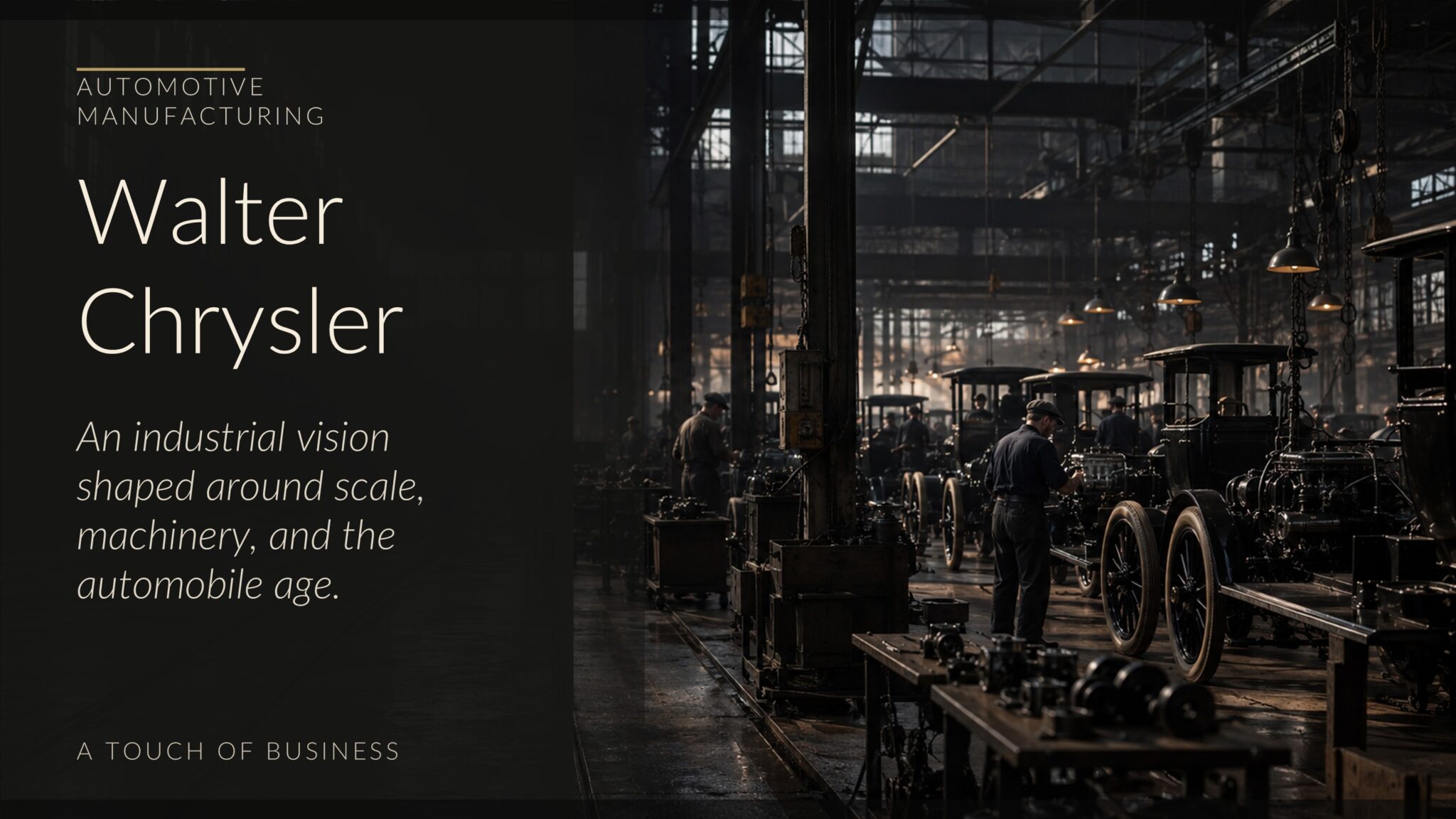
Walter Chrysler had already risen through railroad and locomotive management when Buick offered him a reason to change direction. American Locomotive had raised his salary to $12,000 a year. Buick’s offer was $6,000.
He took the lower-paying job.
In Chrysler’s own account, after looking over Buick’s plant, he told Charles Nash, “I think I could be a useful man in this plant.” That decision moved him from locomotives into automobiles and opened the next phase of a career that would take him through Buick, two troubled automakers, and eventually a company bearing his own name.
A Quick Look at the Life of Walter Chrysler
Biography Summary
Walter P. Chrysler began as a machinist in railroad shops and advanced into large-scale industrial management before entering automobile manufacturing. At Buick he became a senior executive, then moved into turnaround work at Willys-Overland and Maxwell.
The Chrysler Six helped lead to the formation of Chrysler Corporation in 1925, followed by rapid expansion through Plymouth, DeSoto, and the acquisition of Dodge Brothers.
Profile
Full Name: Walter Percy Chrysler
Born: April 2, 1875
Died: August 18, 1940
Birthplace: Wamego, Kansas, United States
Best Known For: Founding Chrysler Corporation
Major Roles: Railroad machinist and manager, Buick president and general manager, corporate turnaround executive, president and chairman of Chrysler Corporation
Learning Machines in the Railroad Shops
Chrysler was born in Wamego, Kansas, and grew up in Ellis. His father worked as a locomotive engineer, placing railroad machinery close to everyday family life. Chrysler eventually entered the Union Pacific shops at Ellis as a machinist apprentice.
The apprenticeship gave him a practical education in machinery. In his autobiography, Chrysler also recalled an incident that briefly cost him his job: he threw oily waste intended for another worker and accidentally struck a foreman. He apologized and was allowed to return. Looking back, he treated the episode as a lesson that made him take the craft more seriously.
After his apprenticeship, Chrysler moved through a succession of railroad jobs and shops. The work changed as his responsibilities grew. He advanced from machinist work into supervision, eventually holding positions that included master mechanic and superintendent of motive power.
At the Chicago Great Western operation in Oelwein, Iowa, his own account describes a particularly fast rise: from master mechanic to general master mechanic and then superintendent of motive power in roughly eighteen months. Before he entered the automobile industry, he had also become works manager at American Locomotive Company’s Allegheny-area operation near Pittsburgh.
A $5,000 Automobile Becomes a Mechanical Study
Cars entered Chrysler’s life before they became his profession. In 1908, while living in Oelwein, he attended the Chicago automobile show and bought a Locomobile for $5,000.
His interest was not limited to driving it. Chrysler later recalled wanting to understand the machine piece by piece, and the episode includes him taking the car apart and reassembling it before seriously using it on the road.
The Locomobile did not by itself determine his next career move, but it showed that Chrysler’s mechanical attention was already extending beyond railroads. The eventual move to Buick gave that interest a much larger field to work in.
Taking Half the Pay to Join Buick
Chrysler was recruited by Buick in 1911 and was serving as works manager by 1912. The move came with a striking financial tradeoff. According to his own account, American Locomotive had raised his salary to $12,000 a year, while Buick offered $6,000.
At Buick, Chrysler began applying manufacturing ideas to automobile production. Changes included assembly-line methods, painting parts before assembly, spray-paint techniques, and other improvements to production flow. In one chassis operation described in his autobiography, output rose from about 45 cars a day to about 200.
The job also changed Chrysler’s place in the industry. William C. Durant elevated him to president and general manager of Buick in 1916. What had begun as a move into a new field had become a senior executive role at one of the major automobile operations of the period.
That relationship did not last indefinitely. Chrysler left Buick and General Motors in 1919 after differences with Durant over management. He had reached the top of a large operating company, but the next stage of his career would be less about running a healthy division and more about dealing with troubled ones.
From Buick Success to Willys and Maxwell Problems
After leaving General Motors, Chrysler was recruited to help the financially troubled Willys-Overland organization. In his autobiography, he remembered being reluctant because a failed rescue could damage the reputation he had built at Buick. He nevertheless accepted a two-year arrangement and insisted on operating authority. During the turnaround, Willys-Overland’s indebtedness fell from about $46 million to $18 million within months.
Willys was not the only distressed automobile company to come his way. Bankers also asked Chrysler to become involved with Maxwell Motor Company. His first reaction, as he later recalled it, was blunt: “I would not touch it with a ten-foot pole.”
He changed his mind.
Maxwell had serious financial and operating problems and had gone through bankruptcy and reorganization. Chrysler became part of the effort to stabilize the business, address costs and financing, and improve its products. Maxwell returned to profitability in 1922 and 1923, although the related Chalmers operation continued to lose money.
Years later, Chrysler described Maxwell as the greatest opportunity of his life. The contrast was significant: a company he initially wanted to avoid became the route to an automobile bearing his own name.
The Chrysler Six Creates a Path Forward
In early 1924, the Maxwell organization introduced the Chrysler Six. It was positioned in the middle of the market and carried features that included a high-compression engine and four-wheel hydraulic brakes.
Chrysler later described showing the new car at New York’s Commodore Hotel and using the favorable public response while seeking financial backing. The Chrysler Six gave the Maxwell organization a stronger product around which to reorganize.
On June 6, 1925, Maxwell was reorganized as Chrysler Corporation. Walter Chrysler became president and chairman.
The company that carried his name had arrived only a few years after he had first resisted becoming deeply involved with Maxwell.
1928 Changes the Scale of Chrysler’s Company
Chrysler Corporation moved quickly after its formation. In 1928, it broadened its product range with Plymouth for the low-priced market and DeSoto for the middle market.
The larger change came through Dodge Brothers. Chrysler negotiated the acquisition, and the deal brought the company additional manufacturing capacity, foundries, truck operations, and an established dealer network. In his own account, Chrysler later called the purchase one of the soundest acts of his life.
The year also raised his public profile far beyond the factory floor. TIME selected Walter Chrysler as its Man of the Year for 1928, a period marked by the new brands, the Dodge acquisition, expansion in commercial vehicles, and plans for the skyscraper that would carry his name.
By then, the mechanic who had entered Buick for half his previous salary was running an automobile company with a much broader national reach.
The Chrysler Building Was a Personal Project
The Chrysler Building became one of the most visible symbols associated with Walter Chrysler, but it was not simply another Chrysler Corporation project. He worked with architect William Van Alen on the New York skyscraper as a personal and family undertaking rather than as a corporate real-estate asset.
Chrysler recalled telling the architects to make the building higher than the Eiffel Tower. When the building opened in 1930, it briefly held the title of the world’s tallest building before the Empire State Building surpassed it.
The distinction between Chrysler the man and Chrysler the corporation matters here. The tower carried the name and was closely associated with the automaker, but it remained a personal and family project rather than a Chrysler Corporation property.
Expansion Gives Way to Depression-Era Retrenchment
The rapid expansion of the late 1920s was followed by a very different operating environment. As automobile sales fell in 1930, Chrysler Corporation closed plants, laid off workers, and reduced administrative expenses.
Walter Chrysler pushed senior managers for major departmental cost reductions, while the company also continued investing in engineering and operating efficiency. Plymouth’s position in the lower-priced market became especially important during the Depression.
This period looked very different from the company’s rapid buildout of 1928. Chrysler Corporation was cutting costs and improving efficiency while continuing to invest in future products.
Airflow Pairs Engineering Ambition With a Commercial Setback
One of those engineering efforts produced the Chrysler Airflow, introduced in 1934 after years of aerodynamic and wind-tunnel research led principally by engineer Carl Breer and his colleagues.
Walter Chrysler supported the program, but the Airflow was not his personal design. The car’s streamlined form and engineering approach were unusual for the period. They also did not translate into the sales the company wanted. Production problems and resistance to its styling hurt the model commercially.
The Airflow added an important counterpoint to Chrysler’s earlier successes. A company built around mechanical improvement could still produce an ambitious engineering program that customers did not accept as expected.
From President to Chairman as Labor Relations Change
In 1935, Chrysler stepped down as president of Chrysler Corporation. K. T. Keller became president, while Chrysler remained chairman of the board.
Two years later, the company faced a major UAW sit-down strike. The five-week conflict included the Dodge Main operation and ended with formal union recognition. Chrysler Corporation became unionized in 1937, marking another change in the industrial system Walter Chrysler had spent decades learning to manage.
By this point, his role was no longer the same as it had been during the rapid expansion of the 1920s. He remained chairman and an important figure in the company, but day-to-day presidential leadership had passed to Keller.
A Legacy Built From Shop-Floor Knowledge
Walter Chrysler died on August 18, 1940, at his Long Island home in the Great Neck and Kings Point area of New York.
His career had covered far more than the founding of one automobile company. It began with practical machine work in railroad shops, expanded into the management of locomotive and automobile plants, and then moved into the reorganization of companies struggling with costs, debt, products, and scale.
The Chrysler name remained attached to both the automaker he founded and the New York skyscraper he developed personally. Yet the connecting thread in his working life was less architectural than mechanical: he repeatedly carried the habits of a machinist into larger and larger industrial systems.
His own concise explanation during the height of his expansion captured that orientation: “I like to build things. I like to do things.”
Timeline
This timeline highlights important milestones in Walter Chrysler’s life and career.

1875
Walter Percy Chrysler is born on April 2 in Wamego, Kansas.
Teen Years
He enters the Union Pacific railroad shops in Ellis, Kansas, as a machinist apprentice.
1901
Chrysler marries Della Forker in June.
Mid-1900s
He advances through railroad shop management and reaches major responsibility at the Chicago Great Western operation in Oelwein, Iowa.
1908
He buys a $5,000 Locomobile after visiting the Chicago automobile show and studies the car’s mechanics closely.
1911–1912
Chrysler is recruited by Buick in 1911 and is serving as works manager by 1912.
1916
He becomes president and general manager of Buick.
1919
Chrysler leaves Buick and General Motors after differences with William C. Durant over management.
1920–1921
He takes on turnaround work at Willys-Overland and becomes deeply involved in the reorganization of Maxwell.
1922–1923
Maxwell returns to profitability, although Chalmers continues to lose money.
1924
The Chrysler Six is introduced through the Maxwell organization.
1925
On June 6, Maxwell is reorganized as Chrysler Corporation. Walter Chrysler becomes president and chairman.
1928
Plymouth and DeSoto expand Chrysler Corporation’s product range, and the company acquires Dodge Brothers.
TIME selects Walter Chrysler as its Man of the Year for 1928.
1930
The Chrysler Building opens in New York and briefly becomes the world’s tallest building.
Chrysler Corporation intensifies cost reductions as the Depression affects automobile sales.
1934
Chrysler and DeSoto Airflow models are introduced after years of aerodynamic research.
1935
K. T. Keller becomes president of Chrysler Corporation. Walter Chrysler remains chairman.
1937
A five-week UAW sit-down strike leads to formal union recognition at Chrysler Corporation.
1940
Walter Chrysler dies on August 18 at his Long Island home.
Further Reading
- Vincent Curcio, Chrysler: The Life and Times of an Automotive Genius
- Walter P. Reuther Library — Chrysler and UAW archival collections
Sources
- Kansas Historical Society: Walter P. Chrysler
- Detroit Historical Society: Walter P. Chrysler, Chrysler Corporation
- Library of Congress / Historic American Engineering Record: Chrysler Center, HAER No. MI-142
- Walter P. Chrysler and Boyden Sparkes: Life of an American Workman
- TIME: Walter P. Chrysler: 1928 Man of the Year
- Fortune: Chrysler (1935 profile)
- Boston Consulting Group: How Automakers Accelerated Out of the Great Depression
- Engineering & Technology / Institution of Engineering and Technology: Classic Projects: The Chrysler Building
- MIT Press / American Design Ethic: Skyscrapers and Streamliners
- Ate Up With Motor: Changing Winds: The 1934–1937 Chrysler Airflow
- Walter P. Reuther Library, Wayne State University: UAW Local 7 Records and Chrysler Sit-Down Documentation