
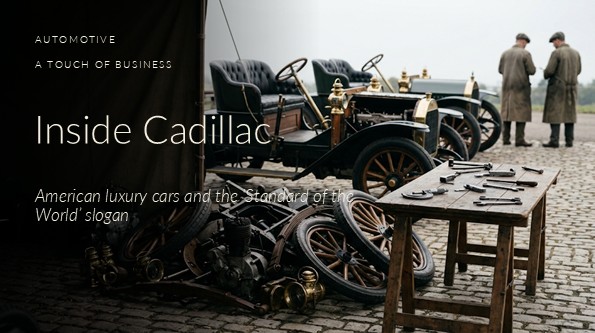
Cadillac emerged from a business that might otherwise have been dismantled. When the earlier Henry Ford Company faltered in Detroit, its remaining investors considered selling the assets. Precision engineer Henry M. Leland proposed building an automobile instead, using an engine supplied by his manufacturing operation.
That decision led to a marque known for precision engineering and the advertising slogan “Standard of the World.” Within seven years, Cadillac was part of General Motors. Its products would later range from lavish postwar automobiles to SUVs, performance models and electric vehicles.
The transition was seldom smooth. Shifts in fuel costs, competition and customer preferences tested the old luxury formula, sometimes with disappointing results.
A Quick Look at the History of Cadillac
Company History Summary
Cadillac is an American luxury vehicle brand founded in Detroit in 1902 and owned by General Motors since 1909. Henry M. Leland’s emphasis on precision manufacturing helped distinguish its earliest automobiles. Electric starting, powerful engines and distinctive postwar styling established important parts of the brand’s identity.
As automotive expectations changed, Cadillac faced setbacks with downsized models and controversial technology, then expanded beyond traditional luxury cars through the Escalade, performance lines and a growing electric vehicle range. Its modern history remains part of General Motors rather than that of an independently owned automaker.
Company Snapshot
Founded: August 27, 1902.
Origin: Detroit, Michigan, United States.
Founding figure: Henry M. Leland, working with investors from the former Henry Ford Company.
Original company: Cadillac Automobile Company; renamed Cadillac Motor Car Company following consolidation in 1905.
Industry: Luxury automobiles and sport utility vehicles.
Parent company: General Motors, which acquired Cadillac in 1909.
Historically known for: Precision manufacture, electric starting, luxury engineering, distinctive styling and the Escalade.
Modern range: Gasoline-powered luxury and performance vehicles alongside electric models.
From a Failed Venture to a Precision-Made Automobile
Henry Ford had already left the Henry Ford Company when the Cadillac venture took shape. The predecessor business should not be confused with Ford Motor Company, a separate enterprise.
With Leland’s proposal adopted, the Cadillac Automobile Company was formed on August 27, 1902. Its first car appeared at the New York Auto Show in 1903, beginning with a comparatively simple single-cylinder automobile rather than the imposing luxury vehicles later associated with the name.
In 1905, the Cadillac operation consolidated with Leland & Faulconer’s manufacturing business and took the name Cadillac Motor Car Company. This was an organizational step in the development of the early automaker, not the founding of today’s General Motors.
Manufacturing precision soon provided Cadillac with a stronger claim to distinction than ornament or size. In 1908, a demonstration of interchangeable automobile parts earned Cadillac the Dewar Trophy. The achievement mattered in an industry where predictable manufacture and replacement parts were central to growing confidence in motorcars. Cadillac’s famous “Standard of the World” phrase emerged as a prestige slogan, rather than an independently established ranking of every automobile on the market.
General Motors acquired Cadillac in 1909 in a transaction reported at $4.5 million. GM founder William C. Durant was an important figure in the larger corporation’s expansion; the acquisition brought Cadillac into a growing automotive group. Henry and Wilfred Leland continued in production management until 1917. Cadillac’s engineering identity now developed within a different ownership structure.
Making Luxury Easier to Drive
Early motoring demanded more physical effort than today’s drivers would recognize. Starting an automobile by hand crank was inconvenient and potentially dangerous. Cadillac’s 1912 use of electric starting and lighting, incorporating a system developed by Charles F. Kettering and Delco, made everyday operation more practical. The innovation earned another Dewar Trophy and offered a new reason to associate Cadillac with engineering rather than appearance alone.
The company also pursued increasingly sophisticated engines. Its 1915 Type 51 introduced a production V8 that became a significant milestone in Cadillac’s technical history. GM celebrates the V8 as a major innovation in its heritage materials.
Under GM ownership, luxury also grew more varied. The LaSalle companion marque, introduced in the late 1920s, added design-focused vehicles to the group’s luxury offering without replacing Cadillac’s name or corporate identity. GM heritage materials also identify synchromesh transmission development during this period.
Cadillac’s 1930 V16 provided a striking expression of top-end mechanical ambition. Yet its arrival coincided with the Great Depression, when an exceptionally expensive automobile faced a difficult market. The engine distinguished the range, but technical achievement and commercial demand were not the same thing.
Tailfins, V8 Power and Postwar Prestige
World War II interrupted ordinary civilian automobile production. In the postwar years, Cadillac’s engineering and design took on a visual character that would become closely associated with American luxury cars.
Tailfins appeared on Cadillac models in 1948, giving the vehicles a recognizable styling element. The following year brought a new overhead-valve V8, connecting the marque’s established interest in engine technology to the performance expectations of the period. Design and mechanical development worked together in shaping Cadillac’s postwar image.
The fins grew more prominent, reaching a particularly dramatic form on the 1959 models. Other conveniences, including automatic climate control listed in GM’s historical materials for 1964, reflected a broader idea of luxury in which comfort and equipment mattered alongside size and appearance.
These decades established a powerful cultural image, but that image was tied to a particular automobile market. The large, elaborately styled luxury car would not remain an uncontested formula.
When the Luxury Formula Became Harder to Sustain
Fuel-economy concerns, regulations and changing competition placed pressure on the traditional American luxury-car model during the 1970s and 1980s. Cadillac’s long association with large vehicles made the transition especially visible. General Motors responded through new models, downsizing and experiments with engine technology, with mixed results.
One experiment was the V8-6-4 engine introduced for 1981. Its variable-displacement system sought to adjust engine operation in response to driving needs, but contemporary performance and drivability problems contributed to its quick withdrawal from mainstream applications. The episode exposed the gap between a promising technical idea and the refinement expected in a luxury car.
The Cimarron presented a different problem. Introduced for 1982 and built on General Motors’ J-car architecture, the smaller Cadillac shared too much of its underlying character with less expensive GM vehicles for many automotive reviewers. The model attracted sustained critical disapproval and was discontinued after 1988. Its reception illustrated how a premium badge alone could not secure a favorable response to a visibly shared mass-market platform.
Changes to Cadillac’s larger sedans brought their own backlash. A 1989 Los Angeles Times report described the response to downsizing and Cadillac’s later lengthening of some sedan lines, with early buyer reactions reported as encouraging. These difficulties were not the result of one model or one executive decision. Technology, product positioning, regulation and a changing competitive market all formed part of the challenge.
Escalade and a New Definition of Cadillac
By the late 1990s, Cadillac’s historical center of gravity was still the luxury automobile, but another category offered a way to reach buyers: the luxury sport utility vehicle. The Escalade entered the market for the 1999 model year.
Its significance extended beyond the addition of another nameplate. The Escalade gave Cadillac a place in a vehicle category increasingly associated with premium equipment, imposing design and a different form of everyday utility. The substantially redesigned 2002 version adopted the angular styling that helped define Cadillac’s “Art and Science” design direction.
GM also developed V-Series performance vehicles and other technology within the Cadillac lineup during the 2000s and beyond. These efforts widened the brand’s identity beyond the traditional large sedan. The Escalade’s long-term importance is clear in Cadillac’s modern product mix, without establishing a particular model’s share of brand revenue.
Electric Vehicles and a New International Stage
Cadillac’s most recent transformation has involved electric propulsion. Beginning with the LYRIQ era in the 2020s, GM expanded the brand’s electric offerings. By September 2026, GM described five central electric nameplates: OPTIQ, LYRIQ, VISTIQ, ESCALADE IQ and CELESTIQ. The range spans different expressions of luxury rather than a single electric replacement for the conventional sedan.
In May 2026, GM reported that Cadillac had exceeded 100,000 cumulative electric vehicle sales in the United States. The company also said that roughly three-quarters of buyers across its specified EV models were new to Cadillac. Those figures describe cumulative U.S. sales and GM’s account of buyers, not annual global results.
The electric expansion has not meant an immediate end to gasoline-powered Cadillacs. As of November 11, 2026, Cadillac remained a GM-owned luxury brand with conventional, performance and electric vehicles. How the growing electric range would shape the brand over time remained uncertain.
A separate effort increased Cadillac’s international visibility through motorsport. In March 2025, Formula 1 and the FIA approved an entry backed by General Motors and TWG Motorsports. The Cadillac Formula 1 Team made its championship debut in 2026. The team uses the Cadillac name, but it is a separately organized motorsport project, not the old Cadillac Automobile Company reconstituted as an independent racing business. Its longer-term impact on Cadillac’s vehicle business remained uncertain.
A Brand Still Being Recast
The distance between Leland’s small early automobile and Cadillac’s present range is considerable. Manufacturing precision helped establish the marque, electric starting strengthened its engineering reputation, and postwar styling made its cars unmistakable. Later, downsizing and shared-platform decisions exposed the limits of an established luxury identity, while the Escalade gave Cadillac a different kind of flagship presence.
Today’s electric models and Formula 1 association represent further changes, not the conclusion of the story. Cadillac remains part of General Motors, and its long history continues to reflect how the meaning of luxury changes with technology, products and buyers.
Timeline
These milestones highlight the major changes in Cadillac’s ownership, engineering, product identity and current direction.

1902
Cadillac Automobile Company is formed in Detroit after Henry Ford leaves the earlier Henry Ford Company venture.
1903
The first Cadillac automobile is displayed at the New York Auto Show.
1905
Cadillac consolidates with Leland & Faulconer and becomes Cadillac Motor Car Company.
1908
Cadillac earns a Dewar Trophy for demonstrating interchangeable automobile parts.
1909
General Motors acquires Cadillac.
1912
Cadillac introduces electric starting and lighting, earning another Dewar Trophy.
1915
The Cadillac Type 51 introduces a production V8.
1930
Cadillac introduces its V16 automobile during the onset of the Great Depression.
1948–1949
Cadillac adopts tailfins in 1948 and introduces a new overhead-valve V8 in 1949.
1981–1982
Cadillac introduces the V8-6-4 engine and then the J-car-based Cimarron, both associated with difficult product transitions.
1999
The Escalade enters the luxury SUV market.
2002
A redesigned Escalade reflects Cadillac’s angular “Art and Science” design direction.
2022–2026
Cadillac expands its electric range, led by LYRIQ and additional EV nameplates.
2025–2026
The GM-and-TWG-backed Cadillac Formula 1 Team secures approval and debuts in the 2026 championship.
FAQs
Question: Who founded Cadillac, and did Henry Ford found it?
Answer: Henry M. Leland was the central founding figure, working with investors associated with the former Henry Ford Company. Henry Ford had already departed that business before Cadillac Automobile Company was established in 1902. Ford Motor Company is a separate company.
Question: Who owns Cadillac today?
Answer: General Motors owns Cadillac. GM acquired the automaker in 1909, and Cadillac operates today as the group’s luxury vehicle brand rather than an independently traded car company.
Question: Why did Cadillac use the phrase “Standard of the World”?
Answer: It was Cadillac’s historic prestige slogan, associated with its early reputation for precise manufacturing and interchangeable parts. It should be understood as advertising language, not a verified global quality ranking.
Question: Is Cadillac exclusively electric?
Answer: No. As of November 2026, Cadillac offered both gasoline-powered vehicles and electric models, including LYRIQ, OPTIQ, VISTIQ, ESCALADE IQ and CELESTIQ.
Question: Is the Cadillac Formula 1 Team the same company as the Cadillac car brand?
Answer: No. The Formula 1 operation is a separate team backed by General Motors and TWG Motorsports. It races with Cadillac branding, while the automobile brand remains part of GM.
Interviews & Firsthand Resources
General Motors on Cadillac’s Electric-Vehicle Sales
GM’s May 2026 statement provides a firsthand account of the brand’s electric-vehicle expansion and its reported cumulative U.S. sales milestone. It also describes GM’s view of how Cadillac EVs were attracting buyers new to the brand. The figures are company-reported and are most useful as a contemporary statement of the strategy’s progress.
Further Reading
- General Motors Heritage Collection — Cadillac vehicles and historical materials
- GM Heritage Archive — historical documents and special collections
Sources
- Detroit Historical Society: Cadillac Motor Company.
- HISTORY: General Motors Buys Cadillac.
- General Motors: GM Heritage: An Iconic Legacy, 1912 Cadillac Model 30, 1915 Cadillac Type 51, 1931 Cadillac V16.
- MotorTrend: History of the Cadillac Cimarron, Cadillac Escalade: A Visual History.
- Curbside Classic: The 1981 Cadillac V8-6-4.
- Los Angeles Times: Cadillac Cruises Back.
- Cadillac and General Motors: Cadillac Luxury Vehicles, Cadillac Surpasses 100,000 U.S. EV Sales, Cadillac EV Range in 2026.
- FIA and Formula 1: The Cadillac Formula 1 Entry, Joint Statement on the 2026 Eleventh Team, Cadillac Team Profile.