
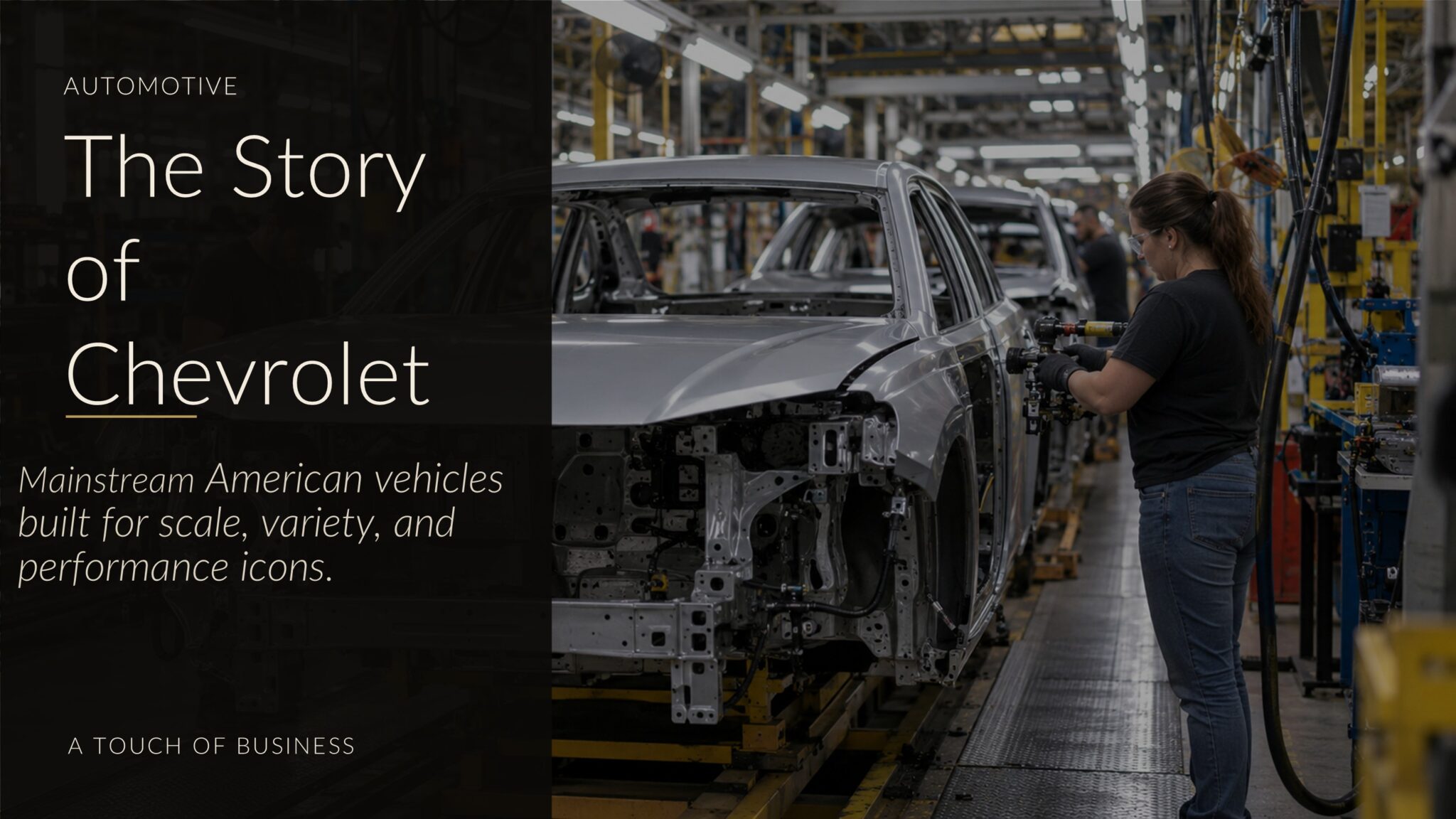
Chevrolet’s history is built around a recurring tension: mass-market scale on one side, distinctive products and technology on the other. The business began independently in 1911, entered General Motors in 1918, and grew into a broad-market GM vehicle brand.
Along the way, Corvette and the small-block V8 added a performance identity, safety and quality problems brought new pressures, General Motors pushed Chevrolet into more international markets and later pulled back from some of them, and electrification opened another period of change.
A Quick Look at the History of Chevrolet
Company History Summary
William C. Durant and Louis Chevrolet formed the Chevrolet automobile business in 1911. Their partnership soon split over product direction, and Durant pushed the business toward lower-priced, higher-volume vehicles. Chevrolet’s growth later helped Durant regain control of General Motors, and Chevrolet became part of GM in 1918.
Over the following decades, Chevrolet combined a mass-market role with products such as Corvette, the small-block V8, and Camaro. Its later history included safety and quality challenges, international expansion and retreat, GM’s 2009 corporate restructuring, and a continuing move into electric vehicles.
Company Snapshot
Founded / Origin: 1911.
Founders: William C. Durant and Louis Chevrolet.
Original Name: Chevrolet Motor Company is the preferred reader-facing form; historical sources also use Chevrolet Motor Car Company.
Industry: Automotive.
Current Parent: General Motors Company.
Current Status: Chevrolet is a GM vehicle brand, not a separate publicly traded company.
Best Known For: Broad-market vehicles, trucks and SUVs, performance products such as Corvette, and an expanding electric-vehicle portfolio.
Major Historical Turning Point: Chevrolet became part of General Motors in 1918, ending its independent corporate phase.
Two Founders With Different Ideas for Chevrolet
William Durant entered the Chevrolet story after losing control of General Motors in 1910. Louis Chevrolet was already known as a racing driver and engineer. Together they formed a new automobile business in 1911 and gave it the Chevrolet name.
A recollection preserved by General Motors gives the early partnership a human voice. Louis Chevrolet later recalled Durant telling him, “We’re going to need a car.” Chevrolet answered, “So I built it.”
The partnership did not last. GM historical material describes a disagreement over what kind of vehicles the business should sell. Durant favored more affordable cars aimed at a larger market, while Louis Chevrolet preferred a higher-priced product. Louis left in 1913.
Durant kept control and pushed Chevrolet toward lower-priced, higher-volume vehicles. That shift gave the young business a path to much greater scale and set up the next major turn in its history.
Chevrolet Becomes Durant’s Route Back to General Motors
Chevrolet’s growth soon mattered beyond its own product line. Durant used his position in the growing business and a stock-acquisition campaign to rebuild control of General Motors. GM historical material says Chevrolet held a controlling interest in GM by 1916.
In May 1918, Chevrolet became part of General Motors. That integration is the central corporate dividing line in the brand’s history: before 1918, Chevrolet was an independent automobile enterprise; afterward, it continued as part of GM.
By the 1920s, Chevrolet had become a major mass-market competitor. In 1927, Chevrolet outsold Ford in the United States. Ford regained first place in 1928 after introducing the Model A, but the one-year shift showed how far Chevrolet had moved from its independent beginnings.
From Wartime Production to a Performance Identity
Chevrolet remained a high-volume GM brand through the following decades. During World War II, Chevrolet-operated facilities participated in military production, including aircraft-engine work.
After the war, Chevrolet added a stronger performance dimension to its broad-market role. On June 30, 1953, the first production Corvette came off the line in Flint, Michigan. GM records 300 Corvettes produced that first year.
Corvette’s importance does not depend on a broad “first sports car” claim. Smithsonian material documents an earlier fiberglass Glasspar sports car and notes that its creator, Bill Tritt, advised General Motors during Corvette development. Corvette’s lasting significance came from giving Chevrolet a dedicated sports car inside a high-volume brand.
For the 1955 model year, Chevrolet introduced its 265-cubic-inch small-block V8. The architecture spread widely across Chevrolet vehicles and became another long-running part of the brand’s performance identity. Camaro followed for the 1967 model year, adding another performance-oriented nameplate.
Safety Scrutiny, Recalls, and Quality Problems
The Corvair became one of the best-known products in the U.S. auto-safety debate after criticism from Ralph Nader. Congressional material from later years shows that criticism of the car and General Motors’ handling of the controversy remained active long after the initial dispute.
In 1971, General Motors recalled 6.7 million vehicles after an investigation into defective motor mounts that could fail and cause the throttle to be pulled wide open. Chevrolet models were materially involved, but the recall action belonged to GM.
The Chevrolet Vega brought another set of problems. Retrospective automotive reporting documents corrosion, engine durability and overheating issues, axle problems, and recalls. Those failures were significant, but they were only part of a wider period in which import competition, regulation, fuel-economy pressure, and oil shocks were reshaping the market.
By the 1970s, Chevrolet’s story was no longer simply about adding models and building scale. Safety, durability, fuel use, regulation, and changing competition had become more visible constraints on the products GM developed and sold under the brand.
Global Expansion, a New GM, and European Retrenchment
General Motors increasingly used Chevrolet beyond its traditional U.S.-centered role. A major step came in 2002, when GM acquired key assets of the bankrupt Daewoo Motors operation. GM Daewoo then became an important Korean engineering and manufacturing base.
In 2004 and 2005, GM expanded Chevrolet branding onto Korean-built vehicles in Europe and other markets. The strategy widened Chevrolet’s international footprint and positioned the name as a broader global and value-oriented brand.
The corporate structure behind Chevrolet changed sharply in 2009. General Motors Corporation, the pre-2009 parent often described as Old GM, entered Chapter 11. General Motors Company, a newly incorporated Delaware company, acquired substantially all of Old GM’s operating assets through a court-supervised Section 363 transaction completed in July 2009.
Chevrolet continued under the new General Motors Company. The brand itself did not file for bankruptcy as a separate company; the legal identity of its parent changed while Chevrolet continued in the market.
The international strategy also became more selective. In December 2013, GM announced that it would largely end mainstream Chevrolet sales in Western and Central Europe by the end of 2015 and concentrate regional resources on Opel and Vauxhall, while continuing to offer selected Chevrolet products.
Chevrolet’s global history therefore did not move in one direction. GM expanded the brand into new markets, then narrowed its role where management no longer saw the same strategic fit.
Electrification and Another Shift in Chevrolet’s Footprint
General Motors began selling the Chevrolet Volt extended-range electric vehicle in North America in 2010. The Volt opened a new technology chapter for a brand whose mainstream lineup still relied heavily on conventional cars, trucks, and SUVs.
The later Bolt EV expanded that effort, but electrification also brought new quality risks. In 2021, GM expanded a Bolt EV recall over rare battery manufacturing defects and estimated about $1 billion in additional costs for that action at the time of the announcement.
GM continued adding electric products under Chevrolet. In 2024, BrightDrop electric commercial vans moved under the Chevrolet brand. By October 1, 2026, Chevrolet’s lineup included EVs alongside trucks, SUVs, performance vehicles, vans, and other commercial products.
The transition has not followed a straight line. Reuters reported in September 2026 that GM had reduced the planned production run for the current Bolt and expected production to end in the first quarter of 2027 as the plant shifted toward other products.
Chevrolet’s geographic role was also being adjusted. Reuters reported in August 2026 that GM and SAIC renewed their 50-50 SAIC-GM joint venture for another 20 years. Under the revised strategy, Chevrolet retail sales in China were being ended while Chevrolet-related export production could continue through the separate SAIC-GM-Wuling venture.
Chevrolet Today
As of October 1, 2026, Chevrolet is a vehicle brand of General Motors Company rather than a separate public corporation. GM’s U.S. vehicle brands include Chevrolet, Buick, Cadillac, and GMC.
Chevrolet continues to span broad-market trucks, SUVs, performance vehicles, commercial vehicles, and EVs. That mix reflects a pattern visible across more than a century: mass-market scale has remained central while performance products, technology shifts, corporate restructuring, and changing regional strategies have repeatedly altered how the brand competes.
Chevrolet’s history is therefore not a simple line from founding to uninterrupted growth. The business began with a disagreement over product direction, became part of GM after helping Durant regain control, challenged Ford at mass-market scale, built a performance identity, faced safety and quality problems, expanded internationally, withdrew from some markets, and continued through a major change in GM’s legal structure. The current chapter remains open as GM continues to adjust Chevrolet’s geographic role and electric-vehicle portfolio.
Timeline
This timeline highlights the major milestones that shaped Chevrolet’s corporate lineage, market role, products, and current direction.

1911
William C. Durant and Louis Chevrolet form the Chevrolet automobile enterprise.
1913
Louis Chevrolet leaves after disagreeing with Durant over product direction.
1916
Durant uses his position in Chevrolet to regain control of General Motors.
May 1918
Chevrolet becomes part of General Motors, ending its independent corporate phase.
1927
Chevrolet outsells Ford in the United States. Ford regains first place in 1928 after introducing the Model A.
1942-1945
Chevrolet-operated facilities participate in wartime production, including aircraft-engine work.
June 30, 1953
The first production Corvette is built in Flint, Michigan.
1955 model year
Chevrolet introduces the 265-cubic-inch small-block V8.
1967 model year
Chevrolet introduces Camaro as its entry into the pony-car segment.
1971
General Motors recalls 6.7 million vehicles over defective motor mounts; Chevrolet models are materially involved.
2002
General Motors acquires key Daewoo assets, creating a Korean operating base later used in Chevrolet’s international expansion.
2004-2005
GM expands Chevrolet branding onto Korean-built vehicles in Europe and other markets.
July 10, 2009
General Motors Company completes the acquisition of substantially all operating assets of the bankrupt General Motors Corporation. Chevrolet continues under New GM.
2010
Chevrolet Volt sales begin in North America.
December 2013
GM announces that mainstream Chevrolet sales in Western and Central Europe will largely end by the close of 2015.
2021
GM expands the Bolt EV battery recall over rare manufacturing defects.
August 2024
General Motors moves BrightDrop electric commercial vans under the Chevrolet brand.
August 2026
GM and SAIC renew their joint venture while restructuring Chevrolet’s role in China. Chevrolet retail sales are being ended while export production can continue through SAIC-GM-Wuling.
September 29, 2026
Reuters reports a reduced production plan for the current Chevrolet Bolt.
FAQs
Question: Who founded Chevrolet?
Answer: William C. Durant and Louis Chevrolet founded the Chevrolet automobile business in 1911. Their partnership was short-lived because they differed over product direction, and Louis Chevrolet left in 1913.
Question: Is Chevrolet a separate company from General Motors?
Answer: No. Chevrolet is currently a General Motors vehicle brand, not a separate public company. It began as an independent business and became part of GM in 1918.
Question: Did Chevrolet help William Durant regain control of General Motors?
Answer: Yes. Durant used his position in the growing Chevrolet enterprise and a stock-acquisition campaign to rebuild control of GM before Chevrolet became part of General Motors in 1918.
Question: Was Corvette the first mass-produced sports car?
Answer: The available material does not support that broad claim. Smithsonian material documents an earlier fiberglass Glasspar sports car and notes that its creator, Bill Tritt, advised GM during Corvette development.
Question: Did Chevrolet go bankrupt in 2009?
Answer: No. General Motors Corporation, Chevrolet’s parent, entered bankruptcy. General Motors Company acquired substantially all of Old GM’s operating assets, and Chevrolet continued under the new parent.
Question: Why did Chevrolet leave mainstream Europe?
Answer: GM announced in 2013 that it would largely end mainstream Chevrolet sales in Western and Central Europe by the end of 2015 and focus regional resources on Opel and Vauxhall.
Question: Is Chevrolet still sold in China?
Answer: As of October 1, 2026, GM’s renewed China strategy was ending Chevrolet retail sales in China. Chevrolet production for export could continue through the separate SAIC-GM-Wuling venture.
Interviews & Firsthand Resources
William Durant and Louis Chevrolet: GM Heritage
General Motors’ heritage feature on William Durant covers his loss of GM control, his partnership with Louis Chevrolet, their early difference over product direction, and the role Chevrolet played in Durant’s return to GM. It also preserves a brief recollection from Louis Chevrolet about the company’s early days.
Chevrolet Brothers Archival Documents
The Chevrolet Brothers collection is useful for readers who want to examine original-document chronology around the company’s organization in 1911. The archival material is more useful than treating the site’s interpretation as a definitive company history.
Sources
- General Motors: The Fearless Spirit of William Durant, Chevrolet – The Story of a Global Brand, 1953 Chevrolet Corvette, 70 Years of Chevrolet Small-Block V8 Power, Research & Development, BrightDrop Moves Under Chevrolet Brand, General Motors to Recall Additional Bolt EVs, 1967 Chevrolet Camaro Pace Car, Tonawanda Propulsion: 90 Years of Engine Building
- The Henry Ford: Ford Rouge Factory Tour History and Timeline
- Smithsonian National Museum of American History: The Race to the Museum: Glasspar Sports Car, 1953
- National Highway Traffic Safety Administration: Recalls Supported by NHTSA
- U.S. Government Publishing Office: 1982 Congressional Record material on Corvair criticism
- MotorTrend: Chevrolet Vega retrospective
- WardsAuto: GM Debuts Korean-Built Chevys in Paris
- Reuters / Business Standard: GM to Drop Chevy Brand in Europe to Focus on Opel
- U.S. Securities and Exchange Commission / General Motors Company: July 2009 Form 8-K, 2025 Form 10-K
- Reuters: GM Renews China Joint Venture with SAIC, GM’s Bolt EV Gets Smaller Production Run
- Chevrolet: Chevrolet Vehicles