
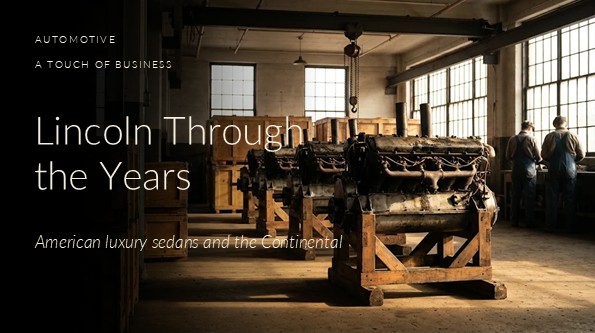
When Ford Motor Company acquired Lincoln, it added a luxury car line alongside the mass-market Model T. Lincoln’s Detroit factory had built aircraft engines during World War I.
Under Edsel Ford’s direction, Lincoln began to develop a reputation for styling as well as engineering. The cars that established that reputation served different buyers, from those who could afford the lower-priced Zephyr to those drawn to the Continental.
A Quick Look at the History of Lincoln
Company History Summary
Lincoln is Ford Motor Company’s luxury vehicle brand. Its history runs from the Lelands’ independent Detroit business through the Town Car and Navigator to today’s SUV lineup in the United States. Ford also expanded the brand into China, where Lincoln continued to sell a sedan in 2026.
Company Snapshot
Founded / Origin: August 29, 1917, in Detroit, Michigan
Founders: Henry Leland and Wilfred Leland
Original Name: Lincoln Motor Company
Owner: Ford Motor Company since 1922
Industry: Luxury vehicles
Current Leadership: Joaquin Nuño-Whelan, president of Lincoln
Best Known For: The Continental, Town Car and Navigator
From Liberty Engines to Luxury Cars
Henry Leland and his son Wilfred had worked at Cadillac under General Motors. They brought that manufacturing experience to a federal wartime program with several contractors building the Liberty aircraft engine. Lincoln signed its first engine contract two days after its founding. The Smithsonian’s history of the Liberty engine puts Lincoln’s workforce at 142 when it organized and about 6,000 within its first year of operation.
After the war, the Lelands turned their plant over to luxury-car production. They completed their first motorcar in September 1920. Early sales disappointed in a difficult postwar economy, and the company went into receivership. Ford Motor Company bought Lincoln for $8 million. The sale was formalized at the Detroit factory on February 4, 1922.
How the Zephyr and Continental Changed Lincoln
Under Edsel Ford’s direction, Lincoln offered its own body styles as well as designs from outside coachbuilders. Dietrich, for example, built the body for a 1929 Model L Convertible Victoria. During the Depression, sales of Lincoln’s Model K, priced above $4,000, fell sharply.
The streamlined Zephyr entered the line for model year 1936 at about $1,300. Its body and frame were built as a single structure, and its development drew on design work by John Tjaarda of Briggs Manufacturing. According to The Henry Ford, the Zephyr accounted for more than 90 percent of Lincoln’s production in its first model year.
Edsel Ford commissioned designer E. T. “Bob” Gregorie to make a personal car using the Zephyr as a starting point. The prototype reached Edsel in Florida in March 1939. After the reception it drew there, he directed that the design go into production.
The production Continental debuted that October for model year 1940. The Continental gave Lincoln a prestige model with a distinctive design, and it sold in limited numbers. World War II interrupted its run.
Postwar Continentals and the Rise of the Town Car
Ford brought Lincoln and Mercury into a single division in 1945. Benson Ford led its postwar organization, which developed a more dedicated dealer network for the two marques. The original Continental returned for the 1946 model year and ended after 1948.
William Clay Ford returned to the Continental idea with the Mark II for 1956 and 1957. His team worked in Ford’s separate Continental Division and sold the Mark II under the Continental make. It cost about $10,000, and Ford built roughly 3,000 over the two model years. The Henry Ford describes the Mark II as a prestige project whose value to Ford included the attention it brought to the broader car line.
Designer Elwood Engel gave the 1961 Lincoln Continental a restrained look that endured through the 1969 model year. The range included a four-door convertible. For 1969 Ford also revived its separate personal-luxury Mark line with the Continental Mark III.
For the 1981 model year, the Town Car became its own model line and Lincoln’s flagship sedan. It was already well established by the time the Navigator arrived.
The Navigator and a Changing Luxury Market
The 1998 Navigator brought the upscale appointments of Lincoln’s sedans to a full-size SUV. In the 1998 U.S. sales tally, Cadillac initially appeared to lead Lincoln by 222 vehicles. An internal audit found that the General Motors division had overstated its December sales by 4,773 vehicles. Cadillac acknowledged the error and apologized in May 1999. The correction put Lincoln ahead, with 187,121 sales to Cadillac’s 182,570. Mercedes overtook Lincoln in 1999.
Ford also pursued buyers of European-style sport sedans with the Lincoln LS. It won MotorTrend’s 2000 Car of the Year award and ran through 2006.
The Town Car continued as Ford restructured its North American operations. Under the Way Forward plan, Ford ended assembly at Wixom, Michigan, in 2007 and moved the Town Car to St. Thomas, Ontario. Ford discontinued Mercury at the end of 2010. Town Car production ended in 2011.
A Relaunch, a New Market and the Continental’s Return
In December 2012, Ford revived the Lincoln Motor Company name in a campaign for its luxury brand. Ford announced a dedicated Lincoln design studio as part of the relaunch. Ford reported 82,150 U.S. Lincoln sales for 2012, less than half the 1998 total.
China gave Lincoln another market for both cars and SUVs. Ford launched the brand there in April 2014, and the first dealerships opened that November in Beijing, Shanghai and Hangzhou. They initially sold the MKZ sedan and MKC crossover. Lincoln president Kumar Galhotra described the openings as part of “Lincoln’s reinvention as a global luxury automotive brand.”
Ford revived the Continental for model year 2017, following its earlier discontinuation in 2002. Ford built the new sedan in Flat Rock, Michigan, for sale in the United States and China. Reuters reported that Ford equipped versions for Chinese customers with features focused on rear-seat comfort.
In March 2020, Changan Ford rolled out locally built Corsairs in Chongqing. The manufacturer is a joint venture between Ford and Chongqing Changan Automobile. Ford’s chief financial officer had cited lower costs and reduced tariff exposure as advantages of building cars for that market in China.
That same year, Ford brought the U.S. runs of the Continental and MKZ to an end. Ford cited the shrinking U.S. full-size premium sedan segment in announcing the Continental decision. The U.S. range became all SUVs, while China remained a market for Lincoln sedans. Chinese market data recorded sales of the locally built Lincoln Z in 2026.
Lincoln’s SUV Lineup and Ford’s U.S. Production Plans
As of November 18, 2026, Lincoln’s U.S. lineup centered on the Navigator, Aviator, Nautilus and Corsair model families, with a China-built Corsair Hybrid introduced for 2027. Ford reported 106,868 U.S. Lincoln sales for 2025, including 22,185 Navigators.
Ford builds the Navigator in Louisville, Kentucky, and the Aviator in Chicago. In August 2026 it announced plans to expand U.S. Lincoln production beginning in 2030 and phase out imports of China-built Lincoln vehicles for the U.S. market. Ford CEO Jim Farley cited tariffs as a factor in an interview with Reuters.
Timeline
Key milestones from Lincoln’s wartime founding to Ford’s latest announced U.S. production plans.

1917–1920
Henry and Wilfred Leland found Lincoln Motor Company in 1917 to build Liberty aircraft engines. The company completes its first motorcar in 1920.
February 4, 1922
Ford Motor Company formalizes its $8 million purchase of Lincoln.
1936–1940 model years
Ford introduces the Lincoln Zephyr for 1936 and the first production Lincoln Continental for 1940.
1945
Ford organizes Lincoln and Mercury into the Lincoln-Mercury Division.
1956–1961 model years
Ford’s separate Continental Division offers the Mark II for 1956 and 1957. The Lincoln Continental receives Elwood Engel’s redesign for 1961.
1981 model year
The Town Car becomes a distinct Lincoln model line.
1997–1999
The 1998 Lincoln Navigator appears in 1997. Cadillac’s 1999 sales correction puts Lincoln ahead in the 1998 U.S. tally.
2012–2014
Ford revives the Lincoln Motor Company name in advertising in 2012. The first Lincoln stores in China open in November 2014.
2016–2020
Ford unveils the revived Continental in 2016 for model year 2017. In 2020, Changan Ford rolls out locally built Corsairs in Chongqing, and Ford ends the Continental and MKZ runs in the U.S.
August 2026
Ford announces plans to expand U.S. Lincoln production beginning in 2030.
FAQs
Question: Who founded Lincoln, and when did Ford buy it?
Answer: Henry Leland and his son Wilfred founded Lincoln Motor Company in 1917. Ford Motor Company bought it out of receivership in February 1922.
Question: Was the Continental Mark II a Lincoln?
Answer: Ford sold the 1956–1957 Continental Mark II as a separate Continental make. William Clay Ford led the division that built it, drawing on the earlier Lincoln Continental’s design legacy.
Question: Does Lincoln still make sedans?
Answer: The U.S. lineup is all SUVs. Ford ended the U.S. Continental and MKZ after model year 2020, while China market data still recorded sales of the locally built Lincoln Z sedan in 2026.
Interviews & Firsthand Resources
Bob Gregorie on the Continental
In this 1985 archival clip, E. T. “Bob” Gregorie offers the designer’s perspective on the Continental. It accompanies the story of how a personal car for Edsel Ford became a production model.
Watch the interview clip at The Henry Ford
Jim Farley on Lincoln’s U.S. Production Plans
Reuters reporter Nora Eckert interviewed Ford CEO Jim Farley and U.S. Commerce Secretary Howard Lutnick about the planned production shift. Farley explains how U.S. tariffs figured into Ford’s decision about vehicles for the U.S. market.
Read the Reuters interview report
Sources
- Smithsonian Institution Press / National Air and Space Museum: The Liberty Engine, 1918–1942
- The Henry Ford: Lincoln Motor Company, The Fords and Lelands at the Acquisition of Lincoln Motor Co. by Ford Motor Co., 1922, Lincoln – Birth and Rebirth, Edsel Ford’s 1941 Lincoln Continental, William Clay Ford and the Continental Mark II, Lincoln Continental Convertible, 1961, Proposed Lincoln Continental Mark III Emblems, 1967
- Lincoln Motor Car Heritage Museum: A Brief Lincoln History
- Lincoln & Continental Owners Club: The 1949-51 Lincoln Production Story
- Lincoln: Lincoln Town Car, Lincoln Luxury Vehicles: Complete Lineup
- Los Angeles Times: An Expert Navigator of Sport-Ute Terrain, Cadillac Apologizes to Lincoln for Inflating Sales Numbers
- WardsAuto: Lincoln Opens First China Stores
- Ford Motor Company: Exhibit 99, accelerated Way Forward announcement, Form 10-K for fiscal year ended December 31, 2012, Form 10-K for fiscal year ended December 31, 2025, Ford Motor Company to Increase Lincoln Production in the U.S. Beginning in 2030, Production Ends At Wixom Assembly Plant, Lincoln Town Car Moves To ST. Thomas, Ford U.S. Q4 2025 Sales Release, December 2012 U.S. sales results
- Lincoln via PR Newswire: Lincoln Announces Its New 2013 Campaign: Introducing the Lincoln Motor Company
- Autocar India staff: Beijing 2014: Lincoln car brand launched in China
- Reuters via Investing.com: Ford unveils resurrected Lincoln Continental, targets China market, Ford to build more Lincolns for Chinese market locally – CFO
- Car and Driver: Lincoln Continental Is Canceled as Brand Shifts Focus to SUVs, 2027 Lincoln Corsair Keeps the Compact Luxury SUV Alive
- Xinhua: Ford’s Lincoln Corsair vehicles roll off production line in SW China
- Reuters: Ford to move production of some Lincoln models from China to US
- Gasgoo: September, 2026 auto sales of Lincoln
- Autoweek: ‘American luxury’ reconsidered: Lincoln-Cadillac rivalry absorbed in broader melee
- University of Michigan Center for Innovation: Joaquin Nuno-Whelan
- MotorTrend: Lincoln LS – Motor Trend’s Car of the Year, 7 Cars That Came So Close to Greatness but Missed the Mark