
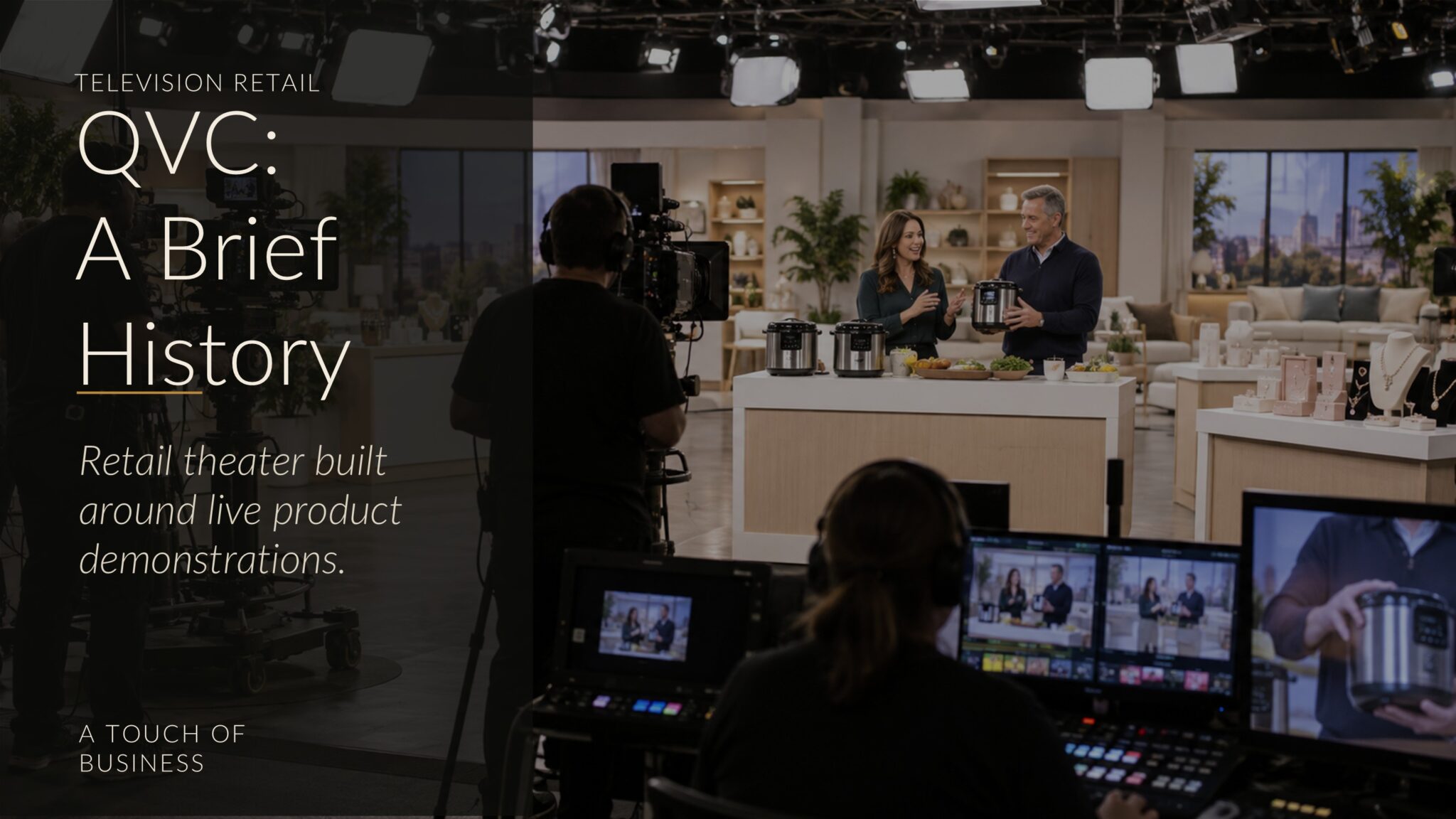
When QVC first went on the air in 1986, its sales model centered on live television and direct-response shopping. Over the next four decades, the same basic capability—hosts demonstrating products while viewers could buy remotely—moved onto the web, mobile devices, streaming services, and social platforms.
The corporate structure around that model changed repeatedly. QVC passed through Comcast and Liberty control, HSN moved under QVC, Inc., and the parent company changed names. In 2026, a prepackaged Chapter 11 restructuring reduced more than $5 billion of debt and produced an unusual legal reset: the former QVC, Inc. emerged as the new QVC Group, Inc.
A Quick Look at the History of QVC
Company History Summary
Joseph M. Segel founded QVC in 1986, and its first U.S. live broadcast aired that November. The name stands for Quality, Value, Convenience. Early growth included the 1989 acquisition of CVN, followed by international expansion and a gradual move from television-only shopping toward digital channels.
Later chapters brought new owners, the addition of HSN under QVC, Inc., a major fulfillment-center fire, turnaround programs, and a stronger push into streaming and social commerce. In August 2026, the operating company emerged from Chapter 11 under the QVC Group, Inc. name.
Company Snapshot
Founded: June 13, 1986
Founder: Joseph M. Segel
Name Meaning: Quality, Value, Convenience
Headquarters: West Chester, Pennsylvania
Business Model: Live product demonstrations and direct-response retail across television and digital channels
Current Legal Company: QVC Group, Inc., the reorganized company formerly known as QVC, Inc.
Key Brands Presented by the Company: QVC, HSN, Ballard Designs, Frontgate, Garnet Hill, and Grandin Road
Current Leadership: Mike George, interim CEO and chair as of October 1, 2026
QVC Operating Markets: United States, United Kingdom, Germany, Japan, and Italy
Building a Different Home-Shopping Model
Home Shopping Network was already operating when Joseph Segel began studying televised retail. In a later interview, Segel recalled reviewing HSN’s public material and watching the service before concluding, “I felt that there were lots of ways to do it better.”
Independent accounts describe QVC’s early model as emphasizing clearer product explanation, faster fulfillment, disclosed charges, and a less abrasive selling style. Segel assembled a television team despite having no previous television-production experience.
Segel founded QVC in June 1986. Its first U.S. live broadcast aired on November 24, reaching about 7.6 million homes. By January 1987, live U.S. programming had expanded to 24 hours a day.
Scale came quickly. In 1989, QVC agreed to acquire CVN, a larger home-shopping competitor, in a cash-and-stock transaction valued at roughly $400 million in contemporary reporting. Published figures vary somewhat by timing and valuation basis, but the combined operation had much greater scale and was positioned to compete more directly with HSN.
The CVN deal is an early example of acquisition accelerating QVC’s scale rather than leaving growth entirely to new distribution and customer gains.
Media Ambition, International Expansion and New Owners
QVC entered a different phase in 1993. Segel retired as chairman, and Barry Diller became a major figure in the company’s leadership. Under Diller, QVC launched a multibillion-dollar bid for Paramount Communications. Viacom ultimately won the 1993–1994 bidding contest, ending that attempt to move far beyond home shopping.
International expansion was already beginning. QVC UK started broadcasting in October 1993, followed by Germany in December 1996 and Japan in April 2001. Italy joined the operating footprint in 2010.
Control also changed. Comcast gained majority control of QVC in 1995. In September 2003, Liberty acquired Comcast’s roughly 57% stake. Combined with Liberty’s existing holding, the transaction gave Liberty about 98% ownership of QVC.
Through those changes, QVC remained the operating business while different parent companies controlled it. That distinction becomes especially important later, when HSN and the QVC Group name enter the corporate history.
From Television Shopping to Multiplatform Retail
QVC’s move beyond television began long before streaming and social commerce became central to management strategy. QVC.com launched in 1996, giving customers an online purchasing channel alongside the television operation.
By 2011, QVC.com generated about $2.0 billion, or 36.8% of QVC U.S. net revenue. Sixty-four percent of new U.S. customers made their first purchase through QVC.com that year. By 2017, about 80% of new U.S. customers made their first purchase through QVC.com, including mobile.
Those figures show how deeply digital purchasing had entered the business before the sharpest pressure on traditional cable distribution. QVC was no longer simply a television channel with an attached website; online and mobile purchasing had become important parts of customer acquisition.
The operating idea, however, remained recognizable: product presentation and personality-led content connected to a direct purchasing path. What changed was where customers watched and bought.
HSN Joins QVC as the International Picture Becomes More Mixed
QVC and HSN had competed in home shopping for decades before their corporate paths converged. In 2017, Liberty Interactive—QVC’s parent—acquired the approximately 62% of HSN it did not already own. QVC, Inc. itself was not the 2017 acquirer.
On December 31, 2018, Qurate Retail transferred its ownership of HSN into QVC, Inc. The QVC and HSN consumer brands remained distinct, while QVC U.S. and HSN were later combined for segment reporting as QxH.
International expansion produced a less uniform result. QVC launched ecommerce and television operations in France in 2015, but QVC France ceased operations in March 2019. Management said the French business had underperformed financial and operational expectations and cited market-specific structural challenges.
The contrast with longer-running operations in the United Kingdom, Germany, Japan, and Italy offers a measured lesson from QVC’s international history: the model did not transfer equally well to every market.
Fire, Project Athens and the Push Beyond Cable
A major operational shock arrived on December 18, 2021, when fire significantly damaged QVC’s Rocky Mount, North Carolina fulfillment center. The facility had processed roughly 25%–30% of QVC-U.S. volume and served as the primary hard-goods returns center.
QVC diverted inventory and orders to other facilities and later chose not to rebuild Rocky Mount. The disruption came while the business was also dealing with supply-chain constraints, labor pressure, higher freight and merchandise costs, inflation, and changing consumer patterns.
The fire exposed the risk of concentrating a large share of U.S. volume in one facility, but it was only one of several pressures facing the business.
In June 2022, David Rawlinson and management introduced Project Athens, a multi-year turnaround program focused on customer relationships, core execution, cost reduction, portfolio optimization, and growth in streaming and video commerce. Early phases included inventory reduction and workforce actions.
During the same period, QVC and HSN expanded their combined QVC+ and HSN+ streaming experience across web and smart-TV distribution. Project Athens therefore sat between two eras: the older cable-centered model and a later strategy that put much more emphasis on streaming and social platforms.
WIN, Consolidation and Growing Financial Pressure
Management announced the WIN growth strategy in November 2024, centering it on live social shopping across social and streaming channels. The strategy used three themes: “Wherever She Shops,” “Inspiring People and Products,” and “New Ways of Working.”
Then-CEO David Rawlinson described management’s perceived advantage as QVC’s live content production, retail model, and content distribution. That was management’s strategic framing, not a demonstrated future outcome.
Execution intensified in 2025. QVC U.S. and HSN operations were consolidated at Studio Park in West Chester, and the St. Petersburg campus closed. A March reorganization eliminated about 900 U.S. roles across QVC U.S., HSN, and shared services.
At the same time, financial pressure remained visible. QVC reported 2025 net revenue of about $8.293 billion, down from about $8.997 billion in 2024. Adjusted OIBDA declined from about $1.098 billion to $810 million.
The corporate name also changed in a way that would soon require careful distinction. On February 21, 2025, Qurate Retail, Inc., the parent above QVC, changed its legal name to QVC Group, Inc. That parent is not the same legal entity that carries the QVC Group, Inc. name today.
The 2026 Restructuring Creates a New QVC Group
On April 16, 2026, the then-parent QVC Group, Inc., QVC, Inc., and certain other U.S. affiliates entered voluntary prepackaged Chapter 11 proceedings in the U.S. Bankruptcy Court for the Southern District of Texas. International operations were excluded.
The filing was a financial restructuring rather than a shutdown of QVC’s retail operations. The company cited structural decline in traditional cable and changing video-consumption habits among the pressures facing the business. QVC had also been dealing with revenue weakness, debt, operational disruption, inflation, and supply-chain pressures.
The bankruptcy court entered a confirmation order on July 20, and the restructuring became effective on August 6. Old parent equity was canceled, and creditor groups received new equity under the plan.
The legal identity change is unusual. The former parent became Old QVC Group, Inc. The operating company formerly known as QVC, Inc. changed its legal name to QVC Group, Inc. and became the reorganized public issuer. In other words, the QVC Group, Inc. that existed after August 6, 2026 is legally the former QVC, Inc., not simply the former Qurate Retail parent continuing under the same name.
The reorganized company reported that the restructuring reduced debt by more than $5 billion and provided a new $600 million asset-based lending facility. David Rawlinson stepped down, and Mike George became interim CEO and board chair.
As of October 1, 2026, QVC continued to operate in the United States, United Kingdom, Germany, Japan, and Italy. The company’s distribution mix included television, ecommerce, mobile apps, QVC+ and HSN+, TikTok Shop, and other streaming and social platforms.
Management continued to emphasize the WIN strategy and live social shopping. The long-term operating outcome remained open: only a short period had passed since emergence, so the debt reduction could be stated as a completed financial change, while a durable operating recovery could not yet be established.
QVC’s broader history is therefore less about abandoning television than about carrying a familiar retail capability across successive distribution systems. Cable created the original reach; web and mobile became important purchasing channels; streaming and social became the next strategic focus. The 2026 restructuring opened another chapter without settling how that transition would ultimately perform.
Timeline
This timeline highlights the major milestones that changed QVC’s scale, ownership, distribution model, operating structure, or legal identity.

June 13, 1986
Joseph M. Segel founds QVC.
November 24, 1986
QVC airs its first U.S. live broadcast, reaching about 7.6 million homes.
January 1987
QVC expands its U.S. live programming to 24 hours a day.
1989
QVC agrees to acquire CVN, substantially increasing its home-shopping scale.
1993–1994
Barry Diller leads QVC’s unsuccessful bid for Paramount Communications, while QVC begins its U.K. operation in October 1993.
1995
Comcast gains majority control of QVC.
1996
QVC launches QVC.com, and QVC Germany begins broadcasting in December.
April 2001
QVC Japan begins broadcasting.
September 17, 2003
Liberty acquires Comcast’s QVC stake and gains about 98% ownership of QVC.
October 2010
QVC Italy begins broadcasting.
2015
QVC launches ecommerce and television operations in France.
December 29, 2017
Liberty Interactive acquires the remaining HSN shares it did not already own.
December 31, 2018
Qurate Retail transfers HSN under QVC, Inc.
March 13, 2019
QVC France ceases television and digital commercial operations.
December 18, 2021
A fire significantly damages QVC’s Rocky Mount fulfillment center.
2022
Management announces Project Athens, and QVC and HSN expand the QVC+ and HSN+ streaming experience.
November 15, 2024
Management announces the WIN growth strategy focused on live social shopping.
February 21, 2025
Parent company Qurate Retail, Inc. changes its legal name to QVC Group, Inc.
2025
QVC U.S. and HSN operations are consolidated at Studio Park in West Chester, while the St. Petersburg campus closes.
April 16, 2026
The old parent, QVC, Inc., and certain U.S. affiliates enter a prepackaged Chapter 11 process. International operations are excluded.
August 6, 2026
The restructuring becomes effective. Old parent equity is canceled, former QVC, Inc. becomes the new QVC Group, Inc., and Mike George becomes interim CEO and chair.
FAQs
Question: Who founded QVC, and when?
Answer: Joseph M. Segel founded QVC on June 13, 1986. Its first U.S. live broadcast aired on November 24, 1986.
Question: What does QVC stand for?
Answer: QVC stands for Quality, Value, Convenience.
Question: Did QVC invent television home shopping?
Answer: No. Home Shopping Network was operating before QVC. Segel studied HSN before creating QVC as a competing model that he said could be improved.
Question: Are QVC and HSN the same company?
Answer: No. They remain distinct retail brands. Liberty Interactive, QVC’s parent, acquired the remaining HSN shares in 2017, and HSN was transferred under QVC, Inc. at the end of 2018. QVC U.S. and HSN were later combined for segment reporting as QxH.
Question: Did QVC file for bankruptcy in 2026?
Answer: Yes, but the filing was a prepackaged U.S. Chapter 11 financial restructuring rather than a shutdown. The old parent and certain U.S. affiliates, including QVC, Inc., filed on April 16, 2026. The plan became effective on August 6, when former QVC, Inc. became the reorganized QVC Group, Inc. International operations were excluded.
Question: Who owns QVC now?
Answer: After the August 2026 restructuring, the former QVC, Inc. became the reorganized public QVC Group, Inc. Old parent equity was canceled, and creditor groups received the new equity issued under the restructuring plan.
Question: Is QVC still mainly a television shopping channel?
Answer: Television remains an important distribution channel, but QVC also operates through ecommerce, mobile apps, streaming services, and social platforms including TikTok Shop.
Interviews & Firsthand Resources
Joseph Segel on the Origins of QVC
Wharton Magazine’s interview with Joseph Segel gives a firsthand account of how he encountered Home Shopping Network, why he believed the model could be improved, and how he thought about convenience and entrepreneurship. It is particularly useful for understanding QVC’s founding idea from Segel’s perspective.
Mike George on QVC’s E-commerce Era
This Philadelphia Daily News / Philadelphia Inquirer profile provides a firsthand management perspective from the period when QVC was expanding ecommerce and international operations. It offers useful context on the company’s mid-2000s digital and international growth.
David Rawlinson on the WIN Strategy
QVC Group’s 2024 strategy announcement records management’s explanation of the shift toward live social shopping, streaming, and broader content distribution. It is useful for understanding how leadership framed the transition, while the projected strategic benefits remained company claims.
Sources
- U.S. Securities and Exchange Commission / QVC: QVC, Inc. 2025 Form 10-K, QVC.com filing section, QVC 2017 Form 10-K, QVC 2021 Form 10-K
- U.S. Securities and Exchange Commission / Qurate Retail: Qurate Retail Form 10-K discussion of QVC and HSN, Qurate Retail 2023 Form 10-K — Project Athens
- U.S. Securities and Exchange Commission / Liberty Interactive / HSN: HSN acquisition transaction presentation
- U.S. Securities and Exchange Commission / Comcast: Comcast 2003 QVC sale filing
- U.S. Securities and Exchange Commission / Reorganized QVC Group: August 6, 2026 emergence Form 8-K
- The Philadelphia Inquirer: Joseph M. Segel obituary and QVC history
- Wharton Magazine: Wharton Leader: Joseph Segel, W’51
- The Washington Post: Joseph Segel obituary and QVC history
- Los Angeles Times: QVC Network Inc. to Acquire CVN, Diller Seeks to Outbid Viacom for Paramount
- QVC: QVC global operations
- QVC Group: QVC+ and HSN+ streaming expansion, WIN live social shopping strategy, 2025 organization realignment, 2026 Q2 filing, 2026 restructuring announcement, QVC France closure announcement, QVC 2019 Form 10-K, Qurate Retail becomes QVC Group