
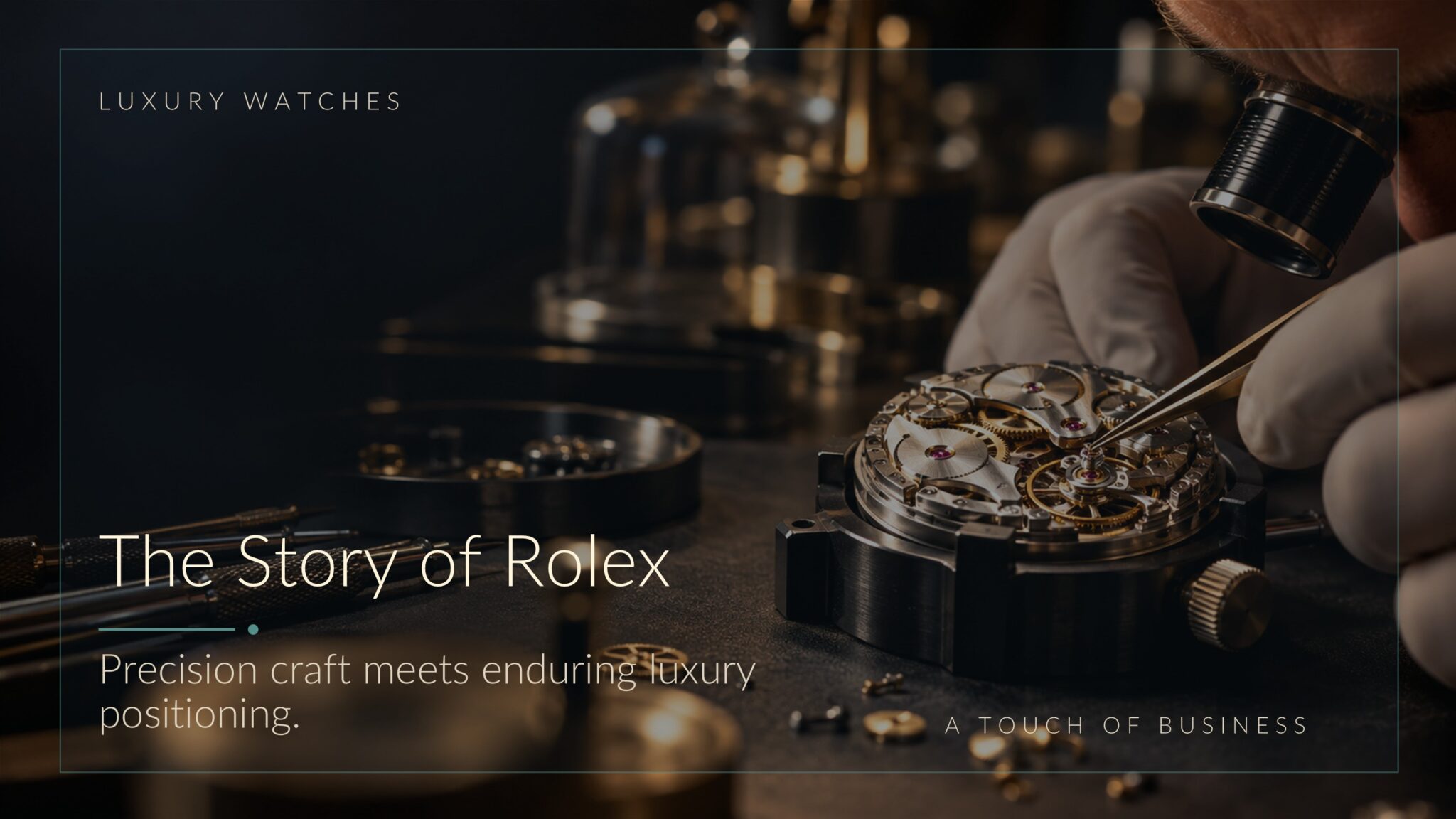
Rolex’s early history was built around a practical challenge: persuading buyers that a wristwatch could be precise, durable, and dependable. Hans Wilsdorf used precision testing, water-resistant design, automatic winding, and public demonstrations to make those qualities visible.
That technical foundation later supported watches associated with diving, travel, exploration, motorsport, and prestige. In the decades that followed, Rolex’s communications increasingly linked the brand with individual achievement, while later leadership brought more of manufacturing under company control.
The modern Rolex group remains privately controlled through the Hans Wilsdorf Foundation. Recent developments include Certified Pre-Owned, the acquisition of Bucherer through Rolex Holding SA, and a major manufacturing and service site under construction in Bulle.
A Quick Look at the History of Rolex
Company History Summary
The Rolex business lineage began with Wilsdorf & Davis in London in 1905. Hans Wilsdorf registered the Rolex trademark in 1908, and the business moved to Geneva in 1919, followed by the registration of Montres Rolex S.A. in 1920.
Rolex built its reputation around precision, water resistance, automatic winding, and watches designed for specific professional or travel uses. Later leadership shifted more manufacturing inside the company, while the Hans Wilsdorf Foundation preserved private control. In the current era, the group has added Certified Pre-Owned distribution, acquired Bucherer through Rolex Holding SA, and begun a major expansion in Bulle.
Company Snapshot
Founded / Origin: 1905, through predecessor Wilsdorf & Davis
Founders: Hans Wilsdorf and Alfred Davis
Original Name: Wilsdorf & Davis Ltd.
Origin: London, England
Rolex Trademark: Registered in 1908
Geneva Transition: The business moved to Geneva in 1919; Montres Rolex S.A. was registered there in 1920
Industry: Mechanical wristwatches
Owner: Hans Wilsdorf Foundation
Related Watch Company: Montres Tudor SA, a separate company under the same foundation-controlled structure
Current Leadership: Jean-Frédéric Dufour, CEO
Best Known For: The Oyster case, Perpetual automatic winding, and long-running professional watch families
From a London Distributor to a Geneva Watch Company
Wilsdorf & Davis started as a London timepiece-distribution business. Wilsdorf sourced small Swiss movements, including from Bienne, as he worked to make wristwatches more credible as reliable timekeepers.
Precision became an early proof point. In 1910, a wristwatch associated with the business received a Swiss Certificate of Chronometric Precision from the Official Watch Rating Centre in Bienne. In 1914, a Rolex wristwatch received a Kew Observatory Class A certificate.
Wilsdorf had registered the Rolex trademark in 1908, giving the business a compact brand identity before its Swiss corporate structure took shape. Rolex’s official history places the move to Geneva in 1919 and the registration of Montres Rolex S.A. in 1920.
Business-history research by Pierre-Yves Donzé, summarized by Hodinkee, connects the move with British tariffs and taxes as well as the advantage of being closer to Swiss suppliers and partners. Geneva and Bienne would remain central to the company’s operations, although the important Bienne movement business remained separately owned for decades.
The Oyster Turned Water Resistance Into Public Proof
Water and dust were practical problems for early wristwatches. Rolex had experimented with protective solutions before introducing and patenting the Oyster case in 1926, using screw-down sealing elements to protect the movement.
Rolex has long described the Oyster as the first waterproof and dustproof wristwatch. Independent watch-history sources, however, document earlier waterproof wristwatches, including a 1918 U.S. patent connected with Jacques Depollier & Son. The Oyster’s historical importance therefore rests less on an uncontested claim to being first than on how Rolex advanced, integrated, demonstrated, and commercialized water-resistant wristwatch design.
Hans Wilsdorf made that performance visible. In 1927, swimmer Mercedes Gleitze wore a Rolex Oyster during an English Channel swim lasting more than ten hours. Rolex publicized the event prominently, turning a technical property into something consumers could understand through a real-world demonstration.
The episode established a pattern that would recur in Rolex history: measurable performance was paired with a public story that made the engineering easier to grasp.
Perpetual Winding Created a Lasting Product Architecture
Rolex added another important element in 1931 with its Perpetual automatic system, which used a 360-degree winding rotor. Earlier self-winding wristwatches already existed, including Harwood watches, so Rolex did not invent the first automatic wristwatch.
Its contribution was to make the full-rotor Perpetual system central to its own watches and combine automatic winding with the protected Oyster case. The resulting Oyster Perpetual idea became a durable technical and naming foundation across later Rolex models.
The Datejust followed in 1945. That same year, the Hans Wilsdorf Foundation was created, an institutional change that would later become central to the company’s private ownership structure.
Professional Watches Broadened What Rolex Represented
After World War II, Rolex extended the Oyster and Perpetual platform into watches associated with specific activities and users. The Explorer and Submariner appeared in 1953, followed by the GMT-Master in 1955 and the Day-Date in 1956.
The range continued to broaden after Hans Wilsdorf’s death in 1960. The Cosmograph Daytona arrived in 1963 and the Sea-Dweller in 1967.
These watches gave the company a broader identity than precision and water resistance alone. Diving, international travel, exploration, motorsport, and prestige each became part of the product story without replacing the technical platform built around Oyster cases and automatic winding.
From Technical Credentials to Achievement and Status
Hans Wilsdorf’s death in 1960 ended the founder-led era. André Heiniger succeeded him and led Rolex through a period of international expansion and a major change in communications.
Archival business-history research summarized by Hodinkee identifies a 1966 recommendation from J. Walter Thompson to move Rolex advertising away from political and state leaders and toward successful individuals in business, sport, exploration, and culture. The new direction began the following year.
That shift changed what Rolex sold symbolically. Technical performance remained part of the product, but advertising increasingly linked ownership with personal accomplishment and prestige.
The U.S. market became especially important. Donzé’s research reports that Rolex’s U.S. sales grew five-fold during the 1970s. In 1977, Rolex bought a Fifth Avenue building in New York for $15 million, another marker of the scale of its American expansion.
Mechanical Watches Through the Quartz Disruption
Quartz technology severely disrupted the Swiss mechanical-watch industry in the 1970s and 1980s. Rolex did not simply reject quartz. It participated in quartz research and produced quartz watches in limited quantities.
Under André Heiniger, however, mechanical watches remained the core of the business. That continuity occurred alongside U.S. expansion, a changing communications strategy, and an established family of mechanical models.
Rolex expanded during a period when much of the Swiss watch industry contracted. No single decision explains that outcome. Mechanical commitment operated alongside product continuity, branding, international growth, and competitive change.
Patrick Heiniger and the Move Toward Vertical Integration
Patrick Heiniger succeeded his father André in 1992. During his leadership era, Rolex increased control over manufacturing by acquiring important suppliers and consolidating a production network that had previously depended more heavily on separate specialist companies.
A key milestone came in 2004, when the long-standing Bienne movement operation came under Rolex ownership, bringing a critical supplier that had remained separately owned for decades inside the business.
The result was a much more integrated manufacturing system. Modern Rolex controls major stages of watch design, movement production, cases and bracelets, dials, assembly, testing, and service through its Swiss operations.
Patrick Heiniger left in 2008. Bruno Meier and then Gian Riccardo Marini led Rolex before Jean-Frédéric Dufour was appointed CEO in 2014.
Certified Pre-Owned and the Bucherer Acquisition
In the modern era, Rolex has extended its reach beyond manufacturing into authentication, resale, and selected retail infrastructure.
In 2022, the Rolex Certified Pre-Owned program began at selected Bucherer locations before expanding through participating official retailers. The program created an official route for qualifying pre-owned Rolex watches within the authorized retail network.
A larger structural move followed in 2023, when Rolex Holding SA entered agreements to acquire Bucherer Holding AG and Bucherer Immobilien AG. Swiss and European competition approvals were completed in 2024.
The distinction between Rolex Holding SA and Rolex SA matters here: Swiss competition records identify Rolex Holding SA as the acquirer. Bucherer also continued as a distinct retail business rather than disappearing into Rolex SA.
The acquisition did not signal a stated plan to replace independent authorized retailers. At Dubai Watch Week in 2025, CEO Jean-Frédéric Dufour described Bucherer as “a very small part of our distribution network” and said Rolex had no intention of expanding significantly beyond that approach.
Private Ownership and a New Manufacturing Expansion
Rolex remains privately controlled through the Hans Wilsdorf Foundation. Swiss competition authorities state that the foundation holds 100% of Rolex Holding SA and controls Rolex SA and Montres Tudor SA. The same filing describes Rolex Holding SA and Rolex SA together as the Rolex Group.
That structure also clarifies a frequent point of confusion: Tudor is not simply another name for Rolex SA. Montres Tudor SA is a separate company within the same foundation-controlled structure.
The group is also expanding its physical manufacturing and service infrastructure. Rolex says a major site in Bulle is under construction, with partial opening planned for 2029. The project is designed to combine production, research and development, training, and Rolex World Service functions.
In 2026, the 100th anniversary of the Oyster brought another technical update. Rolex announced that its Superlative Chronometer certification would expand to seven criteria, adding resistance to magnetism, reliability, and durability to the existing areas of precision, waterproofness, self-winding, and autonomy. The company also reported work involving optical atomic clocks as part of its precision and timekeeping research.
A History Built on Proof, Positioning, and Control
Rolex’s history cannot be reduced to one invention or one strategy. The business began with a London distributor working to make wristwatches credible, moved to Geneva, and built technical proof around precision, water resistance, and automatic winding.
The postwar years broadened that foundation into professional and prestige watches. Later leadership changed the brand’s communications, kept mechanical watches central during the quartz disruption, and brought more manufacturing inside the business.
The current era adds another layer: private foundation ownership, certified resale, ownership of Bucherer through Rolex Holding SA, and a new manufacturing and service site under construction. The recurring pattern is not simply expansion. It is the gradual movement from proving the watch itself to controlling more of the systems that make, authenticate, distribute, and service it.
Timeline
This timeline highlights the major verified milestones in the development of Rolex from Wilsdorf & Davis to the modern group.

1905
Hans Wilsdorf and Alfred Davis found Wilsdorf & Davis in London.
1908
Hans Wilsdorf registers the Rolex trademark.
1910
A wristwatch associated with the business receives a Swiss Certificate of Chronometric Precision in Bienne.
1914
A Rolex wristwatch receives a Kew Observatory Class A precision certificate.
1919–1920
The business moves to Geneva in 1919, and Montres Rolex S.A. is registered there in 1920.
1926
Rolex introduces and patents the Oyster water-resistant case.
1927
Mercedes Gleitze wears a Rolex Oyster during an English Channel swim, and Rolex turns the demonstration into a major advertising story.
1931
Rolex introduces its Perpetual automatic system using a 360-degree winding rotor.
1945
Rolex launches the Datejust, and the Hans Wilsdorf Foundation is created.
1953–1956
Rolex launches the Explorer and Submariner in 1953, the GMT-Master in 1955, and the Day-Date in 1956.
1960–1967
Hans Wilsdorf dies in 1960. During the following years, Rolex adds the Cosmograph Daytona and Sea-Dweller, while its communications increasingly focus on individual achievement.
1970s–1980s
Rolex keeps mechanical watches central while also participating in quartz research and limited quartz production during a period of major disruption in Swiss watchmaking.
1992
Patrick Heiniger succeeds André Heiniger.
2004
The Bienne movement operation comes under Rolex ownership and control.
2014
Jean-Frédéric Dufour is appointed CEO.
2022
Rolex Certified Pre-Owned begins at selected Bucherer locations.
2023–2024
Rolex Holding SA moves to acquire Bucherer, with Swiss and European competition approvals completed in 2024.
2026
Rolex marks the Oyster’s centenary with expanded Superlative Chronometer testing criteria while its new Bulle site remains under construction.
FAQs
Question: Who founded Rolex?
Answer: The business lineage began with Wilsdorf & Davis, founded in London in 1905 by Hans Wilsdorf and Alfred Davis. Rolex’s own history centers Wilsdorf because he shaped the Rolex brand and its later product strategy, but Davis was co-founder of the predecessor business.
Question: Was Rolex originally a Swiss company?
Answer: No. The business began in London in 1905. It moved to Geneva in 1919, and Montres Rolex S.A. was registered there in 1920.
Question: Did Rolex invent the first waterproof wristwatch?
Answer: Rolex describes the 1926 Oyster that way, but independent watch-history sources document earlier waterproof wristwatches, including a 1918 Depollier patent. Rolex’s important historical role was in advancing, integrating, demonstrating, and commercializing water-resistant wristwatch technology.
Question: Did Rolex invent the first automatic wristwatch?
Answer: No. Earlier self-winding wristwatches existed. Rolex’s major contribution was its 1931 Perpetual system with a 360-degree rotor, which became central to its automatic watches.
Question: Who owns Rolex?
Answer: The Hans Wilsdorf Foundation owns and controls the Rolex group. Swiss competition records state that the foundation holds 100% of Rolex Holding SA and controls Rolex SA and Montres Tudor SA.
Question: Is Tudor the same company as Rolex?
Answer: No. Montres Tudor SA is a separate company within the same Hans Wilsdorf Foundation-controlled structure.
Question: Why did Rolex acquire Bucherer?
Answer: Regulatory records describe the transaction as a succession solution for Bucherer and note a commercial relationship between the businesses dating to 1924. Rolex said Bucherer would remain independently operated, and CEO Jean-Frédéric Dufour later said the acquisition was not intended to replace the wider authorized-retailer network.
Interviews & Firsthand Resources
Jean-Frédéric Dufour at Dubai Watch Week
This 2025 discussion with Rolex CEO Jean-Frédéric Dufour provides useful current context on Bucherer, the authorized-retailer network, Certified Pre-Owned watches, employment, apprenticeships, and Rolex’s approach to customer relationships. It is especially useful for understanding how management publicly framed the Bucherer acquisition after the transaction was completed.
Further Reading
Sources
- Rolex: History — 1905–1919, Behind the Crown — Mastering Waterproofness, History — 1926–1945, History — 1953–1967, Rolex Acquires Bucherer, Watchmaking — Bulle, Rolex Certified Pre-Owned Programme, Oyster Story
- WatchTime: 10 Things to Know About Rolex, Reaching New Depths: A History of the Dive Watch
- Hodinkee: Everything You Need to Know About the Vintage Rolex Bubbleback, A Week on the Wrist: The Rolex Datejust, Four Revolutions: Part 3 — A Concise History of the Mechanical Watch Revolution, Review of The Making of a Status Symbol, Inside All Four Rolex Manufacturing Facilities, Rolex CEO on Retail and Authorized Dealers
- Fondation Hans Wilsdorf: The Foundation
- SWI swissinfo.ch / Bloomberg: Rolex Names Dufour CEO
- Swiss Competition Commission: Rolex/Bucherer Competition Decision
- WatchPro: Rolex Executives Take Top Jobs at Bucherer