
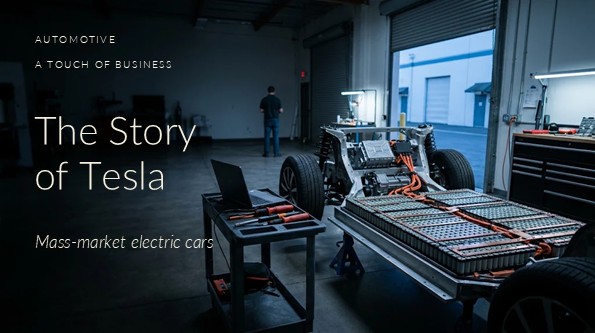
On March 17, 2008, Tesla Motors began regular production of the Roadster. For a company incorporated less than five years earlier, that was a major step: a premium electric sports-car concept had become a vehicle it could build and deliver. It did not settle the larger question of whether Tesla could manufacture cars in substantial numbers.
That next test would require something very different from a sports-car project. Tesla went public, acquired an established automobile plant in Fremont, California, and began delivering the Model S sedan. Later, the Model 3 brought an even more demanding production ramp. The distinction between building an appealing product and repeatedly building it at scale would run through much of Tesla’s history.
By 2026, Tesla also operated an energy-storage business and had introduced limited robotaxi rides. Elon Musk was directing attention toward autonomous mobility and humanoid robots, even as vehicle deliveries had declined in two consecutive years. The company that began with the Roadster was operating on several fronts, but its next transformation remained an open question.
A Quick Look at the History of Tesla
Company History Summary
Tesla Motors, Inc. was incorporated in 2003 by Martin Eberhard and Marc Tarpenning. Elon Musk led an early financing round in 2004 and later became chief executive. The Roadster established Tesla’s first production-car foothold; the Model S, Model 3 and successive factories brought the challenges of manufacturing at greater scale.
The business subsequently expanded into battery storage and solar energy, while Tesla’s more recent strategy placed greater emphasis on autonomous ride services, software and robotics. Its 2024–2025 vehicle-delivery declines and the regulatory review of Cybercab in 2026 are important parts of that continuing history.
Company Snapshot
Founded: July 1, 2003, as Tesla Motors, Inc., incorporated in Delaware.
Original Incorporators: Martin Eberhard and Marc Tarpenning.
Recognized Co-Founders: Martin Eberhard, Marc Tarpenning, Elon Musk, Ian Wright and JB Straubel; the broader designation followed a 2009 settlement.
Company Name: Tesla Motors, Inc. became Tesla, Inc. on February 1, 2017, without forming a new company.
Headquarters: Austin, Texas, since December 2021; Texas state of incorporation since June 2024.
Public Listing: Nasdaq, symbol TSLA.
Businesses: Electric vehicles and related services; energy generation and storage; developing autonomous mobility and humanoid robotics activities.
Key Historical Vehicles: Roadster, Model S, Model X, Model 3, Model Y and Cybertruck.
Leadership as of November 19, 2026: Elon Musk, chief executive officer; Robyn Denholm, board chair.
The Roadster Project and the People Behind It
Martin Eberhard and Marc Tarpenning established Tesla Motors in July 2003. The original business centered on an expensive, lithium-ion-powered sports car rather than an immediately mass-market vehicle. Its proposition was to show that an electric car could offer performance and practical range, then use that starting point to support a broader product line.
The founding history is more complicated than the common shorthand that credits one person. Musk led Tesla’s Series A financing in 2004 and became board chair; Ian Wright and JB Straubel were also part of the early founding team. A 2009 settlement of a dispute over founder terminology led to all five being recognized as co-founders. Eberhard and Tarpenning, however, were the original incorporators, and Eberhard was the company’s first CEO.
In August 2006, Musk laid out a staged strategy in a published company essay: begin with a high-priced sports car, move toward less expensive vehicles and offer ways to generate zero-emission energy. One of the stated aims was to “build a wide range of models, including affordably priced family cars.” The essay documented an ambition; the subsequent business would still have to meet the costs and complexities of that progression.
Roadster production did not begin without engineering difficulties, including changes involving the transmission and powertrain. When Tesla announced regular production on March 17, 2008, Ze’ev Drori was CEO. Musk became CEO later that year. In November, Tesla announced a board-approved $40 million convertible-debt financing commitment as Roadster manufacturing increased. The commitment reflected the financing demands of the early operation, not a claim that the full amount had already been received in cash.
The Roadster reached customers, but a larger vehicle business would require a different manufacturing operation.
Fremont and the Leap Beyond a Sports Car
By 2010, Tesla needed more than a niche vehicle and successive private financing rounds to pursue its sedan plans. The company priced its initial public offering at $17 a share on June 28, 2010, and began trading on Nasdaq the following day. The public offering increased access to capital, although some shares sold in the transaction belonged to existing stockholders rather than generating proceeds for Tesla itself.
Another turning point came that October. Tesla Motors acquired the former NUMMI automobile plant in Fremont, California. The purchase was an acquisition of the facility from the NUMMI entity, not an acquisition of Toyota or General Motors. What mattered operationally was the manufacturing base: Tesla now had an established automotive assembly site on which to build its own production capabilities.
The Model S reached its first customers on June 22, 2012. Compared with the low-volume Roadster, the sedan called for more repeatable vehicle assembly and a wider business operation. Tesla also drew on a U.S. Department of Energy loan facility as part of its development and manufacturing financing. That was real public-sector financing, and it came with repayment obligations.
In May 2013, Tesla repaid the outstanding obligations on its $465 million Department of Energy loan facility, including applicable early-repayment fees, ahead of schedule. The payoff closed a federal financing chapter that had helped support its move into larger-scale manufacturing.
The move from Roadster to Model S followed the direction Musk had described in 2006. Yet delivering the sedan was only one part of the challenge: manufacturing costs, production rates and future model development still had to be managed.
More Than Cars: Batteries, Storage and Solar
As Tesla expanded vehicle production, battery supply and battery-system costs remained central to its operations. In July 2014, Tesla Motors and Panasonic signed an agreement to cooperate at the Nevada Gigafactory. Their roles were distinct: Tesla would provide and manage the site and assemble modules and packs, while Panasonic would manufacture and supply cells and invest in associated equipment. This was a production partnership, not a merger of the two companies.
The following year brought a broader use for battery technology. In April 2015, Tesla introduced the Powerwall and larger storage products for businesses and utilities under Tesla Energy. The company was no longer presenting batteries only as components of its cars. During the third quarter of 2015, first deliveries of the Model X also added a sport-utility vehicle to the automotive lineup.
Solar energy became part of the company structure in November 2016, when Tesla Motors completed a stock-for-stock acquisition of SolarCity Corporation. SolarCity had previously been an independent business; after the merger, it survived as Tesla’s wholly owned subsidiary. The acquisition brought solar-generation activities alongside Tesla’s storage products, but it also raised conflict-of-interest and valuation questions among shareholders.
Those questions reached the courts. Shareholders challenged the fairness of the SolarCity transaction, and in 2023 the Delaware Supreme Court affirmed a lower-court finding that the deal met the standard of entire fairness. That legal outcome should be distinguished from a judgment about whether the acquisition ultimately delivered all of its commercial ambitions.
The energy business would become increasingly material to Tesla’s results. Its path also shows why the company’s history cannot be described solely through the launches and sales of cars.
Model 3 Makes Production the Central Challenge
On February 1, 2017, Tesla Motors changed its corporate name to Tesla, Inc. The original corporation continued under a broader name after the entry into energy generation and storage. The change did not represent a second founding or a break in the company’s legal history.
Model 3 deliveries began in July 2017. Whereas the Model S and Model X occupied more expensive, lower-volume positions, the Model 3 was intended for substantially larger production. The previously publicized $35,000 version remained a planned offering rather than the configuration of every car delivered at launch.
Through 2018, Tesla confronted bottlenecks in the Model 3 ramp and pushed toward producing roughly 5,000 vehicles a week. A deadline-driven production milestone attracted attention, but contemporary reporting questioned whether the pace could be sustained. Later filings documented substantial improvements alongside continuing manufacturing challenges. The difficult ramp showed that demand and repeatable factory output were separate hurdles.
The year also brought a separate governance crisis. In September 2018, the U.S. Securities and Exchange Commission charged Musk over statements about taking Tesla private and charged Tesla concerning disclosure controls. Musk and Tesla resolved their respective civil cases without admitting or denying the allegations, with each agreeing to a $20 million penalty. Musk remained CEO but relinquished the board chairmanship; Robyn Denholm became chair in November.
Model 3 showed the tension at the center of Tesla’s expansion: vehicle appeal could bring the company toward a larger market, but consistent manufacturing and corporate oversight were necessary to operate at that scale.
Shanghai, Model Y and a Wider Factory Network
Tesla’s next manufacturing expansion reached beyond the United States. In 2019, it established local vehicle production at its Shanghai facility, its first overseas automobile plant. Building in China gave Tesla a production base in a major vehicle market and added capacity that could also serve export demand. The significance lay in the operating footprint, not in any claim that a single plant explained all subsequent growth.
Model Y broadened the vehicle range, and Tesla’s production numbers became markedly larger. For 2020, the company reported 509,737 vehicles produced and 499,550 delivered. It also recorded its first full-year profit under U.S. generally accepted accounting principles, with net income of $721 million. Revenue from regulatory credits contributed materially to that result, an important qualification when interpreting the automotive economics of the period.
In December 2021, Tesla moved its corporate headquarters from California to Austin, Texas. The relocation was separate from the later change in its state of incorporation. In March and April 2022, Tesla’s Berlin-Brandenburg and Texas factories respectively began Model Y deliveries, extending manufacturing across additional regions. Both facilities still faced the normal limitations of early production ramps.
The factory network made Tesla a very different organization from the early Roadster operation. It also increased the number of sites, suppliers, markets and production systems management had to coordinate. Expansion itself was not the endpoint; the operating question was how that capacity would perform as the vehicle market changed.
A Leading Model Meets a Tougher Car Market
By 2023, Model Y had become a prominent measure of Tesla’s manufacturing scale. JATO Dynamics ranked it the world’s best-selling individual passenger-vehicle model for that year in estimates covering 151 markets.
That year also marked an infrastructure milestone. Ford and General Motors agreed to adopt Tesla’s North American charging connector and provide access to Tesla’s Supercharger network. The agreements extended the influence of Tesla’s charging system beyond its own vehicles; they did not, by themselves, resolve the separate process of formal technical standardization.
Cybertruck took several years to reach customers. Unveiled in 2019, the pickup began customer deliveries on November 30, 2023. Its arrival broadened the lineup as Tesla faced a more competitive market for its established vehicles.
In June 2024, Tesla completed its conversion from Delaware to Texas incorporation following shareholder approval. Its headquarters had already moved to Austin in 2021. Meanwhile, sales trends became less favorable: annual Tesla vehicle deliveries fell in both 2024 and 2025. Reuters reported competition from Chinese and other manufacturers, changes in U.S. electric-vehicle incentives and a weaker response to Tesla’s brand among the pressures around demand. Those factors did not come with a verified breakdown assigning a precise share of the decline to any one cause.
Tesla delivered 1,636,129 vehicles in 2025, roughly 8.6% fewer than in 2024. Total revenue declined to $94.827 billion from $97.690 billion in 2024, while net income attributable to common stockholders was $3.79 billion. Automotive weakness stood alongside a contrasting energy result: Tesla deployed 46.7 gigawatt-hours of energy storage during 2025, and its energy generation and storage revenue increased.
Regulatory questions also remained part of the operating environment. A U.S. recall in 2023 involving approximately 2.03 million Tesla vehicles addressed Autopilot-related concerns, and the National Highway Traffic Safety Administration opened a review of the remedy’s adequacy in 2024. Tesla’s Full Self-Driving (Supervised) system requires an attentive human driver; its name does not make ordinary customer vehicles driverless. These issues help explain why the move toward a commercial robotaxi service involved more than another product launch.
Austin Robotaxis and the Cybercab Transition
On June 22, 2025, Tesla began limited, paid robotaxi rides in Austin using Model Y vehicles. The initial operation included a person described as a front-passenger-seat safety monitor. This was a narrowly introduced ride service, not the widespread, unsupervised operation of a dedicated Cybercab fleet.
In January 2026, Musk publicly announced that Tesla would discontinue the Model S and Model X. Tesla’s filing for the quarter ended September 30 subsequently described their “product sunset in mid-2026.” The distinction matters: the January statement set out a change of direction, while the later filing recorded the product sunset. Musk also discussed using Fremont manufacturing space for the Optimus humanoid robot program, but future manufacturing ambitions were not evidence of an established high-volume robot business.
In September 2026, Tesla introduced Cybercab vehicles into its Austin ride service. The following day, the National Highway Traffic Safety Administration announced an Audit Query concerning whether Tesla’s safety self-certification adequately demonstrated compliance with federal vehicle standards for the unusual, driver-control-free design. The inquiry was a regulatory review, not a final determination that the vehicles failed to comply or a clearance establishing that they did.
Tesla continued to describe autonomy, robotaxis, AI computing and Optimus as areas of strategic investment. As of November 19, 2026, these efforts formed a significant part of Tesla’s stated direction, while their long-term commercial scale and profitability remained uncertain. The step from launching a limited service to making it reliable, compliant and broad-based would be another execution test.
Where Tesla Stood in 2026
As of November 19, 2026, Tesla, Inc. remained a publicly traded Texas corporation headquartered in Austin, led by CEO Elon Musk and board chair Robyn Denholm. Its reportable operations centered on automotive activities and energy generation and storage. Model 3 and Model Y remained the main volume vehicles, while Cybercab service and humanoid robotics occupied different, still-developing stages.
The latest reported quarter illustrated the scale and range of the business without settling its future direction. In the third quarter of 2026, Tesla reported 486,532 vehicle deliveries and 13.7 gigawatt-hours of energy-storage deployments. For the nine months ended September 30, it reported $78.669 billion in revenue, $2.38 billion in net income attributable to common shareholders and 36.0 gigawatt-hours of storage deployments. These were interim figures, not full-year 2026 results.
The Roadster brought Tesla’s first car to customers; Fremont and the Model 3 ramp tested its ability to manufacture at much greater scale. By late 2026, the Cybercab service and Optimus program posed a new version of that recurring challenge: turning ambitious technology plans and limited operations into established businesses while meeting technical and regulatory demands.
Timeline
These milestones trace Tesla’s progression from a sports-car startup to an automotive, energy and emerging autonomous-mobility business.

July 1, 2003
Martin Eberhard and Marc Tarpenning incorporate Tesla Motors, Inc. in Delaware.
2004
Elon Musk leads the Series A financing and becomes board chair, joining the early company alongside other future recognized co-founders.
August 2, 2006
Musk publishes a staged strategy beginning with an expensive electric sports car and aiming toward more affordable vehicles and clean-energy generation.
March 17, 2008
Tesla Motors begins regular Roadster production.
June–October 2010
Tesla Motors begins Nasdaq trading after its initial public offering and buys the former NUMMI factory in Fremont.
June 22, 2012
First Model S customer deliveries begin.
May 22, 2013
Tesla repays its outstanding U.S. Department of Energy loan facility ahead of schedule.
July 2014–2015
Tesla and Panasonic agree to cooperate on the Nevada Gigafactory. Tesla unveils Powerwall and larger storage products in April 2015, and first Model X deliveries follow in the third quarter.
November 21, 2016
Tesla Motors completes its acquisition of SolarCity, which becomes a wholly owned subsidiary.
February–July 2017
The corporation changes its name to Tesla, Inc.; first Model 3 deliveries begin later that year.
2018
Model 3 production ramp difficulties dominate operations. Musk and Tesla settle SEC civil charges; Robyn Denholm becomes board chair.
2019–2020
Tesla establishes vehicle manufacturing in Shanghai and reports its first full-year GAAP net profit for 2020.
December 2021–April 2022
Tesla moves its headquarters to Austin; the Berlin-Brandenburg and Texas factories subsequently begin Model Y deliveries.
2023
JATO ranks Model Y as the world’s best-selling individual passenger-vehicle model for the year. Ford and GM agree to adopt Tesla’s charging connector, and Cybertruck customer deliveries begin.
June 13, 2024
Tesla completes its change of state of incorporation from Delaware to Texas.
2024–2025
Tesla reports consecutive annual vehicle-delivery declines; 2025 deliveries total 1,636,129 vehicles, while energy-storage deployments reach 46.7 gigawatt-hours.
June 22, 2025
Tesla begins limited paid robotaxi rides in Austin using Model Y vehicles with a safety monitor.
Mid-2026
Tesla’s Model S and Model X product sunset takes effect, as recorded in the third-quarter filing.
September 2026
Tesla adds Cybercab vehicles to its Austin service. NHTSA opens an Audit Query into Cybercab safety self-certification.
Third Quarter 2026
Tesla reports 486,532 vehicle deliveries and 13.7 gigawatt-hours of energy-storage deployments for the quarter.
FAQs
Question: Who founded Tesla?
Answer: Martin Eberhard and Marc Tarpenning originally incorporated Tesla Motors in 2003. Elon Musk, Ian Wright and JB Straubel were also recognized as co-founders following the resolution of a founder-label dispute in 2009. Musk led a major early financing round in 2004; he was not the company’s sole original incorporator.
Question: Was Elon Musk Tesla’s first CEO?
Answer: No. Martin Eberhard was Tesla’s first chief executive. Ze’ev Drori was CEO when regular Roadster production started in March 2008, and Musk became CEO later in 2008.
Question: Did Tesla repay its federal vehicle-development loan?
Answer: Yes. Tesla repaid the outstanding obligations on its U.S. Department of Energy loan facility in May 2013, ahead of schedule. The loan was government financing, not an unpaid grant.
Question: What happened when Tesla acquired SolarCity?
Answer: Tesla Motors completed a stock-for-stock acquisition of SolarCity on November 21, 2016, after which SolarCity remained in existence as a wholly owned Tesla subsidiary. Shareholders challenged the deal’s fairness, but in 2023 the Delaware Supreme Court affirmed a lower-court finding of entire fairness.
Question: Is Tesla only an electric-car manufacturer?
Answer: No. Tesla’s operations also include battery storage, solar energy and vehicle-related services such as charging and software. Robotaxi services and humanoid robotics are additional areas of activity and investment, with their longer-term commercial scale still uncertain as of November 2026.
Question: Does Tesla’s Full Self-Driving (Supervised) mean a customer car drives without a human driver?
Answer: No. Full Self-Driving (Supervised) is driver-assistance technology that requires an attentive driver. Tesla’s limited robotaxi operations are a separate service, with their own deployment and regulatory questions.
Question: Were Tesla’s Model S and Model X still in production in November 2026?
Answer: Tesla’s filing for the quarter ended September 30, 2026 describes a mid-2026 product sunset for Model S and Model X. That followed Musk’s January announcement that the two models would be discontinued.
Interviews & Firsthand Resources
An Evening with Elon Musk — Computer History Museum
This 2013 event offers a firsthand perspective on Tesla’s early leadership and Musk’s role as investor and executive. It is useful alongside the documented incorporation record because an individual’s recollections and the formal history of founder designations are not necessarily the same kind of evidence.
Read the Computer History Museum event transcript
The Secret Tesla Motors Master Plan — Elon Musk
Musk’s August 2006 essay sets out the original staged approach of moving from a premium electric sports car toward less expensive vehicles and energy generation. Reading it in its original form makes clear which aims were publicly stated at the time, before their later operational results could be known.
Read the original Tesla master plan
Sources
- Computer History Museum: Fairchildren — Tesla Motors founding entry
- Los Angeles Times: Tesla founders end legal fight (2009)
- Tesla — Early Strategy and Product Releases: The Secret Tesla Motors Master Plan (2006), Roadster production begins (2008), Financing commitment (2008), IPO pricing (2010), Model S customer deliveries (2012), DOE loan repayment (2013)
- U.S. Securities and Exchange Commission — Tesla Filings: Fremont plant acquisition (2010), SolarCity merger completion (2016), Company name change (2017), Tesla fiscal 2017 Form 10-K, Headquarters relocation (2021), Q1 2022 shareholder update, 2025 Form 10-K, Q3 2026 Form 10-Q
- Tesla and Panasonic: Nevada Gigafactory cooperation agreement (2014)
- Reuters via Investing.com: Powerwall and energy-storage launch (2015), Tesla manufacturing approval in China (2019), GM and Ford charging agreements (2023)
- Tesla: Model X first deliveries (2015), Cybertruck deliveries (2023), 2024 shareholder meeting results, Q3 2026 deliveries and deployments, Robyn Denholm board biography
- Delaware Supreme Court: In Re Tesla Motors, Inc. Stockholder Litigation (2023)
- Reuters via Business Standard: Model 3 production milestone and limits (2018)
- U.S. Securities and Exchange Commission: Elon Musk and Tesla civil settlements (2018)
- Associated Press via Atlanta Journal-Constitution: Tesla 2020 annual profit and regulatory credits
- JATO Dynamics: Global vehicle-model ranking for 2023
- Reuters: Competition and Tesla’s 2025 delivery decline, Austin robotaxi service launch (2025)
- Axios: Musk’s Model S and Model X discontinuation announcement (2026)
- U.S. National Highway Traffic Safety Administration: Autopilot recall remedy query (2024), Cybercab self-certification Audit Query (2026)