
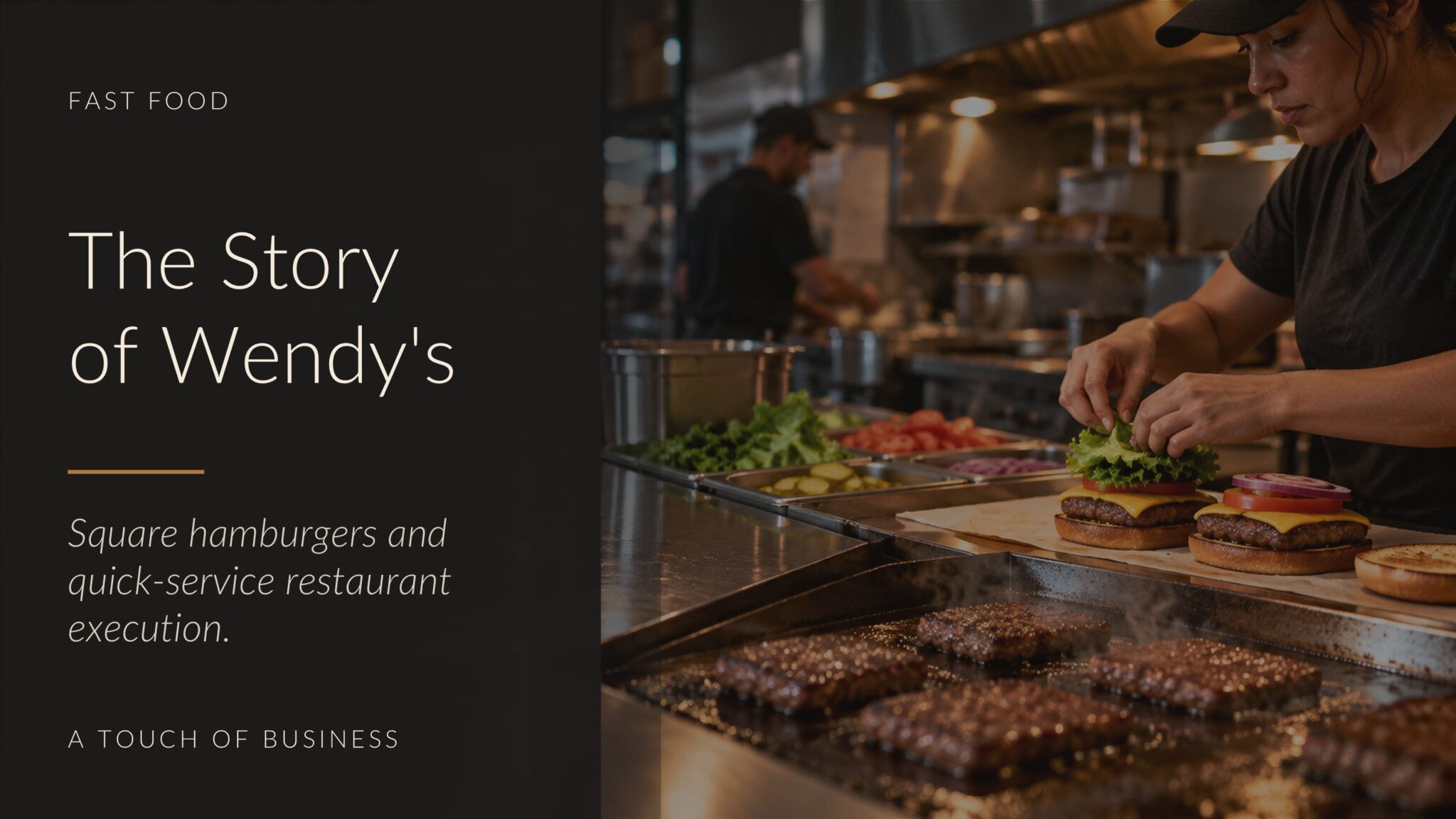
Square hamburgers helped make Wendy’s recognizable, but the business that Dave Thomas started in Columbus, Ohio, would become much more complicated than a single restaurant. Franchising carried his concept across borders. Later leaders experimented with new menus, acquired other chains and oversaw a merger that changed the identity of the public company behind the brand.
Through those changes, a recurring question remained: how could a fast-growing restaurant system maintain the food and service that distinguished it? That question took on new urgency in 2025 and 2026, when Wendy’s management began another attempt to improve performance across a predominantly franchised chain.
A Quick Look at the History of Wendy’s
Company History Summary
Founded by Dave Thomas in 1969, Wendy’s expanded from a Columbus hamburger shop into an international quick-service chain. Its major turning points include the 1984 “Where’s the beef?” campaign, a national breakfast retreat, ownership and divestiture of Tim Hortons and Baja Fresh, and the 2008 merger with Triarc.
After the 2011 sale of Arby’s, the modern public parent took the name The Wendy’s Company. Most of its restaurants later became franchise-operated. By October 2026, management was working to reverse declining U.S. sales.
Company Snapshot
Founded: November 15, 1969, as a restaurant brand.
Founder: Dave Thomas.
Original Name: Wendy’s Old Fashioned Hamburgers.
Founding Location: Columbus, Ohio, United States.
Headquarters: Dublin, Ohio (modern publicly traded parent).
Industry: Quick-service restaurants and franchising.
Publicly Traded Parent: The Wendy’s Company (Nasdaq: WEN).
Chief Executive: Bob Wright, effective May 21, 2026.
Best Known For: Square hamburgers and the Wendy’s restaurant chain.
Operating Model: Approximately 95% of restaurants were franchise-operated as of December 28, 2025.
Dave Thomas Builds a Different Hamburger Restaurant
Thomas brought restaurant-industry experience to the first Wendy’s, which opened on November 15, 1969, at 257 East Broad Street in Columbus. According to Wendy’s account of its founder, he saw an opportunity for a simpler hamburger restaurant serving fresh-beef patties with toppings chosen by customers. He named it Wendy’s Old Fashioned Hamburgers after the nickname of his daughter Melinda.
The square hamburgers stood out, but the menu also included chili, French fries, soft drinks and Frosty desserts. Together, those foods supplied a recognizable menu as additional restaurants opened.
In 1970, Wendy’s introduced a pickup window, adding a convenient way for customers to order. It was one of the format changes that preceded the chain’s expansion beyond Columbus.
Franchising supplied the next growth mechanism. Wendy’s says Thomas began selling franchise rights for entire cities or regions in 1973, rather than individual stores alone. The chain reached Canada in September 1975, opening in Hamilton, Ontario, and the original Wendy’s business went public in September 1976.
Wendy’s chronology marks the opening of its 1,000th restaurant in 1978. That scale introduced a lasting operational challenge: delivering a consistent experience through an expanding network of locations and owners.
National Attention Meets the Limits of Expansion
As the restaurant count increased, Wendy’s introduced additions to its menu, including salad bars in 1979 and baked potatoes in 1983. These choices broadened what customers could order without removing the hamburger from the center of its identity. National advertising then gave the brand a line far more famous than any new menu item.
In 1984, actress Clara Peller appeared in Wendy’s commercials asking, “Where’s the beef?” The campaign contrasted the chain’s hamburger message with competing fast-food offerings, and the phrase spread into popular conversation. The national attention made the advertisement a defining moment in Wendy’s public identity.
The next major menu experiment had a different outcome. Wendy’s introduced a national made-to-order breakfast program in July 1985, adding preparation demands to restaurants accustomed to lunch and dinner service. Contemporary reporting described weak results and operational difficulties. Breakfast became largely optional for operators, and by October 1986 only about 800 of roughly 3,450 Wendy’s restaurants were still serving it.
That retreat coincided with broader financial problems. Wendy’s International also reported a $47.05 million third-quarter net loss and a $75 million charge tied to plans to dispose of marginal operations, including underperforming company-owned restaurants and other units. The restructuring extended beyond breakfast.
The breakfast setback illustrated the difficulty of fitting a more complex menu into daily restaurant operations. Advertising, meanwhile, drew more directly on the founder: Dave Thomas began appearing in Wendy’s television commercials in 1989.
Buying Beyond Burgers, Then Returning to the Core
Wendy’s expansion did not stop at new restaurants or menu items. In December 1995, the original Wendy’s operating company acquired Tim Hortons, the Canadian coffee-and-doughnut chain. The acquisition brought another restaurant business under Wendy’s ownership, but Tim Hortons remained a distinct brand, not a new kind of Wendy’s location.
Thomas continued to be a public symbol of the chain while supporting adoption advocacy. He founded the Dave Thomas Foundation for Adoption in 1992 and died on January 8, 2002, at age 69. His death ended a prominent personal presence in the advertising, while the company was moving into another area of restaurant investment.
In 2002, Wendy’s International agreed to acquire Baja Fresh for a reported $275 million. CEO Jack Schuessler described the deal as part of management’s ambitions in fast-casual dining. That expansion into an adjacent restaurant category would prove short-lived.
By 2006, Wendy’s International was separating its two prominent non-Wendy’s holdings. Tim Hortons conducted an initial public offering in March; on September 29, Wendy’s International distributed its remaining Tim Hortons interest to shareholders. The spin-off ended its ownership of that chain.
In October 2006, Wendy’s International agreed to sell Baja Fresh for approximately $31 million, completing the divestiture on November 28. The reported sale price was far below the 2002 purchase price, although the price comparison alone does not capture the investment’s full financial outcome.
Interim CEO Kerrii Anderson explained the intended refocus in the October announcement: “This transaction, as well as our September 29th spin-off of Tim Hortons, will allow us to sharpen our focus on the Wendy’s brand.” After the two divestitures, Wendy’s International once again had a narrower restaurant portfolio.
The Triarc Merger Changes Wendy’s Corporate Identity
The next major transformation involved ownership rather than the menu. By 2008, Wendy’s International and Triarc Companies, Inc., the parent of Arby’s, were separate corporate businesses. Their boards approved a merger, completed on September 29, 2008. The surviving public parent was Triarc, which changed its name to Wendy’s/Arby’s Group, Inc.; Wendy’s International became part of that group.
It would be misleading to describe the merger simply as Wendy’s buying Arby’s. The deal placed both restaurant businesses under the Triarc-derived listed parent; Roland Smith served as chief executive of the combined group.
The combined arrangement did not continue indefinitely. Wendy’s Restaurants sold Arby’s to a buyer formed by Roark Capital, effective July 4, 2011. The following day, Wendy’s/Arby’s Group adopted the name The Wendy’s Company, concentrating the listed parent once again on the Wendy’s brand.
This history gives Wendy’s two distinct corporate reference points: Thomas founded the restaurant brand in 1969, but the legal predecessor of today’s listed parent traces to a separate 1929 incorporation in the Triarc lineage. The earlier date belongs to the parent company’s legal history, not the hamburger chain’s founding.
With the Arby’s separation complete, Wendy’s introduced Dave’s Hot ‘N Juicy hamburgers in 2011 and moved into a broader restaurant image and remodeling program in the following years. The next structural shift would affect who actually operated the restaurants.
Modernizing Restaurants and Moving Toward Franchising
Wendy’s Image Activation effort changed the visual presentation of restaurants and the brand. Alongside those changes, The Wendy’s Company and its operating businesses began reducing the number of restaurants they ran directly. The 2013 System Optimization initiative included sales of company-operated locations to franchisees.
Refranchising was a major change in how the business worked, not simply a transfer of store addresses. Company filings report sales of 327 restaurants to franchisees in 2015 and another 310 in 2016. By January 1, 2017, company-operated restaurants represented roughly 5% of the system.
Under that model, most Wendy’s locations are managed by independent franchise operators. The public parent collects royalties, fees and other franchise-related revenue while retaining a smaller directly operated restaurant base. Sales made to customers across all Wendy’s restaurants are therefore different from revenue reported by The Wendy’s Company itself.
This operating model gives franchisees a central role in daily restaurant performance, while corporate leaders must work with independent owners on standards, investments and restaurant economics. Those relationships became particularly important during the chain’s next sales slowdown.
Breakfast Returns as Ordering Channels Change
Decades after its earlier breakfast retreat, Wendy’s introduced another nationwide U.S. breakfast program in March 2020. The timing coincided with the onset of the COVID-19 pandemic, when restaurant service and ordering habits were undergoing significant disruption. This was a return to the daypart, not Wendy’s first national attempt to serve breakfast.
Wendy’s launched a U.S. loyalty program in July 2020 as its app, mobile ordering and delivery channels became more important. Those services gave customers more ways to interact with the chain beyond the counter and pickup window.
In May 2023, Wendy’s and Google Cloud announced a generative-AI drive-through ordering pilot called Wendy’s FreshAI. The announcement described a pilot, not a chainwide rollout.
Sales Pressure and Another Attempt to Reset Wendy’s
By 2025, The Wendy’s Company was reporting substantial pressure in the United States. U.S. systemwide same-restaurant sales declined 5.6% that year. Management presented Project Fresh as an effort to improve the brand, restaurant operations, the store network and capital allocation. A plan to close selected weak U.S. restaurants formed part of that response; it was not a plan to shut down the chain.
There were broader economic pressures too. Contemporary reporting described soft spending among some lower-income customers and aggressive discounting across the restaurant industry. Those conditions formed part of the operating environment, while management also raised concerns about Wendy’s own value proposition and franchisee economics.
Kirk Tanner left his position as Wendy’s chief executive in 2025, and Ken Cook then served as interim CEO. The Wendy’s Company board appointed Bob Wright, effective May 21, 2026, while Cook continued as chief financial officer. Wright took over as the chain faced falling U.S. sales and the challenge of coordinating changes across thousands of franchise locations.
The scale of the problem was apparent in second-quarter 2026 results, covering the period ended June 28. U.S. same-restaurant sales fell 7.0% from a year earlier, while global systemwide sales declined 6.5%. In August, the company withdrew its full-year financial outlook and reduced its quarterly dividend to $0.07 per share.
Wright described the challenge in the August results release: “Our traffic, our value proposition and franchisee economics are not meeting our expectations.” He outlined priorities for the menu, marketing, restaurant operations, digital experience and franchisee economics. Speaking to The Wall Street Journal, he also criticized past cost-cutting for what he saw as damage to food quality. Those were the opening priorities of a turnaround, not its results.
International expansion remained part of management’s plans. In the first quarter of 2026, Wendy’s announced an agreement for the development of up to 1,000 restaurants in China. As of June 28, 2026, the global system had 7,180 operating restaurants—5,724 in the United States and 1,456 internationally—while the China figure remained a future development goal.
As of October 12, 2026, Wendy’s remained an operating international restaurant chain under the publicly traded Wendy’s Company. The business Dave Thomas founded had grown into a predominantly franchised system, passed through several portfolio changes and acquired a different public-company lineage. Its latest leadership team was trying to restore traffic and improve quality and value across the network. The outcome was still uncertain.
Timeline
These milestones trace Wendy’s development from its first Columbus restaurant to the modern franchised company.

November 15, 1969
Dave Thomas opens the first Wendy’s Old Fashioned Hamburgers in Columbus, Ohio.
1970–1973
Wendy’s adds a pickup window in 1970 and begins its regional franchising program in 1973.
1975–1976
The Wendy’s restaurant system enters Canada through Hamilton, Ontario, in 1975; the original Wendy’s business completes an IPO in 1976.
1978
Wendy’s records its 1,000th restaurant, according to the company’s chronology.
1984
The “Where’s the beef?” advertising campaign featuring Clara Peller gains national recognition.
1985–1986
Wendy’s International rolls out a nationwide made-to-order breakfast program, then retreats from the format amid operational difficulties; wider restructuring is announced in 1986.
1989
Dave Thomas begins appearing in Wendy’s television advertising.
1995
Wendy’s acquires Tim Hortons, bringing the Canadian chain under its ownership.
2002
Dave Thomas dies in January; Wendy’s International acquires Baja Fresh that year.
2006
Wendy’s International spins off its remaining Tim Hortons interest in September and completes the Baja Fresh sale in November.
September 29, 2008
Triarc and Wendy’s International complete their merger. The surviving listed parent becomes Wendy’s/Arby’s Group.
July 2011
Wendy’s Restaurants sells Arby’s; the listed parent changes its name to The Wendy’s Company.
2013–2017
System Optimization and refranchising reduce company restaurant ownership to approximately 5% of the network.
March–July 2020
Wendy’s launches a new nationwide U.S. breakfast program in March and a U.S. loyalty program in July.
May 2023
Wendy’s and Google Cloud announce a Wendy’s FreshAI drive-through ordering pilot.
2025
The Wendy’s Company introduces Project Fresh amid declining U.S. comparable restaurant sales.
May–August 2026
Bob Wright becomes chief executive in May; August second-quarter results prompt the withdrawal of full-year guidance as management outlines turnaround priorities.
FAQs
Question: Who founded Wendy’s, and who was Wendy?
Answer: Dave Thomas founded Wendy’s in Columbus, Ohio, on November 15, 1969. According to Wendy’s founding account, the restaurant was named for his daughter Melinda, whose nickname was Wendy.
Question: Why does The Wendy’s Company have a corporate history older than 1969?
Answer: The restaurant brand began in 1969, but the modern public parent follows a separate legal lineage through Triarc, whose corporate predecessor was incorporated in 1929. Triarc combined with Wendy’s International in 2008, and the surviving parent adopted The Wendy’s Company name in 2011. The 1929 date is not the founding date of the hamburger chain.
Question: Does Wendy’s still own Tim Hortons or Arby’s?
Answer: No. The original Wendy’s business acquired Tim Hortons in 1995 and separated its remaining ownership in 2006. Wendy’s and Arby’s were later under a shared public parent following the 2008 Triarc merger, but Wendy’s Restaurants sold Arby’s in 2011.
Question: Did Wendy’s first introduce breakfast in 2020?
Answer: No. Wendy’s introduced a nationwide breakfast program in 1985, then largely withdrew it by 1986. March 2020 marked a later nationwide U.S. breakfast relaunch.
Question: Is Wendy’s closing, or does the parent operate every restaurant?
Answer: Wendy’s was still operating internationally as of October 12, 2026. Management announced plans to close selected underperforming U.S. locations, not the entire chain. About 95% of Wendy’s restaurants were franchise-operated at December 28, 2025.
Interviews & Firsthand Resources
Bob Wright on the Return to Burger Fundamentals
Heather Haddon’s August 2026 report in The Wall Street Journal draws on Bob Wright’s assessment of Wendy’s performance after he became chief executive. The conversation focuses on food quality, value and operations as he laid out the changes he hoped to make.
View the leadership interview/report
Wendy’s August 2026 Results and CEO Statement
Wendy’s second-quarter 2026 earnings release provides Wright’s own explanation of the company’s operating pressures and his turnaround priorities. The release also records the latest restaurant count and sales results discussed in this history.
Further Reading
- Columbus Metropolitan Library: Original Wendy’s Location — A local-history exhibit documenting the original downtown Columbus restaurant and its later closure.
Sources
- Wendy’s: The Wendy’s Story, Dave’s Legacy — Founding Wendy’s.
- Associated Press (via Deseret News): Wendy’s Founder Dave Thomas Dies.
- TIME: Prime Ribbing (1984).
- Los Angeles Times: How Wendy’s Botched Breakfast, Wendy’s International in Red During Quarter, Wendy’s Agrees to Buy Baja Fresh, Wendy’s Takes a Big Loss on Baja Fresh Sale.
- Wendy’s International, Inc. / SEC: 2006 Tim Hortons Spin-Off Form 8-K, Baja Fresh Sale Completion in Form 10-Q, 2006 Baja Fresh Sale Announcement.
- Triarc / Wendy’s–Arby’s Group / SEC: 2008 Merger Completion, 2011 Arby’s Sale and Corporate Renaming.
- The Wendy’s Company / SEC: FY2015 Form 10-K, FY2016 Form 10-K, FY2025 Form 10-K, 2026 Bob Wright Appointment Form 8-K.
- Google Cloud and Wendy’s: 2023 FreshAI Pilot Announcement.
- Associated Press: 2025 Wendy’s Restaurant Closure Plans.
- The Wendy’s Company, Investor Relations: First-Quarter 2026 Results, Second-Quarter 2026 Results.
- The Wall Street Journal: Wendy’s CEO Aims for Chain to Get Back in the Burger Fight.