
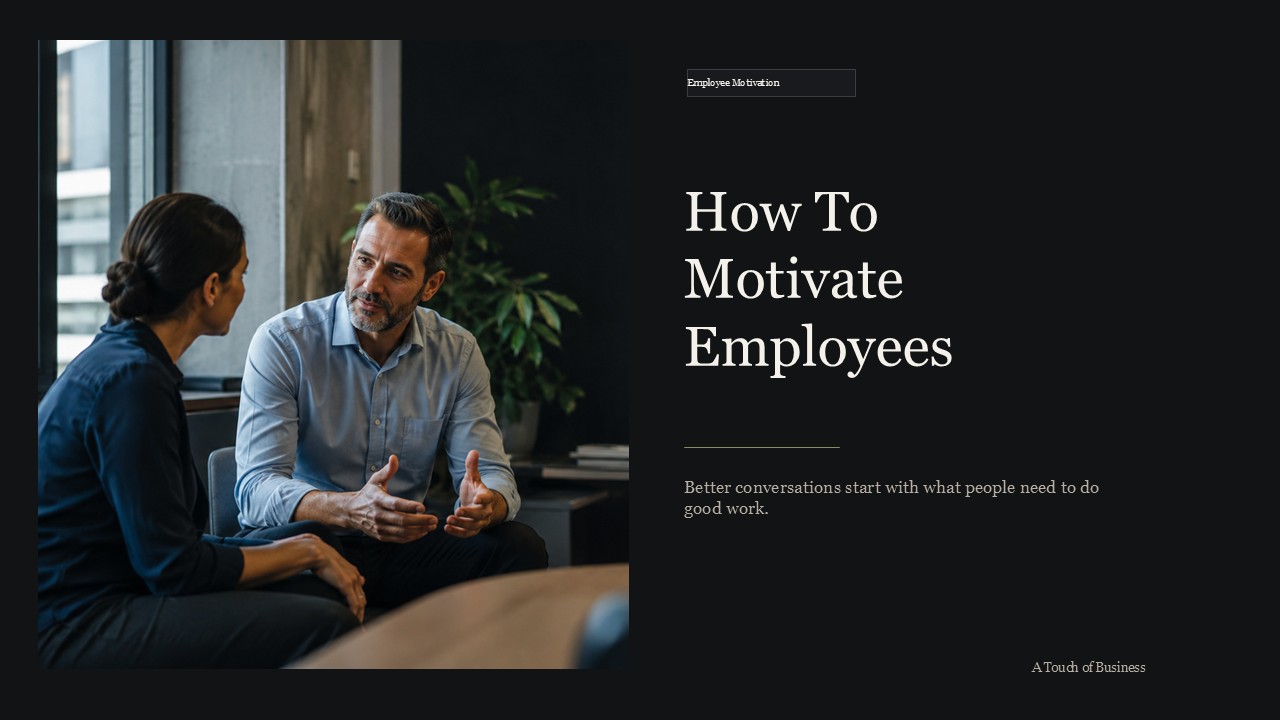
How To Motivate Employees
Motivation comes from within, but as a manager, you can influence it. You can’t just tell someone “get motivated” and expect it to happen. What works is using methods that support motivation, then paying attention to what’s actually working for your team.
Some people are naturally self-motivated. Others need a manager who creates the right conditions. Below are practical tactics for motivating employees, tested by managers and backed by research. Try a few, watch what moves the needle for your team, and keep doing more of that.
Let Your Employee Know You Trust Them
When you tell someone “I trust you,” they feel important, and they know their performance counts. They’re more likely to invest in their work because you’ve shown you trust them. Now imagine hearing “I don’t trust you” instead — that can damage work performance fast.
An employee who cares about their job may work to earn back that trust. One who doesn’t may settle for doing the bare minimum.
Tell your competent employees “I trust you” when the moment calls for it, then watch how their performance changes.
Set Achievable Goals For Your Employee
Giving employees clear goals and standards builds motivation. Without a goal, most people default to the day-to-day task list — no direction, no improvement, and no real motivation. With a goal, they have something to work toward, and that alone lifts motivation.
This isn’t just a hunch. Goal-setting theory, developed by researchers Edwin Locke and Gary Latham, is one of the most well-tested theories in workplace psychology. It found that people perform best when goals are clear, specific, and challenging but achievable, and when they get regular feedback on progress.
The key is to set a goal that’s achievable but still requires effort — not so easy that hitting it feels like nothing. Give it clear expectations and a measurable benchmark, so your employee knows exactly what hitting the target looks like.
For example, don’t just say “this month’s goal is to increase sales.” Instead, say: “In the next 30 days, we need to increase sales by 3.5%. Our monthly sales are at $86,350, so by April 25th we need to reach $89,375. If each team member makes two extra cold calls a day and follows up with existing customers, we can hit that target.”
Be Transparent
Being honest with your employees builds trust and stronger working relationships. Transparency doesn’t mean giving away trade secrets — it means being straight with people. Better relationships lead to better motivation.
Get to Know Your Employees
Genuinely getting to know your employees builds a sense of caring. When your team knows you care, they tend to put in more effort than they would for a manager who never talks to them.
You don’t have to be best friends with every employee. Getting to know them on a professional level is enough.
Prioritize Work-Life Balance
Keeping your personal life and work life separate matters. Without that separation, your days blur together, you can get overwhelmed, and you risk drifting from the people who matter most. Make it a habit to protect that line.
Once you’ve got your own balance in place, you’re in a better position to help your team with theirs. Not every employee will want to be as engaged with work as you are, and that’s fine — but you can still coach them on managing work and personal life. Helping them get that right can give their motivation a real boost.
Have an Open-Door Policy
An open-door policy leads to better working relationships. It keeps you in the loop on what’s going on with your team, and it gives employees somewhere to turn when they need it.
An open door only works if it comes with real coaching and support. Without that, it’s just an open door. Coaching and support are what actually improve motivation and morale, one employee at a time.
Recognize a Job Well Done
Give credit where credit is due. Picture an employee who consistently goes above and beyond — accurate, on time, doing great work — and never once hears about it.
A simple “thank you,” “good job,” or “congratulations” goes a long way. Acknowledging someone’s work doesn’t mean giving them a raise or letting them coast.
You’re already providing them with steady employment. When a real opportunity comes up, you’ll lean toward your best people anyway. In the meantime, let them know when they’re doing well — it means more than you might think.
Tell Them WHY, So They Get On Board
Managers often ask employees to do something a certain way, or to change what they’re doing, in ways that don’t immediately make sense to the employee. It happens all the time.
The manager usually has a good reason. It’s far more effective to say: “Stop the order you’re working on and start this one — the customer just called.”
Add the reason, and it lands differently: “They need this delivered by 8 a.m. A storm badly damaged their building, and this order will help them get back up and running.”
Once the employee understands why, they’re focused on the job itself instead of wondering why they were asked to switch.
Focus on Solutions to Problems
Here’s how to handle problems: start by figuring out how and why the problem happened.
Once you understand it, don’t dwell on blame. Blame doesn’t produce a solution — it just upsets the team and burns time that could go toward fixing the actual issue.
Instead, focus on a solution that prevents the problem from happening again. Get feedback from the team once you have one. Their input can sharpen the solution, and involving them in solving it tends to lift motivation across the board.
Model this approach with your team when problems come up, and they’ll start using it on their own.
Give Your Team Authority
Giving your team authority to lead and make decisions is a solid motivational tactic and coaching technique.
When you let an employee make decisions related to their own job, you build their skills and their confidence. Letting them lead a project they’re qualified for works the same way.
Give Employees Room to Work
Micromanaging is how some managers try to make sure every task gets done exactly their way.
Employees generally do their best work when they have room to complete tasks their own way. The end result should be consistent for everyone, but how each person gets there can vary. Some employees prefer to work step by step; others prefer to rearrange the order. As long as the outcome is correct, that’s fine — let your team members build their own workflow when you can.
One employee couldn’t stand still at his station, and it became a recurring complaint. He couldn’t stay still even during a one-on-one conversation, which was worth noting on its own.
His work was on time and accurate, so letting him move around wasn’t a problem — it just wasn’t how everyone else worked.
Create a Good Work Environment
A good work environment is one of the more effective ways to motivate a team. It’s a broad topic, but a few starting points help. Look at working conditions first: are your employees comfortable? Are they struggling with something you could fix?
If your team works in the cold, for example, look at what you can change. Can you offer more frequent warm-up breaks? Adjust the space to run warmer? Provide better cold-weather gear? Making employees more comfortable boosts productivity, and that boosts motivation.
A relaxed atmosphere matters too. When your team can be themselves at work instead of feeling like they have to watch every word, it feels less like a grind and more like a place they want to be. People still need to be respectful and get the job done — but there’s room for both.
Focus on Teams, Not Just Individuals
Building strong teams is on you as the manager. It’s easy to favor your top performer, but one standout employee isn’t enough to carry a large team. You need everyone working together.
Coach your strongest performers to help weaker teammates — with their agreement, since leading takes buy-in. When your team leaders genuinely help other members grow, you’ve got a real foundation for building a stronger team.
Recognize the team as a whole. As weaker members improve, recognize that too, and keep acknowledging your top performer’s role in the team’s success. Once this is in place, your team leaders start developing leaders of their own.
Celebrate Wins
Managers often spend most of their energy on problems and say little when the team performs well.
Mistakes need addressing, sure — but celebrating wins matters just as much. Not just the big ones. Acknowledge progress when you see it. A simple “nice work” goes further than most managers expect.
Money as a Means of Motivation
Everything above works without spending a dollar. Here are a few monetary options worth considering too.
Raise
A raise that rewards strong performance is a straightforward way to motivate employees. Make sure it’s earned, and use it to encourage that employee to keep performing at a higher level.
Point System
A points system gives employees points for hitting specific targets. Points can be redeemed for cash, gift cards, merchandise, or paid time off.
Bonuses
A bonus is sometimes the better option over a raise, since it’s a one-time payout rather than an ongoing cost.
Some bonuses are set in advance to motivate the team toward a specific target. Others are given after the fact, simply to say “great job, keep it up.”
Give Your Employees Ownership in the Company
If your company can issue stock or set up a profit-sharing plan, giving employees a stake is one of the strongest ways to keep them motivated. They’re no longer just employed — they’re owners.
Employee ownership isn’t a fringe idea. The National Center for Employee Ownership (NCEO), a nonprofit research organization, has tracked and promoted employee ownership plans like ESOPs since 1981 — a sign this option has real staying power for businesses that want to use it.
Key Points and Facts About Motivating Employees
- Motivation mostly comes from within, but managers can create the conditions that support it.
- Trust, clear goals, recognition, and autonomy consistently drive employee motivation more than pressure does.
- Global employee engagement is currently low — Gallup’s 2026 report puts it at 20%, the lowest level since 2020.
- Goal-setting research shows people perform best with goals that are specific, challenging, and paired with regular feedback.
- Money matters, but it’s one tool among many — non-monetary tactics like trust and recognition cost nothing and work just as well.
Action Steps for Motivating Employees
This Week
- Tell one competent employee directly that you trust them, and mean it.
- Set one clear, specific goal with a teammate, including a number and a deadline.
- Acknowledge one piece of work someone did well, out loud.
This Month
- Review your team’s working conditions and fix one thing that’s making the job harder than it needs to be.
- Give one employee more authority or ownership over a task they’re already good at.
- Start explaining the “why” behind requests, not just the “what.”
Ongoing
- Keep an open door, and back it up with real coaching, not just availability.
- Celebrate wins as consistently as you address problems.
- Watch what’s working for your team specifically, and do more of that.
Checklist for Motivating Employees
- Build trust
- Tell employees directly when you trust them
- Follow through so trust is earned both ways
- Set clear goals
- Make goals specific and measurable
- Set a deadline and a clear benchmark
- Recognize good work
- Say thank you when it’s earned
- Do it consistently, not just once a year
- Give autonomy
- Let employees choose how they get the work done
- Hand off real decisions, not just tasks
- Improve the environment
- Fix physical working conditions where you can
- Allow a relaxed, respectful atmosphere
- Consider monetary options
- Use raises, bonuses, or a points system where it fits your budget
- Explore profit-sharing or ownership plans for the long term
FAQ: Motivating Employees
What motivates employees the most?
- It varies by person, but trust, recognition, clear goals, and autonomy are consistently among the strongest drivers — often more than money alone.
Does money motivate employees?
- Yes, but it’s not the only lever. Raises and bonuses work best alongside non-monetary tactics like recognition and trust, not as a replacement for them.
How do I motivate an employee who seems disengaged?
- Start with a direct conversation. Find out what’s actually going on, then look at whether they have clear goals, real autonomy, and any recognition for what they’re doing well.
Can you motivate every employee the same way?
- No. People respond differently to trust, recognition, autonomy, and money — get to know your team well enough to know what moves each person.
References: