
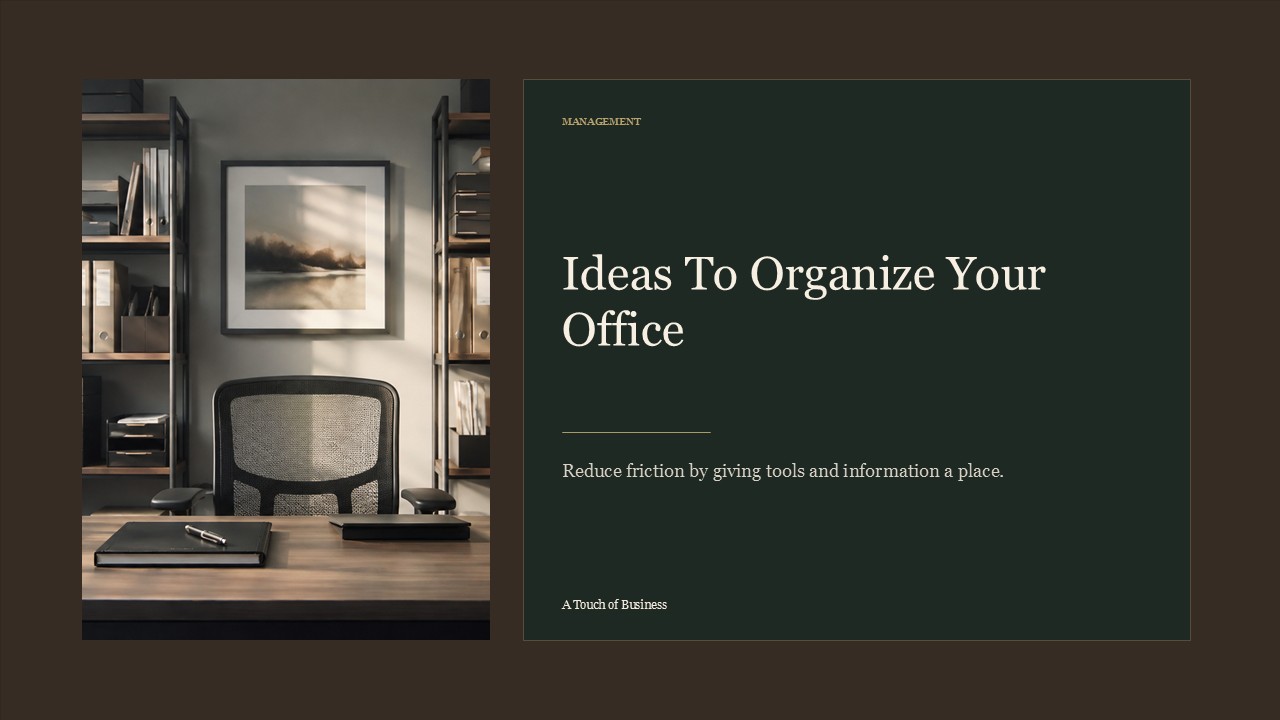
Simple Ideas To Organize Your Office
Is your office unorganized and keeping you from performing at your best?
In this article, I’ll share what’s worked for me in setting up and organizing my office. You don’t have to copy every step — just use the tips that make sense for you.
Research backs up why this matters. The average person spends about 4.3 hours a week hunting for misplaced paperwork, and executives can lose roughly an hour a day the same way.
I spend 80% of my time in my office, so it makes sense to set it up to be as comfortable as possible, on my own terms.
Everyone’s different. But when my office is organized, clean, and everything is where I want it, I’m far more productive than when it’s cluttered and messy.
Let’s look at a few areas you can focus on to organize your office, so you feel good working in it and get more done.
Planning
Start by planning what areas to organize. A plan helps you see the whole picture and know what’s actually needed.
I did a full makeover a few years ago, and I haven’t needed one since. Taking time to plan first, then execute, kept things clean and organized ever after.
Keep your plan simple. Note what you want to organize and clean, and what items you’ll need to set things up the way you like.
Keep that notepad handy for the next few sections — you’ll want it for each one.
What Do You Want To Get Rid Of?
The first step is deciding what to get rid of.
Organizing is one of the best times to clear out the big stuff — an old cabinet, a worn-out chair, a desk that’s seen better days. This is your chance to remove anything you no longer want in your office.
You don’t have to replace everything. Just clear out some items while updating others.
Space Considerations
Do you have enough space in your office? If you’re tight on space, extra wall space or storage units can help.
Unused wall space is a good spot for shelving or cabinets.
In a larger room, try pulling cabinets forward a foot or two instead of pushing them against the wall. You can use the space behind them for storage.
That storage stays out of sight, and the office looks cleaner. If that doesn’t work for you, look for cabinets with more shelves, or research space-saving shelving ideas.
Mapping Everything Out
Grab a notepad and start writing down the categories you want to organize.
For example, map out a supply cabinet — an area for cables, backup hard drives, and equipment you don’t use daily. Add a spot for tools like a laminator, cutting board, or document binder.
Once that area is mapped out, move to your desk. Map out what you need on the desktop and in the drawers.
Next, figure out what bins or shelving you’ll need to buy. Take measurements first, so you know an item — plastic organizers, for example — will fit before you’re at the store. It’s fine to buy two or three options to compare, then return the ones that don’t work.
Office Equipment
Look at your equipment next. Is anything giving you trouble, running slow, or just not doing the job? Maybe your monitor is showing odd colors, or it’s time for a wider screen.
A wireless printer or a docking station can make things more organized and efficient. This is a good time to update equipment to match your office’s new setup, and get rid of anything old.
If you run a business, some equipment purchases may qualify for a tax deduction under IRS Section 179 — but this depends on how much you use it for business, when it’s placed into service, and the current IRS limits. Check current IRS guidance or ask a tax professional before assuming a purchase qualifies.
Declutter
Over time, your office collects things you don’t really need.
Clutter attracts more clutter. Research from DePaul University has linked office clutter to higher stress and emotional exhaustion — so cutting it isn’t just about looks, it affects how you feel at work.
Say you have a pile of unfinished paperwork on your desk. It’s easier to add new paperwork to the pile than to put it away.
The same happens with shelves. When new supplies come in, it’s tempting to set them on a cluttered shelf instead of putting them where they belong.
From my experience, once your office is organized and everything has a place, you naturally start putting things away immediately, and clutter stops building up.
People declutter in different ways. My method: grab a few large bins and clear everything out in one pass. Trying to declutter while you organize takes far more time, so I clear it all out first and organize later.
Each bin gets a category — supplies, equipment issues, items I’m not using at the moment, items I’ll never use, and garbage.
As I sort, I drop items into the matching bin and note what I’m keeping, so I know how much space I’ll need to organize it later.
Desk Decluttering
Time to declutter your desk. This won’t take long — there’s only so much room on a desk.
I prefer a clean desktop with minimal items: speakers, keyboard, mouse, noise-canceling headphones, and one desk organizer. Everything else goes in the drawers for the items I use. That gives me room to work and a good feeling.
Once your desktop is set, declutter the drawers. A desk drawer organizer can help keep everything in place.
Filing Cabinet Decluttering
Filing cabinets fill up fast. Go through your files, reorganize them, and toss the old paperwork you no longer need.
For tax paperwork, the IRS generally requires records for three years from when you filed. Some situations call for longer — up to six years if income was underreported by more than 25%, or indefinitely if a return was never filed.
As a cautious rule of thumb, many advisors recommend keeping tax documents for up to seven years. Check current IRS guidelines, or ask your accountant if you’re unsure.
Labeling
After organizing your office, wait about a week to make sure nothing needs to change. Once everything is in place and you’re happy with it, get your labeler out.
Label your shelves, drawers, file folders, and anything else that needs it. A consistent labeling theme helps with both function and looks.
If you have several plugs on a power bar, label each one for clarity — one for the computer, one for the printer, one for the monitor. That way you can identify each cord at a glance.
Tips for Keeping Your Office Organized
Once your office is organized and set up the way you want, the next step is keeping it that way.
Changing Habits
Build a few small habits. When I’m done for the day, or stepping away for a few hours, I put everything away so my desktop is clean when I come back.
At first, I put everything away only at the end of the day. But once I timed myself, I found it took less than 30 seconds. That’s when I started cleaning up every time I stepped away for a few hours.
I also don’t let paperwork pile up when it comes to bills. I used to pay bills once every few weeks or once a month. Paperwork would pile up, and I’d lose track of my expenses. I’d think I had plenty of money in the bank. Then I’d pay a month’s worth of bills, and it would all be gone.
Now I pay bills as they come in. It gives me a more accurate read on my bank balance and keeps the clutter away.
Purchasing Items
Before buying anything for my office, I ask myself: will I really use it? Will it clutter my office? Once your office is clean and organized, you’ll naturally start avoiding purchases that could clutter it again.
Reorganize
You can go through this process again once a year, every four months, or once a month — whatever fits your routine.
After a major overhaul, you rarely need to start from scratch again. Doing it takes far less time and keeps everything tidy.
Conclusion
An organized office comes down to a few habits: plan first, declutter in one pass, set up storage that fits your space, and label what you can.
Once you’re in the habit of organizing your office, you won’t need to think about it — you’ll just do it.
Key Points and Facts About Organizing Your Office
Why It Matters
- Office clutter is linked to higher stress and emotional exhaustion, according to DePaul University research.
- The average person spends about 4.3 hours a week searching for misplaced paperwork.
What To Do
- Plan first, so you know what you actually need before you buy anything.
- Sort clutter into labeled bins in one pass, rather than decluttering while you organize.
- Label shelves, drawers, and folders once everything has a home.
Money And Records
- Some office equipment may qualify for a Section 179 tax deduction, depending on business use and current IRS limits.
- The IRS generally requires tax records to be kept for three years, though some situations call for longer.
Action Steps for Organizing Your Office
Plan First
- Walk through your office and note what needs organizing.
- Write down what to get rid of and what you’ll need to buy.
Declutter
- Set out a few labeled bins — keep, storage, donate, garbage.
- Sort your desk, shelves, and filing cabinets into the bins in one pass.
Set Up Storage
- Measure your space before buying organizers or shelving.
- Use wall space, or pull cabinets forward to add hidden storage.
Label Everything
- Wait about a week after organizing to confirm the setup works for you.
- Label shelves, drawers, folders, and power cords.
Build The Habit
- Put items away at the end of each work session.
- Handle bills and paperwork as they arrive instead of letting them pile up.
Checklist for Organizing Your Office
- Plan
- List what to remove, keep, and buy.
- Declutter
- Sort everything into labeled bins.
- Set Up Storage
- Measure your space and choose organizers or shelving.
- Update Equipment
- Replace anything slow, broken, or inefficient.
- Label
- Label shelves, drawers, folders, and cords.
- Maintain
- Put items away daily, and reorganize every few months.
FAQ: Organizing Your Office
How often should I reorganize my office?
- Most people find once every few months to once a year is enough after the first major overhaul.
Is new office equipment tax deductible?
- Some equipment may qualify for a Section 179 deduction if it’s used mostly for business and placed in service during the tax year. Check current IRS limits or ask a tax professional.
How long should I keep business tax records?
- The IRS generally requires three years, though some situations call for longer. Many advisors recommend keeping records for up to seven years as a cautious rule of thumb.
What’s the fastest way to declutter?
- Set out a few labeled bins and sort everything in one pass, instead of decluttering while you organize.
References:
- Section179.org — 2026 Section 179 Tax Deduction: Limits & Calculator
- Block Advisors — Section 179 Deduction Guide 2026
- 1-800Accountant — How Long Should You Keep Business Tax Records?
- Beancount.io — How Long Should You Keep Business Records? The IRS 3-4-6-7 Year Rules
- MLR — Tax Record Retention: How Long Should You Keep Your Business and Personal Financial Documents?
- EHS Today — Reducing Office Clutter
- Newswise — Clutter’s Real Effect on Mental Health, Productivity in the Office (DePaul University research)