
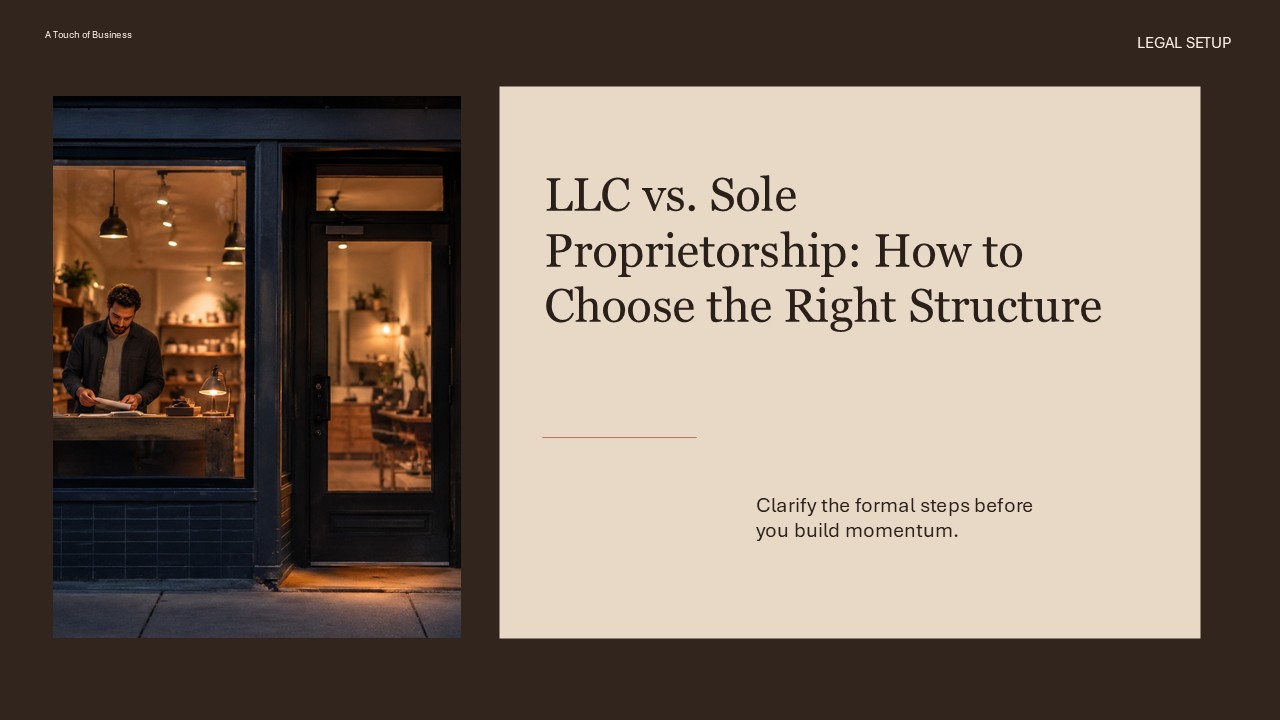
When starting a business, one of the first decisions you’ll make is choosing the right structure for your entity. Each business structure has its own features, advantages, and disadvantages.
Learn each structure’s characteristics before you decide. That way you can pick the one that actually fits how you plan to run and grow your business.
How to Choose Between an LLC and a Sole Proprietorship
This post covers the differences between an LLC and a sole proprietorship, so you can find out which option is better for your business.
What Is a Sole Proprietorship?
A sole proprietorship is a business structure run and managed by one person. It’s the most basic structure, and it doesn’t take much expertise or capital to form and operate.
A sole proprietorship is a good choice if you want to test a business idea without registering an entity. It’s the easiest way to start a business since you don’t have to file it with the state. See the pros and cons of a sole proprietorship for more detail.
What Is an LLC?
A limited liability company, abbreviated as an LLC, is an entity structure formed to protect its owners from personal liability. Anyone can register this business structure in the United States, whether a citizen or a foreigner. The owners of an LLC are called members.
Unlike a sole proprietorship, you have to register an LLC with the state. There are also protocols and requirements you need to meet to form one.
There are different types and classes of LLCs:
- Single-member vs. multi-member LLCs. Single-member LLCs have one owner; multi-member LLCs have more than one.
- Holding vs. operating LLCs. Holding LLCs exist solely to hold assets such as real estate and don’t conduct operations. Operating LLCs conduct business activities such as processing, marketing, and selling goods and services.
- Member-managed vs. manager-managed LLCs. In a member-managed LLC, the members own and run daily operations. In a manager-managed LLC, the members own the LLC but hire managers to run daily operations.
- Foreign vs. domestic LLCs. A foreign LLC is registered in one state but operates in another. A domestic LLC is registered and managed in the same state.
- Series LLC. A parent LLC with individual LLCs organized underneath it.
- Professional LLC (PLLC). Offers professional services such as medical or legal assistance and requires a license to operate.
Side By Side Comparison: LLC vs. Sole Proprietorship
| LLC | Sole Proprietorship |
| Offers personal liability protection, with some exceptions | No personal liability protection |
| Registration with the state required | No requirement to register with the state |
| Is a separate legal entity from its members | Is not a separate legal entity from its owner |
| Costly to form | Easy to form and dissolve |
| Profits and losses divided by ownership share or the operating agreement | The owner keeps all the business’ profits and incurs losses alone |
| Can undergo pass-through taxation or elect corporate taxation | Undergoes pass-through taxation |
| Owners make decisions together | The sole proprietor has the final say on what happens to the business |
Detailed Difference Between LLCs and Sole Proprietorships
You’ve already seen a side-by-side comparison of LLCs and sole proprietorships. Here’s a closer look at the differences between these two business structures.
Personal Liability Protection
Sole proprietorships offer no personal liability protection. The owner is personally liable for the business’ debts and liabilities. If the entity can’t pay its debts, the lender can claim the owner’s personal assets.
An LLC offers personal liability protection to its members. In most cases, members aren’t personally responsible for the company’s debts, and lenders can’t claim personal assets if the LLC defaults on a loan.
That protection has limits, though. Most lenders will still require a personal guarantee before approving a small business loan, especially for newer or smaller LLCs — the lender’s decision depends more on the business’s financial strength and credit history than on its legal structure alone.
Courts can also “pierce the corporate veil” and hold owners personally liable if they commingle personal and business funds, skip basic formalities like a separate business bank account, or use the LLC to commit fraud.
Keeping business and personal finances separate is one of the simplest ways to protect the liability shield an LLC provides.
Separate Legal Entity
Sole proprietorships are not separate legal entities from their owner. This means they can’t buy, sell, or own assets in their own name. They also can’t get into a lawsuit or enter a binding contract in their own name.
LLCs and their members are separate legal entities. An LLC can buy and own assets, get into lawsuits, hire an attorney, or enter into a contract in its own right.
Registration Requirements
Most states in the US don’t require you to register a sole proprietorship. The only thing you may have to do is file for a DBA registration if you use a fictitious name other than your personal name.
As for an LLC, you need to register this business structure with your state. The process also requires you to meet specific protocols, such as filing articles of organization and creating an operating agreement. This agreement identifies the members of an LLC and spells out how the LLC will operate.
Ease of Formation and Dissolution
Sole proprietorships are the most straightforward business structures to form and dissolve. You don’t need to register them with the state or set up a management structure. You, the sole proprietor, are the only one who decides whether to dissolve the business.
LLCs are more costly to form than sole proprietorships and require you to meet specific state requirements. Dissolving one takes member consent, but how much consent depends on your operating agreement and your state’s default rules — some states require a majority of ownership interest, others require unanimous agreement if the operating agreement doesn’t say otherwise.
Taxation Implications
One benefit of a sole proprietorship is there’s no double taxation. Since you and your business aren’t a separate legal entity, the IRS taxes you as one entity at the personal income level.
LLCs get more flexibility. A single-member LLC is taxed as a disregarded entity by default, and a multi-member LLC is taxed as a partnership by default, unless the LLC files Form 8832 to elect corporate tax treatment instead. That means an LLC can end up taxed like a sole proprietorship, a partnership, or a corporation depending on the election made, according to the IRS.
Profit and Loss Sharing
In a sole proprietorship, you keep all the business profits alone. Being the only owner, you’re not required to distribute them to anyone else. The downside is you also absorb losses alone.
In a single-member LLC, you keep profits the same way. In a multi-member LLC, profits and losses are divided according to ownership percentage or however the operating agreement specifies — not necessarily split evenly.
Operations and Management
Decision-making moves faster in a sole proprietorship. You’re the only decision-maker, and you don’t have to consult or get approval from anyone.
An LLC requires more structure. You may need to appoint managers to run daily operations, and LLCs often have employees, which means getting an EIN. Sole proprietors need an EIN too if they plan to hire employees — it isn’t an LLC-only requirement.
How to Choose the Right Structure
When should you pick a sole proprietorship over an LLC, or the other way around? Here are the factors to weigh.
Ease of Expansion
If you want to expand your business or seek funding, an LLC is usually the better fit.
Sole proprietorships have limited expansion opportunities since the sole proprietor is typically the only investor, which caps growth at what the owner can invest. It’s also easier for an LLC to obtain outside funding than a sole proprietorship.
Intentions
If you’re testing a business idea, a structure that doesn’t take much time or capital to start makes sense. A sole proprietorship fits that need, since most states don’t require registration and there are no compliance requirements or ongoing paperwork.
Number of Owners
Sole proprietorships have only one owner. If your business has more than one owner, you’ll need to register an LLC instead.
Citizen or Foreigner
Non-U.S. citizens can legally form either an LLC or a sole proprietorship in the United States
There’s no citizenship requirement for either structure. In practice, though, a sole proprietorship is rarely the right call for a foreign nationa.
Since it offers no liability protection and can create more complicated tax filing requirements for non-residents. An LLC is usually the more practical choice for non-citizen founders.
Conclusion
When choosing a business structure, aim for the one best suited to your situation. If you’re deciding between an LLC and a sole proprietorship, weigh a few key factors.
Personal liability protection is the biggest one — LLCs offer it (with some limits), sole proprietorships don’t.
Also consider whether you plan to expand or seek outside funding, since that’s easier with an LLC. And if your business has more than one owner, an LLC is your only option between the two.
Key Points and Facts About LLCs and Sole Proprietorships
- A sole proprietorship has one owner, no state registration requirement, and no separation between personal and business liability.
- An LLC is registered with the state, is a separate legal entity, and generally protects members from personal liability for business debts.
- LLC liability protection isn’t absolute — personal guarantees on loans and courts piercing the corporate veil can still expose personal assets.
- LLC tax treatment defaults to disregarded entity (single-member) or partnership (multi-member), but an LLC can elect corporate taxation instead.
- Non-U.S. citizens can legally form either structure, though an LLC is usually the more practical choice for liability and tax reasons.
Action Steps for Choosing Between an LLC and a Sole Proprietorship
Assess your liability exposure
- Consider how much personal risk your business activities carry.
- Decide whether that risk is worth accepting under a sole proprietorship or worth protecting against with an LLC.
Think about growth plans
- Decide whether you plan to seek outside investment or expand significantly.
- Choose an LLC if funding or expansion is part of your plan.
Check your ownership structure
- Confirm whether you’re starting the business alone or with partners.
- Register an LLC if there’s more than one owner.
Talk to a professional
- Consult an accountant or attorney about tax treatment options before filing.
- Ask about state-specific registration and compliance requirements before you commit to a structure.
Checklist for Registering Your Business Structure
- Choose your business name
- Confirm the name is available in your state
- File a DBA if you’re a sole proprietor using a name other than your own
- Gather your formation documents
- Draft articles of organization if forming an LLC
- Draft an operating agreement outlining member roles and profit-sharing terms
- Get your tax ID
- Apply for an EIN if you plan to hire employees
- Decide on your LLC’s tax election, if applicable
- Set up separate finances
- Open a dedicated business bank account
- Avoid mixing personal and business funds, especially for LLCs
FAQ: LLC vs. Sole Proprietorship
Can I switch from a sole proprietorship to an LLC later?
- Yes. Many businesses start as sole proprietorships and convert to an LLC once liability protection or funding needs increase.
Does an LLC guarantee I’ll never be personally liable for business debts?
- No. Personal guarantees on loans and courts piercing the corporate veil can still expose your personal assets, even with an LLC.
Can a non-U.S. citizen start a sole proprietorship in the U.S.?
- Yes, it’s legally allowed, though it’s rarely the practical choice given the liability and tax complications non-residents can face.
Will forming an LLC protect me from having to personally guarantee a business loan?
- Not necessarily. Most lenders will still ask for a personal guarantee before approving a loan, especially for newer or smaller LLCs.
References:
- IRS — LLC Filing as a Corporation or Partnership
- Wolters Kluwer — Piercing the Corporate Veil: LLC Risks
- Nolo — Piercing the Corporate Veil: When LLCs and Corporations May Be at Risk
- Dissolve My LLC — How to Dissolve a Multi-Member LLC
- Nav — Why Lenders Require Personal Guarantees for Business Loans
- FindLaw — Does a Sole Proprietorship Need an EIN?
- ZenBusiness — How to Start a Business in the USA as a Non-Citizen Foreigner
- Expat US — How to Start a Business in the USA as a Foreigner
- A Touch of Business — Pros and Cons of a Sole Proprietorship
- A Touch of Business — How to Register a DBA
- A Touch of Business — Getting a Business Tax ID (EIN)