
First impressions matter. When you log in to someone’s social media account, you form an impression of them based on what they post. For a business, that first impression often comes from the company’s logo.
The more customers associate themselves with a business, the more that logo sticks in their mind. Think of Coca-Cola: picture the red, italicized script on a white background. Or McDonald’s: two golden arches forming an “M” on a red backdrop. Both show how much weight a logo carries.
This guide is for small business owners, founders, and managers who are designing a logo for the first time or considering a refresh. It walks through what a logo is (and isn’t), the main types of logos, the elements of a strong design, and a step-by-step process you can follow without hiring a full branding agency.
What Is a Logo?
A logo is a symbol made of text, images, or characters that identifies your company. It gives your business a visual identity and sets it apart from other entities.
A logo is essentially a visual shorthand for your business. It sets the pace for building your brand identity across marketing materials like shirts, business cards, letterheads, and flyers.
A recognizable logo makes your business easier to identify and helps differentiate you from competitors. Every time a customer sees it, they recall their past experience with your company — good or bad.
What a Logo Isn’t
Two common misconceptions:
1. A logo is your brand. A logo is a presentation of your brand, but it isn’t the whole thing. Your brand is how people perceive your company — your reputation, and the emotions it evokes. The logo is simply the visual element that carries that perception.
2. A great logo guarantees success. A unique, well-designed logo doesn’t guarantee business success — you still have to earn customer trust through your product and service. Even an iconic logo won’t save a business that is unreliable or careless with customers; in that case, seeing the logo can remind customers exactly why they shouldn’t buy from you again.
Types of Business Logos
When designing a logo, think about the type and form you want it to take. Here are seven common approaches.
1. Wordmarks
A wordmark is a logo where your business name itself, designed uniquely, is the logo. Visa, Coca-Cola, Google, and Yahoo all use wordmarks. This type works well for newer companies that want customers to learn and associate directly with the company name.
2. Emblems
Emblems (also called badge logos) contain text or a symbol enclosed inside a shape, similar to a seal or crest. They give a traditional, established look. Emblems suit organizations built around heritage or tradition, such as schools and government agencies. Starbucks’ original 1971 logo was a classic emblem — a detailed illustration wrapped in a circular band of text — before the company simplified it into a standalone symbol in 2011.
3. Lettermarks
Lettermarks (or monogram logos) use a business’s initials, styled distinctively. This works well for businesses already known by an abbreviation, such as HP (Hewlett-Packard), NASA (National Aeronautics and Space Administration), IBM (International Business Machines), and HBO (Home Box Office).
4. Pictorial Marks
A pictorial mark is a logo made up of only an icon or image, with no words. Apple, Instagram, Shell, and X all use pictorial marks. Starbucks’ current logo — the siren without any surrounding text — is also a pictorial mark. This type works best for businesses that are already well established, since customers need to already recognize the brand for the image alone to register.
5. Mascots
Mascot logos use an illustrated character to represent the brand, fictional or based on a real person. This type is effective for building an emotional connection, since customers naturally relate to a character. Mascots work especially well for businesses targeting children or families. Examples include KFC’s Colonel Sanders, Kellogg’s Tony the Tiger, the Michelin Man, Disney’s Mickey Mouse, and Procter & Gamble’s Mr. Clean.
6. Abstract Logo Marks
An abstract mark is similar to a pictorial mark, but built from geometric shapes rather than a recognizable image. Google Drive, Nike, Pepsi, and Airbnb all use abstract marks. Because this style needs to be highly original to work, it’s usually designed by a professional.
7. Combination Marks
A combination mark pairs a wordmark with an image, icon, or mascot. This type also suits newer companies building brand awareness, since the name and the symbol reinforce each other. Lacoste and Burger King are both examples.
Elements of a Good Business Logo
Four components shape how your logo comes together:
1. Typography (Font)
Typography is how you present your letters, words, or initials. Choose a professional font that doesn’t clash with the other elements, and decide deliberately whether to use italics, bold weight, or connecting lines.
2. Color Choice
Color shapes how customers feel about your brand before they read a word. In general branding practice, warm colors like red tend to read as energetic or urgent, while cooler colors like blue and green tend to read as calm or trustworthy. These associations are common conventions rather than fixed rules — they shift depending on culture and context, so treat them as a starting point, not a formula.
3. Logo Style
Not every type of logo fits every business. Lettermarks work well if your company name contains natural initials. Combination marks and wordmarks suit new entities still building name recognition. Mascots work best for a younger audience, while pictorial marks suit a business with an already-established customer base.
4. Graphic Style
Graphic style is how you blend every element into one cohesive design. Start by deciding on your elements individually, then experiment with how they work together — that blend is what makes a logo distinct.
Principles That Make a Good Business Logo
Keep these seven principles in mind as you design:
1. Simplicity
The best logos are clean and uncluttered. The Nike swoosh has very few elements, which is exactly what makes it memorable. Aim for a logo with a small number of components, each identifiable from a distance.
2. Originality
Don’t replicate another company’s logo. Mimicking an existing design makes it harder for customers to tell you apart from that business.
3. Versatility
Your logo will show up in many contexts — marketing materials, your website, signage, and promotional items like pens and water bottles. Design it to hold up across all of them.
4. Balance
Each element should sit in harmony with the others. In a combination mark, for example, the wordmark shouldn’t overpower the icon or vice versa. Align each element symmetrically where possible.
5. Timelessness
A good logo holds up over time. Avoid chasing design trends, which tend to fade quickly. The Coca-Cola logo is the classic example: it has gone through a number of refinements since 1886 — a script adjustment in the 1940s, the addition of the red color in 1934, even a brief fishtail-shaped version in 1958 — but its core script and red-and-white palette have stayed recognizable for well over a century.
6. Memorability
Customers should recognize your logo after a glance or two — most people won’t stop to study it. The more they interact with your business, the more that recognition builds on its own.
7. Complementary Elements
Every piece of your logo should work with the others. If your icon or graphic style is clean and professional, don’t pair it with a playful font. Colors should complement each other too, including their exact shades — work from color codes rather than relying on memory to match them.
Key Points and Facts About Business Logos
- A logo is one visual element of your brand — not the brand itself.
- There are seven common logo types: wordmarks, emblems, lettermarks, pictorial marks, mascots, abstract marks, and combination marks.
- A strong logo balances four elements: typography, color, style, and graphic composition.
- Seven principles guide good logo design: simplicity, originality, versatility, balance, timelessness, memorability, and complementary elements.
- Color associations in branding (red for energy, blue for trust, and so on) are common conventions, not fixed psychological rules — culture and context both matter.
- Even long-standing “unchanged” logos, like Coca-Cola’s, are usually the product of many small refinements over decades rather than a single static design.
Action Steps for Designing a Business Logo
Think about your brand’s story
- Write down why you started the business and what it stands for.
- Identify your target audience before you start designing.
- Answer: What perception and emotion do I want customers to associate with my brand?
- List a few words or adjectives that describe your brand’s identity.
Brainstorm your design
- Note your preferred logo style (wordmark, emblem, mascot, etc.).
- Choose a font direction — size, weight, and whether it’s italicized.
- Pick a maximum of three colors, including exact shades or color codes.
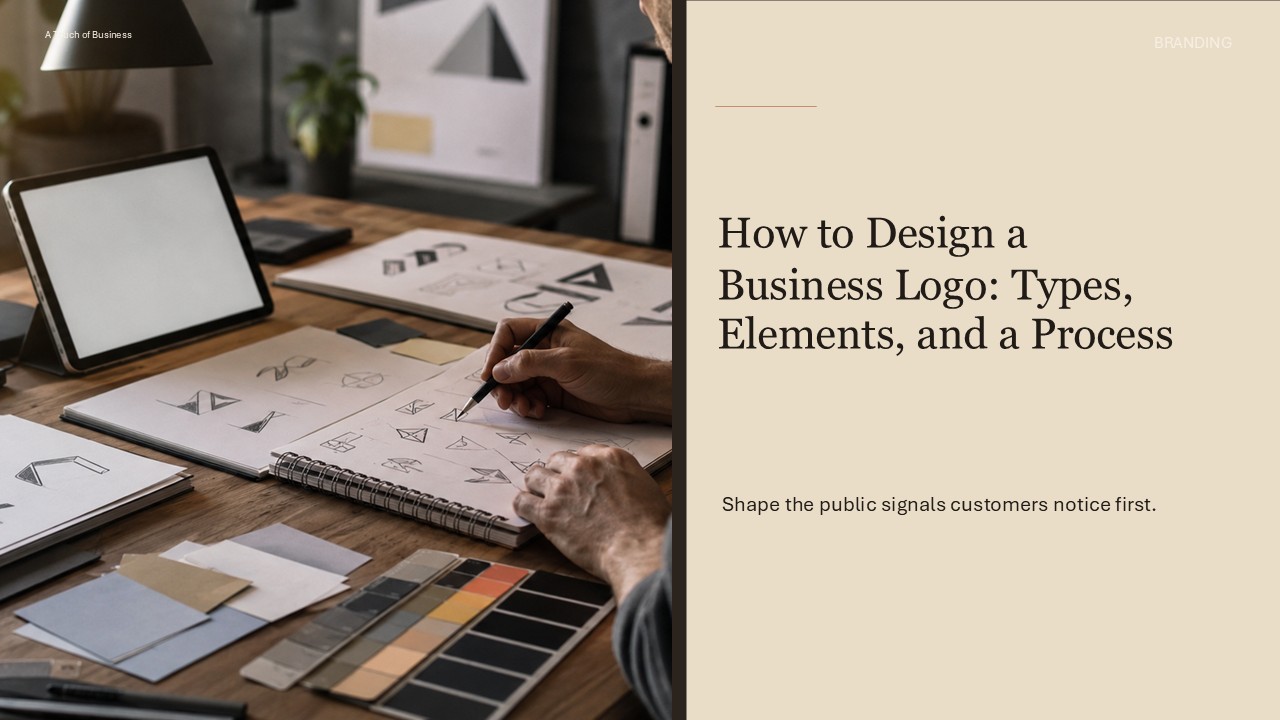
- Sketch how these elements might come together.
Sketch ideas
- Put every idea on paper or in logo software, without judging it yet.
- Sketch broadly — even a rough sketch can spark a better idea later.
Choose your top three sketches
- Review each sketch against your brand story.
- Check each one against the seven design principles above.
- Ask friends, family, or employees for their honest reactions.
- Be willing to discard sketches and start over if none of them land.
Refine your chosen sketch
- Pick the sketch that will hold up best once refined.
- Revisit your brand story to check what still needs to come through.
- Apply the seven principles to sharpen the design.
- Consider combining strong elements from sketches you set aside.
Develop your official logo
- You don’t have to design the logo by hand — logo-making software such as Canva, Looka, Appy Pie’s Logo Maker, and DesignMantic can all produce a finished file.
- AI-powered tools like Looka, Wix Logo Maker, and Tailor Brands (current picks as of 2026) are a fast, low-cost way to test several directions before committing to a paid designer — worth a quick search to confirm these are still the leading options when you’re ready to use them.
- Before finalizing any logo from a free or low-cost tool, confirm the commercial-use rights and check whether high-resolution or vector file exports are included or locked behind a paid tier.
Checklist for Designing a Business Logo
- Define your brand story
- Business purpose and values identified
- Target audience identified
- Brainstorm design direction
- Logo type selected
- Font direction chosen
- Up to three colors chosen, with exact codes
- Sketch and select
- Multiple sketches created
- Top three sketches chosen and tested against the seven design principles
- Feedback gathered from others
- Refine and finalize
- Final sketch refined against brand story and design principles
- Logo built in chosen software (Canva, Looka, Appy Pie, DesignMantic, or similar)
- Commercial-use rights and file export options confirmed
FAQ: Business Logos
Is my logo the same thing as my brand?
- No. Your brand is the overall perception and reputation of your business; the logo is just the visual element that represents it.
Will a great logo guarantee my business succeeds?
- No. A strong logo helps with recognition, but it doesn’t replace good products, service, and customer relationships.
Which type of logo is best for a new business?
- Wordmarks and combination marks tend to work best for new businesses, since they build name recognition alongside the visual design. Pictorial marks generally work better once a business is already well established.
Do color choices in a logo really matter?
- Color contributes to first impressions and is worth choosing deliberately, but the common associations (red for energy, blue for trust, and similar) are general conventions rather than guaranteed effects — culture and context shape how customers actually respond.
Do I need to hire a designer to create a logo?
- Not necessarily. Tools like Canva, Looka, Appy Pie’s Logo Maker, and DesignMantic let you build a logo without design experience. A professional designer is worth considering for a highly original abstract mark or once your brand is ready for a more custom identity.
What should I check before using a free logo-maker tool?
- Confirm the tool grants commercial-use rights for your finished logo, and check whether high-resolution or vector files are included free or require a paid upgrade.
References:
- 1000logos.net — Coca-Cola Logo and Symbol, Meaning, History
- Creative Bloq — The Coca-Cola Logo: A Complete History
- Rabbit Logo — Starbucks Logo: The Evolution of an Iconic Siren
- Linearity — 7 Types of Logos and Which Ones to Use for Your Brand
- GoDaddy — Color Psychology in Logo Design
- Ignyte Brands — Color Psychology in Branding: The Persuasive Power of Color
- Guideflow — 9 Best Logo Design Software for 2026
- AND Academy — The 17 Best Logo Design Tools & Software in 2026